
Sponsoring student visits to biblical museums is one of the more direct ways donors can place young people before the material world of Scripture—languages, geography, artifacts, and the stubborn particularity of Christian claims. For many students, these visits supply what classroom instruction and youth programming often cannot: a credible, embodied sense that the Bible is not a collection of moral lessons, but God’s self-revelation in real history.
The harder question is not whether these trips can be meaningful. It is whether donor funding is designed as discipleship rather than as a subsidized outing, and whether the ministries administering the program can demonstrate integrity, educational seriousness, and measurable stewardship. Mature Christian donors have learned that impact is not a feeling we purchase; it is a fruit we cultivate through disciplined giving.
Why a museum visit can function as formation rather than entertainment
Biblical museums sit at the intersection of catechesis and public credibility. They work with the same basic materials historians use—texts, inscriptions, objects, and comparative cultural evidence—yet they interpret these materials within an explicitly Christian frame. That combination is precisely why student visits can matter: they train young believers to think about faith and evidence without fear, and they equip young skeptics to recognize that Christian claims are not merely private sentiment.
Christian education is competing for attention and plausibility
Many donors sense a growing fragility in adolescent faith. The data broadly confirms the concern, though Christians genuinely disagree about how to interpret the causes and what solutions deserve emphasis. Pew Research has documented substantial generational differences in religious affiliation and practice in the United States, including a notable share of younger adults identifying as religiously unaffiliated Pew Research Center. A museum visit will not reverse cultural currents. It can, however, supply concrete intellectual and spiritual ballast at a moment when plausibility structures are shifting.
Material culture can support reverent confidence in Scripture
A responsible museum does not “prove the Bible” in the simplistic sense donors sometimes hope for. Archaeology rarely works that way; evidence is fragmentary, interpretation requires humility, and some questions remain open. Still, seeing ancient languages, historical reconstructions, and curated artifacts can strengthen a student’s grasp that Scripture emerged within real peoples and places. That is not a substitute for the Spirit’s work through the Word, but it can remove unnecessary obstacles to belief.
What it actually means to sponsor student visits
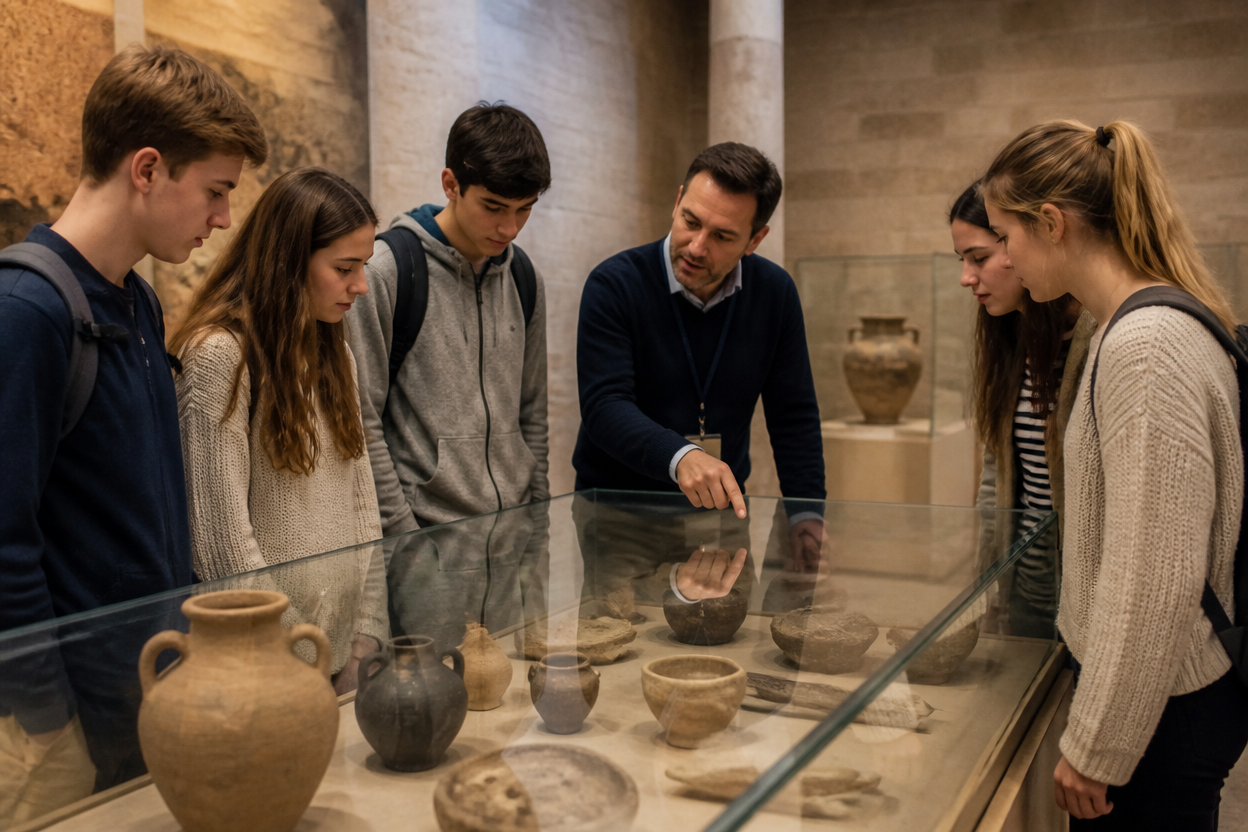
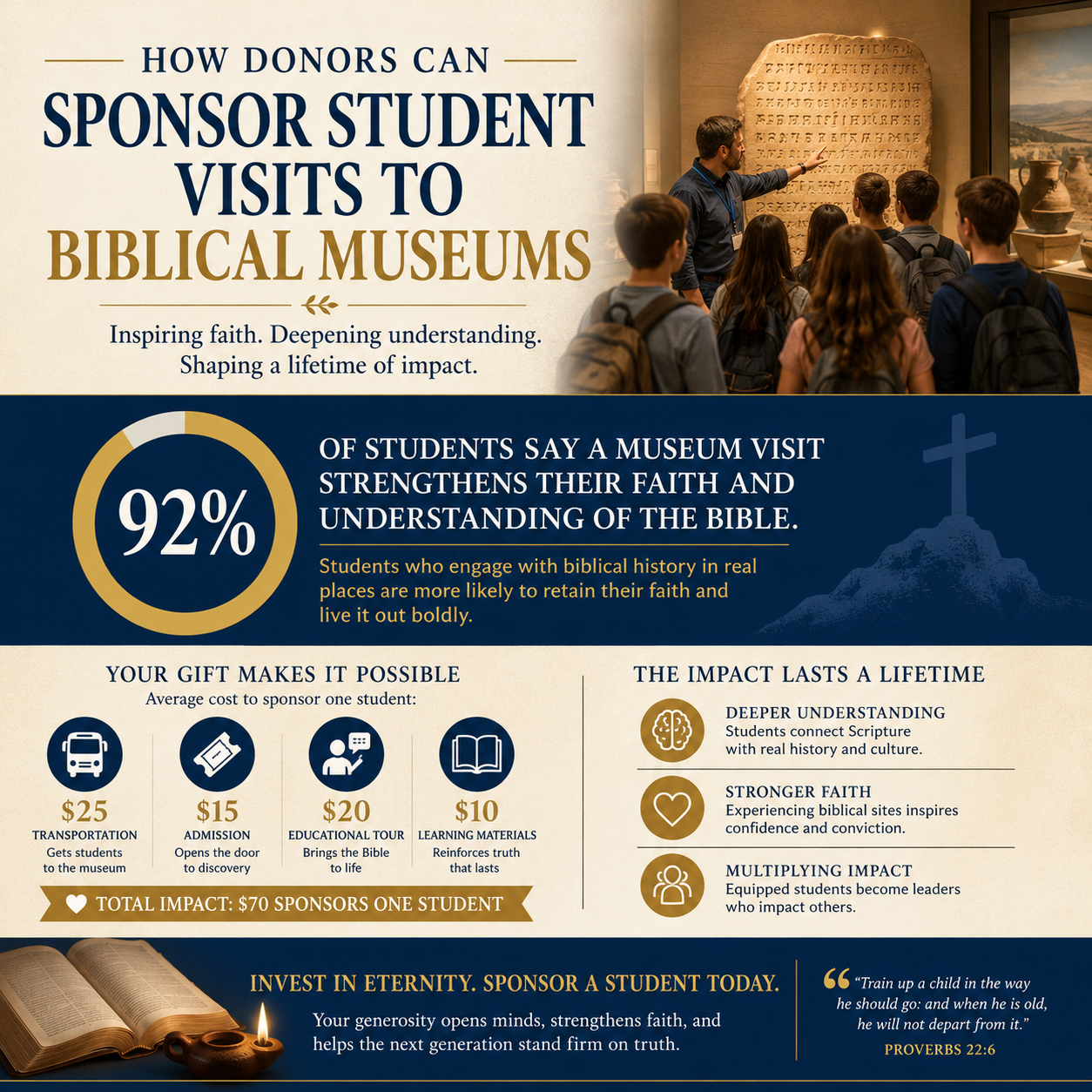
Sponsorship is not merely paying admission. It is underwriting the full chain of access that determines whether a student can attend and what they will receive while there: transportation, curriculum alignment, guided learning, and follow-through in the local church or school. Donors who fund only the visible moment often miss the conditions that make the moment fruitful.
Common sponsorship models and their trade-offs
Most programs fall into a few patterns. Each has strengths, and each introduces predictable risks if unmanaged.
- Scholarship funds that cover ticketing and transportation for Title I schools, church youth groups, or homeschool co-ops with limited means.
- Underwritten curriculum partnerships where the museum provides pre-visit and post-visit materials and trains teachers or leaders.
- “Day of discovery” packages that bundle guided tours, artifact handling, and lectures with age-appropriate apologetics.
- Rural access grants that offset longer travel distances for communities far from major museums.
- Special exhibit underwriting that enables rotating content tied to biblical books, periods, or themes.
Scholarships typically maximize access, but they can drift into transactional charity if there is no educational structure. Curriculum partnerships deepen learning, but they require competent leadership and transparency about outcomes. Exhibit underwriting can be powerful, but it demands strong governance and clear donor reporting because funds are less directly traceable to individual students.
A biblical frame for sponsorship as stewardship
Scripture commends giving that is both generous and thoughtful. “Let each one give as he has decided in his heart, not reluctantly or under compulsion” (2 Corinthians 9:7). That verse is not a permission slip for impulsive giving; it is a call to voluntary, faith-filled discernment. Sponsorship at its best is not a sentimental purchase of inspiration. It is a measured commitment to formation, offered freely and administered responsibly.
Questions donors should ask before funding a museum visit program
Donors often ask whether a museum’s content is “biblically faithful.” That question matters, but it is incomplete. The more comprehensive inquiry is whether a ministry is faithful in doctrine and also trustworthy in practice: how it handles money, how it governs itself, how it reports results, and how it treats students as image-bearers rather than as fundraising stories.
Faithfulness and educational seriousness
A donor can responsibly ask: What is the museum’s confessional posture? What theological boundaries guide interpretation? How are disputed scholarly questions presented? Serious ministries can name what is known, what is inferred, and what remains debated, without collapsing into either skepticism or triumphalism. When museums address archaeology, manuscript history, or Near Eastern context, responsible curation should strengthen confidence without caricaturing the academy.
Financial integrity, governance, and transparency
Across our verification work at Most Trusted, we observe that the strongest ministries treat donor funds as restricted gifts when they are given for specific student access, and they document the chain of custody clearly: how scholarships are allocated, how vendors are selected, and how conflicts of interest are prevented. Donors should expect clear answers on these points:
Financial clarity: Are sponsorship dollars restricted to student access, or do they subsidize general operations? If they subsidize operations, is that stated plainly?
Governance: Does the organization have an independent board with meaningful oversight? Are related-party transactions disclosed?
Reporting: Will the ministry report outputs (students served, schools served) and outcomes (learning objectives, follow-up engagement) without inflating claims?
Safeguarding: Are child protection policies, background checks, and supervision ratios documented and enforced?
These questions align with the concerns we evaluate through The Most Trusted Standard: faith foundation, financial integrity, governance and leadership, and transparency and effectiveness. Donors do not need a cynic’s posture, but they do need the courage to insist on verifiable accountability.
Designing sponsorship for lasting impact
If the aim is discipleship, then a museum visit should be integrated into a broader learning arc. The field has had to reckon with a simple fact: a powerful day does not automatically produce durable formation. Outcomes depend on preparation, interpretation, and reinforcement, especially for students who have limited prior biblical literacy.
Require a plan for preparation and follow-through
The most credible student-visit programs are built around a three-part sequence: pre-visit instruction, on-site guided learning, and post-visit synthesis. Donors can ask for the materials, not merely the promise. A program that can hand a teacher packet, a youth leader guide, and a post-visit reflection assignment is usually a program that has taken education seriously.
In practice, donors can encourage museums and partner groups to align content with what students are already studying—Old Testament history, the life of Christ, early church context, or manuscript transmission. Alignment does not reduce spiritual impact; it makes the day legible and easier to retain.
Measure what can be measured without pretending to quantify grace
Some ministries avoid measurement because they fear reductionism. Others overstate outcomes because they need compelling donor reports. Both approaches erode trust. Mature Christian evaluation names the limits: the Spirit regenerates; we cannot quantify conversion. Yet we can evaluate whether the program is achieving its stated educational and discipleship aims—knowledge gains, biblical literacy, confidence in engaging questions, and engagement with Scripture after the visit.
Where appropriate, donors can request simple tools: pre- and post-visit assessments, teacher feedback, student reflection prompts, and follow-up attendance metrics for partner youth groups. The goal is not to turn ministry into a laboratory; it is to honor the biblical demand that stewards be found faithful (1 Corinthians 4:2).
How to choose trustworthy partners for student sponsorship
Donors typically sponsor through one of three channels: directly to a museum, through a church or school organizing the trip, or through a third-party ministry coordinating access. Each channel can be responsible. Each also introduces distinct accountability questions.
Direct giving to museums
Direct sponsorship can reduce administrative layers, but it increases the donor’s need to evaluate governance and reporting. Donors should examine audited financials when available, look for clear restricted-fund practices, and confirm that scholarship selection is equitable and documented. When donors want to understand the broader ecosystem, we recommend engaging the wider landscape of Biblical Museum Ministries and noting how different institutions define educational outcomes, doctrinal posture, and public claims.
Giving through churches and schools
Church-based sponsorship often provides the best pastoral follow-through, since leaders can connect what students saw to preaching, small groups, and family discipleship. The risk is informality: funds can be handled casually, and safeguarding can vary. Donors can ask churches and schools for a written budget, a supervision plan, and a clear process for awarding scholarships without favoritism.
School-based programs can reach students who will not otherwise enter a museum shaped by Christian conviction. That missional opportunity is real. It also requires clarity about how content is presented in pluralistic settings and whether educators are prepared to handle questions fairly.
Verification as a form of donor care
Because donors cannot personally audit every ministry they support, independent verification exists to reduce information asymmetry. Most Trusted evaluates Christian nonprofits against The Most Trusted Standard so donors can give with confidence grounded in evidence rather than marketing. The ministries that meet the standard tend to publish clearer financial disclosures, maintain stronger board oversight, and report impact with restraint—precisely the posture donors should want when sponsoring students.
Donors seeking programs that integrate education and discipleship may also find it useful to track ministries by focus within How Biblical Museum Ministries Support Education and Discipleship, since not every museum prioritizes student learning in the same way.
FAQs for How donors can sponsor student visits to biblical museums
Should donors sponsor individual students or fund a general scholarship pool?
Either can be responsible. Sponsoring individual students offers clarity and personal connection, but it can create awkward dynamics if students are publicly identified as “charity cases.” A general scholarship pool is often more dignified and administratively sound, provided the selection criteria are written, equitable, and documented. Donors should expect transparent reporting on how many students were funded and what costs were covered.
How can donors ensure a museum trip supports discipleship rather than becoming a one-time experience?
Donors can require a plan that includes pre-visit preparation, guided instruction on-site, and post-visit follow-through in a church or school setting. The most credible programs can show the actual materials used and can report outcomes such as teacher feedback, student reflection work, and evidence of continued engagement with Scripture. That approach treats the visit as part of formation rather than as a stand-alone event.
Giving that strengthens memory, imagination, and faith
Christian donors sponsor student visits to biblical museums because we want young people to inherit more than slogans. We want them to encounter the texture of biblical history, the coherence of the Christian story, and the intellectual seriousness that faithful discipleship requires. When sponsorship is structured with integrity—clear purposes, responsible governance, and verifiable reporting—it becomes a form of stewardship that serves both students and the church.



