
How Biblical Museum Ministries Support Education and Discipleship is ultimately a question about formation: what helps Christians and their children know the Scriptures more deeply, love Christ more steadily, and endure in faith with a mind and heart shaped by truth. For donors, the question is also about stewardship. Museums are expensive institutions, and the difference between a faithful educational ministry and a well-produced attraction is not always obvious from a brochure.
At their best, biblical museum ministries serve the church by joining careful historical work to pastoral clarity. They create spaces where the biblical story is taught as public truth, not private preference, and where visitors are invited to respond with worship, repentance, and obedient trust. The opportunities are real, and so are the tensions: interpretive bias, spectacle replacing catechesis, and donor dollars underwriting projects with thin discipleship outcomes.
Education that serves discipleship rather than replacing it
Biblical literacy in the United States is not a niche concern; it is a discipleship concern. When donors underwrite educational work that treats Scripture as optional or merely symbolic, the church pays the price in weakened conviction and confused moral reasoning. The most credible biblical museum ministries understand their role as supportive: they can illuminate the world of the text, but they cannot substitute for the local church’s ordinary ministry of Word and sacrament.
Many donors sense this tension. A museum visit can create emotion without formation, and curiosity without conversion. The more mature ministries design their educational aims with that risk in mind, aiming for outcomes that serve catechesis: clearer reading of Scripture, deeper confidence in the historical rootedness of the biblical narrative, and a renewed grasp of redemptive-historical coherence.
Making the Bible intelligible to modern minds
Archaeology, ancient Near Eastern studies, manuscript history, and material culture can reduce the distance modern people feel from the biblical world. Done well, this is not an attempt to “prove” Christianity by artifacts, as though faith were a lab result. It is a way of answering honest questions and removing unnecessary stumbling blocks. When the Ethiopian eunuch asked, “How can I, unless someone guides me?” the church has always heard a summons to patient explanation (Acts 8:30–31).
The more careful museum educators distinguish between what is known, what is plausible, and what is speculative. They teach visitors to read evidence soberly. That intellectual humility is not weakness; it is an act of truth-telling that strengthens trust over time.
Strengthening the church’s teaching ministry
Many biblical museums function best when they see pastors, Christian school teachers, and parents as primary multipliers. Educator toolkits, age-appropriate curriculum, docent training rooted in orthodox theology, and take-home resources can extend a single visit into months of discussion. This is especially valuable for churches without specialized staff who can field hard historical questions about Scripture.
For donors, one practical sign of seriousness is whether a museum can articulate how its programs serve congregational discipleship rather than compete with it. Partnerships with churches, measurable learning aims for students, and clear doctrinal boundaries usually indicate a ministry seeking to build the body rather than build a brand.
Programs that move beyond exhibits into formation
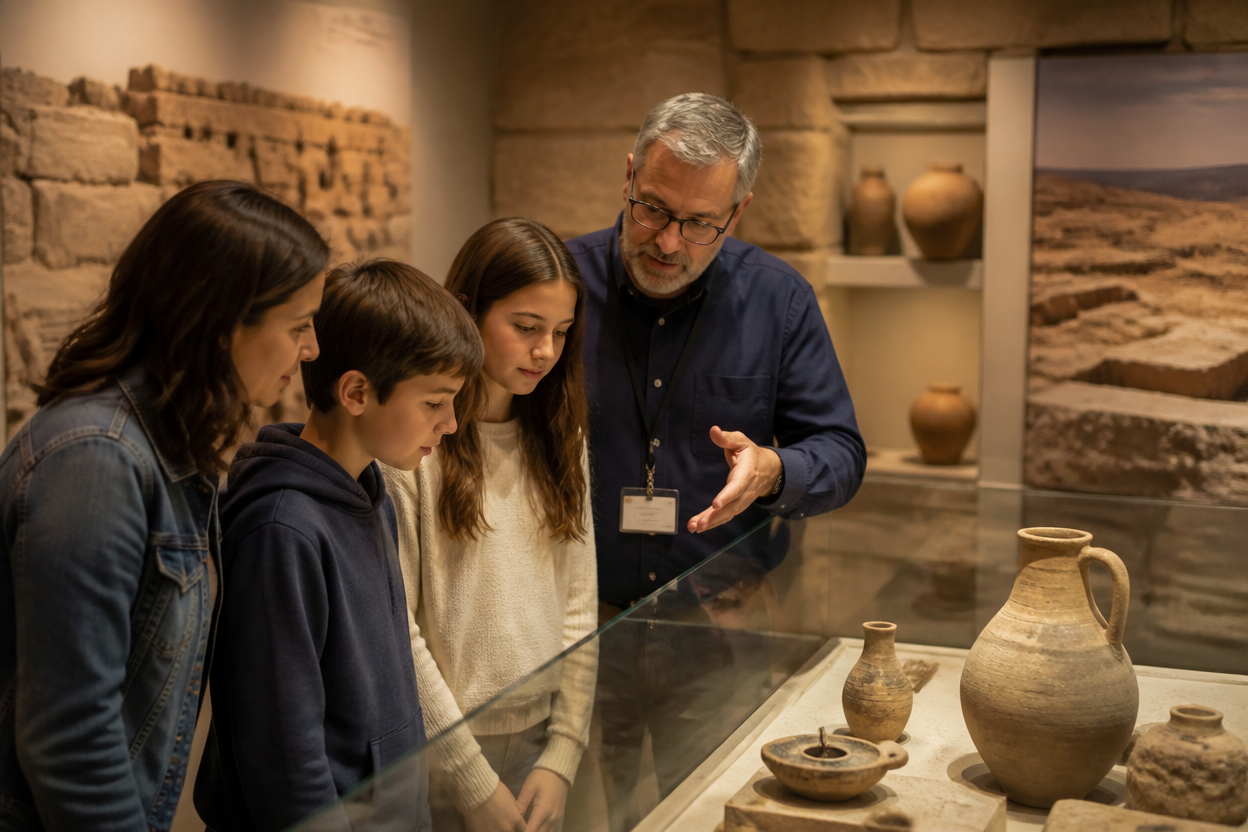
Biblical museum ministries are often judged by their exhibits because exhibits are visible. Yet discipleship usually happens through programming: guided interpretation, teaching, conversation, and the slow work of integrating knowledge with obedience. The ministries that endure tend to invest in programs that are repeatable, scalable, and accountable—especially for children, students, and families.
Student visits and the moral responsibility of access
If a biblical museum serves only those who can pay full price and travel easily, it will reach a narrow slice of the church. Donors can change that. Subsidized admissions, transportation grants, and partnerships with Christian schools and churches can remove barriers that otherwise keep students away.
Educational access matters broadly across American schooling. The National Center for Education Statistics reports that in 2022–23, about 19% of public school students were English learners, students with disabilities, or both—groups that often require adapted learning supports to fully benefit from educational experiences (National Center for Education Statistics). Museums that plan intentionally for accessibility—clear language, multisensory learning options, and trained educators—serve the church’s educational calling with integrity.
Tours that teach interpretation rather than merely information
A tour can be a spectacle, or it can be a guided act of reading. Strong tours do more than describe artifacts; they teach visitors how to weigh claims, how to read a biblical text in context, and how to see Christ in the whole counsel of God. They avoid the subtle temptation to turn the Bible into an object of curiosity, detached from repentance and faith.
For donors, it is reasonable to ask whether docents are trained theologically, not only operationally. A museum may have excellent historians and still leave visitors with a fragmented, moralized, or de-Christologized message. The church needs institutions that are capable of accurate scholarship and faithful proclamation without collapsing one into the other.
Resources for small groups and households
Many donors are searching for investments that strengthen everyday discipleship: dinner-table conversations, small group study, and intergenerational learning. Museums can contribute through digital archives, short-form teaching series, discussion guides, and object-based learning prompts that train Christians to read attentively.
Here the tension is subtle. Digital resources can widen reach, but they can also dilute accountability and theological oversight. The most credible resources are those with clear authorship, confessional clarity, and transparent sourcing—so that church leaders and parents know what they are commending.
What careful donors should ask about integrity and effectiveness
Biblical museum ministries often require significant capital: facilities, exhibit fabrication, conservation, security, and specialized staffing. Large budgets are not automatically a red flag; they are a feature of the medium. The stewardship question is whether spending is aligned with mission and whether leadership has built a governance and accountability structure strong enough to handle complexity.
Across our verification work at Most Trusted, we observe that donor confidence rises when ministries can explain, in plain terms, how decisions are made, how theological commitments are safeguarded, and how financial practices support long-term faithfulness. The ministries that meet The Most Trusted Standard tend to treat transparency as a spiritual discipline rather than a marketing tactic.
Faith foundation and interpretive accountability
Museums interpret; they do not merely display. That is true for secular institutions and it is true for Christian ones. The question is whose interpretive authority is operating and whether it is disciplined by Scripture and the historic Christian faith.
Christians genuinely disagree about certain questions in the biblical museum world: how to speak about contested archaeological claims, how to present differing scholarly viewpoints without confusing lay visitors, and how to handle denominational differences on secondary doctrines. Wise ministries name what they are doing. They publish statements of faith, identify scholarly advisors, and create review processes that prevent a single donor, charismatic founder, or celebrity scholar from becoming the final authority.
Financial integrity beyond the overhead obsession
Donors sometimes default to simplistic ratios, especially in expensive fields like museums. Yet the nonprofit sector has repeatedly warned against reducing effectiveness to overhead percentages. The well-known “Overhead Myth” statement—signed by GuideStar (now Candid), Charity Navigator, and the BBB Wise Giving Alliance—argues that overhead ratios can mislead donors and distort nonprofit behavior (Candid).
The better questions are concrete: Is there an independent audit? Are reserves handled prudently? Is revenue diversified beyond a small handful of major donors? Are related-party transactions disclosed? Does the ministry avoid debt structures that force constant fundraising pressure and mission drift? Museums that are always one gala away from instability will struggle to prioritize discipleship outcomes over the demands of cash flow.
Transparency and effectiveness that can be verified
Because museums can attract attention, they can also be tempted to report reach in ways that flatter rather than clarify. Attendance numbers matter, but they are not the same as learning, and learning is not the same as discipleship. It is fair for donors to ask for more than foot traffic: pre- and post-visit assessments for student programs, teacher feedback, repeat engagement metrics for digital resources, and evidence of sustained partnerships with churches and schools.
Evidence can be modest without being evasive. Not every outcome is measurable, and mature leadership will admit that. Yet a refusal to measure anything beyond attendance is usually a sign that the ministry has not defined what it means by “education” or “discipleship” in operational terms.
How donor support can be targeted to multiply long-term impact
Many donors are drawn to visible giving: funding an exhibit, underwriting a gallery, or placing a family name on a room. Those gifts can serve the church when they fund truthful teaching and public witness. Still, the highest discipleship yield is often found in less visible lines of work: educator training, curriculum development, scholarships, pastoral partnerships, and collections care that preserves resources for future generations.
Sponsoring student access without creating dependency
Scholarships for student visits can be a disciplined form of generosity when they are structured well. The goal is not simply “more kids in the building,” but deeper engagement with Scripture in partnership with the institutions that already bear responsibility for discipleship. Programs that require teacher preparation, structured follow-up, and age-appropriate learning goals respect students and respect donors.
When scholarships are distributed through churches and Christian schools with clear accountability, they can also strengthen local leadership. When they are distributed as one-off giveaways with no follow-up, they may produce momentary excitement with little lasting fruit.
Supporting traveling exhibits with theological clarity
Traveling exhibits can bring high-quality educational content to regions that may never reach a large museum campus. They also carry unique risks: the host venue may frame the exhibit in ways the museum did not intend, and logistical constraints can force simplification. A disciplined traveling exhibit program addresses these risks with strong host agreements, clear interpretive materials, and training for local docents.
Donors can underwrite the kind of infrastructure that prevents drift: standardized educational scripts vetted theologically, careful artifact handling protocols, and evaluation tools that gather feedback from pastors, teachers, and parents rather than only from casual visitors.
Investing in leadership and governance that outlasts founders
Many museum ministries begin with visionary founders. That vision can be a gift, but it is not a governance model. Mature donors increasingly care about whether an institution can survive succession without abandoning its mission.
Across the nonprofit sector, governance failures are rarely sudden; they are usually the fruit of weak boards, conflicts of interest, and unclear lines of accountability. Donors who want durable impact should ask whether the ministry has an independent board with relevant expertise, whether board members are rotated, and whether leadership compensation and related-party relationships are disclosed plainly. These are not secular concerns. They are basic forms of honesty.
Giving that strengthens the church’s teaching witness
Biblical museum ministries can serve education and discipleship when they treat truth as a trust, not a commodity. They can help Christians read Scripture with clearer eyes, help students locate the biblical story in the real world, and help churches address sincere doubts without fear. They can also drift into spectacle, ideological capture, or institutional ambition that outpaces accountability.
Donors do not need to choose between theological fidelity and professional excellence. The church should expect both. When evaluating opportunities within Biblical Museum Ministries, the most responsible path is to fund institutions that can show, with verifiable evidence, that their governance is sound, their finances are clean, their teaching is faithful, and their educational claims are honest. That is the kind of giving that builds confidence rather than regret.



