
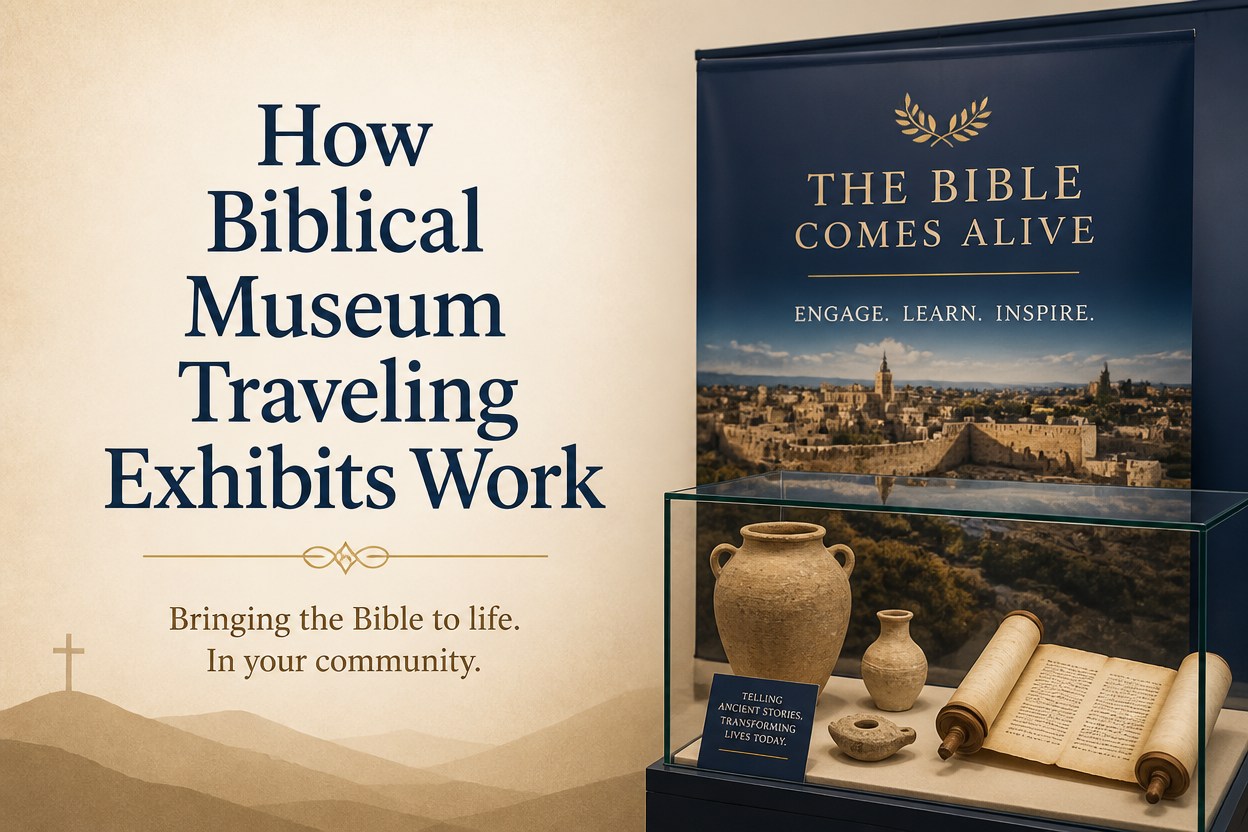
How biblical museum traveling exhibits work is not primarily a question of logistics, although logistics matter. It is a question of stewardship: how a ministry carries fragile artifacts, handles Scripture with integrity, and forms visitors without turning the Bible into a prop for fundraising or culture-war messaging.
For Christian donors, traveling exhibits can feel unusually tangible. They place physical objects, credible scholarship, and embodied storytelling in front of churches, schools, and civic spaces that may never visit a major museum. Yet the same mobility that makes these exhibits accessible also multiplies risk: conservation concerns, interpretive bias, and financial strain hidden behind a polished display. Mature generosity asks how the work is done, not only whether it is impressive.
Traveling exhibits begin with a curatorial thesis and a theological commitment
What an exhibit is actually promising
A traveling exhibit is not a warehouse of interesting things; it is an argument made in space. Curators decide what the exhibit is about, what claims are defensible, what is speculative, and what is devotional. In biblical content, the line between historical reconstruction and theological affirmation must be handled with care. Christians confess that Scripture is God-breathed (2 Timothy 3:16), and that conviction should produce intellectual honesty rather than anxiety. Where evidence is limited, the exhibit should say so.
Responsible ministries typically articulate a curatorial thesis in writing before they design anything. That thesis governs object selection, interpretive panels, and the visitor pathway. Donors should expect to see a statement of purpose that can be evaluated: Is the goal discipleship, education, evangelistic engagement, or a blend? Each aim is legitimate, but each changes the interpretive posture and the metrics of success.
How scholarship is sourced and vetted
Because “biblical museum” can range from academically rigorous to merely theatrical, the harder question is whether the exhibit’s claims are accountable to recognized scholarship. Serious exhibit teams build advisory structures: credentialed scholars for languages and history, conservators for materials science, and educators for age-appropriate learning outcomes. The best work is transparent about where scholarly consensus exists and where Christians genuinely disagree, such as the dating of certain texts or the identification of particular sites.
When exhibits touch archaeology, donors should be alert to sensationalism. The market rewards bold claims. Faithful witness does not require maximalist conclusions; it requires truthfulness. We recommend asking whether interpretive text distinguishes between “attested,” “probable,” and “possible,” and whether citations or a bibliography are provided for those who want to go deeper.
Object selection and provenance determine credibility
Provenance is a moral issue, not an academic detail
Most visitors cannot evaluate authenticity, but they can be harmed by a ministry’s carelessness. The legitimacy of a traveling exhibit rests on provenance: documented ownership history, lawful export and import, and credible authentication. In the biblical antiquities market, weak provenance has been linked to looting and the destruction of archaeological context, which is an irreparable loss for historical knowledge. For donors, provenance is part of neighbor-love: refusing to benefit from exploitation.
Ministries that handle antiquities should be conversant with international norms and national laws. They should also have written acquisition policies. When items are borrowed, those policies still matter, because a ministry can launder reputational risk by presenting questionable objects without owning them.
Replicas, facsimiles, and digital assets can be the wiser choice
Not every exhibit requires original artifacts. High-quality replicas and facsimiles can teach effectively while reducing conservation and security risk. Digital interactives can also extend access for churches and schools with limited budgets. Donors sometimes prefer “the real thing,” but fidelity is not measured by rarity. What matters is whether the exhibit tells the truth about what is original, what is reconstructed, and what is interpretive.
Clear labeling is an ethical minimum. If a facsimile is presented as an original, the ministry has not simply made a museum error; it has trained visitors to accept falsehood for the sake of a spiritual experience.
Logistics are where stewardship becomes visible
Conservation, shipping, and security are non-negotiable
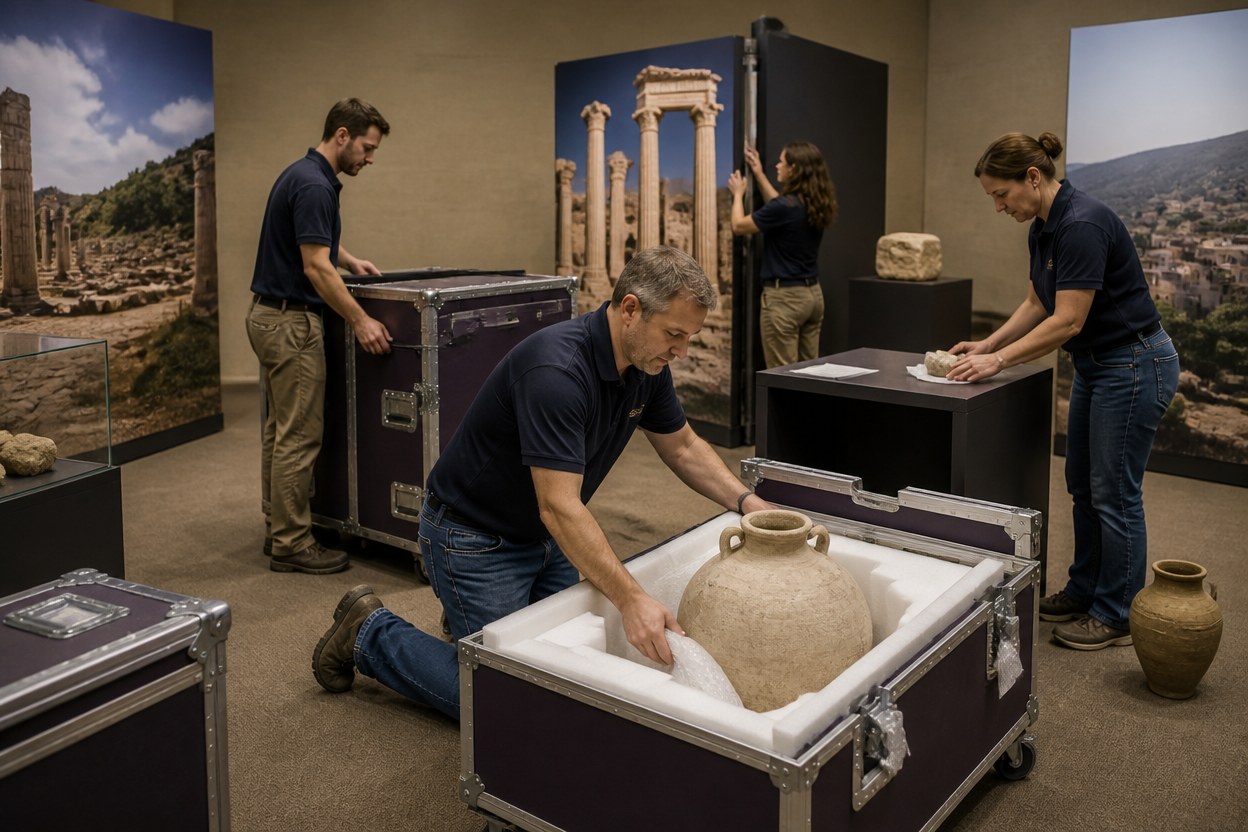
Traveling exhibits operate as moving ecosystems. Temperature, humidity, vibration, and light exposure can degrade manuscripts, textiles, papyri, wood, and metals. Responsible organizations budget for museum-standard cases, environmental monitoring, and trained art handlers. They plan shipping routes with risk mitigation and carry adequate insurance. These costs can feel like “overhead,” but they are mission-critical when the mission includes preserving and accurately presenting cultural heritage.
Donors should not assume that an exhibit that looks professional is conservationally sound. Many failures are invisible until years later. In our verification work at Most Trusted, we observe that ministries committed to long-term stewardship tend to document policies, contracts, and chain-of-custody procedures rather than relying on personality and goodwill.
Venue selection shapes both impact and integrity
Exhibits travel to churches, Christian schools, public libraries, universities, community centers, and sometimes secular museums. Each setting changes the expectations for interpretive neutrality, accessibility, and programming. Churches may want explicit calls to faith; civic venues may require educational framing without confessional claims. A faithful ministry will not smuggle proselytism into a contract that requires otherwise, nor will it mute the Christian meaning of Scripture when the context is explicitly ecclesial.
Operationally, venues also determine foot traffic and revenue. Some ministries charge admission; others are underwritten by sponsors; others are offered as a service to host institutions. The model is not inherently right or wrong, but each model creates incentives that must be governed.
Educational and discipleship outcomes must be defined and measured
Formation is not the same as attendance
The temptation with traveling exhibits is to treat attendance as the main proof of impact. Large crowds can be a blessing, but Christian formation is rarely reducible to footfall. If the exhibit claims discipleship value, it should be able to describe what discipleship looks like in that context: deeper biblical literacy, greater confidence in Scripture’s historical rootedness, increased engagement with the local church, or improved intergenerational teaching in the home.
When museums serve schools, outcomes may include standards-aligned learning objectives and measurable gains in content knowledge. For Christian schools, the integration of faith and learning should be explicit and careful, honoring both historical evidence and doctrinal commitments without turning either into a weapon.
What strong visitor engagement often includes
Well-designed traveling exhibits generally combine cognitive, affective, and participatory learning. They offer multiple pathways for visitors who arrive skeptical, curious, devout, or wounded by prior religious experience. The ministry’s task is not to control every conclusion, but to present the material truthfully and invite serious reflection.
- Docent training that distinguishes between evidence, interpretation, and testimony
- Age-appropriate educational guides for churches and schools
- Clear labeling of originals, facsimiles, reconstructions, and artist renderings
- Primary-source excerpts and translations, not only paraphrases
- Accessible design for visitors with disabilities and varying reading levels
These practices align with the broader calling of biblical museum ministries to support education and discipleship, a field we address more fully in How Biblical Museum Ministries Support Education and Discipleship.
Funding models and governance can either protect or distort the mission
Revenue pressure can tempt ministries to exaggerate
Traveling exhibits are expensive: fabrication, shipping, staffing, marketing, and insurance. When a ministry is carrying large fixed costs, it may feel pressure to book aggressively, overpromise impact, or overstate the certainty of contested claims in order to sell tickets and sponsorships. Christian donors understand this tension because many ministries operate on thin margins. Still, integrity is tested precisely where incentives bend toward hype.
The field has also had to reckon with reputational damage when exhibit claims collapse under scrutiny. The consequences are not merely financial. They erode trust in Christian public witness and can harden skepticism toward biblical history itself.
What donor diligence should focus on
Donors should evaluate traveling exhibit ministries with the same seriousness they bring to any major Christian work. At Most Trusted, we assess organizations against The Most Trusted Standard, a 15-criteria framework spanning Faith Foundation, Financial Integrity, Governance and Leadership, and Transparency and Effectiveness. Applied to traveling exhibits, several questions become especially clarifying:
Is the board independent enough to challenge leadership when fundraising pressures rise? Are financial statements clear about restricted funds, exhibit amortization, and related-party transactions? Does the ministry publish meaningful outcomes rather than marketing claims? Are scholarly advisors named, and are conflicts of interest disclosed?
For donors who want to understand where traveling exhibits fit within the broader landscape, Biblical Museum Ministries provides context on how these organizations serve the church and the public square.
FAQs for How biblical museum traveling exhibits work
Do biblical museum traveling exhibits usually include original artifacts?
Some do, but many rely heavily on replicas, facsimiles, and digital interactives. Originals increase cost and risk and require stricter environmental controls and security. A credible ministry will clearly label what is original and provide basic provenance and authentication information where appropriate.
What should donors ask before funding a traveling exhibit ministry?
Donors should ask for the curatorial thesis, acquisition and provenance policies, conservation and shipping protocols, and evidence of educational or discipleship outcomes. Financially, request clarity on how exhibit costs are capitalized or expensed, how restricted gifts are handled, and how the board provides oversight when revenue depends on ticket sales or venue bookings.
A faithful exhibit treats truth as part of worship
Biblical museum traveling exhibits can serve the church by strengthening biblical literacy and giving embodied context to the world of Scripture. They can also serve neighbors by presenting Christian claims with intellectual seriousness and humane restraint. The decisive question for donors is whether the ministry’s practices match its testimony: careful provenance, honest interpretation, disciplined governance, and measurable educational value offered in love of God and love of neighbor.



