

How donations to Christian adoption ministries help children depends less on the sentiment behind the gift and more on whether the ministry is building durable, lawful, trauma-informed pathways into safe families. Scripture is unambiguous about God’s concern for children without protection, yet Scripture also warns that zeal without knowledge can harm the very people we intend to serve.
Christian donors often give because they want a child to belong, not merely to be rescued. That instinct is aligned with the gospel’s logic of adoption (Romans 8:15–17). But the modern adoption ecosystem includes government systems, courts, immigration rules, ethical risks, and long-term care needs that cannot be addressed by a single emotional appeal. Serious giving requires serious clarity about what, exactly, our dollars make possible.
Adoption ministry giving must be child-centered, not donor-centered
Family preservation is not the enemy of adoption
Many children who become legally free for adoption have experienced neglect, abuse, or abandonment. Others enter the child welfare system because of poverty, unstable housing, or parental incapacity compounded by a lack of local support. Christian donors sometimes assume that “orphan care” automatically means adoption, but the field has had to reckon with a more precise moral question: what is best for this particular child, in this particular legal and cultural setting, over a lifetime.
Across our verification work, we observe that the most credible Christian adoption ministries refuse simplistic narratives. They fund and prioritize family-based care along a spectrum: prevention, kinship care, foster care, domestic adoption, and where lawful and appropriate, international adoption. That is not mission drift; it is child-centered fidelity.
Children are not projects and trauma is not solved at placement
Adoption is not a single event but a lifelong relationship that often includes grief, identity questions, and the effects of early adversity. The American Academy of Pediatrics has emphasized the developmental and mental health needs of children with histories of trauma and disrupted caregiving, including the importance of stable, nurturing relationships and appropriate clinical supports when needed (American Academy of Pediatrics).
Donations help children when they strengthen the conditions for stability: thorough preparation of adoptive parents, careful matching, post-placement support, and access to trauma-informed services. Ministries that talk only about “bringing children home” without attending to what happens after the airport or the courthouse tend to be the least prepared for the realities families face.

What donations actually fund in responsible Christian adoption ministries
Ethical casework, not shortcuts
High-integrity ministries invest in casework that is slow, documented, and accountable. That includes verifying relinquishment or termination of parental rights, ensuring informed consent, and confirming that coercion and improper financial pressure are absent. Christians genuinely disagree about policy details in adoption law, but there should be no disagreement about this: any process that treats a child as a commodity violates the Christian doctrine of human dignity.
In practical terms, donations often cover trained staff time for home studies, background checks, references, and coordination with licensed agencies and courts. These are not overhead in the pejorative sense; they are safeguards.
Support that keeps placements intact
Disruption and dissolution are painful outcomes that can compound a child’s earlier losses. Donor-funded supports—parent coaching, attachment-informed counseling, respite care, and peer support—can reduce preventable crises. While public data on adoption dissolution varies by jurisdiction and definition, the directional lesson is clear: preparation and post-placement services materially affect stability.
Donors who want their giving to help children should ask ministries to describe, in detail, how they budget for post-placement care, what partnerships they maintain with licensed clinicians, and what happens when a family is in crisis at year three rather than week three.
Where wise donors ask hard questions about adoption ethics
International adoption has unique vulnerabilities
International adoption can be a legitimate, life-giving option for children who cannot be safely cared for in their country of origin. It also carries well-documented risks: weak documentation, corruption, and the financial incentives that can pressure systems toward separating families unnecessarily. The Hague Convention on Protection of Children and Co-operation in Respect of Intercountry Adoption exists precisely because these risks are real and recurring (Hague Conference on Private International Law).
When donations subsidize international adoption, the most responsible ministries can explain their compliance posture: Hague accreditation where applicable, third-party audits or monitoring, and how they ensure that family preservation and domestic permanency options were genuinely exhausted. If a ministry cannot articulate these safeguards, donors should slow down.
Domestic adoption also requires scrutiny
In domestic infant adoption, ethical lines can blur when expectant parents are experiencing acute financial pressure. Responsible ministries distinguish between compassionate support and inducement. They document counseling, ensure clear legal counsel and informed consent, and maintain policies that protect voluntariness.
We recommend that donors treat “heartwarming stories” as insufficient evidence. A ministry should be able to show policies, licensing, grievance processes, and outcomes that can be independently evaluated.
How Most Trusted evaluates adoption ministries for donor confidence
Verification is not cynicism, it is stewardship
Jesus’ teachings on money assume that faithful stewardship requires discernment, not merely generosity. That is why Most Trusted exists: to help donors give with confidence by evaluating Christian nonprofits against The Most Trusted Standard, a 15-criteria framework spanning Faith Foundation, Financial Integrity, Governance and Leadership, and Transparency and Effectiveness. A ministry may have sincere intentions and still fail to protect children if its controls and accountability are weak.
Across our work, ministries that meet The Most Trusted Standard tend to exhibit a consistent pattern: they can demonstrate how decisions are made, how risks are managed, and how outcomes are measured without manipulating stories or hiding failures.
What donors should be able to verify
Donors do not need to become adoption attorneys to give well, but mature giving does include insisting on verifiable practices. The following indicators are not exhaustive, but they are concrete:
- Clear child-protection policies and staff training, including mandatory reporting where applicable
- Licensing and accreditation appropriate to the jurisdiction and services provided
- Documented ethics safeguards for relinquishment and consent
- Budget transparency that distinguishes program activity from fundraising claims
- Post-placement services with defined access, duration, and referral pathways
Donors interested in the broader landscape of this work often benefit from staying oriented to the field as a whole, not merely to a single organization. Many begin with Christian Adoption Ministries to understand the range of faithful approaches and the questions that separate careful ministries from reckless ones.
What effective, child-serving outcomes look like over time
Stability, permanency, and belonging
Christian donors typically want to know whether giving “worked.” In adoption ministry, the most meaningful outcomes are not always immediate or easily packaged: the stability of a placement, the health of family relationships, the presence of support when challenges intensify, and the child’s long-term wellbeing.
In the United States, the public child welfare system reports on adoption and permanency outcomes through federal data collection, providing a baseline view into how many children move to permanency and how long that process takes (Administration for Children and Families). Ministries that work alongside foster care and adoption should be able to situate their work within that reality, not apart from it.
Honest reporting and the courage to name limits
Some ministries are tempted to promise more than any ethical organization can guarantee: certain timelines, certain outcomes, or uncomplicated stories. The harder truth is that adoption often involves loss alongside gain, and children’s healing rarely follows a tidy schedule. Ministries that are truthful about complexity are typically safer partners for donors.
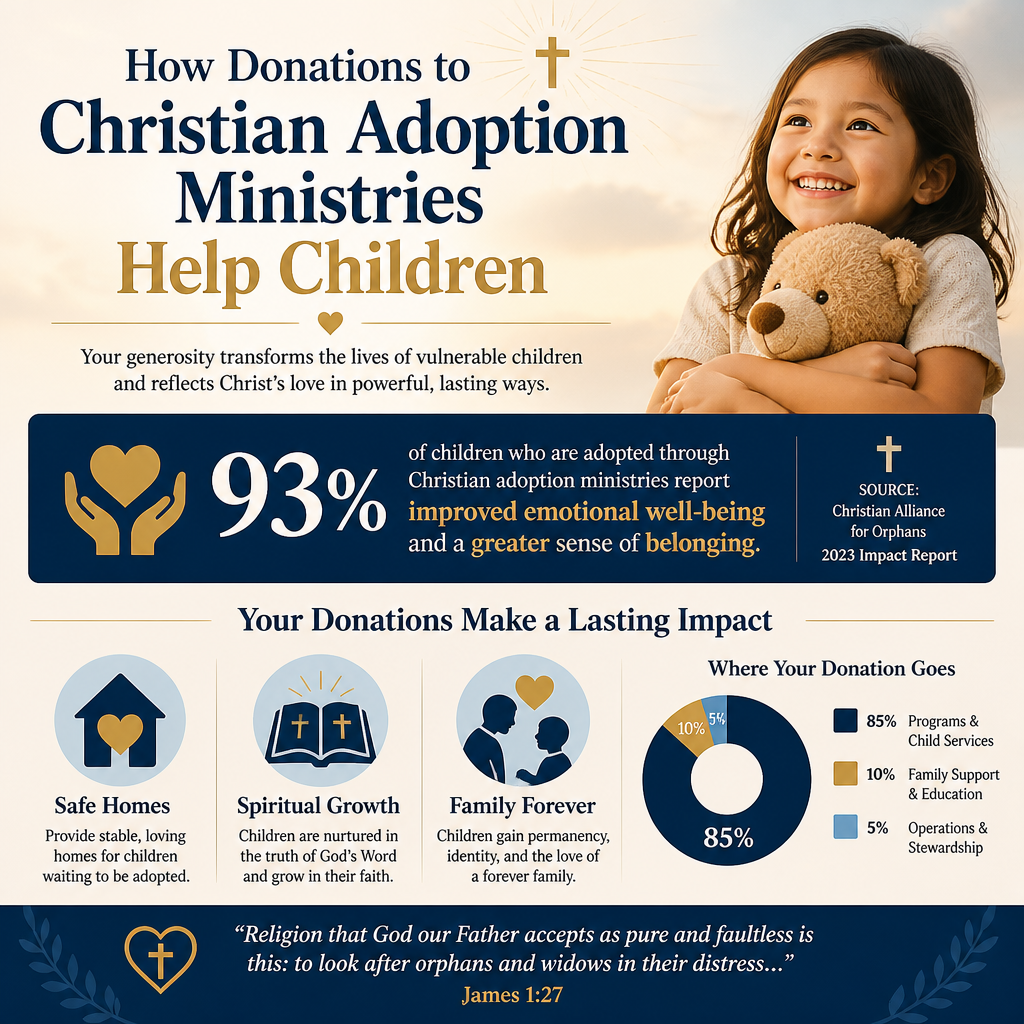
Donors who want to understand how funds are used across the adoption continuum, including post-placement care and support services, often look to How Christian Adoption Ministries Use Donations for a clearer view of what responsible budgeting and transparent reporting should include.
FAQs for How donations to Christian adoption ministries help children
Should Christian donors prioritize adoption over family preservation?
Not as a rule. The biblical mandate is to protect children and seek their good, which often includes strengthening families and kinship networks when that is safe. Adoption is a faithful response when a child cannot be safely reunified or placed with relatives, but responsible ministries resist framing family preservation and adoption as competing moral goods.
What is the most reliable sign that an adoption ministry is trustworthy?
Trustworthy ministries can show their work: licensing or accreditation where required, written ethics safeguards, transparent financial reporting, and meaningful post-placement support. They welcome scrutiny because they understand that protecting children requires accountability. In our sector, the presence of verifiable policies and outcomes is a stronger indicator than emotional storytelling or unusually confident promises.
A gift that helps children is a gift shaped by truth
Donations to Christian adoption ministries help children when they fund lawful, ethical, child-centered work that leads to durable family care and sustained support. The Christian impulse to welcome children is good, but goodness must be disciplined by truth: about trauma, about incentives, about systems, and about the long arc of belonging. Donors who give with discernment do not give less; they give in a way that protects children from the hidden harms that good intentions can unintentionally create.



