

When donors ask what adoption support costs Christian ministries provide, they are usually asking two questions at once. First, what does faithful, effective post-placement care actually require? Second, what does it cost to do it without shifting hidden burdens onto families who are already stretched by trauma, disability, and complex legal realities.
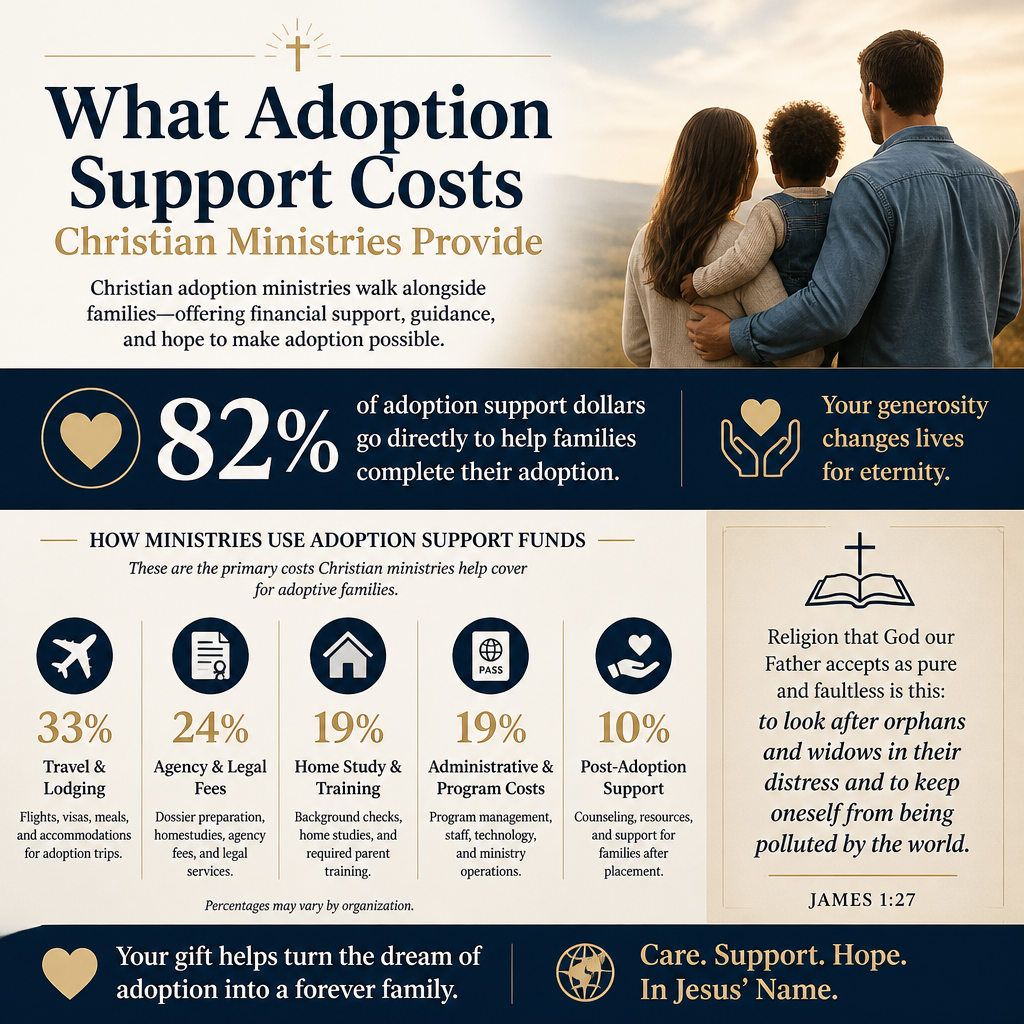
Scripture is unambiguous about God’s concern for children without protection and for families under pressure. James calls care for orphans and widows “pure and faultless” religion (James 1:27). Yet the modern adoption landscape forces hard choices: what is properly the church’s responsibility, what belongs to public systems, and what a ministry can responsibly promise without creating dependency or false expectations. Mature donors do not need sentiment; they need clarity about real costs, real outcomes, and real accountability.
Adoption support is more than a line item
Adoption is a legal event, but adoption support is a long pastoral and clinical journey. The ministries that endure are the ones that treat support as part of discipleship and family strengthening, not as optional “extras” once a placement is complete. In verification work, we see that post-placement spending often signals the ministry’s theology of the child and its seriousness about long-term outcomes.
Common categories of adoption support costs
Most adoption-related support costs Christian ministries provide fall into a handful of categories: mental health services, case management and coaching, parent training, crisis intervention, and practical assistance tied to a child’s needs. Some ministries also provide respite care networks, support groups, and referral partnerships, which may be less expensive than direct services but still require staff time, safeguarding protocols, and follow-up.
Donors should be cautious about simplistic labels. “Counseling” can mean anything from a volunteer-led support group to evidence-informed trauma therapy delivered by licensed clinicians. “Family support” can mean short-term gift cards or multi-year coaching relationships. The budget category is not the whole story; the program design and safeguards matter.
Why post-placement costs rise over time
Many adoptive families report that needs intensify after the “honeymoon” period, when initial stability gives way to deeper attachment work and behavioral realities. This is consistent with what child development researchers have long observed: early adversity affects brain development and stress regulation, often surfacing in school demands, puberty, or transitions.
What this means in practice is that ministries committed to post-placement care often face a long tail of costs. A short burst of support may be meaningful, but it is not the same as a ministry preparing for multi-year accompaniment.

The largest cost drivers are clinical and relational
Adoption support becomes expensive when a ministry aims to deliver competent, consistent care rather than occasional encouragement. The heaviest costs usually sit in staff time and clinical expertise, not in facilities or marketing. For donors, this is the moment to resist the “cheap equals efficient” reflex. When the need is trauma-impacted family care, under-investment can produce predictable harm.
Trauma-informed counseling and therapy
Families may seek play therapy, attachment-focused therapy, family systems counseling, or psychiatric care, depending on a child’s history and current functioning. A ministry may fund sessions directly, subsidize copays, or provide grants for families to access vetted providers. The cost per family can vary widely based on local provider rates, session frequency, and whether services are covered by insurance.
Research on adverse childhood experiences has helped the field name what many adoptive parents already know: early trauma correlates with later health and social challenges. The original ACE Study, conducted by CDC and Kaiser Permanente, documented dose-response relationships between childhood adversity and later outcomes, shaping how many clinicians and ministries think about long-term support (CDC ACEs overview).
Case management, coaching, and crisis response
Some of the most consequential work is not therapy but coordination. Families often need help navigating schools, Individualized Education Programs, Medicaid waivers, disability services, and local mental health systems. Ministries that provide skilled case management incur real salary costs, training costs, and supervision costs. Crisis response—after a hospitalization, a disrupted placement, or a safety incident—requires experienced staff and clear safeguarding protocols.
The harder question is not whether a ministry “has a hotline,” but whether it has a responsible model for triage, mandated reporting, documentation, and referrals. Donors should expect ministries to treat child safety and family stability as non-negotiable, even when it is costly.
Practical assistance is meaningful, but it must be governed well
Many Christian ministries provide tangible support: respite weekends, childcare during trainings, meals during a crisis, transportation help, and disability-related equipment. These supports are often relatively modest per item, but they multiply quickly at scale. They also require policies that protect dignity, prevent favoritism, and ensure funds serve the stated purpose.
Respite care and support groups
Respite care can prevent burnout and preserve placements, but it is also a safeguarding environment. A ministry offering respite must invest in background checks, training, supervision, and clear boundaries. Support groups can be low-cost compared to clinical therapy, yet effective facilitation still requires trained leaders who can recognize crises, avoid harmful peer counsel, and refer appropriately.
Donors evaluating this area should pay attention to how a ministry recruits and trains respite providers, how it handles medical complexities, and how it ensures that respite is restorative rather than destabilizing for children who struggle with transitions.
Direct aid and the stewardship tension
Christians genuinely disagree about the right balance between direct aid and capacity-building. Some donors prefer grants and gift cards because they feel concrete. Others worry about the “starvation cycle” dynamic in nonprofit funding, where programs are pressured to appear inexpensive, leading to underinvestment and fragility. Stanford Social Innovation Review has described this pattern and its consequences for organizational effectiveness (Stanford Social Innovation Review).
What this means for adoption support is straightforward: direct aid can be compassionate and appropriate, but if it replaces sustainable staffing, training, and accountability, it may only postpone the next crisis. Strong ministries can explain how practical assistance fits into a broader plan for family stability.
- Short-term crisis support tied to a documented care plan
- Subsidized counseling with vetted providers and outcome tracking
- Respite care with safeguarding, screening, and supervision
- Parent training that is specific to trauma, attachment, and disability
- School and systems navigation support for complex cases
Donors should expect transparency about what is and is not covered
A common donor frustration is ambiguity: a ministry says it “supports adoptive families,” but families still face large out-of-pocket expenses and limited access to services. Clear communication is not merely customer service; it is moral clarity. Families should not discover after placement that “support” means an annual webinar rather than actual care.
What responsible ministries typically disclose
In our view, ministries serving donors and families well tend to publish clear descriptions of eligibility, scope, and limits: which families qualify, whether support extends to foster-to-adopt placements, whether services are limited by geography, and how crises are handled. They also explain what they do not fund—long-term residential treatment, ongoing medication costs, or specialized schooling—if those are outside their model.
This is one reason we encourage donors to evaluate ministries through disciplined criteria rather than impressions. Most Trusted exists to help donors give with confidence by evaluating Christian nonprofits against The Most Trusted Standard, examining faith commitments alongside financial integrity, governance, and transparency about outcomes. When donors understand a ministry’s support model and reporting practices, giving becomes a form of stewardship rather than guesswork.
How to read budgets without falling for simplistic ratios
Adoption support often looks like “overhead” to the untrained eye because it requires experienced staff, supervision, training, and careful documentation. Mature donors have increasingly recognized that the simplistic overhead ratio is not a reliable proxy for impact. Charity Navigator, Candid (GuideStar), and the BBB Wise Giving Alliance jointly warned donors against judging nonprofits primarily by overhead percentages, emphasizing results and transparency instead (Charity Navigator).
The more useful question is whether the ministry’s spending matches its stated theory of care, and whether the organization can show credible evidence that families are actually being helped.
Verification questions that clarify whether support costs are well spent
Christian donors are not merely funding services; they are funding moral responsibility. The families and children served are often carrying histories of loss, coercion, abuse, or institutional neglect. A ministry’s adoption support spending should therefore be evaluated with the same seriousness we would apply to any work involving vulnerable people: governance, safeguarding, outcomes, and theological integrity.
What to ask before funding adoption support
Before underwriting post-placement programs, we recommend asking questions that force operational clarity.
First, what is the ministry’s model of care: short-term stabilization, long-term accompaniment, clinical services, or referral coordination? Second, what standards govern who provides care—licensure, supervision, trauma training, child protection policies? Third, what outcomes does the ministry track: placement stability, caregiver stress reduction, child school functioning, reduced crisis episodes, or other indicators? Fourth, how does the ministry ensure that financial assistance does not create perverse incentives or inequity among families?
Where to place adoption support within the wider orphan care landscape
Some donors arrive at adoption support because they are exploring the broader world of orphan care, family preservation, and child welfare. The landscape is diverse: domestic adoption, foster care, international adoption, kinship care, and reunification efforts each carry distinct ethical and practical questions. For donors who want a grounded view of the broader field, we address these tensions and ministry models in Christian Adoption Ministries.
Other donors want to focus specifically on how a ministry uses funds and whether post-placement support is a meaningful portion of the work or an aspirational tagline. The distinctions among program spending, governance, and reporting practices are central to How Christian Adoption Ministries Use Donations, because funding decisions shape what families can realistically expect.
FAQs for What adoption support costs Christian ministries provide
Do Christian adoption ministries usually pay for therapy?
Some do, but the model varies. Ministries may offer a limited number of subsidized sessions, grants for families to choose a provider, or in-house counseling if they employ licensed clinicians. Donors should look for clarity on eligibility, dollar limits, provider vetting, and whether the ministry tracks outcomes beyond attendance.
Is direct financial assistance the most effective form of adoption support?
Direct aid can be appropriate in crisis moments, especially when it prevents a placement from collapsing or stabilizes a family during a high-stress period. Yet long-term effectiveness often depends on whether aid is paired with competent case management, trauma-informed support, and clear safeguards. Mature ministries can explain why they fund what they fund, and what they do instead when a need falls outside their scope.
Adoption support costs are a test of seriousness
Post-placement support reveals whether a ministry understands adoption as a beginning, not a finish line. The costs are real because the needs are real: trauma, attachment disruption, disability, and systems navigation are not resolved by goodwill alone. Christian donors can give with both compassion and rigor by funding ministries that tell the truth about what they provide, protect families and children with strong safeguards, and demonstrate outcomes consistent with their stated mission.



