

How Christian adoption ministries communicate with donors is not a marketing question first. It is a discipleship question shaped by the moral gravity of children, family, and the church’s duty to speak truthfully. Donors are not purchasing an outcome. They are entrusting resources to a ministry that claims to act in the name of Christ, often in cross-cultural settings where power imbalances are real and the risks of unintended harm are not theoretical.
Because adoption sits at the intersection of gospel theology, trauma, civil law, and international policy, communication that is merely inspiring tends to become either manipulative or misleading. The ministries most worthy of Christian support learn to tell the truth with tenderness: honoring birth families, protecting children’s dignity, and refusing to reduce complex cases to celebratory narratives designed to produce gifts.
Donor communication begins with theological clarity and moral seriousness
Adoption language should sound like Scripture, not a sales funnel
Scripture’s language about God’s adoption of believers is doxological and covenantal; it is never transactional. Paul grounds adoption in the Father’s initiative and the Spirit’s sealing work (Romans 8:15–17). That theology does not map neatly onto modern legal adoption, and mature ministries say so directly. They honor the beauty of adoption without treating every adoption case as a simple, unqualified good.
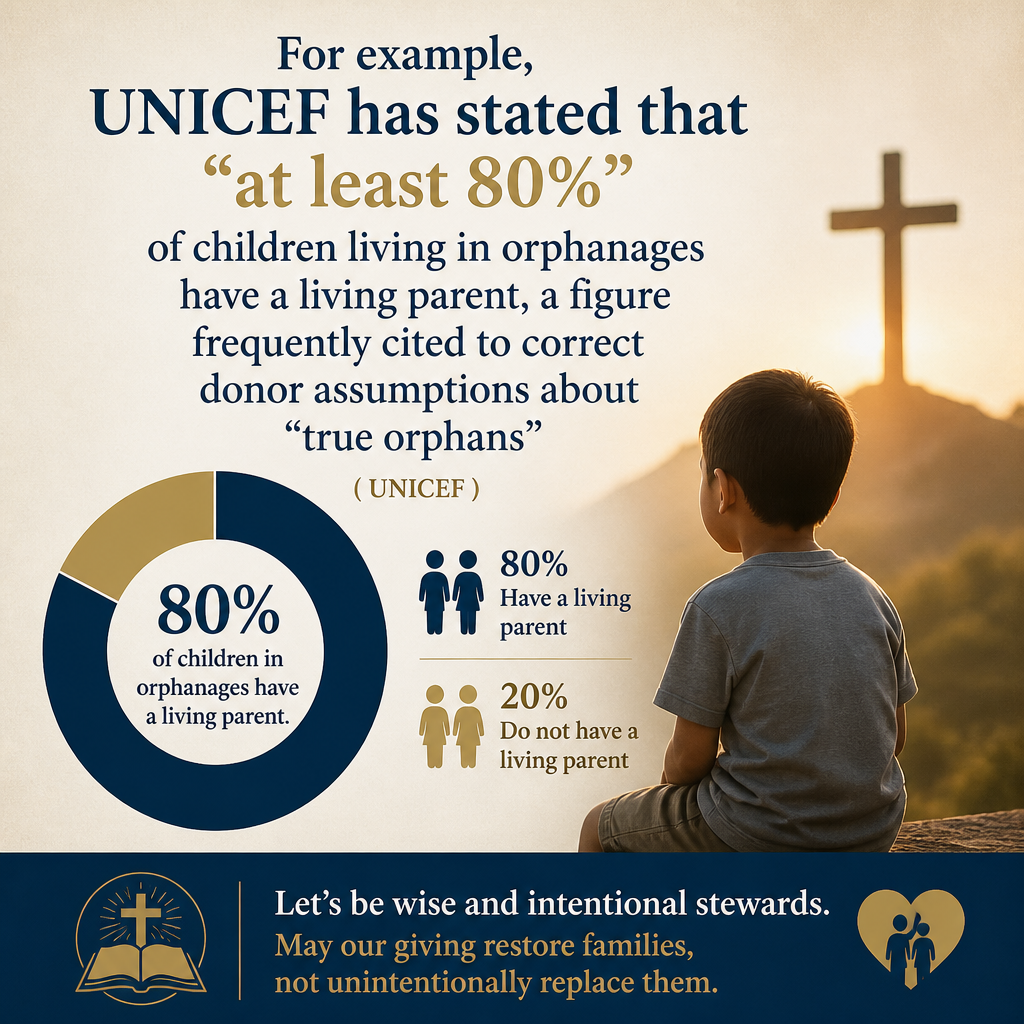
What this means in practice is that donor communication should resist easy metaphors. It should also resist the common shortcut of turning adoption into a generic stand-in for “orphan care” without defining terms. The modern field has had to reckon with the fact that many children in residential care settings have at least one living parent. For example, UNICEF has stated that “at least 80%” of children living in orphanages have a living parent, a figure frequently cited to correct donor assumptions about “true orphans” (UNICEF).
Truth-telling is part of protection
Christian donors often want to know, with understandable urgency, whether a child is safe and whether a family has been formed. Yet the child is not a storyline. Ministries that communicate responsibly explain their privacy and safeguarding commitments up front: why names are withheld, why photos are limited, why certain details cannot be shared even with faithful supporters. In a field where children’s past trauma and identity can be exploited unintentionally, restraint is a moral act.

Responsible ministries communicate in a way that does not commodify children
Photography and storytelling must obey the dignity of the image of God
The Christian doctrine of the imago Dei imposes non-negotiable limits on how ministries present children to the public. We have seen donor updates that effectively turn a child’s hardest moments into fundraising collateral: tearful face, partial biography, a promise that “your gift changes everything.” The problem is not emotion. The problem is extraction—taking what is most vulnerable in a child’s story and using it to move money.
More credible communication describes need without staging it. It tells donors what safeguards are in place: consent practices, staff training, photo policies, and how the ministry handles social media reposting. It also names what the donor will not receive: direct access to children, travel experiences designed to “meet the kids,” or personal communications that bypass child protection protocols.
Adoption should not be framed as the primary answer when family preservation is possible
Christians genuinely disagree about the best policy mix for caring for vulnerable children across contexts. Still, the sector has broadly learned that separating children from families is not a neutral act. Strong ministries therefore communicate a clear hierarchy of interventions: keeping children safely with their parents when possible; kinship care when parents cannot provide safe care; and adoption, particularly international adoption, as one possible path when other family-based options are not viable.
Communication that reflects this moral order does not weaken donor confidence. It strengthens it, because it signals that the ministry is not driving toward adoption numbers as a proxy for impact. It also aligns with the principle—recognized well beyond Christian circles—that institutionalization can carry significant developmental risks for children. The American Academy of Pediatrics has warned that young children raised in institutional settings can experience delays in physical, cognitive, and socio-emotional development, and it recommends family-based care whenever possible (American Academy of Pediatrics).
Donors should expect verifiable clarity about money, outcomes, and constraints
Financial communication must separate fees, fundraising, and restricted giving
Adoption ministries sit under unusually intense financial scrutiny because the public can confuse legitimate service costs with “buying a child.” Responsible communication begins by explaining the difference between (1) client fees paid for defined services, (2) philanthropic gifts that subsidize care, and (3) restricted funds designated for specific programs. When these streams are blurred, suspicion grows and ethics erode.
At Most Trusted, our verification work consistently finds that the most reliable ministries treat financial transparency as a form of discipleship. They publish audited financials when feasible, explain how restricted gifts are handled, and clarify whether fundraising appeals are tied to actual budget lines. They also refuse simplistic overhead claims, recognizing that the “Overhead Myth” letter—signed by leading nonprofit evaluators—warned donors against using overhead ratios as the primary measure of effectiveness (Charity Navigator).
Outcome reporting should reflect what adoption can and cannot promise
Donors deserve more than inspiring stories. They also deserve a ministry that speaks plainly about what is measurable. Adoption does not guarantee long-term flourishing. It can involve attachment disruption, identity grief, and complex family dynamics that take years to address. Ministries that communicate honestly describe the supports they provide—pre-adoption education, home study processes, post-adoption counseling referrals, trauma-informed training—and they name where their responsibility ends.
This is where donors benefit from a clear evaluative framework. The Most Trusted Standard examines ministries across Faith Foundation, Financial Integrity, Governance and Leadership, and Transparency and Effectiveness. That combination matters in adoption work because good intentions alone do not produce safe systems. Competent governance, conflict-of-interest controls, and documented safeguarding policies are part of what it means to love children with integrity.
Strong communication shows governance and safeguarding, not just vision
Boards and accountability should be visible to donors
Adoption and orphan care ministries operate in environments where incentives can distort judgment: pressure to produce placements, pressure to raise funds, pressure to satisfy receiving-country and sending-country regulatory demands. In that environment, governance is not paperwork. It is protection. Donors should expect to see evidence of oversight: an active board, disclosed leadership, clear policies, and a mechanism for reporting concerns.
When ministries are reluctant to share who governs them, who sets compensation, or how conflicts are managed, donors should ask why. Transparency does not eliminate risk, but opacity multiplies it.
Safeguarding must be communicated as a system
Donors often assume safeguarding is a background matter, handled quietly by professionals. Yet strong ministries communicate safeguarding openly because it is central to trust. They outline how they screen staff and volunteers, how they control access to children, how they handle allegations, and whether an external party is involved in investigations. In cross-border contexts, they also explain how they comply with relevant laws and standards in each jurisdiction.
A brief list of the kinds of donor-facing disclosures that tend to signal maturity is instructive:
- Written child protection policy with clear reporting channels
- Limits on child images, identifying details, and social media use
- Training expectations for staff, contractors, and volunteers
- Clear separation between case decision-making and fundraising functions
- External financial review, audit, or equivalent accountability practices
These are not mere administrative markers. They are practical expressions of Jesus’ warning that causing “little ones” to stumble is a grievous matter (Matthew 18:6).
Donor communication should help supporters give with wisdom, not impulse
Healthy ministries invite questions and name tensions
Communication that treats donors as spiritual adults does not panic when questions arise. It expects them. Adoption includes legitimate debates: the ethics of international adoption in contexts with weak civil registries, the risk of financial inducements for relinquishment, the consequences of long institutional care, and the long-term needs of adoptees as they grow into adulthood. A ministry that never names these tensions is not necessarily hiding wrongdoing, but it is failing to form donors in truthful charity.
Some of the most helpful communication we see is not promotional at all. It is educational: clarifying how family preservation is evaluated, what trauma-informed care entails, why timelines vary, what accreditation or regulatory processes require, and how the ministry avoids perverse incentives.
Donors can evaluate communication quality, not only ministry claims
Christian donors often ask, “How do we know whom to trust?” Part of the answer is to examine not only what a ministry claims, but how it speaks. Does it present children as neighbors to be honored or projects to be completed? Does it provide verifiable documents or only moving stories? Does it respect birth families and local churches, or does it speak as if Western money is the decisive actor?
Those seeking a broader understanding of the landscape can begin with Christian Adoption Ministries, where the central terms and risks of the field can be considered without reducing the subject to slogans. When assessing how funds are described and reported, How Christian Adoption Ministries Use Donations offers a focused lens on what transparent ministries typically disclose.
FAQs for How Christian adoption ministries communicate with donors
What should we do when a ministry’s fundraising stories feel emotionally coercive?
We recommend pausing before giving and requesting the ministry’s safeguarding and communications policies. Ask how they obtain consent for stories and photos, what details they withhold to protect children, and whether they can provide program documentation that matches the appeal. If a ministry is unwilling to explain its practices with clarity, donors should treat that as a meaningful signal and consider redirecting support to organizations that communicate with greater restraint and verifiability.
Is it appropriate for an adoption ministry to report success primarily through adoption placement numbers?
Placement counts can be one relevant metric, but they are not sufficient on their own and can create distorted incentives if treated as the main measure of faithfulness. Strong communication pairs any placement reporting with evidence of ethical practice: family preservation efforts, adherence to legal requirements, post-adoption support, and independent accountability. Donors can ask for outcome reporting that reflects the full moral purpose of the work: the child’s long-term welfare and the integrity of the process.
A standard of communication worthy of the work
Adoption ministry touches tender places in the body of Christ: infertility grief, the longing to protect children, the desire to see families restored. That tenderness can be honored without being exploited. The ministries that communicate most responsibly treat donors not as an audience to be moved, but as stewards to be formed—through truth, evidence, and reverent speech about children made in God’s image. Where communication is careful, verifiable, and theologically grounded, donors can give with a steadier conscience and a clearer sense of what faithful love requires.



