
How do Bible translation ministries measure spiritual impact without reducing the work of the Holy Spirit to a spreadsheet? Christian donors ask this because Bible translation is both unavoidably measurable and finally mysterious: God uses words on a page, preached and read, to bring life (Romans 10:14–17), yet the fruit of that life is not ours to manufacture or to claim.
Most ministries in this field now operate with a dual accountability. They must be faithful to Scripture and to the church, and they must be responsible stewards of funds entrusted for a purpose that often unfolds over decades. The question is not whether to measure, but how to measure in a way that is theologically honest, ethically sound, and practically useful for wise giving.
Spiritual impact begins with defining faithfulness
Before a ministry can credibly speak about “impact,” it must state what it believes it is accountable to accomplish. In Bible translation, the most responsible ministries begin with a doctrine of Scripture, a theology of the church, and a clear understanding of what translation can and cannot do.
Translation outcomes are not the same as conversion outcomes
Scripture teaches that God’s Word is living and active (Hebrews 4:12). It also teaches that faith comes through hearing the message of Christ (Romans 10:17). That creates a genuine expectation that accessible Scripture matters. But Scripture does not authorize ministries to treat conversion as a controllable output, or to assume that distribution equals discipleship. A sober doctrine of regeneration leaves room for patience, prayer, and humility.
What this means in practice is that ministries should distinguish between outcomes they directly steward and outcomes they pray for. They can directly steward translation quality, community engagement in the process, access pathways, and local church partnership. They can contribute to, but not guarantee, conversion and long-term spiritual formation.
Faithful measurement must serve the church, not replace it
The New Testament’s pattern is ecclesial: the Word is preached, taught, and embodied in the life of a community. Translation efforts that bypass the local church often drift toward a product mindset—publishing a text—rather than cultivating the conditions under which the Word is read, heard, and obeyed. Mature donors increasingly ask whether a translation ministry is strengthening the church’s ministry of the Word rather than building parallel structures.
For donors assessing this field broadly, we maintain a dedicated topic page on Bible Translation Ministries, where the key accountability questions tend to recur across organizations and contexts.

Credible ministries measure what they can verify without moral inflation
Bible translation has long measured what is tangible: languages reached, New Testaments completed, Bibles printed, and distribution numbers. Those are not trivial metrics. They represent real access that did not exist before. But donors should be alert to moral inflation—treating impressive operational statistics as if they were themselves proof of spiritual fruit.
Operational metrics have a legitimate place
Responsible operational indicators include translation milestones, quality assurance steps, and delivery pathways. For example, the scale of global language need is often cited to clarify why the work remains unfinished; a frequently referenced estimate is that roughly 7,000 languages are spoken worldwide, a figure commonly reported by SIL International’s Ethnologue Ethnologue. The number itself does not prove spiritual impact, but it does illuminate the scope of access barriers.
Similarly, ministries may reference broader Scripture engagement realities that affect strategy. The share of U.S. adults reading the Bible at least weekly has been reported around one-fifth in recent years, underscoring that access alone does not guarantee use; the American Bible Society’s annual State of the Bible research tracks these patterns American Bible Society.
Verifiability matters because incentives distort reporting
Donors are right to be cautious. The incentive to demonstrate “results” can pressure ministries to overclaim, especially in fundraising contexts where compelling stories outperform careful nuance. The credible posture is not silence about outcomes, but clarity about what is being measured, what is being inferred, and what remains unmeasured.
Across our verification work at Most Trusted, we observe that ministries with durable credibility tend to treat metrics as a form of truth-telling before God and neighbor. They resist the temptation to make every report read like a revival. They describe setbacks, delays, and limits without treating them as threats to the mission.
Strong impact frameworks connect translation to Scripture engagement and church formation
The most persuasive accounts of spiritual impact follow a chain of logic: translation quality and accessibility lead to Scripture engagement, which over time contributes to discipleship, worship, leadership development, and the strengthening of local churches. Each link in that chain can be evaluated with appropriate methods and appropriate modesty.
Scripture engagement is measurable, but it requires careful design
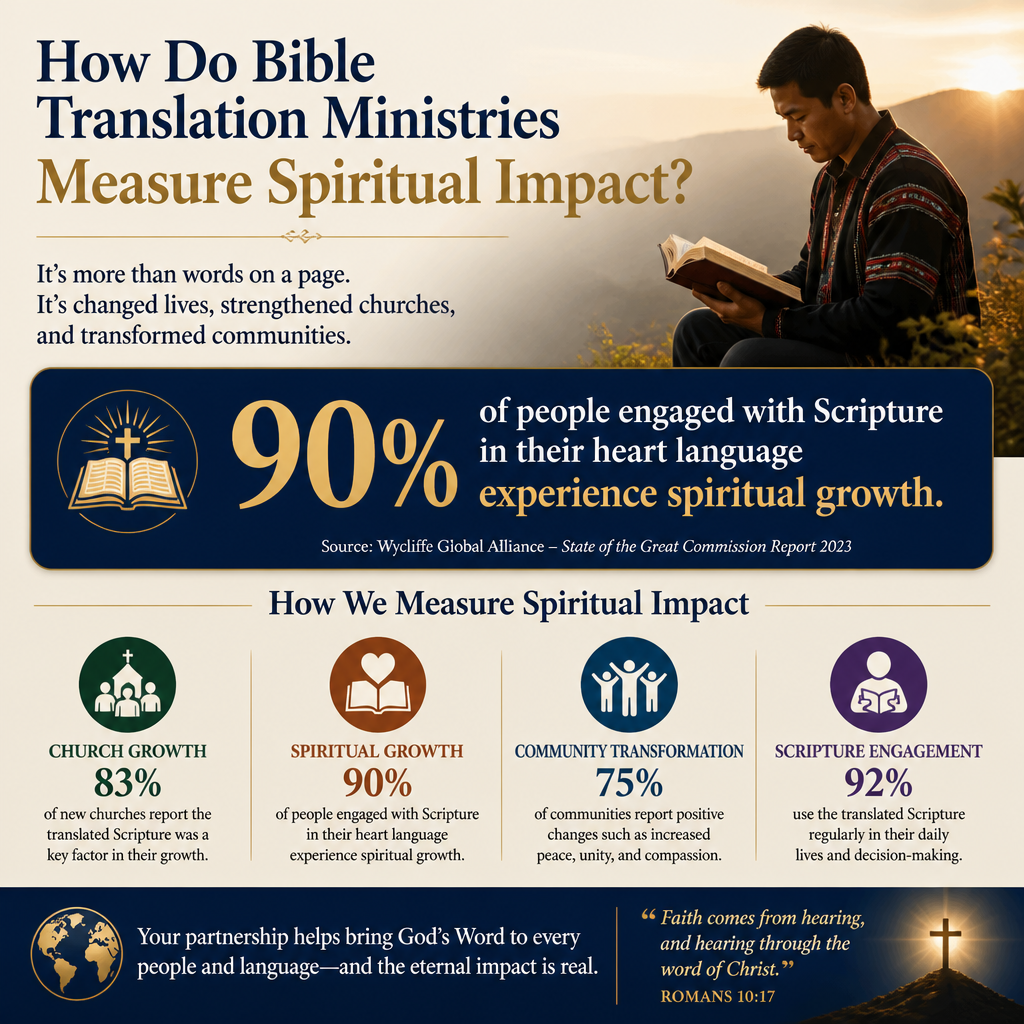
Ministries commonly measure Scripture engagement through distribution and usage signals: audio Bible listening sessions, app downloads, completion rates for literacy classes, participation in Scripture-based small groups, and requests for additional portions. These are intermediate outcomes—not final spiritual verdicts—but they are closer to “impact” than shipment counts alone.
Method matters. Usage statistics can be inflated by passive downloads or one-time curiosity. Surveys can be shaped by social desirability bias, especially where respondents believe a “spiritual” answer is expected. Better ministries counter these risks by triangulating: combining quantitative indicators (usage data) with qualitative evidence (local leader interviews, observation, and case documentation) and with longitudinal follow-up.
Church-centered indicators keep the work accountable to biblical ends
Translation ministries that work in partnership with local churches can credibly track church-centered indicators such as: Scripture being used in preaching, translation being adopted in congregational worship, training of local translators and reviewers, and the development of local teaching materials that reflect orthodox doctrine.
This approach aligns with the conviction that Scripture is given to form a people, not merely to inform individuals. Donors should ask whether “impact” is defined in ways that strengthen the church’s ordinary means of grace: the Word read and preached, prayer, sacraments where practiced, and disciplined community life.
Donors should watch for integrity risks unique to translation work
Bible translation is often complex, cross-cultural, and long-horizon. Those features create particular risks that donors should not ignore: doctrinal drift, unhealthy power dynamics, data manipulation pressures, and the subtle replacement of local agency with donor-driven priorities.
Theological and linguistic fidelity are not optional
Translation choices are never theologically neutral. A ministry’s doctrinal commitments, translation philosophy, and review process matter. Donors should ask who sits at the table for key decisions: qualified local church leaders, trained mother-tongue speakers, and experienced exegetes. A credible ministry will explain its consultant checks, back-translation practices where used, and the role of broader church oversight.
Christians genuinely disagree about certain translation philosophy questions—formal equivalence versus functional equivalence, how to render key terms in receptor languages, and how to handle idioms. Mature ministries acknowledge these debates rather than presenting their choices as self-evident.
Ethical partnership requires local ownership, not symbolic consultation
A translation that is technically accurate but socially rejected will not serve the church. Ministries increasingly measure whether communities actually receive and use a translation, not merely whether a project is “completed.” That requires attention to local ownership: who requested the work, who helped shape the orthography and terminology, and whether the translation aligns with the worship life and teaching patterns of local churches.
For donors comparing organizations within the field, our category page on How Bible Translation Ministries Measure Impact addresses recurring questions about evidence, spiritual language, and accountability.
What The Most Trusted Standard looks for in impact claims
Donors do not need ministries to promise what only God can give. They do need ministries to demonstrate that they are faithful, transparent, and effective within the responsibilities they actually control. The Most Trusted Standard evaluates ministries across 15 criteria grouped into four areas: Faith Foundation, Financial Integrity, Governance and Leadership, and Transparency and Effectiveness. In Bible translation, those criteria converge in a distinctive way around truthfulness and patience.
Questions we recommend donors ask before accepting impact narratives
- Are spiritual outcomes distinguished from operational outputs? Credible reporting differentiates translation milestones from discipleship outcomes and treats each with appropriate evidence.
- Is the theory of change explicit? Ministries should explain how translation connects to engagement and how engagement is supported through local churches or trusted partners.
- Are methods clear and limitations admitted? When surveys or usage analytics are used, donors should see sampling logic, definitions, and honest constraints.
- Is local church partnership structurally real? Not merely advisory, but integrated into governance of projects, review processes, and distribution strategies.
- Are finances aligned with the long horizon of the work? Translation requires steady funding, not volatility driven by marketing cycles. Clear reserves policy and transparent project accounting are meaningful signals.
Transparency is a theological discipline
Christian ministry communications can slip into a genre where every story sounds uncomplicated and every update ends in triumph. That does not train donors in truth. It trains them in sentiment. Ministries that meet The Most Trusted Standard tend to communicate with a steadier moral posture: gratitude without manipulation, claims proportionate to evidence, and a willingness to let the work be slow.
That posture is not a branding choice. It is a form of obedience. “Therefore, having put away falsehood, let each one of you speak the truth with his neighbor” (Ephesians 4:25). Donors should not accept less from ministries that speak in Christ’s name.
FAQs for How do Bible translation ministries measure spiritual impact
Should a Bible translation ministry report conversion numbers?
It may report conversion stories when they are verifiable and responsibly framed, but conversion totals are rarely a reliable or ethically clean metric for a translation organization. The more credible approach is to measure what the ministry directly stewards—translation quality, accessibility, Scripture engagement pathways, and local church adoption—while treating conversion and long-term transformation as fruit we seek in prayer and expect God to grant through the church’s ministry of the Word.
What indicators best show that a translation is actually being used?
Usage is best demonstrated through converging evidence: adoption by local churches for preaching and worship, sustained participation in Scripture groups, measurable audio or app engagement beyond one-time downloads, demand for reprints or additional portions, and testimony from local leaders that the translation is shaping teaching and discipleship over time. A single metric is usually easy to inflate; a pattern across several indicators is harder to manufacture.
Measuring impact without pretending to control grace
Bible translation ministries measure spiritual impact most responsibly when they treat it as an accountability question, not a marketing claim. Donors can look for a coherent chain from faithful translation to genuine engagement to church-centered formation, supported by evidence that is specific, verifiable, and modest about what it cannot prove. That combination—faithfulness, transparency, and patience—honors both the seriousness of stewardship and the freedom of God to bring life through his Word.



