
How Bible translation ministries measure impact is not a secondary question for Christian donors; it is a stewardship question. When the stated outcome is spiritual—people hearing God speak in a language of the heart—donors rightly ask what can be counted, what must be discerned, and what cannot be responsibly claimed.
Scripture itself teaches that some fruit is visible and some is hidden. Paul can describe planting and watering, yet insists that “God gives the growth” (1 Corinthians 3:6). A mature approach to impact measurement in Bible translation will honor that distinction: it will track what can be verified, it will tell the truth about what cannot be known with certainty, and it will resist the subtle temptation to turn the work of the Spirit into a reportable metric.
Impact begins with clarity about what translation can and cannot accomplish
Bible translation ministries commonly speak of “access,” “engagement,” and “church impact” as if these were interchangeable. They are not. Access is a necessary condition for discipleship and church formation, but it is not the same as engagement; engagement is not the same as conversion; and conversion is not the same as long-term obedience in a local body. The first discipline of measurement is to define outcomes in a way that respects those differences.
At the access level, ministries can measure concrete deliverables: a New Testament completed, a set of Scripture portions published, an audio Bible recorded, a sign language translation drafted, or a digital distribution channel established. These are not “mere outputs” in the pejorative sense. In a field where hundreds of millions still lack Scripture in a language they understand, access is a morally weighty outcome, not an administrative checkbox. The Wycliffe Global Alliance summarizes this remaining need in global terms and tracks progress at a sector level (Wycliffe Global Alliance).
The harder question is what comes after the “dedication” ceremony. A New Testament can exist in a library and remain unopened; it can circulate widely and still not be understood; it can be read and still not be trusted. Ministries that speak responsibly about impact distinguish between what their teams directly do (translation, publishing, training, partnership) and what they rightly desire but cannot control (spiritual awakening, lasting church health).
Why donors should be cautious with spiritual claims
It is easy to overstate causality in ministry communications. A testimony may be true and still not be generalizable. A rise in church attendance may coincide with a translation release and still be driven by other factors—local evangelists, migration, political pressures, or a parallel discipleship movement. Sophisticated donors do not require secularized proof, but we do require honesty about attribution.
What a faithful theory of change looks like
The best ministries articulate a plausible pathway: translation completed, Scriptures made available in appropriate formats, local leaders trained, Scripture engagement facilitated, and local churches equipped to teach and disciple. That pathway makes room for God’s sovereignty and human responsibility. It also yields measurement points that can be assessed without pretending to measure regeneration itself.
Good measurement distinguishes outputs, outcomes, and credible signs of spiritual fruit
Translation work is long-horizon and multi-stage. A donor who only asks, “How many translations did you finish?” risks misunderstanding both the cost and the time required. A donor who only asks, “How many people came to Christ?” risks incentivizing inflated claims. Better questions follow the arc of the work and recognize different kinds of evidence.
Outputs that should be verifiable
Outputs are the ministry’s direct deliverables, and they should be documented in a way an outside reviewer can follow. Examples include: project status by language, milestones achieved (drafting, community testing, consultant checking, publication), the number of trained local translators or reviewers, and distribution volumes by format (print, audio, app, sign language video). These can be audited through project documentation, publication records, and partner confirmation.
Where possible, ministries should align language and project identifiers with widely used sector references so that donors can cross-check claims. One common reference point is the progress-tracking work associated with global Bible access and translation need (often coordinated across multiple organizations) (United Bible Societies).
Outcomes that are measurable without exaggeration
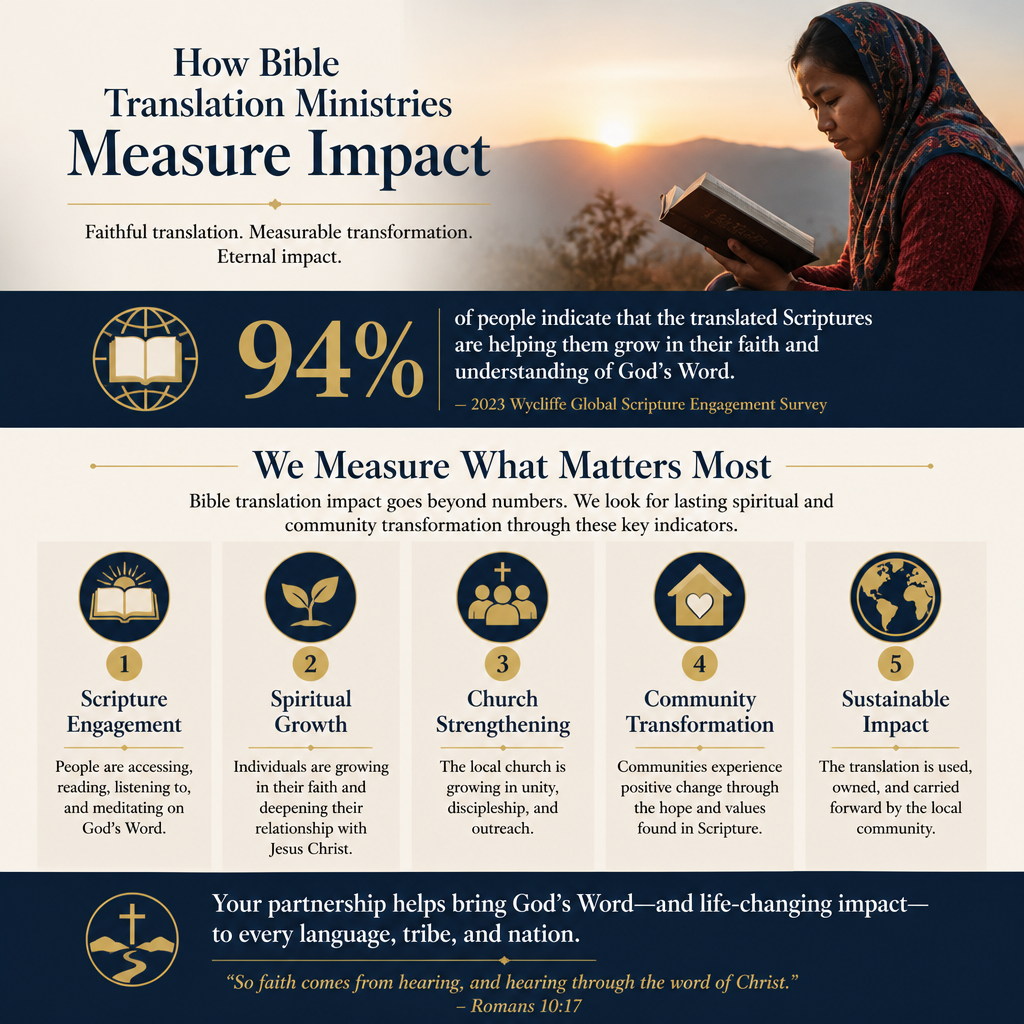
Outcomes describe what changes for people and communities because of the ministry’s work, even if the ministry is not the sole cause. In Bible translation, credible measurable outcomes often include: increased Scripture use in local churches, incorporation of translated passages into preaching and teaching, measurable engagement with audio or app-based Scripture, increased literacy participation connected to Scripture-based materials, and trained local facilitators leading reading and discussion groups.
Donors should expect ministries to use mixed methods. Quantitative measures—attendance in Scripture groups, app engagement, audio distribution counts—are useful but limited. Qualitative methods—structured interviews, focus groups, observation protocols—are often the only way to understand comprehension, trust, and social dynamics around Scripture. Qualitative research is not “soft” when it is conducted with rigor and transparency about sampling and limitations.
Signs of spiritual fruit that should be described with care
Some realities matter most and measure least. Repentance, reconciliation, perseverance in suffering, and the slow formation of Christian conscience are not clean metrics. Still, ministries should not avoid reporting them; they should report them carefully. The difference is whether spiritual fruit is presented as testimony (illustrative, not exhaustive), as a pattern observed with humility, and as something discerned in partnership with local churches rather than declared by outsiders.
What happens after a New Testament is finished determines much of the impact
A completed New Testament is often the moment donors see. It is also the moment the most important work can either deepen or dissipate. Ministries that plan for “post-translation” impact do not treat the publication event as the finish line; they treat it as the transition from production to reception.
Scripture engagement is not an accessory
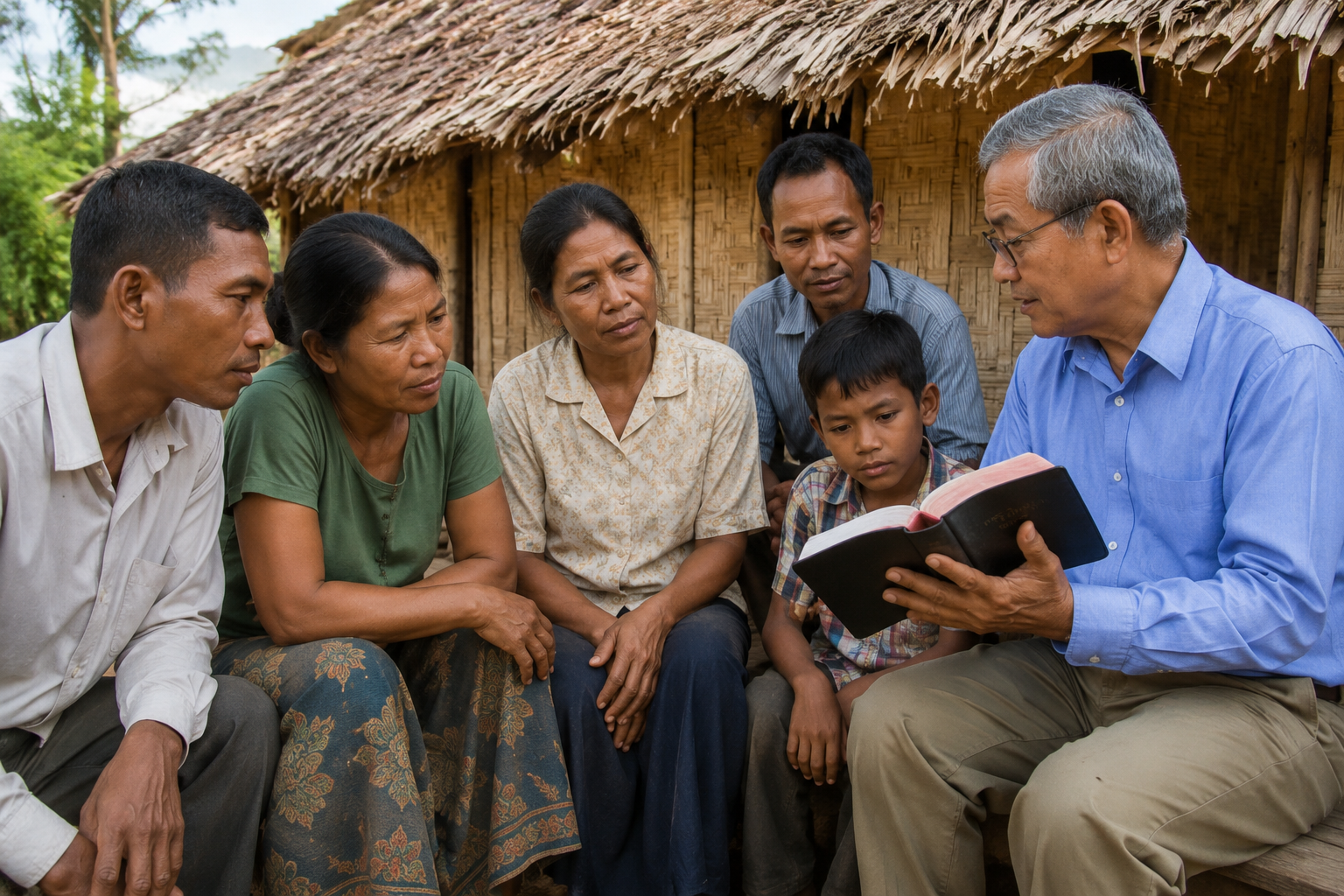
Many translation organizations now invest explicitly in Scripture engagement—facilitating listening groups, training local leaders to teach from the translated text, developing context-appropriate study resources, and addressing comprehension barriers. This is not a concession to donor expectations. It is a recognition of the biblical pattern that the Word is given to be heard, understood, and obeyed (Nehemiah 8:8).
The field has also had to reckon with the reality that “distribution” does not guarantee “use.” Digital availability can be high while sustained reading is low. Audio can reach non-literate populations but still require trusted guides for interpretation. Where ministries measure engagement, donors should ask how they avoid confusing initial curiosity with lasting incorporation into worship and discipleship.
Local ownership is an impact indicator, not a sentimental value
Translation quality and long-term use depend on local ownership: churches and communities that regard the translation as “ours,” not as an imported product. Ministries can measure ownership through concrete indicators: local review committees functioning well, local church leaders advocating for use, sustained demand for reprints or audio copies, and local institutions (seminaries, training centers) incorporating the text.
Christians genuinely disagree about how much external funding should remain in the system over time. Some argue that long-term subsidies are necessary in linguistically complex contexts. Others warn that dependency can deform leadership incentives. Donors do not need a simplistic answer, but we do need ministries to show they have wrestled with these dynamics rather than assuming money is neutral.
Discipleship and church health require longitudinal patience
When a translation is newly available, early stories can be dramatic. Over the long term, the more decisive outcomes are often quiet: pastors able to preach without relying on a trade language, children catechized in their mother tongue, and believers equipped to test teaching against Scripture. These are precisely the outcomes that require years to observe. Ministries that measure impact responsibly tend to plan for follow-up windows that extend beyond the first wave of enthusiasm.
How donors should evaluate impact claims using The Most Trusted Standard
Impact measurement is never only a technical exercise. It is also a governance and integrity issue, because incentives shape reporting. Across our verification work at Most Trusted, we find that the most credible Bible translation ministries combine a theologically serious posture with disciplined transparency: they define terms, disclose limitations, and publish enough detail for a donor to understand what is being claimed and what is not.
The Most Trusted Standard evaluates ministries across Faith Foundation, Financial Integrity, Governance and Leadership, and Transparency and Effectiveness. That framework matters here because impact claims can be distorted by weak governance, unclear leadership accountability, or fundraising pressure, even when field teams are faithful.
Questions that clarify whether “impact” is being measured or marketed
- Are the ministry’s outcomes stated precisely? Donors should see clear definitions for “reached,” “served,” “engaged,” and “in use,” along with data sources.
- Is there a plausible causal story? Ministries should explain how translation work connects to engagement and discipleship through local partners, training, and distribution.
- Are limitations disclosed? Responsible reports name what is unknown: sampling gaps, security constraints, and attribution challenges.
- Are local churches treated as agents? Impact that sidelines local leadership is usually fragile and sometimes harmful.
What transparency should look like in practice
At minimum, donors should expect annual reporting that includes project progress, financial clarity, and evidence of outcomes consistent with the ministry’s stated strategy. For Bible translation, transparency also includes methodological clarity: what translation principles are used, what checking processes are followed, and how theological commitments guide contested choices (for example, how key terms are rendered in particular linguistic contexts).
We also encourage donors to distinguish between a ministry’s internal dashboards and what is released publicly. Internal tracking can be more detailed; public reporting must be safe and appropriate. Security concerns in sensitive regions can be real. The question is whether ministries disclose constraints honestly rather than using “security” as a blanket reason for avoiding accountability.
Donors exploring the broader ecosystem may find it helpful to situate these questions within Bible Translation Ministries as a category, because the field includes different models—some highly specialized in linguistic work, others integrating engagement and church partnership more directly.
Stewardship requires both rigor and humility
Bible translation ministries measure impact best when they refuse two equal errors: treating spiritual outcomes as unknowable, or treating them as controllable. Christian donors can ask for verifiable evidence of faithful work—clear milestones, transparent reporting, credible engagement indicators—while also honoring the truth that only God grants lasting fruit. The ministries most worthy of trust tend to speak that way: with rigor about what they can show, humility about what they cannot, and confidence that the Word of God does not return void (Isaiah 55:11).



