

Bible translation ministries avoid funding gaps by treating translation as a long obedience rather than a short campaign, then building financial systems that can endure slow work, currency shocks, and shifting donor attention. For Christian donors, the question is not only whether the work is urgent—it is whether the ministry can carry faithful commitments through the years it takes to bring Scripture to a language community with accuracy, dignity, and lasting access.
The stakes are higher than a temporary slowdown in output. Funding gaps can break trust with local church partners, interrupt literacy and Scripture engagement work that makes translation usable, and pressure teams toward haste where patience is required. Scripture commends careful stewardship, not merely sincere intention: “Moreover, it is required of stewards that they be found faithful” (1 Corinthians 4:2).
Translation timelines require a different kind of financial discipline
A mature donor approach begins by acknowledging what translation actually is. It is not simply a text production project. It is a multi-year collaboration that involves linguistics, biblical languages, community review, consultant checking, orthography decisions, and increasingly, audio and digital distribution. Each phase carries different cost profiles and different risks.
Why gaps happen even in respected ministries
Funding gaps are often less about scandal than about mismatch. Donors love launches and finished products, but translation requires long middle years where progress is real yet less visible. Ministries may also underestimate the cost of supporting national colleagues well, maintaining compliance across multiple jurisdictions, or sustaining member care for teams living cross-culturally.
Economic volatility compounds the problem. A team budget denominated in U.S. dollars may be spent in multiple currencies; inflation or devaluation can change the work’s cost without changing its scope. When ministries treat these dynamics as exceptional rather than normal, the “surprise” becomes a structural deficit.
What stability looks like in practice
Across our verification work at Most Trusted, the ministries that meet The Most Trusted Standard tend to name these realities plainly in donor communications and planning. They distinguish between translation costs, Scripture engagement costs, and organizational backbone costs. They also set expectations that biblical faithfulness includes financial candor, even when candor is less emotionally compelling than celebration.
Healthy revenue is diversified without becoming distracted
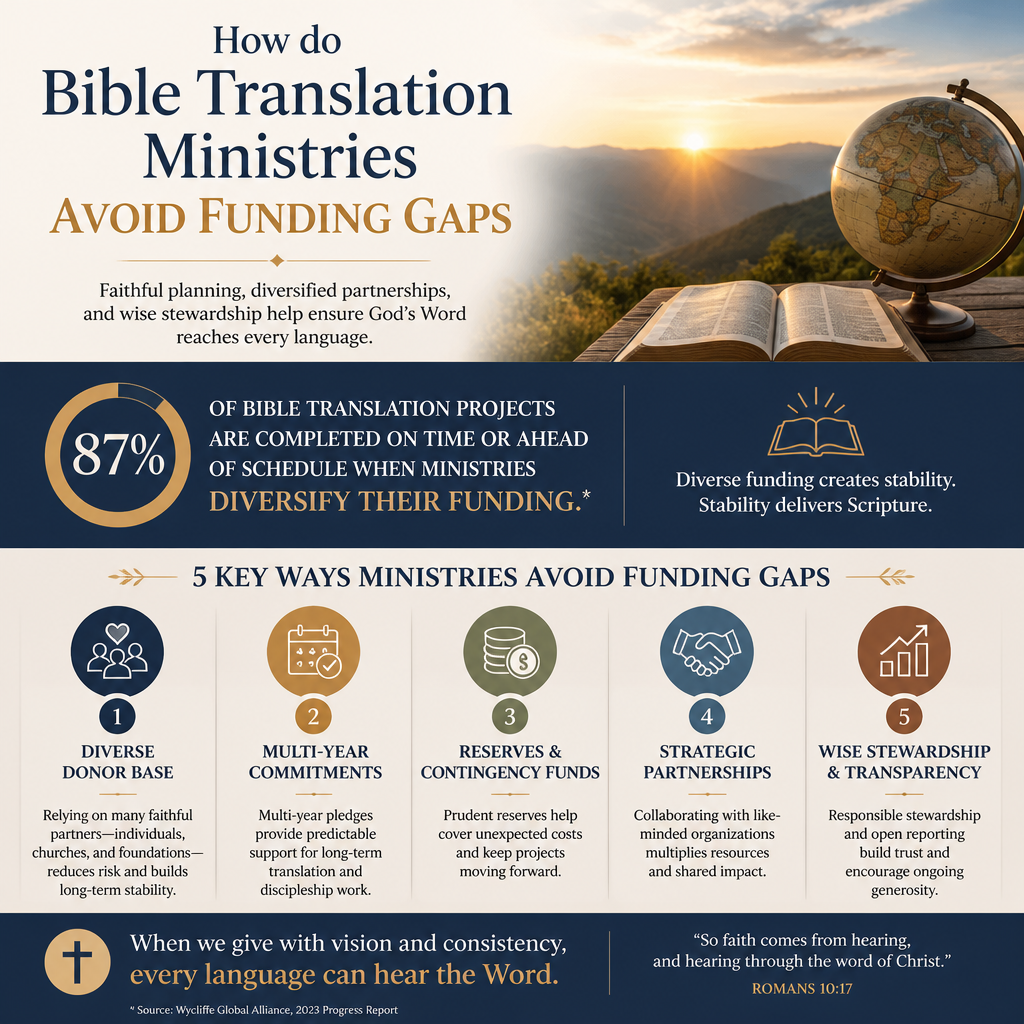
Avoiding gaps rarely comes from a single large donor, even when God provides generous patrons. It more often comes from a portfolio: a broad base of recurring givers, a disciplined major-gifts program, and selective institutional support that does not distort the ministry’s calling. Diversification is not cynicism; it is prudence shaped by the reality that human giving is variable.
Recurring giving is not glamorous, but it is formative
Monthly support is one of the strongest predictors of stability for many ministries. It aligns with the regularity of payroll, field operations, and consultant schedules. It also forms donors in long-term partnership rather than episodic rescue. The challenge is that building recurring support requires patient communication, reliable receipting, and a theology of partnership that honors both the giver and the work.
For donors evaluating translation ministries, it is reasonable to ask what proportion of revenue is recurring and how the ministry nurtures retention. The aim is not to reduce ministry to metrics, but to ensure that spiritual ambition is matched by operational maturity.
Major gifts and grants can help or harm
Large gifts can accelerate critical milestones: a consultant checking sprint, a cluster of communities beginning oral Scripture work, a literacy initiative paired with distribution. They can also create fragility if the ministry builds fixed obligations on top of volatile, one-time revenue. The harder question is whether leadership treats large gifts as capital to strengthen long-term capacity or as permission to expand without guardrails.
Institutional grants bring their own tensions. Some are deeply aligned with Scripture translation; others introduce reporting burdens or program constraints that are difficult for field teams. Christians genuinely disagree about how much grant funding is appropriate for missionary work. A prudent approach asks whether grant-funded initiatives serve the local church and language community or subtly shift the ministry toward donor-driven outputs.
Cash reserves and contingency planning are spiritual realism
Some donors hesitate when they see reserves, assuming that any unspent cash signals lack of need. Yet Scripture commends wise preparation without anxiety. Joseph’s storehouses in Genesis were not an indictment of faith; they were a means of preserving life through famine. Translation ministries operate in environments where delays are normal: visas change, political contexts tighten, illness interrupts travel, and key reviewers move away.
Right-sized reserves prevent avoidable harm
A reasonable reserve policy can keep local colleagues paid, prevent abrupt project pauses, and reduce the temptation to take misaligned money in a crisis. Donors can ask for clarity on the ministry’s reserve target, board-approved rationale, and conditions for using reserves. The goal is not hoarding. It is continuity, so that communities are not whiplashed by donor cycles.
In broader nonprofit finance, evidence suggests many organizations have limited liquidity. For example, the Nonprofit Finance Fund has repeatedly reported that a significant share of nonprofits experience cash flow challenges and do not have enough operating cash on hand at various points in the year. Translation ministries are not immune, and cross-border complexity can make liquidity even more fragile.
Scenario planning is part of integrity
Contingency planning does not require a pessimistic posture. It requires leaders who can name risks and make decisions early. Ministries that avoid severe gaps tend to plan for donor churn, exchange-rate swings, and project delays. They also separate restricted and unrestricted funding carefully, so that designated gifts do not create the illusion of health while core operations quietly weaken.
Donors who want to go deeper into the financing dynamics across the field can consult our coverage of How Bible Translation Ministries Are Funded as a reference point for the recurring patterns that create resilience or fragility.
Transparent reporting builds trust and stabilizes giving
Funding gaps are not only a financial event; they are a trust event. When donors feel surprised, they often disengage. When local partners feel uncertain, they may question whether the ministry will remain present when the work grows costly or slow. Transparency is therefore not a marketing preference. It is a stewardship obligation.
What donors should be able to see
At minimum, mature ministries provide current financial statements to the board, publish recent audited financials when appropriate for their size and context, and explain how funds are allocated across translation, engagement, and support functions. They avoid the temptation to hide essential overhead behind spiritual language. The “Overhead Myth” letter—endorsed by major evaluators—rightly argues that simplistic overhead ratios can mislead donors and harm nonprofits that need strong infrastructure (Charity Navigator).
- Clear distinction between restricted and unrestricted revenue
- Project-level budgets that match stated milestones
- Credible explanations of delays and revisions
- Board oversight of financial policies and risk
- Consistent, non-manipulative donor communications
Outcome reporting without reductionism
Translation outcomes are not always captured by a single number. Counting “verses completed” can reward speed over quality. Counting “languages started” can reward expansion over finish. The better practice is narrative and measurable reporting together: progress against agreed milestones, description of community review, and evidence of Scripture use where appropriate.
We are careful here. Scripture engagement metrics can be hard to gather responsibly, and digital analytics can overstate depth. Yet donors can still ask whether a ministry is learning and adapting, and whether it reports both successes and limitations with integrity.
Governance and partner practices reduce the risk of crisis-driven fundraising
Funding gaps often reveal governance weakness. When boards are passive, when financial oversight is minimal, or when executive authority is unchecked, ministries drift into reactive fundraising. Sound governance does not guarantee stability, but it reduces the likelihood that preventable decisions create avoidable emergencies.
Board oversight that matches the complexity of the work
Translation ministry boards should understand cross-cultural risk, restricted funding, and the ethics of donor communication. They should review budgets, monitor liquidity, and ensure that leadership is not using optimism as a substitute for planning. Under The Most Trusted Standard, we look for evidence of functioning oversight: documented decisions, conflict-of-interest practices, and accountability structures that protect the mission and the people involved.
Local partnership is a financial issue, not only a theological one
The field has learned that translation is strongest when it is deeply embedded in local church life. This is theologically fitting—Scripture belongs to the people of God—and it is operationally stabilizing. When local partners have ownership, the work is less vulnerable to expatriate turnover and donor fashion. But partnership must be handled with honor: fair compensation, clarity about intellectual property and publication rights, and shared decision-making about priorities.
Donors exploring specific ministries may also benefit from our broader perspective on Bible Translation Ministries, where we evaluate how organizational faithfulness and operational credibility fit together.
FAQs for How do Bible translation ministries avoid funding gaps
Should a Bible translation ministry have cash reserves?
Yes, within a clear and disciplined policy. Right-sized reserves can prevent harmful interruptions, protect local colleagues from abrupt funding shocks, and reduce pressure to accept misaligned funding in a crisis. Donors should expect transparency about the target reserve level, board approval, and the circumstances under which reserves are used.
Is project-restricted giving or general giving better for avoiding gaps?
Both can be faithful, but they function differently. Project-restricted gifts can help complete defined milestones and can be motivating for donors. Unrestricted giving often does more to prevent funding gaps because it supports essential functions that are difficult to fund with restricted dollars: field supervision, financial controls, member care, technology, and compliance. Mature ministries explain this distinction plainly and invite donors into the kind of partnership the work requires.
Funding stability is part of translation faithfulness
Bible translation is a ministry of the Word, and it deserves the seriousness that Scripture itself commands. Avoiding funding gaps is not about financial sophistication for its own sake. It is about keeping promises to language communities, honoring local partners, and refusing to let preventable instability undermine careful, reverent work. Donors serve this mission best when they support ministries whose planning, governance, and transparency are as disciplined as their theology is sincere.



