
How Christian recovery ministries define lasting sobriety cannot be reduced to counting “days clean.” The Christian claim is larger: freedom is not only abstinence from a substance but restoration of a person before God, within the church, and within responsible community. For donors, the question is not whether a ministry uses a familiar vocabulary, but whether it defines sobriety with theological clarity and then measures it with integrity.
Addiction presses on the church’s doctrine of the human person. Scripture names both moral agency and spiritual bondage; it speaks of desires that “wage war against your soul” and of liberation that is more than self-mastery. Many recovery ministries have learned that if sobriety is defined narrowly, reporting becomes easy but formation becomes thin. If sobriety is defined expansively, reporting becomes harder but discipleship becomes honest.
Lasting sobriety is first a theological claim about bondage and freedom
Christian recovery refuses both moralism and medical reductionism
The field has had to reckon with two distortions. The first is moralism: treating addiction as merely willpower failure and “sobriety” as mere compliance. The second is reductionism: treating addiction as only a medical condition and “sobriety” as symptom management. Christian ministries that mature over time generally reject both. They can affirm clinical realities—withdrawal, relapse risk, co-occurring disorders—without surrendering the biblical diagnosis of the heart.
Paul’s language in Romans 6 is instructive: “slaves of sin” and “set free from sin” are not metaphors for improved habits; they are descriptions of dominion. In practice, ministries that define lasting sobriety biblically will speak about repentance, confession, restitution where appropriate, and re-formed desires, not only abstinence.
Abstinence is necessary, but not sufficient, for durable recovery
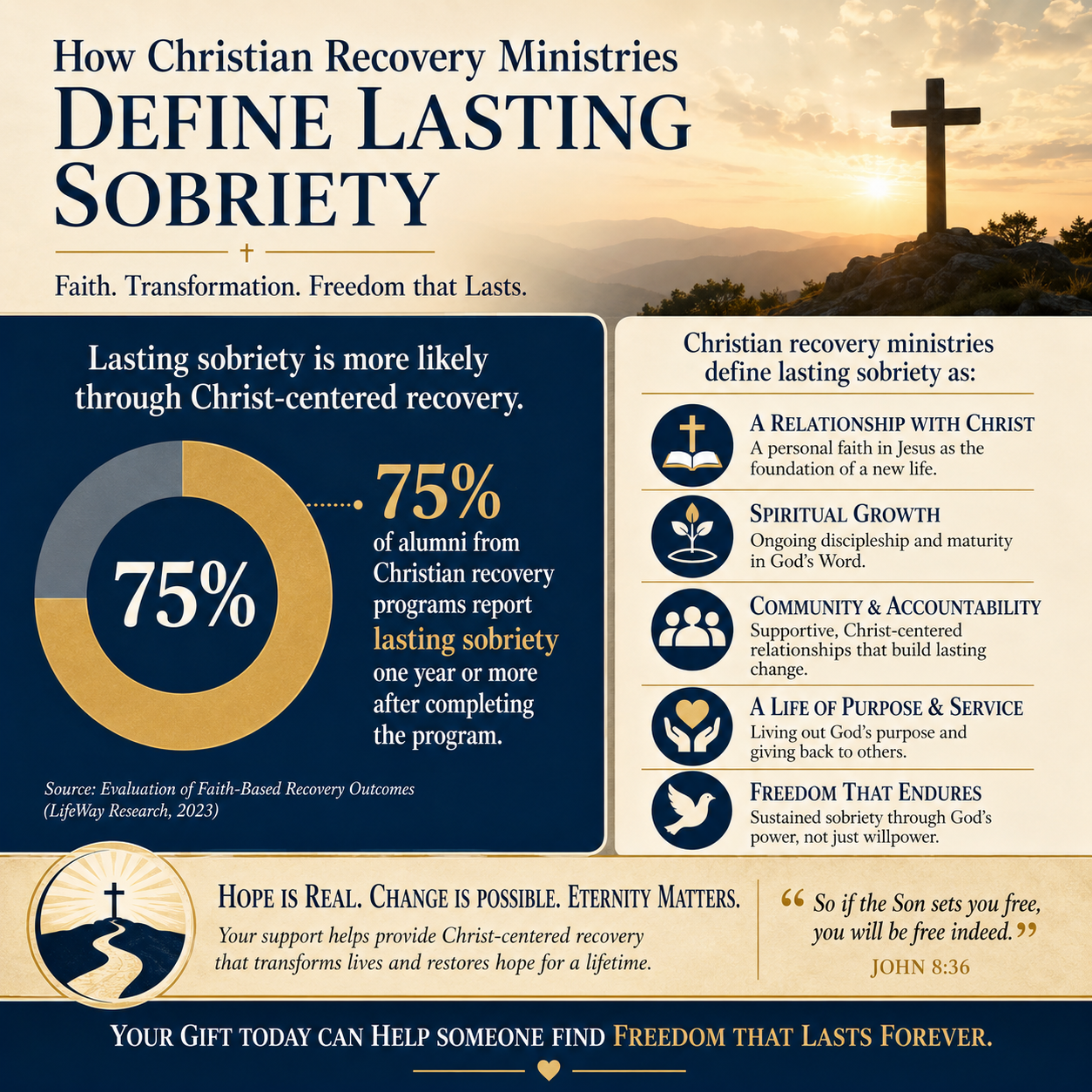
Wise Christian programs treat abstinence as a floor, not a ceiling. They will say plainly that continuing use undermines safety, relationships, employability, and church life. But they will also define sobriety in ways that can sustain a person when the initial crisis fades: a stable pattern of truth-telling, accountable relationships, consistent spiritual practices, and a life structured around worship rather than compulsion.
What this means for donors is that the question “How many people stayed sober?” is not wrong, but it is incomplete. A ministry may report abstinence while quietly tolerating deception, serial relationship chaos, or a revolving-door pattern that is never confronted. If lasting sobriety is the stated aim, the definition must account for the whole life that sobriety is meant to rebuild.

Serious definitions include relapse reality without normalizing it
The field must speak truthfully about relapse and not surrender to fatalism
Christians genuinely disagree about how to talk about relapse. Some fear that any mention of relapse “permits” it; others fear that silence produces shame and secrecy. Better ministries hold a third posture: relapse is neither destiny nor surprise. It is a known risk that must be planned for with spiritual and clinical seriousness.
External research also cautions donors against simplistic promises. The National Institute on Drug Abuse has noted that relapse rates for substance use disorders are comparable to those for other chronic medical illnesses, while also emphasizing that relapse is not treatment failure but often a signal that treatment should be adjusted.National Institute on Drug Abuse Ministries that claim “permanent sobriety for everyone who completes our program” may be advertising confidence, but they are often advertising a lack of candor.
Lasting sobriety includes a plan for setbacks and the disciplines that prevent them
Programs that define sobriety responsibly tend to include a structured relapse-prevention approach: trigger awareness, coping skills, community accountability, and rapid re-engagement if someone slips. They also define “success” over time horizons that allow durability to be observed. A 30-day discharge report can be useful; it is not evidence of lasting change.

Donors can ask a constructive question that many ministries welcome: “How do you distinguish between a ministry that is permissive toward relapse and a ministry that is honest about relapse?” The answer should include both pastoral categories (repentance, confession, humility) and operational categories (policies, supervision, follow-up cadence).
Measuring sobriety requires more than self-reporting
Programs need observable markers that do not degrade human dignity
Because addiction thrives in secrecy, ministries often begin with self-report and relational disclosure. But lasting sobriety is difficult to verify if a program relies exclusively on what participants say about themselves. Many ministries therefore include some combination of drug testing, documented participation, third-party accountability, and clinician involvement where appropriate. This is not suspicion; it is realism shaped by love of neighbor.
Some donors hesitate at the idea of verification because they associate it with control. A better frame is stewardship. Christian love does not require naiveté, and Christian mercy does not suspend prudence. Ministries can uphold dignity while still insisting on evidence that aligns with their own stated goals.
Evidence of sobriety should be paired with evidence of stability
The ministries that communicate well to donors usually separate the concept of “sobriety” from the broader concept of “recovery outcomes.” Sobriety can be proxied through abstinence measures and accountability structures. Stability is often observed through longer-term indicators: consistent employment or training, reunification progress when safe, housing stability, reduced legal entanglements, and meaningful church participation.
We recommend listening for whether a ministry can articulate both sets of indicators without implying that employment or family reunification is owed to every participant. Addiction recovery intersects with trauma histories, criminal records, mental illness, and poverty. A careful ministry measures outcomes without punishing those whose barriers take longer to overcome.
Donors should look for definitions that shape program design and reporting
A clear definition prevents mission drift and manipulative storytelling
When a ministry defines lasting sobriety precisely, it becomes harder to manipulate outcomes. Vague language can conceal almost anything: a high dropout rate, selective reporting, or success defined as attendance rather than change. Clear definitions, by contrast, force consistency: the intake process aligns with the program model, the model aligns with the reporting, and the reporting aligns with what the ministry promises publicly.
Across our verification work at Most Trusted, we observe that strong ministries describe their recovery model in plain terms and then show how they track it. They do not rely on emotional testimony alone. Testimony has an honored place in Christian witness; it is not a substitute for responsible reporting.
What The Most Trusted Standard tends to reveal in recovery ministries
The Most Trusted Standard is our 15-criteria framework for evaluating Christian nonprofits across Faith Foundation, Financial Integrity, Governance and Leadership, and Transparency and Effectiveness. In recovery settings, “Transparency and Effectiveness” is often where definitions of lasting sobriety become operational rather than aspirational. Donors should expect a ministry to answer, without defensiveness, what it counts, how it counts it, and what it does when results disappoint.
For donors who are comparing organizations within Christian Addiction Recovery Ministries, the question is not which ministry sounds most confident. It is which ministry is most truthful about the nature of change and most disciplined about documenting it.
- A published definition of “sobriety” that distinguishes abstinence from broader recovery outcomes
- A reporting time horizon that extends beyond graduation or discharge
- Multiple data sources where appropriate, not self-report alone
- Clear relapse policies that combine mercy with accountability
- Documented partnerships with churches, clinicians, or referral networks when the model requires it
Definitions of sobriety should be integrated with discipleship and church life
The church is not an accessory to recovery
Some programs treat the local church as a referral source; others treat it as the primary long-term community that makes endurance possible. The latter approach is closer to the New Testament’s vision of formation. The aim is not merely that a person avoids a substance; it is that they learn to live as a member of Christ’s body with ordinary responsibilities and ordinary supports.
This is also where donors can evaluate theological coherence. A ministry may speak frequently about grace while building a program that functionally depends on shame. Or it may speak about “radical freedom” while neglecting basic disciplines of accountability. Durable sobriety is often sustained by ordinary means: worship, confession, counsel, friendship, and consistent routines.
Long-term care requires honesty about capacity and boundaries
Many donors want a ministry to “stay with people forever.” Some ministries attempt this and collapse under the weight of unmanaged need. Others keep strict boundaries and appear cold. The better ministries name the tension openly: they commit to meaningful follow-up and community connection while also maintaining appropriate limits, safety protocols, and referral pathways for crises they are not equipped to handle.
Donors exploring How Christian Addiction Recovery Ministries Measure Impact should pay attention to whether “impact” is defined as faithful care within a clear scope, or as sweeping promises that the ministry does not have the staffing, governance, or financial structure to sustain.
FAQs for How Christian recovery ministries define lasting sobriety
Is a Christian definition of sobriety different from a clinical definition?
Often, yes. Clinical frameworks typically focus on symptom reduction, risk management, and functional improvement. Christian recovery ministries may include those concerns while also defining sobriety in terms of repentance, renewed worship, reconciled relationships where wise, and life within the church. The best ministries do not pit the two against each other; they integrate clinical prudence with biblical anthropology.
What should donors ask for when a ministry reports sobriety outcomes?
Donors should ask for the ministry’s explicit definition of sobriety, the time horizon used for reporting, and the data sources behind the claims. It is also appropriate to ask how the ministry handles relapse in its reporting: whether relapse is tracked, how it affects outcome reporting, and what steps are taken for re-engagement and safety. A ministry that answers these questions clearly is usually a ministry that is serious about both people and truth.
Lasting sobriety is defined by truth and sustained by faithful structures
Christian recovery ministries serve people at the edge of human strength, where noble intentions are not enough. Lasting sobriety, rightly defined, names both the necessity of abstinence and the deeper work of spiritual and relational restoration. Donors best serve that work by funding ministries whose definitions are biblically grounded, operationally measurable, and reported with humility, because truthfulness is not merely a reporting virtue. It is part of the freedom recovery proclaims.



