
How Christian addiction recovery ministries protect client privacy is not a side issue for cautious administrators. It is a moral obligation grounded in Scripture’s insistence that the vulnerable not be exposed to shame, exploitation, or harm. Donors who fund recovery work are implicitly funding the ministry’s capacity to guard confidences, limit collateral damage to families, and honor the dignity of people who are often rebuilding life from the ground up.
Privacy in addiction recovery is also complex. Ministries must hold together several goods at once: safety within a residential community, truthful reporting to donors, accountability to boards and regulators, and pastoral care that does not turn a person’s story into a fundraising asset. The strongest ministries do not treat those tensions as an inconvenience; they name them and build durable systems to handle them.
Privacy is a dignity issue before it is a compliance issue
Christian recovery work sits at the intersection of confession, healing, and protection. Scripture commends confession and bringing sin into the light (James 5:16), but it also condemns gossip and the exposure of others for advantage (Proverbs 11:13). A ministry can affirm transparency as a Christian virtue while still recognizing that personal disclosures in a recovery setting are not public property.
In practice, privacy is not only about feelings. A breach can cost housing, employment, child custody, or physical safety. Many clients carry histories of domestic violence, legal vulnerability, or unstable family systems. A ministry’s moral burden increases when it asks people to share the most painful parts of their lives as part of treatment.
What donors should expect as baseline commitments
Across our verification work at Most Trusted, the ministries that meet The Most Trusted Standard tend to treat privacy as a governance and discipleship concern, not merely an operational detail. They can explain, in plain language, what information is collected, who can access it, and how long it is retained. They train staff and volunteers to handle spiritual conversations with appropriate restraint, and they correct the common Christian mistake of confusing “openness” with “permission to disclose.”
Consent must be meaningful, not coerced
Consent language is often where well-intentioned ministries drift into ethical trouble. When a person is desperate for a bed, a meal, or a path back to family, “consent” can become functionally coerced. Responsible ministries limit consent requests to what is necessary for care and safety, and they refuse to tie participation to permission for publicity. If testimonials are used at all, they are separated from program access and revisited after a period of stability.

What the law requires and where ministries often misapply it
Donors regularly ask whether Christian recovery programs are bound by HIPAA. Many are not, because HIPAA applies to specific “covered entities” and their “business associates,” primarily in health care billing and clinical settings. Even so, ministries often handle health information, mental health histories, and substance use disclosures that deserve HIPAA-level caution. When a ministry is not legally bound, the ethical standard should generally rise, not fall.
Federal confidentiality rules often matter more than donors realize
Some programs are subject to the federal confidentiality regulations for substance use disorder treatment records known as “42 CFR Part 2.” These rules can apply to federally assisted programs that provide substance use disorder diagnosis, treatment, or referral. Ministries working with Medicaid, federal grants, certain licensing frameworks, or formal treatment models should be able to state clearly whether Part 2 applies and how they comply. The legal text and guidance are maintained by the Substance Abuse and Mental Health Services Administration and the federal government at SAMHSA.
State law, licensing, and mandatory reporting are not optional
Even when HIPAA does not apply, state privacy laws, professional licensing rules for clinicians, and mandatory reporting requirements for abuse can apply. The mature ministries describe these limits with clarity: confidentiality is real, but it is not absolute. Clients are told, early and repeatedly, what must be reported to protect children or prevent imminent harm. That honesty builds trust because it refuses to promise what cannot be delivered.

How disciplined programs design privacy into daily operations
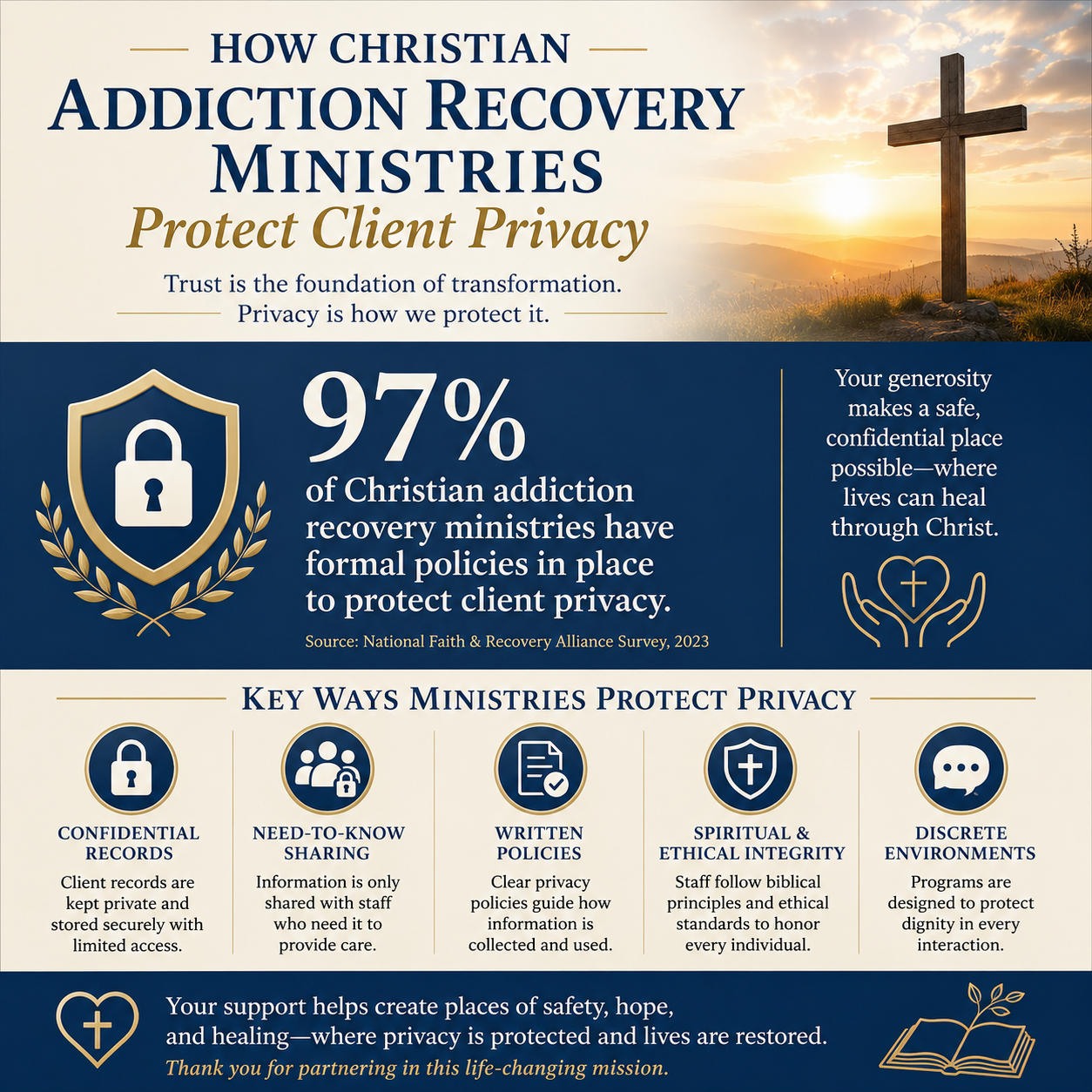
Privacy is rarely lost through malice. More often it is lost through casual systems: an unlocked file cabinet, a group text thread, a prayer request shared too broadly, or a volunteer who treats a client’s story as ministry “news.” The ministries that protect privacy treat operations as moral infrastructure.
Data minimization and access controls
Responsible programs collect less, not more. They gather what is necessary for care and safety, then restrict access by role. A case manager may need treatment history; a volunteer kitchen team does not. They also build practical habits around documentation: consistent naming conventions, secure storage, and clear retention timelines so sensitive records do not linger for years without purpose.
In digital systems, privacy depends on discipline. Multi-factor authentication, device policies, and audit trails matter because breaches rarely come from a cinematic “hack.” They often come from password reuse, lost phones, or overly broad shared accounts. Ministries that handle personal data should also assume that staff turnover will happen and should have formal offboarding procedures.
Group settings require clear norms and careful facilitation
Many Christian recovery ministries rely on group formats: discipleship groups, step work, and communal living. These settings can be powerful for healing, but they are structurally vulnerable to confidentiality failures. Wise programs teach group norms explicitly and enforce them consistently. They also train facilitators to redirect “story sharing” that becomes voyeuristic or unnecessarily detailed.
- Clear confidentiality agreements explained verbally, not only signed on intake
- Defined boundaries for prayer requests so “care” does not become public disclosure
- Role-based access to client information across staff, interns, and volunteers
- Secure incident reporting when a privacy breach or near-miss occurs
- Regular training that includes scenarios specific to recovery communities
Donor communications can honor privacy without sacrificing truth
Christian donors rightly want evidence that giving leads to real restoration. Ministries also need to communicate outcomes to sustain their work. But privacy is often most threatened in the fundraising pipeline: photos, videos, social posts, donor tours, and testimonial-driven appeals. The temptation is subtle: a compelling story raises money, and the ministry convinces itself that the ends justify exposure.
Story stewardship is a spiritual discipline
Testimony is central to Christian witness, yet Scripture does not authorize ministries to pressure the vulnerable into public disclosure. A ministry can treat testimony as a gift offered freely, not as content to be extracted. Programs with strong privacy practices typically separate pastoral care from communications work. They also avoid identifying details when they share program narratives, and they do not place clients in fundraising events where refusal is socially costly.
Where photos or video are used, consent should be specific, time-bound, and revocable. Mature programs assume that a person’s willingness to be public can change after relapse, reconciliation with family, or return to work. Consent forms without pastoral wisdom can still be coercive.
Impact reporting that protects the person
Donors often assume that the only way to demonstrate impact is to provide identifiable stories. That is not true. Ministries can report program effectiveness using aggregated outcomes, third-party evaluations, and audited financial statements—methods that do not put individuals at risk. The National Institute on Drug Abuse notes that addiction is widely understood as a chronic, treatable condition and that relapse can be part of the recovery process, which underscores why public exposure can be so damaging when a person’s path is not linear National Institute on Drug Abuse.
For donors evaluating ministries, a helpful reference point is whether impact claims are specific and appropriately qualified. “We see real transformation” may be spiritually true, but it is not a measurement claim. Conversely, overly precise claims without clear definitions can be a warning sign that a ministry is polishing narratives rather than reporting honestly. For donors who want to examine how ministries approach outcomes with integrity, How Christian Addiction Recovery Ministries Measure Impact provides the broader context that privacy-conscious reporting fits within.
How we evaluate privacy under The Most Trusted Standard
Privacy does not fit neatly into a single checklist item. It touches governance, internal controls, pastoral ethics, and external transparency. Under The Most Trusted Standard, we look for evidence that privacy is designed into the ministry’s leadership posture and daily systems, not merely addressed after a problem occurs.
Governance and leadership accountability
Programs that protect privacy tend to have boards that understand risk. They approve policies, require regular training, and ask for incident reporting. They also set boundaries for donor access: tours, volunteer engagement, and “meet the residents” models are handled with great caution, if allowed at all. A ministry should be able to explain how it protects clients from becoming a living exhibit for donors.
Transparency that does not become exposure
Christian donors sometimes confuse transparency with maximal disclosure. Ethical transparency is different: it tells the truth about finances, leadership, safeguards, and outcomes without turning a person’s trauma into proof. In our experience, the ministries most deserving of trust are often less sensational in their marketing. They show their work through policies, audited statements, and measured reporting rather than through intimate details.
Most Trusted exists to help donors give with confidence by verifying Christian nonprofits against The Most Trusted Standard. For donors exploring organizations in this field, Christian Addiction Recovery Ministries provides a broader view of models, safeguards, and signs of credibility that go beyond any single program’s storytelling.
FAQs for How Christian addiction recovery ministries protect client privacy
Are Christian addiction recovery ministries required to follow HIPAA?
Some are, many are not. HIPAA generally applies to covered health care entities and their business associates, which often involves clinical settings and health care billing. Even when a ministry is not legally bound by HIPAA, it may still be subject to other confidentiality obligations, including state laws, professional licensing rules for clinicians, or federal substance use disorder confidentiality rules in certain contexts. The more reliable question for donors is whether the ministry treats sensitive information with HIPAA-level care regardless of technical status.
How can a ministry show impact to donors without violating privacy?
The responsible approach is to report outcomes in aggregated form, describe methods clearly, and use third-party validation where appropriate—without identifying individuals. Ministries can also communicate faithfulness indicators: program model, staff qualifications, safeguarding policies, audited financials, governance practices, and clearly defined outcome metrics. When personal stories are used, they should be optional, consent-based, and protected from coercion, with identifying details minimized.
Privacy protection is one of the clearest signals of trustworthiness
Recovery work is built on truth-telling, but Christian truth-telling is never a license for exposure. Ministries that protect client privacy tend to be the same ministries that handle money carefully, lead with sober governance, and report outcomes without exaggeration. For donors, privacy is not a peripheral operational concern. It is a revealing measure of whether a ministry truly regards clients as neighbors to be honored, not narratives to be used.



