
How Christian donors can support legal aid for incarcerated people is ultimately a question about whether we believe Scripture’s claims about justice apply to the hidden places of our society. The Bible’s concern for the imprisoned is neither sentimental nor abstract; it is moral clarity in a world where power routinely overwhelms the vulnerable.
Yet Christian giving in this space can become reactive: moved by a story, outraged by a headline, or pulled toward programs that promise quick results. Legal aid is slower, procedural, and often unpopular. It also stands at a critical intersection of truth-telling, due process, and mercy—goods that a just society cannot spare and a faithful church should not neglect.
Why legal aid for the incarcerated belongs inside Christian mercy and justice
The biblical frame is not only compassion but also judgment
When Jesus names visiting those in prison in Matthew 25, he places the incarcerated among the people his disciples are expected to notice and serve. Scripture also insists that God “loves righteousness and justice” (Psalm 33) and condemns partiality in judgment (Deuteronomy 1). Legal aid sits where those concerns meet: the person is made in God’s image, and the process that governs their life must not become a machine of indifference.
Christians genuinely disagree about criminal justice policy. Some prioritize public safety and personal responsibility; others emphasize systemic inequity and the hope of restoration. Serious legal aid ministries typically refuse the false choice. They can affirm the gravity of crime while insisting on lawful process, humane conditions, and truthful outcomes. Donors should expect that kind of moral seriousness rather than ideological performance.
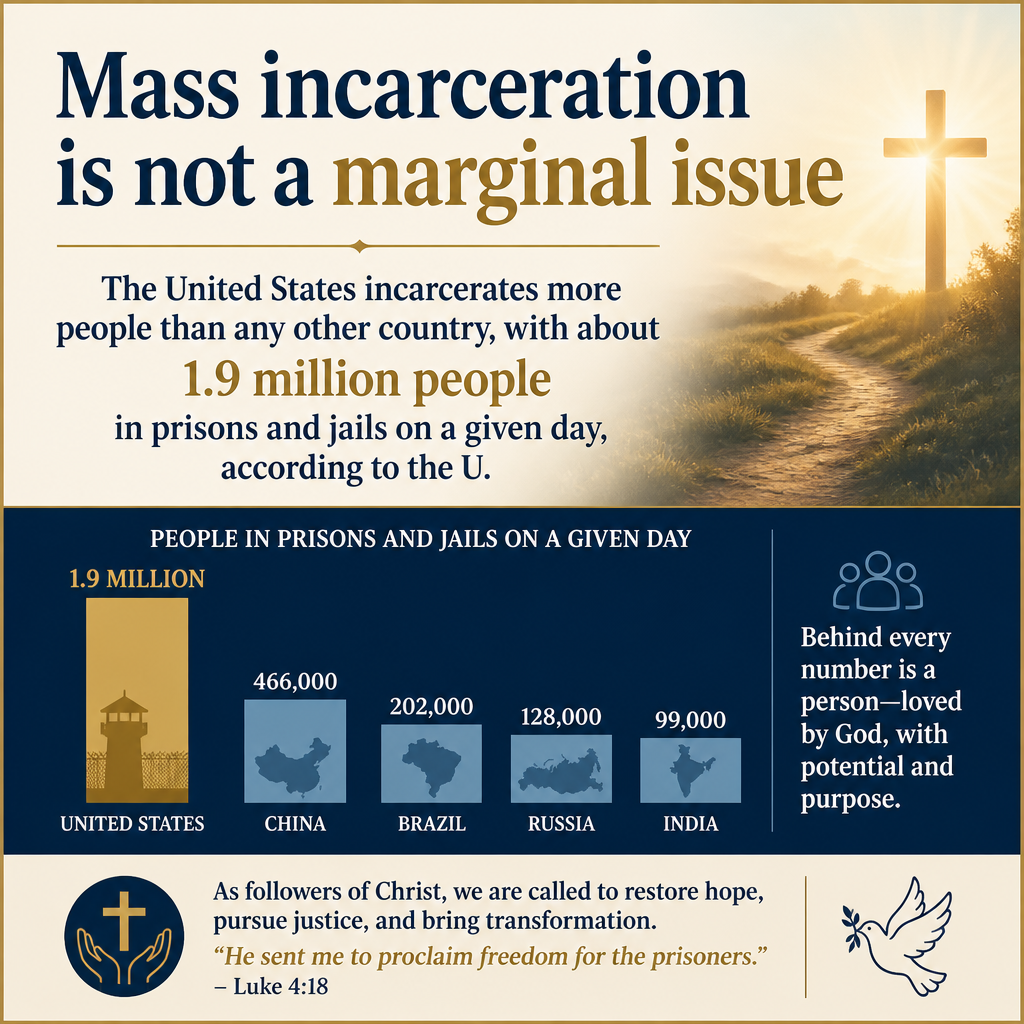
Mass incarceration is not a marginal issue
The United States incarcerates more people than any other country, with about 1.9 million people in prisons and jails on a given day, according to the U.S. Bureau of Justice Statistics. That figure does not include the larger circle of families, victims, and communities bearing long-term costs. Legal representation and post-conviction advocacy are not the only needs in this ecosystem, but they often determine whether a person’s legal status is accurate, proportionate, and consistent with the rule of law.
What this means in practice is that legal aid is not merely “help for individuals.” It is a structural ministry of truth and accountability inside one of the state’s most coercive functions.

What legal aid for incarcerated people actually entails
Four distinct kinds of legal work donors should distinguish
- Direct representation in matters such as parole hearings, prison disciplinary proceedings, or civil rights claims.
- Post-conviction work, including innocence claims, sentencing review, and appeals where new evidence or legal errors are involved.
- Civil legal support for issues like family law, debt, housing, or benefits that shape reentry and stability.
- Legal education and navigation that helps incarcerated people understand options and deadlines, often in partnership with attorneys.
- Impact litigation and policy advocacy aimed at systemic failures, sometimes over years.
Donors should resist the temptation to judge these approaches by a single metric, such as “cases won.” In many contexts, a faithful outcome is not a dramatic courtroom victory but a truthful record, lawful procedure, and reduced harm.
Why the need is so acute behind bars
Legal problems compound in confinement. Deadlines are missed because of limited access to counsel or legal materials. Family relationships deteriorate under financial and logistical pressure. Medical needs become legal questions when care is delayed or denied. Even when a conviction is lawful, the conditions of confinement can raise serious constitutional concerns. The ACLU and other organizations have documented patterns of overcrowding and inadequate medical care in litigation across multiple states, though case facts vary widely by jurisdiction.
For Christian donors, the moral point is not that every claim is valid. The point is that every claim deserves lawful scrutiny, especially when the claimant is under the state’s custody and cannot advocate freely.
How Christian donors can give without fueling dysfunction or ideology
Charity can become performative when it is detached from truth
Legal aid attracts controversy because it touches questions of guilt, accountability, and public safety. Some donors avoid the space entirely. Others support it with a kind of moral certainty that flattens victims’ pain or treats every incarcerated person as a political symbol. Neither posture is worthy of Christian stewardship.
We are dealing with contested facts, incomplete information, and real trauma on all sides. A mature donor posture is to fund organizations that can hold complexity: those that respect victims, honor lawful process, and refuse to manipulate donors with simplistic narratives.
Better questions produce better giving
Across our verification work at Most Trusted, we observe that strong ministries tend to welcome scrutiny, document their work carefully, and articulate what they can and cannot promise. In this field, donors should press for specificity:
Ask about case selection. How does the organization decide which cases to take? Do they have written criteria, conflict-of-interest safeguards, and a process for declining cases responsibly?
Ask about legal competency. Are staff attorneys licensed and in good standing? If they rely on pro bono partners, how are those partners vetted and supervised?
Ask about theology and posture. Many legal aid organizations are not explicitly Christian, and that is not automatically disqualifying for a Christian donor. The more important question is whether the organization’s posture toward truth, human dignity, and justice is consistent with Christian moral reasoning.
Ask about donor communication. Are updates sober and accurate, or do they rely on outrage-driven messaging that undermines credibility over time?
For donors seeking a broader landscape of vetted ministry work, we maintain research on Prison and Post-Prison Ministries that reflects these distinctions in practice, because “prison ministry” is not one thing.
What credibility looks like in legal advocacy and prison ministry reform
Transparency is not optional when the work is complex
Legal work is inherently technical, but donors should not be asked to fund a black box. The ministries and nonprofits most likely to merit sustained support typically publish clear financials, explain their strategy, and report outcomes without triumphalism. They also disclose limits: jurisdictional constraints, backlog realities, and the fact that litigation can lose even when the underlying concern is legitimate.
When we evaluate organizations against The Most Trusted Standard, we look for evidence across faith commitments, financial integrity, governance, and public accountability. In legal aid, governance matters in particular: boards must understand legal risk, protect client confidentiality, and ensure that fundraising does not distort casework priorities.
Impact should be defined with integrity
Some impact can be counted: clients served, motions filed, hearings attended, administrative remedies completed. But the deeper outcomes are harder: a corrected sentence, a safer facility, a restored parent-child relationship, a reduced likelihood of recidivism because legal barriers were removed. Donors should not demand simplistic metrics that pressure ministries into exaggeration.
At the same time, donors should avoid the opposite error: accepting vague “awareness” language in place of demonstrable service. The more credible organizations can explain what changed for real people and what it cost to produce that change.
For donors who want to focus specifically on Legal Advocacy and Prison Ministry Reform, the key is alignment between mission claims and verifiable practice: legal expertise, ethical safeguards, and measurable service that does not depend on sensationalism.
Practical giving strategies for donors who want to sustain legal aid
Fund the unglamorous essentials
Legal aid does not run on inspiration alone. It requires filing fees, investigator time, records retrieval, travel for hearings, translation, and staff who can sustain heavy caseloads without cutting ethical corners. Underfunding can create its own harm: rushed representation, poor documentation, and preventable losses. The “Overhead Myth” consensus statement—signed by leading nonprofit evaluators—underscored that administrative spending is not inherently waste and that effectiveness depends on the right infrastructure, not the lowest overhead ratio, as explained by BBB Wise Giving Alliance.
Donors can responsibly support legal aid by providing flexible funding that allows leaders to staff appropriately and respond to urgent needs without distorting priorities.
Pair legal support with pastoral and reentry support without confusing them
Many Christian donors hope to support both spiritual formation and legal advocacy. That is often wise, but it requires clarity. Spiritual care does not substitute for legal representation, and legal victories do not substitute for discipleship and community reintegration. The strongest ecosystems collaborate across specialties while respecting professional boundaries and client confidentiality.
A balanced portfolio might include a legally focused nonprofit alongside a church-based visitation ministry and a reentry program that addresses employment, housing, and family restoration. Donors should evaluate each on its own terms and avoid requiring one organization to become a one-stop solution.
FAQs for How Christian donors can support legal aid for incarcerated people
Should Christian donors only support explicitly Christian legal aid organizations?
Not necessarily. Many effective legal aid organizations are not confessional, yet operate with a serious commitment to human dignity and due process. Christian donors can support such work as a matter of neighbor-love and justice, while also prioritizing partnerships that respect religious conviction and avoid mission drift. The question is not branding; it is whether the organization’s practices, governance, and public claims are credible and consistent with the moral goods Christians should seek.
How can donors avoid being misled by emotionally compelling but unreliable cases?
Donors should look for organizations with written case-selection criteria, clear explanations of legal posture, and a track record of sober communication. Credible ministries do not promise outcomes they cannot control, and they are careful about facts when public attention is high. Verification can help here: Most Trusted evaluates nonprofits against The Most Trusted Standard so donors can give with confidence grounded in evidence rather than urgency.
Giving that honors both mercy and truth
Legal aid for incarcerated people is a disciplined form of Christian compassion: it insists that those under the state’s power remain visible, accountable, and protected by lawful process. Christian donors can support this work with courage and sobriety—funding organizations that tell the truth, practice transparency, and uphold human dignity without denying the suffering that crime inflicts. That combination is rare, and it is precisely why it deserves careful, sustained support.



