
How law firm partnerships strengthen prison ministry services is not primarily a matter of prestige or publicity. It is a question of whether Christian mercy in prisons is paired with competent legal advocacy, so that discipleship is not forced to compete with avoidable procedural barriers, unlawful conditions, or preventable family collapse.
Jesus named prison visitation alongside feeding the hungry and welcoming the stranger (Matthew 25:36). That mandate does not require ministries to become law firms. But it does require seriousness about what incarceration actually is: a tightly regulated system where rights, policies, and discretionary decisions shape who can be reached, how programs operate, and whether returning citizens face an honest path back into church, work, and family.
Prison ministry is spiritual work in a legal environment
Access and continuity are often legal questions before they are pastoral ones
Most prison ministry leaders can describe the spiritual terrain with clarity: shame, addiction, fatherlessness, estrangement, violence, and the slow rebuilding of trust. Yet the day-to-day constraints often come from policy manuals, facility-level rules, and state or federal regulations. A chapel program can be suspended over security protocols; volunteer access can change with leadership transitions; correspondence and digital messaging can be limited by vendor contracts; even Bible study materials can face review.
When a ministry partners with a law firm, the goal is not to “win” against the system. The goal is to understand the system well enough to serve faithfully inside it. Competent counsel helps ministries interpret rules, communicate with institutions, respond to denials, and protect the integrity of the ministry’s witness when misunderstandings arise.
Complexity is not an excuse for cynicism
Christians genuinely disagree about the best mix of evangelism, rehabilitation, and policy reform. Some fear that legal engagement distracts from proclamation; others fear that avoiding legal realities abandons people to preventable harm. The wiser framing is that spiritual ministry and lawful process are not competitors. When law is just, it can serve peace. When it is misapplied, it can compound suffering.
Donors who care about Prison and Post-Prison Ministries often give to the most visible part of the work: discipleship, mentoring, and reentry support. Partnerships with attorneys usually happen quietly, but they can remove obstacles that would otherwise diminish every dollar given to direct ministry.

Where law firm partnerships add real strength
Targeted legal support can protect ministry capacity
Law firm partnerships are most constructive when they are defined, limited, and aligned with the ministry’s mission. Ministries rarely need open-ended litigation. They more often need help with narrow questions: volunteer agreements, liability and insurance, facility MOUs, intellectual property for curriculum, employment compliance, and crisis response protocols.
This kind of support reduces fragility. It prevents a single incident, allegation, or administrative shift from collapsing years of relationship-building. It also helps ministries avoid improvised legal decisions that can create unnecessary risk for inmates, volunteers, and staff.
Some needs are fundamentally legal, not programmatic
Many prison and post-prison outcomes are affected by legal status: family court orders, child support arrears, fines and fees, housing restrictions, occupational licensing barriers, and the long tail of a criminal record. A ministry can offer prayer, mentorship, and job readiness training and still watch a returning citizen lose employment because a licensing board denies an application.
The U.S. Department of Justice has noted that “nearly all” incarcerated people will eventually return to their communities, which makes reentry realities unavoidable for ministries committed to long-term discipleship Bureau of Justice Assistance. Legal aid partnerships can help address the barriers that discipleship alone cannot remove.
- Record relief strategy where available, including expungement or sealing pathways
- Identification and documentation issues that block employment and housing
- Family stabilization through custody, visitation, and support-order modification guidance
- Benefits and compliance counseling to reduce technical violations and recidivism risk
- Rights education so returning citizens can navigate systems without antagonism or naiveté
Theological and ethical tensions donors should name directly
Advocacy can be faithful without becoming partisan
Many donors have learned to be cautious about “advocacy,” not without reason. In the contemporary nonprofit landscape, advocacy can become a substitute for service, and political identity can displace Christian moral reasoning. Prison ministry does not need to borrow the tone of the culture war to take law seriously.
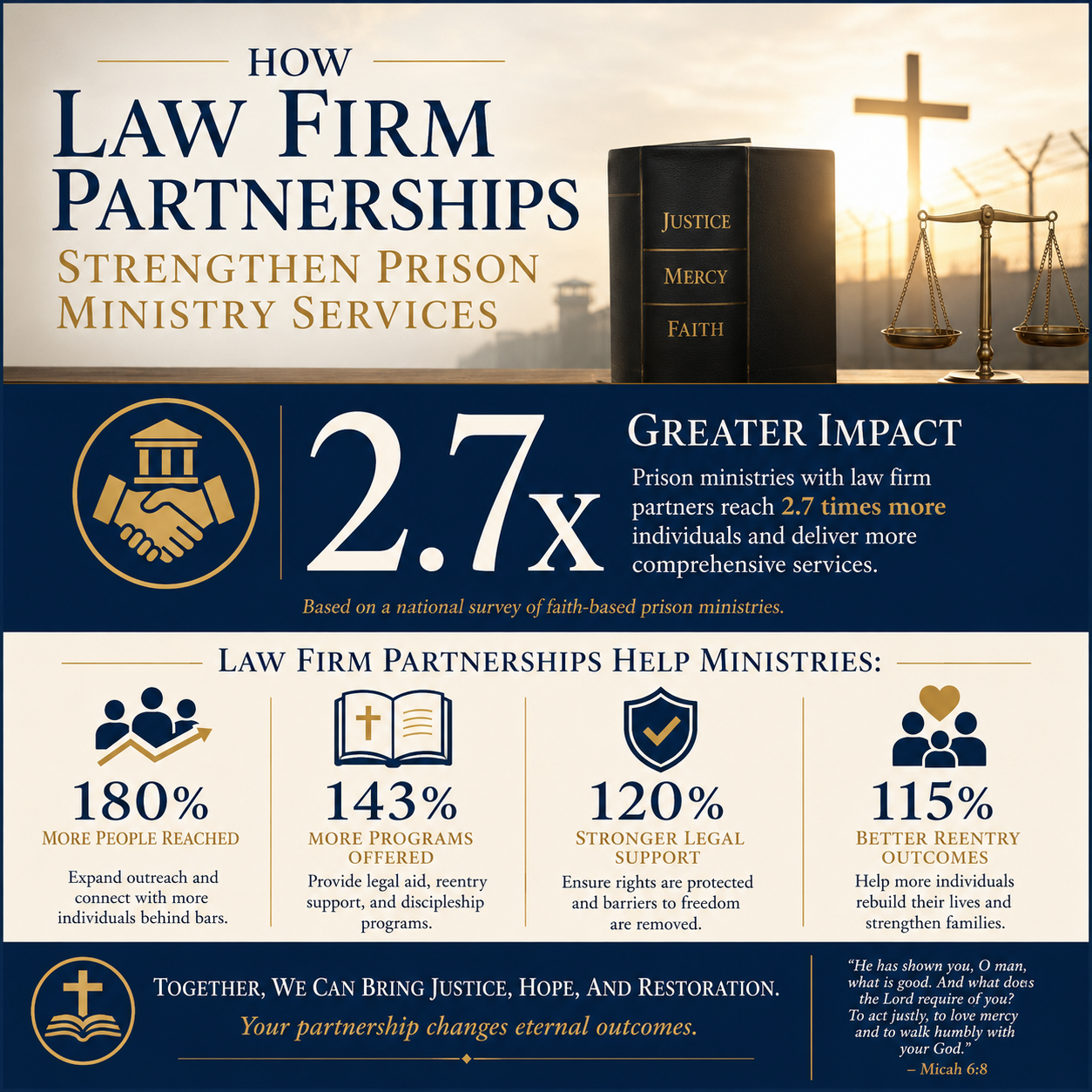
Law firm partnerships can be structured to serve clear, biblical goods: humane treatment, truthful process, family preservation when appropriate, and the rehabilitation of offenders. Those goods are not owned by any party. They are expressions of neighbor love and a sober view of human dignity, including the dignity of victims and communities.
Justice includes victims, public safety, and restoration
Christian ministry in prisons can drift into a sentimental frame that forgets why prisons exist. Scripture’s moral universe is not embarrassed by accountability. The cross itself is the meeting place of mercy and justice. Donors should be wary of models that imply that consequences are always oppression, or that restoration can be rushed without truth-telling.
At the same time, the field has had to reckon with the reality that incarceration can include unnecessary harm, including avoidable violence, medical neglect, and procedural confusion. The Bureau of Justice Statistics has reported high rates of mental health concerns among incarcerated populations, which shapes the pastoral and practical demands of ministry Bureau of Justice Statistics. Legal partners can help ministries respond to urgent needs without turning every problem into a public spectacle.
What strong partnerships look like in practice
Defined scope, shared expectations, and humility about expertise
The healthiest arrangements begin with clarity. The ministry names its mission and boundaries; the law firm names its capacity and constraints. Both sides recognize that legal expertise does not confer spiritual authority, and spiritual authority does not confer legal competence.
Good partnerships also respect the pace and protocols of correctional institutions. Some attorneys are experienced in criminal defense but unfamiliar with chaplaincy access, volunteer management, or prison program approval processes. The partnership strengthens ministry when counsel is willing to learn the operational reality rather than impose an outside playbook.
Pro bono is helpful, but sustainability matters
Many law firms want to serve through pro bono work, and donors should be grateful for that. But pro bono capacity can shift with leadership, economic cycles, and staffing. Ministries that rely on legal help should still budget for at least some paid counsel, especially for governance, employment, and risk areas where delays are costly.
One of the quieter strengths a donor can underwrite is legal capacity that does not depend on crisis. Stable counsel allows ministries to plan, not simply react. That planning posture is often the difference between a program that endures for decades and a program that repeatedly restarts after preventable disruption.
How donors can evaluate these partnerships with confidence
Trustworthy legal collaboration is visible in governance and transparency
Donors do not need to read legal briefs to assess whether a ministry is engaging law firms well. They can look for governing behaviors: board oversight of risk, documented policies for volunteer safety, incident reporting procedures, and a clear description of what legal services do and do not cover. These are signals of maturity, not bureaucracy.
Across our verification work at Most Trusted, we find that ministries that meet The Most Trusted Standard tend to treat compliance and transparency as forms of stewardship, not as public relations. They can explain how partnerships protect beneficiaries, staff, and volunteers, and they can document decision-making when legal questions intersect with mission.
Warning signs that legal partnership has become a substitute for ministry
Law firm partnerships strengthen prison ministry services when they are in service of pastoral faithfulness, not when they become the ministry’s identity. Donors should be cautious when legal work dominates public communications, when the ministry cannot articulate spiritual outcomes, or when the organization consistently frames itself primarily in adversarial terms.
Wise donor diligence also asks whether the ministry has credible accountability structures in place. Legal counsel can reduce risk, but it cannot replace honest boards, financial integrity, or transparent reporting. For donors focused on Legal Advocacy and Prison Ministry Reform, the question is not whether a ministry ever engages attorneys; it is whether that engagement is ordered toward justice, mercy, and measurable faithfulness.
FAQs for How law firm partnerships strengthen prison ministry services
Do law firm partnerships distract prison ministries from the gospel?
They can, if legal conflict becomes the ministry’s organizing purpose. In their healthiest form, law firm partnerships remove barriers that keep people from receiving pastoral care, discipleship, and stable reentry support. The gospel is not advanced by avoidable legal confusion, unsafe volunteer practices, or preventable program shutdowns.
What should donors ask a prison ministry about its legal partnerships?
Donors can ask about scope and accountability: What legal services are provided, and why? Who on the board oversees risk and compliance? How does the ministry protect confidentiality and informed consent? How are outcomes reported without turning beneficiaries into case studies? Clear answers are a sign that legal help is integrated as stewardship rather than spectacle.
Strength that serves mercy and truth
Law firm partnerships strengthen prison ministry services when they help ministries keep faith with people who live under constraint: incarcerated men and women, their families, and the communities to which they will return. Donors should not romanticize either law or ministry. The Church’s calling is to bear witness to a kingdom where justice and mercy meet, and to steward resources with enough seriousness that our compassion becomes durable.



