
Legal advocacy and prison ministry reform sit at a difficult intersection: the church’s call to visit those in prison and the state’s authority to punish wrongdoing. Donors often feel the tension acutely. Mercy can sound like naiveté, and justice can harden into indifference. A faithful approach refuses both errors, remembering that Scripture holds together accountability, restraint, and the dignity of every person made in God’s image.
What makes this category uniquely complex is that legal systems shape the daily reality of incarceration as much as any prison program does. A Bible study may strengthen a man’s conscience and hope, yet a parole process, cash bail decision, disciplinary hearing, or lack of counsel can still determine whether he returns home or remains inside. Christian donors who support prison and post-prison ministries are often deciding whether their giving should address symptoms, structures, or both. The wisest giving typically does not choose only one.
Why legal advocacy belongs in serious prison ministry
Christian concern for the incarcerated is not a modern innovation. Jesus explicitly included prison ministry among the works of mercy by which his disciples are recognized (Matthew 25:36). That mandate does not prescribe a particular strategy. It does, however, require that we take incarceration seriously as a site of human suffering, moral formation, and institutional power.
Legal advocacy enters the picture because incarceration is administered through law: charging decisions, plea negotiations, sentencing guidelines, probation conditions, disciplinary sanctions, and reentry barriers. A ministry can be exemplary in spiritual care while still operating within a system that produces preventable harm. Legal advocacy, at its best, does not compete with discipleship. It clears obstacles that keep people from stability, restitution, and restoration.
Mercy and accountability are not opposing virtues
Christians genuinely disagree about how much reform is prudent and how much is permissive. That disagreement is understandable. Scripture’s moral universe includes both compassion for the vulnerable and the state’s responsibility to restrain evil (Romans 13:1–4). Yet the biblical concern for justice also includes due process, equal weights and measures, and protection against partiality (Deuteronomy 16:19–20). Advocacy for fair procedure and proportionate punishment is not a departure from justice; it is part of justice.
Prison ministry reform is often downstream of family stability
Incarceration is rarely an isolated event. It is connected to family disruption, housing instability, addiction, and untreated mental illness. When a parent is incarcerated, the consequences spill into the next generation. The U.S. Department of Justice has documented that millions of children in the United States have had a parent in prison at some point during childhood (Bureau of Justice Statistics). Donors who care about children, foster care pressures, and community stability should see why reform is not an abstract political project. It is often a concrete act of neighbor love.
Where this category fits within prison and post-prison work
Some donors treat legal work as separate from ministry, as if it were only political. The better framing is vocational: legal aid can be a form of service, and policy work can be a form of public witness. For donors exploring how this fits alongside direct ministry, our wider coverage of Prison and Post-Prison Ministries places legal advocacy in context with visitation, reentry, family support, and spiritual formation.

What effective legal advocacy and reform actually look like
“Reform” can mean many things, some wise and some reckless. Donors serve the church best when they fund specific, bounded work with measurable outputs: legal representation, rights education, reentry record-clearing, court accompaniment, restorative justice partnerships, or narrowly tailored legislative advocacy grounded in evidence.
Direct legal services that remove predictable barriers
Many incarceration-related harms are administrative and solvable: suspended driver’s licenses that block employment, unpaid court debt that triggers warrants, incorrect criminal records, or parole conditions that are practically unworkable. Ministries focused on reentry often find that the most “spiritual” obstacle a returning citizen faces is a bureaucratic wall. Legal clinics that address expungement, record correction, benefits eligibility, and family-law issues can reduce chaos and keep households intact.
Donors should look for programs with clear eligibility rules, competent supervision, and strong referral relationships with churches, halfway houses, and employer networks. Legal work is high-trust work. It requires careful boundaries and consistent follow-through, not merely good intentions.

Sentencing reform that is principled and limited
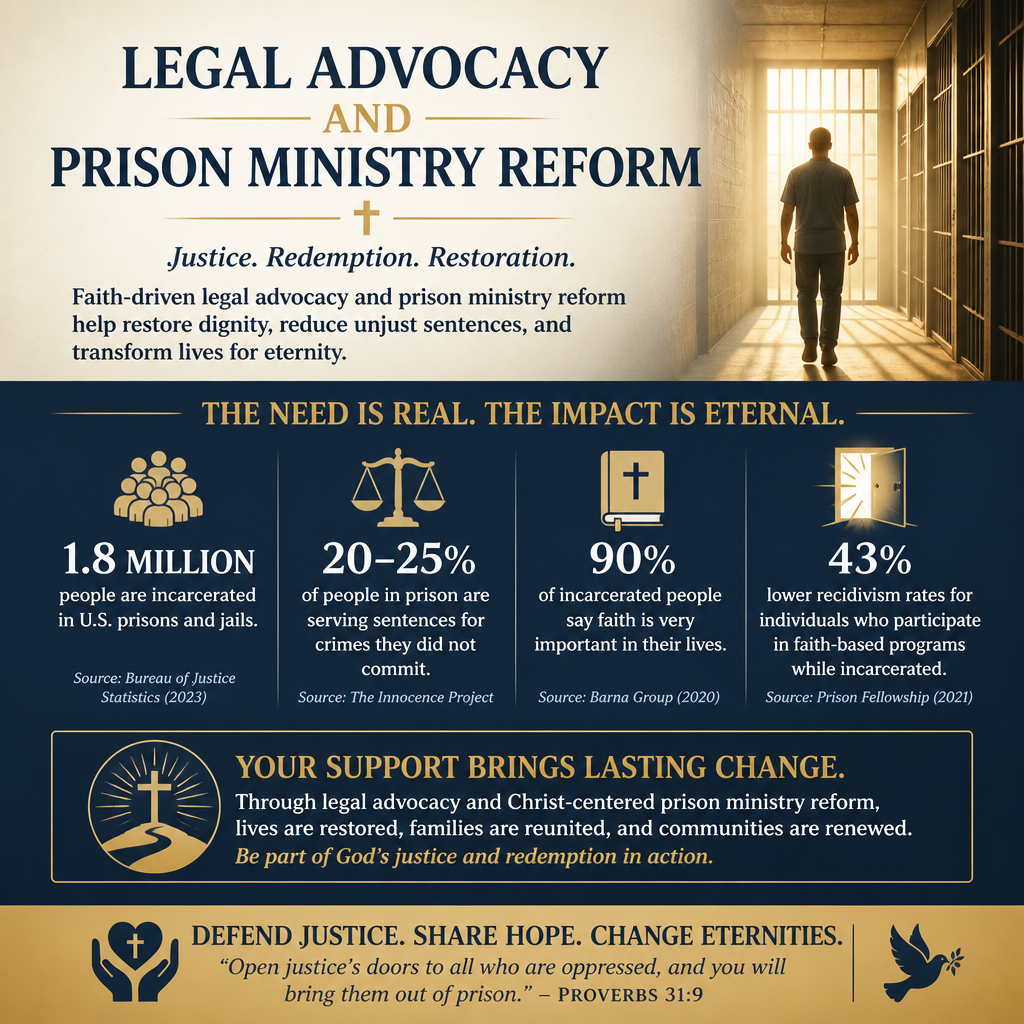
Sentencing reform is contested because the moral stakes are real: victims, public safety, and the credibility of law. Yet the United States has an unusually large incarcerated population by international comparison, a reality widely documented in criminology and public policy research (The Sentencing Project). Christian engagement here should be neither slogan-driven nor partisan. It should be guided by principles such as proportionality, individualized assessment, and the recognition that long sentences can create diminishing returns for public safety while multiplying social costs.
Credible reform efforts typically emphasize narrow changes: addressing extreme mandatory minimums, expanding diversion for nonviolent offenses with treatment accountability, improving parole decision processes, and ensuring meaningful access to counsel. Donors can ask whether a ministry’s policy positions are supported by serious analysis and whether they are paired with practical work that strengthens families and reduces recidivism risk factors.
Prison conditions work that treats dignity as nonnegotiable
Conditions advocacy is often where Christian donors feel the greatest moral clarity: safety from assault, protection for the mentally ill, access to medical care, and the basic right to practice one’s faith. These concerns are not sentimental; they are about the kind of society we are willing to be. Regardless of guilt, those in custody remain image-bearers. Ministries that pursue chaplaincy support, religious liberty protections, grievance-system improvements, or oversight mechanisms can complement pastoral care inside facilities.
How Christian donors can fund legal work without losing theological and fiduciary clarity
Funding legal advocacy and prison ministry reform requires more diligence than funding many direct-service programs. The reason is simple: legal work can drift into ideological capture, and it can also become opaque. Mature donors respond by funding organizations with a clear Christian identity, disciplined governance, transparent reporting, and a demonstrated commitment to truth-telling about results.
Distinguish charity, legal aid, and lobbying
In the United States, most ministries operate under 501(c)(3) rules that permit limited advocacy but restrict partisan political activity and certain lobbying levels. Donors should insist on clarity about what the organization does: direct representation, community legal education, impact litigation, administrative advocacy, or legislative lobbying. Responsible ministries describe these activities plainly, report expenditures accurately, and maintain careful compliance policies.
It is also worth noting that some legal work is not “advocacy” in the political sense at all. Providing counsel to someone facing eviction upon release, helping restore child visitation rights, or correcting a background check is simply service. Donors should not penalize ministries for doing competent legal triage, but they should require the kind of reporting that makes that work intelligible.
Ask the questions that protect both mission and integrity
Across our verification work at Most Trusted, we observe that the strongest ministries tend to welcome scrutiny rather than manage impressions. For legal-focused prison ministries, donors can ask:
- What is the ministry’s theory of change? How do legal services connect to discipleship, family restoration, employment, and church integration?
- Who provides legal services, and under what supervision? Are attorneys licensed? Are volunteers trained? Are there malpractice safeguards?
- How are clients screened and prioritized? Do criteria align with mission and capacity, or is demand driving uncontrolled expansion?
- What outcomes are tracked? For example: records cleared, benefits restored, parole hearings supported, or compliance plans stabilized.
- How does the ministry handle victim concerns? Does it speak responsibly about harm, restitution, and community safety?
These questions are not adversarial. They reflect the biblical expectation that those entrusted with resources be found faithful (1 Corinthians 4:2).
Evaluate partners with a full view of stewardship
Legal ministries often have cost structures that look different from food distribution or mentorship programs. Competent legal counsel is labor-intensive. Donors sometimes fixate on overhead ratios and miss the more important question: whether the organization is governed well, financially honest, and transparent about what outcomes are plausible.
Here The Most Trusted Standard provides a disciplined lens. A ministry should demonstrate a clear faith foundation, sound financial integrity, credible governance and leadership, and transparent effectiveness reporting. Donors do not need perfection, but they should require evidence of mature oversight and public accountability.
Common risks and how to give wisely
Legal advocacy can be deeply constructive, but it carries predictable risks. Naming them directly helps donors fund the good without being naive about the field’s vulnerabilities.
Mission drift into partisan identity
Some organizations begin with a clear Christian commitment to mercy and justice, then gradually adopt the language and incentives of partisan coalitions. When that happens, the incarcerated can become symbols rather than neighbors, and ministries can treat political wins as a substitute for pastoral presence. Donors should look for ministries that articulate positions with theological and empirical care, avoid demonizing opponents, and maintain meaningful relationships with churches and correctional stakeholders.
Overpromising outcomes that the system controls
Even excellent legal work cannot guarantee release, a favorable parole decision, or broad legislative change. Ministries that promise certainty are not being candid. Wise donors support organizations that report honestly on what they can control: quality of representation, number of clients served, timeliness of follow-up, and documented case resolutions. They also acknowledge hard cases and unintended consequences rather than publishing only celebratory stories.
Underestimating the need for coordination with direct ministry
A legal victory without a reentry plan can still end in disaster. A man released with no housing, no treatment continuity, and no church community is being set up for failure. The most constructive legal reform initiatives are usually paired with practical supports: mentoring, employment pipelines, addiction recovery partnerships, trauma-informed pastoral care, and family reunification services. Donors can prioritize ministries that collaborate rather than compete.
Confusing compassion with the absence of discernment
Christian mercy is never a refusal to name sin as sin. Some incarcerated people have done profound harm. Others are in prison for actions tied to addiction, coercion, or immaturity. Many carry a history of victimization themselves. A mature ministry does not collapse these differences. It speaks truthfully about moral responsibility while still insisting that no one is beyond repentance, and no community is helped by a system that cultivates despair.
Giving that strengthens justice and mercy
Legal advocacy and prison ministry reform are most faithful when they are shaped by a thick Christian account of the person: accountable, redeemable, and worthy of due process and humane treatment. Donors can support this work with confidence when organizations are transparent about what they do, disciplined about what they do not do, and governed with the kind of integrity that welcomes public evaluation.
We encourage donors to fund ministries that pair legal competence with pastoral seriousness, and policy aims with tangible care for families and local churches. When the church supports both mercy and justice in the public square, it bears witness to a Kingdom where truth is not sacrificed to sentiment, and compassion is not withheld in the name of respectability.



