
How Christian anti-trafficking ministries partner with shelters is one of the clearest windows into whether a ministry’s public promises translate into survivor-centered practice. For Christian donors, the question is not merely whether a ministry “supports shelters,” but whether the partnership protects survivors, strengthens local capacity, and reflects the character of Christ—truthful, patient, and committed to the long work of restoration.
Survivor care sits at the intersection of trauma, law, healthcare, housing, spiritual formation, and public systems that rarely coordinate well. Shelters carry real risk: safety threats from traffickers, high staff turnover, secondary trauma, and the moral pressure to show quick “success.” The most trustworthy partnerships name these realities plainly and build structures that reduce harm rather than simply increasing activity.
Partnership begins with clarity about roles and authority
Many failures in anti-trafficking collaborations start with a quiet assumption: that the ministry bringing funds or volunteers should also set the agenda. Healthy shelter partnerships reverse that impulse. They begin by recognizing that the shelter’s primary obligations are safety, compliance, and clinical integrity, while the ministry’s obligation is to serve that mission with humility and competence.
Written agreements are not bureaucracy for its own sake
A memorandum of understanding can sound overly formal to donors who prefer relational language. In survivor care, clarity is kindness. Written agreements reduce confusion about who makes decisions, what data can be shared, how referrals work, and what happens when a plan fails. They also protect survivors from becoming the object of competing programs.
Across our verification work at Most Trusted, the ministries that meet The Most Trusted Standard tend to define partnership terms in writing, revisit them regularly, and treat compliance as part of Christian integrity rather than a secular inconvenience.
Shelter leadership must retain authority over resident care
Survivor care environments require consistent boundaries. When a ministry’s donors expect spiritual programming, public storytelling, or visible “impact,” ministries can be tempted—sometimes unintentionally—to press shelter staff to accommodate donor-driven preferences. A sound partnership keeps clinical and case-management decisions with qualified shelter leadership and makes pastoral care available without making it coercive or performative.
What this means in practice is that chaplaincy and discipleship are offered through informed consent, with opt-in participation, and with safeguards for residents who have experienced religious manipulation. Mature ministries accept that spiritual fruit cannot be forced, and that the New Testament pattern of persuasion is fundamentally non-coercive.

Safety, confidentiality, and informed consent are nonnegotiable
Anti-trafficking work invites publicity, and publicity can be dangerous. The same digital channels that help ministries raise funds can also expose survivors, staff, and locations. Trustworthy shelter partnerships treat safety and confidentiality as part of loving one’s neighbor, not as an obstacle to marketing.
Data sharing is limited, purposeful, and governed
Shelters and partner ministries often need to coordinate across multiple systems: law enforcement, medical providers, counselors, and employment services. Not every partner needs every detail. Responsible partnerships follow a principle of minimum necessary disclosure, document permissions, and train staff and volunteers accordingly.
For donors evaluating programs, a practical marker is whether the ministry can describe, in plain terms, what information it collects, why it collects it, where it stores it, and who has access. This is not a niche concern. The U.S. Department of Health and Human Services lists trafficking as a serious form of violence and notes the need for trauma-informed, coordinated services that protect victim safety and autonomy U.S. Department of Health and Human Services.
Photography and storytelling require a higher standard
Christians genuinely disagree about how public a survivor’s story should be, even when consent is obtained. The tension is real: testimony can honor God’s deliverance, and public awareness can mobilize resources. Yet coercion can be subtle when a person’s housing, community standing, or spiritual approval feels at stake.
Responsible ministries and shelters develop shared standards that often include: no location identifiers, no recognizable images, careful language that avoids sensationalism, and a default posture that privacy is a form of dignity. Donors should be cautious of communications that trade in dramatic detail but cannot explain safeguards.
Effective partnerships invest in the shelter’s long-term capacity
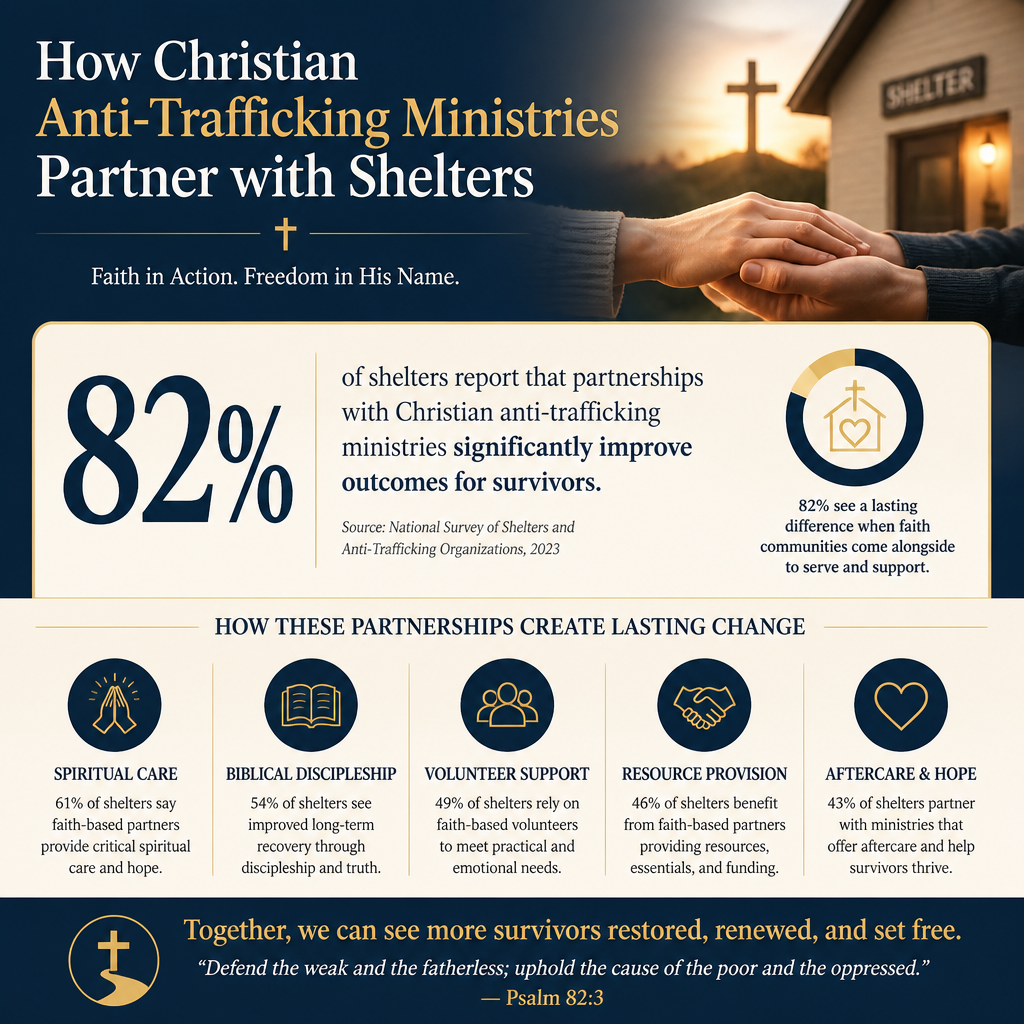
Many donors naturally gravitate to direct services: beds, meals, counseling hours, emergency transportation. Those are essential. But shelter partnerships become transformative when they also strengthen the shelter as an institution—its staff formation, its governance, its systems, and its financial resilience.
Training, supervision, and secondary trauma care are part of mission
Survivor care is demanding for staff. Burnout and turnover harm continuity and undermine trust with residents. Strong partnerships fund staff training and supervision, not only resident-facing programs. They help shelters access evidence-based practices in trauma treatment, case management, and risk assessment, and they budget for staff care because exhausted caregivers cannot provide stable, patient presence.
For donors, this requires recalibrating what “impact” looks like. A training budget line can be an impact line. A clinical supervisor’s hours can be an impact line. These are not overhead in the pejorative sense; they are part of responsible service delivery.
Financial support should reduce volatility, not increase it
One of the more sobering patterns in the nonprofit sector is how easily funding restrictions can distort programs. When a shelter must chase many small restricted gifts, leaders lose time for supervision, partnerships, and long-term planning. Where possible, wise donors prefer flexible support that allows shelter leadership to address the real constraints on the ground.
The broader philanthropic community has increasingly recognized that simplistic pressure to minimize “overhead” is counterproductive. Charity Navigator, Candid, and the BBB Wise Giving Alliance jointly warned that overhead ratios are a poor proxy for effectiveness and can mislead donors away from what organizations actually need to operate well Charity Navigator.
Within Survivor Care in Christian Anti-Trafficking Ministries, the ministries that sustain shelter partnerships over time tend to fund capacity: staff development, secure facilities, quality assurance, and the unglamorous administrative work that keeps residents safe.
Christian distinctives should be expressed with restraint and theological seriousness
Christian donors often hope that faith-based ministries will offer something more than services: the presence of Christ, the hope of the gospel, and a community where shame is not the final word. That aspiration is legitimate. The question is how to offer Christian witness in shelter contexts where residents may have complex spiritual histories and where coercion can be easily disguised as “care.”
Pastoral care must be opt-in and trauma-informed
When a shelter allows spiritual care, mature partnerships define qualifications, oversight, and boundaries. Chaplains and volunteers should be trained in trauma dynamics, mandatory reporting, and appropriate pastoral practices. They should also understand that spiritual language can trigger or confuse survivors whose exploitation included religious manipulation.
Scripture gives a frame for this restraint. Jesus does not break the bruised reed (Isaiah 42:3). That is not sentimentality; it is a description of how the Messiah handles fragile people and fragile faith. A partnership that honors this pattern will prioritize safety, consent, and patient presence over immediate spiritual outcomes.
Church connections should expand community without collapsing boundaries
Shelters may invite churches to provide meals, mentorship, employment connections, or housing pathways. Those can be meaningful expressions of the Body of Christ. Yet churches can also unintentionally create pressure—especially when volunteers seek emotionally gratifying experiences or when congregations treat survivors as symbols rather than neighbors.
Responsible partnerships set expectations for churches: training before engagement, clear rules about contact and communication, strict confidentiality, and the willingness to serve without access to personal stories. The goal is not to withhold compassion, but to ensure compassion is governed by wisdom.
Donors can evaluate shelter partnerships with concrete questions
Anti-trafficking is an arena where publicity outpaces proof. Donors who want to give with confidence should expect ministries to demonstrate not only conviction, but verifiable practice—especially in how they partner with shelters that bear the daily weight of survivor care.
Questions that reveal the substance of a partnership
We recommend asking for specifics that a credible ministry should be able to answer without evasion. A short list can clarify whether the partnership is mature or merely aspirational.
- Who holds clinical authority for resident care decisions, and how is that authority protected?
- What written agreements govern referrals, confidentiality, and volunteer access?
- How are staff and volunteers trained in trauma-informed care and boundaries?
- What portion of support strengthens shelter capacity rather than funding only visible programs?
- How does the ministry handle storytelling, consent, and privacy in donor communications?
Verification strengthens, rather than replaces, discernment
Donors sometimes feel they must choose between trusting a compelling Christian story and demanding accountable evidence. A mature approach refuses that false choice. At Most Trusted, we assess ministries against The Most Trusted Standard, a 15-criteria framework that examines faith foundation, financial integrity, governance and leadership, and transparency and effectiveness. The point is not suspicion; it is stewardship.
Within Christian Anti-Trafficking Ministries, trustworthy shelter partnerships tend to show measurable humility: clear boundaries, documented safeguards, consistent reporting, and an evident willingness to be evaluated.
FAQs for How Christian anti-trafficking ministries partner with shelters
Should Christian donors prefer ministries that run their own shelters?
Not necessarily. Operating a shelter requires specialized compliance, security planning, clinical oversight, and a high tolerance for complex risk. Some ministries are called and equipped to do it well; many are not. A partnership model can be wiser when it strengthens an experienced shelter’s capacity while allowing the ministry to focus on prevention, aftercare services, legal advocacy, or church mobilization. Donors should look for evidence of competence and governance appropriate to the level of responsibility, not merely for the presence of a facility.
Is it a warning sign if a shelter partner will not share detailed outcomes?
It depends on what is being requested. With trafficking survivors, privacy and safety can properly limit what is shared publicly, especially details that could identify residents or locations. A trustworthy partnership can still report meaningful information in aggregate, describe methods and safeguards, and explain how it evaluates effectiveness without exposing survivors. Donors should be wary when a ministry offers dramatic stories but cannot explain its policies, training, or accountability.
What faithful partnership ultimately requires
How Christian anti-trafficking ministries partner with shelters is a test of whether compassion is governed by truth. The most trustworthy partnerships protect survivor agency, invest in institutional strength, and practice spiritual care with reverence and restraint. Christian donors serve the cause best when generosity is paired with careful evaluation, so that giving does not merely express concern, but helps build places of refuge where healing can take root over time.



