
Why Christian adoption ministries prioritize family preservation is not a fashionable reframing of “orphan care.” It is a moral and theological correction to a model that, at times, has treated children as transferable needs rather than image-bearers with histories, kin, and claims upon the church’s protection. For donors who want their generosity to be both compassionate and clean-handed, family preservation is often where the hardest work begins.
Scripture’s commands are clear: God “executes justice for the fatherless” (Deuteronomy 10:18) and condemns those who “turn aside the sojourner from justice” (Malachi 3:5). Yet the field of adoption and child protection has had to reckon with an uncomfortable reality: even well-funded, Bible-quoting efforts can unintentionally weaken families, incentivize separation, or normalize practices that would not withstand scrutiny if applied to our own congregations.
Family preservation is the first expression of biblical justice and mercy
Orphan care in Scripture assumes protection, not procurement
James 1:27 defines “pure and undefiled religion” as care for orphans and widows in their distress, not the creation of orphans through preventable separation. The Old Testament pairs care for the vulnerable with repeated warnings against oppression, theft, and corrupted courts. Those warnings are not abstract; they speak directly to the risk in any system where poverty can be mistaken for parental unfitness, and where money can create perverse incentives.
Christian donors often feel the tension: the desire to bring a child into a stable home, and the obligation not to participate in a pipeline that subtly rewards family breakdown. Ethical adoption ministry begins with a disciplined distinction between poverty and neglect. Poverty calls for support; neglect calls for protection; both call for truth.
Christian adoption is rooted in grace, not entitlement
Christian theology speaks with unusual clarity about adoption: “In love he predestined us for adoption to himself as sons through Jesus Christ” (Ephesians 1:5). But that doctrine does not grant Christians a claim on other people’s children. It forms Christians into people who can love sacrificially without controlling outcomes, including outcomes that feel emotionally urgent.
In our verification work at Most Trusted, the ministries that most consistently meet The Most Trusted Standard tend to treat family preservation as an extension of pro-life conviction and neighbor-love, not as a competing agenda. When preservation is possible and safe, it is often the closest practical analogue to the biblical vision of justice: strengthening what sin, poverty, and crisis have threatened to unravel.

Evidence from child development and systems ethics supports keeping families intact when safe
Children generally do better in families than institutions
The modern orphan care movement has learned, often through painful evidence, that institutional care is not neutral. A major review of institutional care found significant associations between early institutionalization and later deficits in physical growth, cognition, and socio-emotional development, with earlier placement into family-based care linked to better outcomes The Lancet. Donors do not need to become clinicians to grasp the principle: stable, committed caregiving relationships are not a luxury; they are a developmental necessity.
Family preservation, when paired with serious child protection, is an attempt to keep the child connected to the most natural and potentially durable network of belonging. When families can be made safe, it is hard to justify defaulting to solutions that remove the child from language, community, and kin.
The field has faced documented incentives that can harm families
Christians genuinely disagree about how often “bad incentives” drive separation, but reputable observers have documented patterns donors should not ignore. Reporting on global orphanage systems has described cases where children with living parents are placed in residential care due to poverty and the financial structures that reward full beds The New York Times. This does not indict every program; it does clarify why a preservation-first posture is a safeguard against structural sin.
What this means for donors is straightforward: we cannot evaluate outcomes only by counting adoptions or by showcasing compelling child profiles. We must ask whether a ministry’s model minimizes incentives for unnecessary separation and increases incentives for verified reunification, kinship care, or safe support to birth families.
Family preservation is a child protection strategy, not a softer alternative to adoption
Preservation requires real safeguarding, not sentimentalism
Family preservation is sometimes caricatured as keeping children in unsafe homes. Responsible ministries do not treat preservation as an automatic good; they treat it as a goal pursued under clear safety thresholds and credible oversight. The question is not whether families are “ideal.” The question is whether the child can be protected from abuse, chronic neglect, trafficking risk, and coercion.
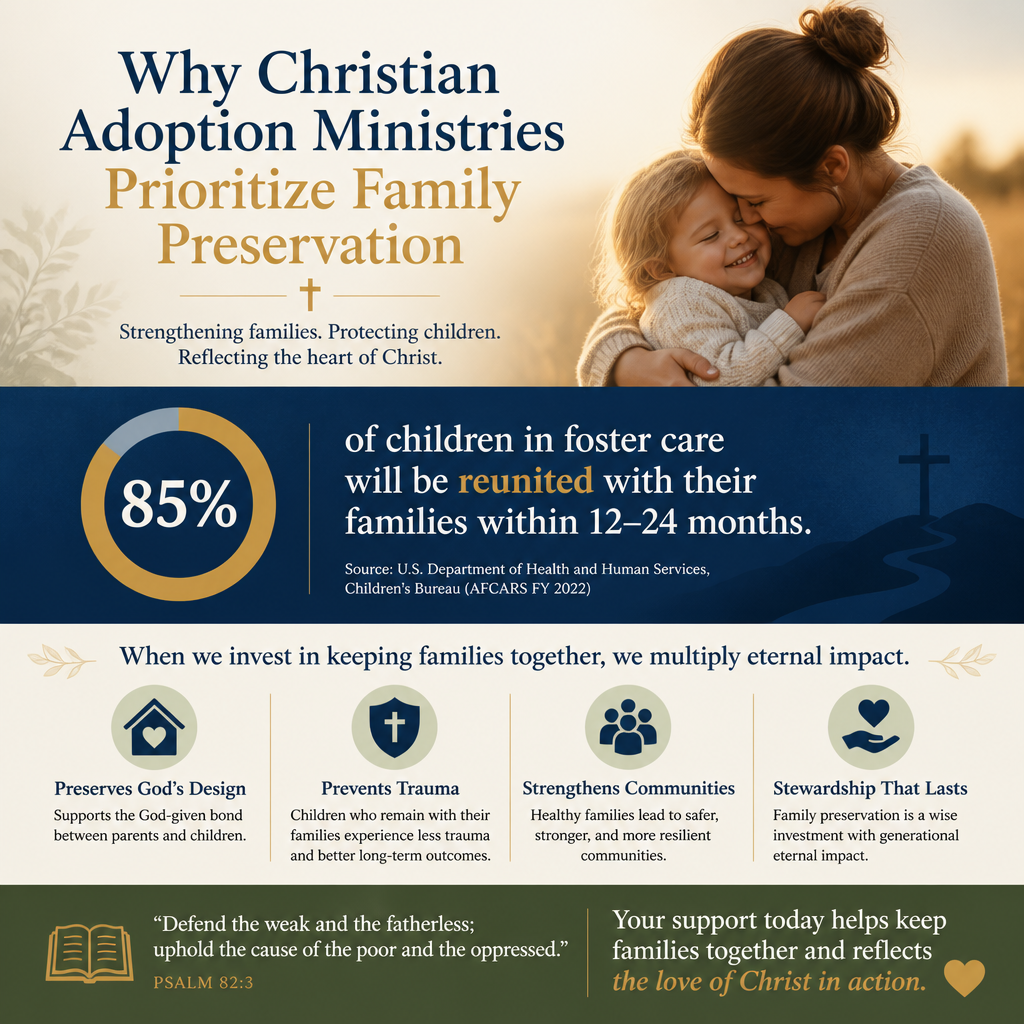
In practice, preservation work that respects the child often includes rigorous case management, verified identity documentation, and coordinated child protection referrals. Done well, it is not cheaper or easier than adoption. It is simply more aligned with the moral intuition that families should not be dissolved because they are poor.
Kinship care and reunification are often underfunded and undercelebrated
Adoption fundraising frequently centers on the heroic. Preservation centers on the faithful: helping a grandmother obtain legal guardianship, supporting a single mother to maintain housing, addressing untreated addiction, or rebuilding income after medical crisis. These are not sentimental projects; they are structural interventions that prevent family separation and reduce vulnerability to exploitation.
For donors seeking to support ethical practice within Christian Adoption Ministries, the key is to look for ministries that budget and staff for reunification and kinship care with the same seriousness they bring to adoption placements. When a ministry only has capacity for placements but not for prevention, the model tends to drift toward separation as the most fundable outcome.
Donors should evaluate whether preservation is principled and verifiable
Preservation claims are easy to make and harder to prove
Because family preservation has become a recognized best practice, it is now common in marketing language. Donors should assume that good intentions are real but incomplete. The mature question is whether a ministry’s stated commitment is operationalized through measurable safeguards and transparent reporting.
Across our verification work, we have found that the most credible ministries treat family preservation as a set of accountable practices rather than a slogan. They can explain how they identify families, verify consent, document case decisions, and prevent financial pressure from shaping outcomes.
Practical indicators donors can request without overstepping
Donors do not need access to sensitive case files to evaluate integrity. A ministry that is doing preservation well can usually provide policy-level clarity and aggregated reporting. The questions below are not hostile; they are an act of stewardship.
- What are the ministry’s written thresholds for family preservation versus removal for safety?
- How is parental consent obtained and documented, and what safeguards exist against coercion?
- What percentage of cases result in reunification or kinship care, and how are those outcomes defined?
- Does the ministry fund legal aid, birth family support, and post-reunification follow-up?
- What independent oversight exists for complaints, whistleblowing, and adverse incidents?
These are also the kinds of questions The Most Trusted Standard is designed to press into, across faith commitments, financial integrity, governance, and transparent evidence of outcomes. Most Trusted exists because donors deserve more than assurances when children’s welfare is at stake.
Family preservation reshapes how Christian donors think about impact and cost
The hardest outcomes to fund are often the most ethical
Donors frequently ask whether family preservation is “efficient.” The honest answer is that preservation can be slow, staff-intensive, and difficult to summarize in a single number. Yet Christian stewardship is not simply about low unit cost; it is about faithful use of resources toward righteous ends. The parable of the Good Samaritan is not a cost-minimization exercise; it is an account of costly mercy directed by clear moral perception.
That does not excuse waste. It does mean donors should expect a preservation-forward ministry to spend meaningfully on trained social workers, trauma-informed practice, legal compliance, and monitoring. These costs are not overhead in the pejorative sense; they are protective infrastructure.
Adoption still matters, but it should not be the default solution
There are circumstances where adoption is necessary and beautiful: when parents are deceased, when abandonment is real, or when reunification would expose a child to ongoing harm. Christian donors should not be manipulated into viewing preservation and adoption as ideological opposites. A serious ministry will pursue the least disruptive permanency option that is truly safe, and it will say plainly when adoption is the right outcome.
Within Ethics and Child Protection in Christian Adoption Ministries, the central donor question becomes whether an organization’s model is ordered toward the child’s long-term good rather than toward a fundraising narrative. Where preservation is principled, adoption is more trustworthy because it is more clearly necessary.
FAQs for Why Christian adoption ministries prioritize family preservation
Does prioritizing family preservation mean a ministry is anti-adoption?
No. Prioritizing preservation means a ministry treats adoption as one form of permanency among several and seeks first to keep children safely connected to their families and kin. When preservation is not possible without endangering the child, ethical ministries pursue alternative permanency options, including adoption, with careful documentation and safeguards.
What should donors watch for to avoid funding harmful separation incentives?
Donors should be cautious when an organization’s funding model depends heavily on placement volume, when consent and documentation practices are vague, or when reunification and kinship care receive little budget or staffing. A credible ministry can describe its safeguarding policies, independent oversight, and how it measures preservation outcomes without compromising child privacy.
A preservation-first posture is a credibility test for Christian compassion
Family preservation is not a retreat from the call to care for the fatherless. It is an insistence that Christian compassion be ordered by justice, truth, and the long obedience of protecting children without exploiting vulnerability. Donors who fund preservation are often funding fewer headlines and more holiness: the quiet work of strengthening families so that fewer children become fatherless in the first place.



