
Christian addiction recovery includes family discipleship because addiction rarely confines its damage to one person. It forms and deforms habits, trust, financial stability, and spiritual imagination across an entire household. When recovery is treated as an individual project—detox, meetings, a new routine—families often remain trapped in the same patterns of fear, control, secrecy, and resentment that grew around the addiction in the first place.
For Christian donors, this is not merely a program-design question. It is a question of stewardship and discipleship: what kinds of ministries most reliably bear fruit that lasts, and what kinds of efforts inadvertently produce a revolving door. Across our verification work at Most Trusted, we observe that ministries aligned with The Most Trusted Standard tend to state their outcomes in terms that include repaired relationships, restored responsibilities, and sustained church engagement, not only sobriety markers.
Addiction is a household reality before it is a clinical category
Family systems shape the relapse environment
Scripture refuses to imagine human beings as isolated spiritual units. Sin is personal, but its consequences ripple through covenant relationships. When Paul addresses the churches, he speaks to households and community bonds, not only individual consciences. Addiction follows this same moral and relational logic: it expresses itself in the body, but it reorganizes the home.
The clinical literature uses the language of “family systems” to describe how roles and routines adapt around ongoing substance use. Christian ministry uses different terms—idolatry, fear, enabling, bitterness, deception—but the lived reality overlaps. If a household has learned to survive through denial, hypervigilance, or control, those habits will pressure a recovering person back into old coping strategies, even after sincere repentance.
Families carry secondary trauma and spiritual confusion
Many families living with addiction experience chronic stress that resembles trauma exposure: disrupted sleep, financial instability, unpredictable conflict, and repeated broken promises. Those experiences do not disappear when the addicted family member becomes sober. Without intentional care, family members may interpret “recovery” as a demand to forget what happened or to resume trust without wisdom. That is not forgiveness; it is avoidance.
Ministries that include family discipleship can name these wounds and walk people toward practices that are both biblical and psychologically informed: confession without manipulation, forgiveness that refuses vengeance, and boundaries that protect the vulnerable. The goal is not to re-create the past with a religious gloss. The goal is a re-ordered household that can tell the truth.

Discipleship addresses the heart, not only the habit
Sobriety is not the same as sanctification
Christians genuinely disagree about how to map addiction onto theological categories—disease, sin, both, or neither in any simple sense. What serious recovery ministry cannot deny is that substance misuse is often entangled with worship: what we reach for to quiet fear, to medicate shame, to control pain, or to secure relief. Scripture describes this dynamic with clarity. “Be filled with the Spirit,” Paul writes, contrasting intoxication with a different kind of filling (Ephesians 5:18). The contrast is not merely behavioral; it is spiritual allegiance.
Family discipleship matters because the household often shares the same functional gods. A spouse may idolize control. A parent may idolize reputation. An adult child may idolize independence. Without discipleship, the family may simply trade one false refuge for another: from substances to rage, from chaos to rigid control, from lying to silent contempt.
Repentance and repair require a shared moral language
Recovery conversations frequently break down because family members lack a shared vocabulary for truth and repair. One person speaks in therapeutic categories, another in moral condemnation, another in spiritual slogans. Discipleship can give families a coherent language rooted in Scripture: sin and suffering, confession and restitution, patience and endurance, wisdom and boundaries.
This is where many donors have seen disappointment: a program celebrates a “graduation,” but a year later the marriage is still disintegrating and the children remain alienated. Discipleship pushes beyond milestone moments toward durable formation. If donors want to support ministries that aim at that depth, it is wise to evaluate whether the ministry’s theory of change includes the family and the local church, not only the participant.

Family discipleship protects the vulnerable and clarifies boundaries
Restoration is not the same as immediate reconciliation
Christian language about forgiveness can be misused to pressure victims of addiction-related harm into premature reconciliation. Ministries that take Scripture seriously must also take safety seriously. Repentance is tested over time. Trust is rebuilt through observable change. Wisdom in the book of Proverbs is not sentimental; it distinguishes between the repentant and the foolish.
Family discipleship provides a framework for the slow work of repair without making the harmed party responsible for the addict’s emotional stability. It teaches what many families need to hear: boundaries are not a failure of love. They are often the necessary structure within which love can again become truthful.
Children require deliberate pastoral care
Children in addicted homes often become translators, peacekeepers, and secret-keepers. They may carry distorted theology: that God is like an unpredictable parent, that confession is dangerous, that anger is safer than sadness, or that church language exists to cover reality rather than reveal it. If a recovery ministry does not address children, it may inadvertently leave the next generation vulnerable to repeating the pattern.
For donors evaluating Christian addiction recovery ministries, a simple question is instructive: does the ministry have a plan for the family members who did not “cause” the addiction but were shaped by it? In many credible programs, this includes structured family education, pastoral counseling, and age-appropriate care for children—not as an optional add-on, but as part of the ministry’s understanding of discipleship.
Church-based recovery works best when the household is not ignored
The local church can become a sustaining community
Many recovery models emphasize peer support and accountability, and rightly so. Yet Christian ministry has a distinctive resource: the church as a covenant community under the Word, sacraments, and discipline. When recovery is connected to the local church, the recovering person is not merely joining a support group; they are learning to live as a member of a body.
That body includes marriages, parents, children, and friendships. If the family remains outside the discipleship process, church involvement can become another compartment: “his recovery,” “her program,” with little integration into household life. Over time, that division weakens both recovery and family stability.
Healthy ministries equip churches, not only individuals
Across Christian Addiction Recovery in Families and Churches, we see a consistent distinction between ministries that treat churches as referral sources and ministries that treat churches as formation contexts. The latter tend to invest in training: how small groups support families without enabling, how pastors respond to relapse without shame or naïveté, and how congregations protect children while also offering mercy.
Donors often assume a “church-based” ministry automatically has these competencies. That is not always true. Churches can be courageous and unprepared at the same time. The most responsible ministries acknowledge the tension: confidentiality versus accountability, grace versus safety, restoration versus consequence. They build policies and training accordingly.
What donors should verify before funding family-centered recovery
Fruitfulness can be claimed, but it must be evidenced
Family discipleship is compelling language, but donors should still ask for verifiable clarity. What does the ministry mean by “discipleship”? How is it delivered? Who provides it? What safeguards exist when family conflict includes coercion, domestic violence, or child endangerment? Serious ministries can answer these questions without evasiveness.
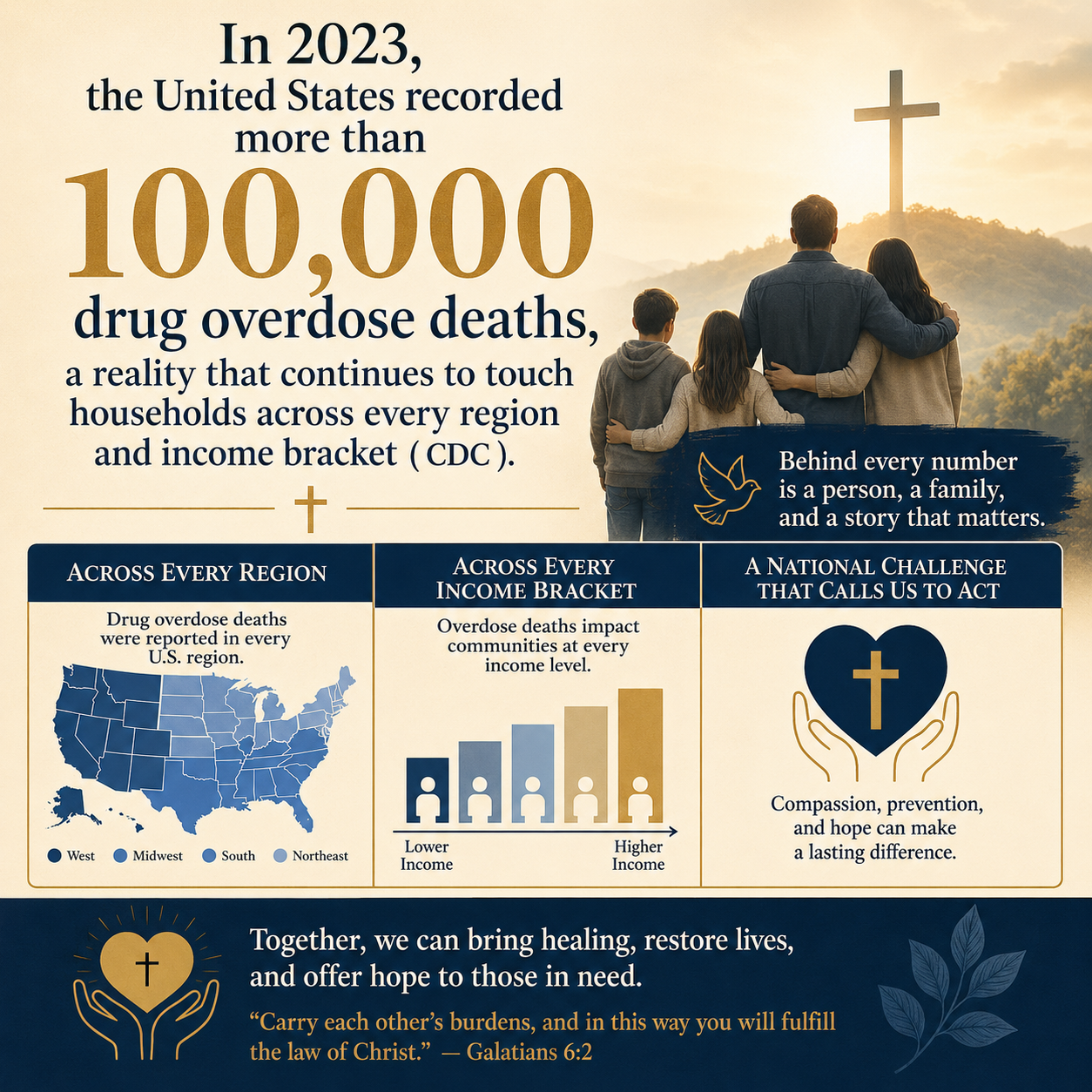
Government data underscores the scale of the problem families face. In 2023, the United States recorded more than 100,000 drug overdose deaths, a reality that continues to touch households across every region and income bracket (CDC). When the stakes are that high, donors have a responsibility to fund work that is both compassionate and competent.
Practical signals of integrity and readiness
As donors consider Christian Addiction Recovery Ministries, the question is not whether a ministry uses Christian language. The question is whether the ministry’s practices align with Christian truth and good governance. Family discipleship increases complexity: it requires additional staff skill, clearer policies, and better accountability. It also increases the likelihood that recovery is sustained and harms are not repeated.
What this means in practice is that donors should look for several concrete signals:
- Defined family programming with clear participation expectations and pastoral oversight
- Safeguarding protocols for children and vulnerable adults, including mandated reporting procedures where applicable
- Competent counseling boundaries that distinguish pastoral care, peer support, and licensed clinical treatment
- Church partnership clarity describing how referrals, follow-up, and confidentiality are handled
- Outcome reporting that addresses relational repair and stability, not only attendance or short-term completion
Research also cautions donors against simplistic confidence in self-reported transformation. A substantial share of people with substance use disorders do not receive treatment in a given year, indicating both access barriers and the challenge of sustained engagement (SAMHSA). Ministries that include families often increase engagement because spouses and parents become informed partners rather than exhausted bystanders, but this is precisely where program integrity matters.
Most Trusted exists to help donors weigh these realities with rigor. The Most Trusted Standard examines a ministry’s faith commitments, financial integrity, governance and leadership practices, and transparency and effectiveness. For family-centered recovery ministries, those criteria become especially relevant: family work is sensitive work, and sensitivity without accountability can become harm.
FAQs for Why Christian addiction recovery includes family discipleship
Is family discipleship appropriate if the addicted person is not yet sober?
Often it is, though the content and expectations may differ. Families can learn to establish truthful boundaries, stop patterns of enabling, and seek pastoral and clinical support even before sobriety. In many cases, early family discipleship focuses less on “fixing” the addicted person and more on protecting children, stabilizing the household, and forming a shared commitment to truth. Responsible ministries also recognize that certain conditions—active violence, coercion, or severe instability—require immediate safety planning and may exceed what a church-based program should handle alone.
What should donors ask a recovery ministry about involving children?
Donors should ask whether the ministry has age-appropriate care pathways and safeguarding policies, not merely informal advice. This includes how staff are screened and trained, whether mandatory reporting obligations are understood and followed, and how the ministry collaborates with churches and licensed professionals when a child has experienced trauma. Ministries that speak clearly about these matters tend to be more trustworthy than those that rely on general assurances.
A donor’s stewardship aim is durable restoration, not isolated milestones
Christian addiction recovery includes family discipleship because redemption in Christ is not merely the cessation of a behavior. It is the re-ordering of loves, the re-building of truth, and the slow repair of relationships that were bent by sin and suffering. When ministries disciple families, they treat addiction as the household reality it has become, and they seek restoration that can endure temptation, relapse risk, and the pressures of ordinary life.
For donors, the question is whether the ministries we fund are designed for that durability. The ministries most worthy of confidence are usually those that can articulate a theologically grounded vision of family restoration, and then substantiate it with governance, safeguards, financial integrity, and transparent outcomes consistent with The Most Trusted Standard.



