
How biblical museum ministries use donor funds is not a peripheral question for Christian donors. Scripture treats money as a test of worship and wisdom, and museums that claim a biblical mission are making a public theological argument with private financial decisions.
Many donors feel a genuine tension here. Museums can preserve fragile artifacts, teach Scripture to the next generation, and strengthen public witness. They can also become expensive monuments, driven by ambition, controversy, or unclear outcomes. Faithful stewardship requires more than good intentions; it requires verifiable practices that match the ministry’s stated mission.
What donors are really funding in a biblical museum ministry
Mission delivery is more than exhibits
In biblical museum ministries, the visible gallery is only the front edge of the work. Donor funds often support collections care, curatorial research, conservation labs, educational programming, and the basic infrastructure that keeps objects and visitors safe. For many ministries, a meaningful share of costs is fixed: climate control, security, insurance, and facilities maintenance do not scale down easily when attendance dips.
The question is not whether these costs exist, but whether they are governed in a way that serves ministry outcomes rather than institutional self-preservation. In our verification work at Most Trusted, the ministries that meet The Most Trusted Standard tend to make their “behind the scenes” expenses intelligible to donors: what is required, what is discretionary, and what is directly tied to the stated biblical purpose.
Acquisitions and loans carry ethical and legal weight
Acquiring or borrowing artifacts can be one of the most expensive and reputationally sensitive lines in a museum budget. Transport, conservation, appraisals, specialized storage, and legal review can add significant cost even when an item is donated or loaned. Donors should expect policies for provenance, cultural property, and repatriation to be written, enforced, and aligned with both civil law and Christian ethics.
Faithfulness and formation as measurable aims
Spiritual formation is not easily reduced to attendance
Christian donors sometimes inherit a secular framework for museum success: foot traffic, brand reach, and earned revenue. Those measures matter, but they are not identical with discipleship. A biblical museum ministry should be able to explain how its exhibits and programs serve the church and the public—whether by biblical literacy, family catechesis support, scholarly engagement, or evangelistic witness—without implying that a ticket sale is the same thing as spiritual fruit.
What this means in practice is that donors should look for ministries that define outcomes with theological clarity and operational humility. A museum can name goals such as “increasing confidence in the historical credibility of the Gospels” or “equipping parents to teach Scripture,” but it should also acknowledge what cannot be proven, and avoid triumphalist claims.
The harder question is whether messaging matches method
Christians genuinely disagree about how museums should handle contested scholarly questions—textual criticism, archaeology, the relationship between faith and historical method, or how to present disputed artifacts. Donors should not reduce these debates to slogans. They should ask whether the ministry’s approach is candid about evidence, careful with claims, and respectful toward visitors who arrive skeptical.
A useful donor lens is to examine whether interpretive choices are constrained by transparent standards. When a ministry’s public-facing certainty is not matched by internal documentation, peer review, or disclosed limitations, donor funds can inadvertently support advocacy that looks educational but functions as propaganda.
Budget lines that signal integrity rather than anxiety
Administration is not the enemy, but secrecy is
Christian donors have been trained to fear “overhead,” yet the field has largely corrected that simplistic mindset. The “Overhead Myth” statement—signed by GuideStar, Charity Navigator, and the BBB Wise Giving Alliance—argued that judging nonprofits primarily by overhead ratios is misleading and can pressure organizations into underinvesting in governance, evaluation, and staff capacity GuideStar.
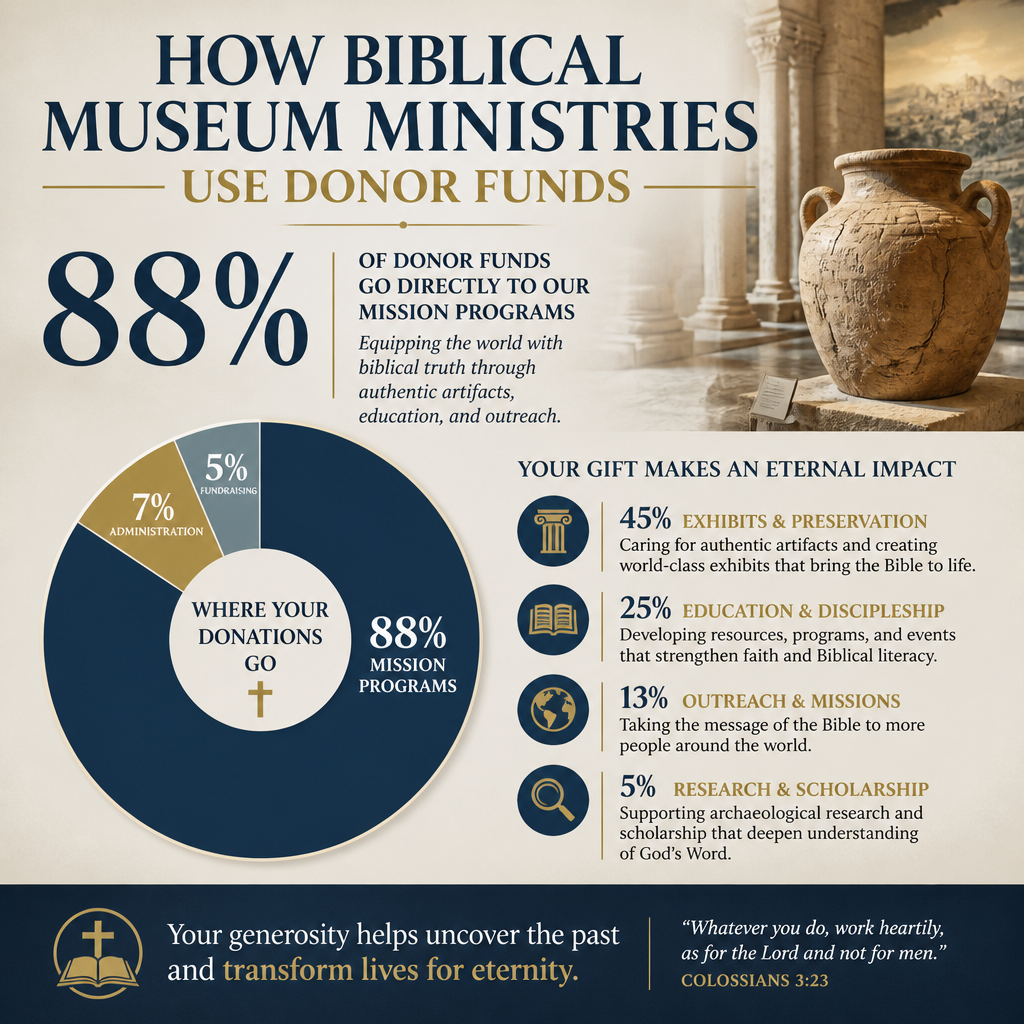
For museum ministries, certain administrative expenses are morally protective: compliance, audit work, collections documentation, and safety protocols. The question is whether these costs are right-sized, competently managed, and explained with candor. A thinly staffed finance function in a complex museum environment is not automatically “efficient”; it can be a risk to donors, staff, and the ministry’s witness.
Capital projects can bless or distort a ministry
Buildings are often the largest financial decision a museum ministry will make. Capital campaigns can expand public access and preserve collections, but they also create ongoing operating costs that outlive the campaign. Wise donors ask not only, “Can they build it?” but also, “Can they operate it without chronic emergency fundraising or compromising programs?”
In practice, healthy capital planning tends to include realistic attendance assumptions, clear restrictions on capital gifts, contingency planning, and governance discipline around change orders and scope expansion. The warning signs are familiar: vague projections, pressure-driven timelines, and a public narrative that treats scale as synonymous with faithfulness.
Governance and controls that protect the ministry and the donor
Boards must govern beyond fundraising
Because museums blend ministry, scholarship, education, and high-value assets, board competence matters. Donors should expect a board that can oversee risk, approve major transactions, set executive accountability, and ensure that theological commitments are not merely a statement on a wall.
Basic controls are not bureaucratic; they are a form of neighbor-love in financial practice. They reduce temptation, prevent avoidable scandals, and keep staff from being asked to carry risks that should be borne by systems. In the biblical pattern, stewardship is accountability before God and others, not private confidence.
Common controls donors should expect to see
Many donors are not auditors, and they should not have to become one to give wisely. Still, certain practices are reasonable to expect in a museum ministry with meaningful donor support:
- Clear restricted-gift policies and documentation of how restrictions are honored
- Regular financial statements reviewed by the board, not only management
- Conflict-of-interest disclosures for board and senior staff, with enforcement
- Written collections and provenance policies, including ethical acquisition standards
- Independent financial review or audit appropriate to size and complexity
For donors seeking a broader framework for assessing these governance and disclosure questions in this field, we address them across Accountability and Transparency in Biblical Museum Ministries with attention to recurring strengths and failure modes.
Transparency that serves truth, not merely reputation
Financial clarity should connect dollars to decisions
Museum ministries often present financials in ways that are technically compliant but pastorally unhelpful: line items that obscure major drivers, program categories that lump education with marketing, or narratives that focus on activity rather than outcomes. Mature transparency does more. It explains why costs are what they are, what has changed, and what trade-offs leadership is choosing.
Donors should expect public documents—annual reports, Form 990s when applicable, audited statements when available—to be accessible and consistent. When a ministry is reluctant to share basic financial information, the problem is rarely “privacy.” More often it is governance weakness, internal confusion, or fear that the numbers will not withstand scrutiny.
Earned revenue and donor revenue must be handled with theological sobriety
Museums frequently blend ticketing, retail, licensing, events, and philanthropy. Earned revenue can reduce donor dependence, but it can also reshape incentives: programming decisions can tilt toward what sells rather than what forms. Donor revenue can protect mission integrity, but it can also invite capture by a few large gifts if governance is not strong.
A ministry should be able to name how it resists these distortions. That includes clear policies around donor influence, separation between development promises and curatorial judgment, and a coherent theology of public witness. For donors evaluating the broader landscape of ministries that claim a museum calling, Biblical Museum Ministries provides context for how these organizations differ in model, scale, and risk profile.
FAQs for How biblical museum ministries use donor funds
Should Christian donors avoid museum ministries because of high facilities costs?
No. Facilities costs are inherent to preserving collections and hosting the public, and they can be faithful stewardship when governed well. Donors should focus on whether the ministry explains those costs clearly, maintains appropriate controls, and demonstrates that facilities serve mission outcomes rather than institutional prestige.
What is a reasonable way to evaluate a biblical museum ministry without reducing everything to overhead ratios?
Donors can ask whether the ministry connects spending to mission with verifiable evidence: clear restricted-gift practices, transparent reporting, competent board governance, and policies that address high-risk areas such as provenance and conflicts of interest. The Overhead Myth statement provides a helpful corrective against simplistic ratio-based judgments while still affirming the need for accountability Charity Navigator.
Stewardship that strengthens a public Christian witness
Biblical museum ministries can serve the church and the broader public by presenting Scripture, history, and material culture with care. Donor funds make that possible, but they also create obligations: financial integrity, truthful communication, and governance strong enough to withstand pressure when controversies arise. The Christian donor’s calling is not suspicion, but prudent love—giving in a way that honors the Lord, protects neighbors, and supports ministries whose practices can bear the weight of their claims.



