
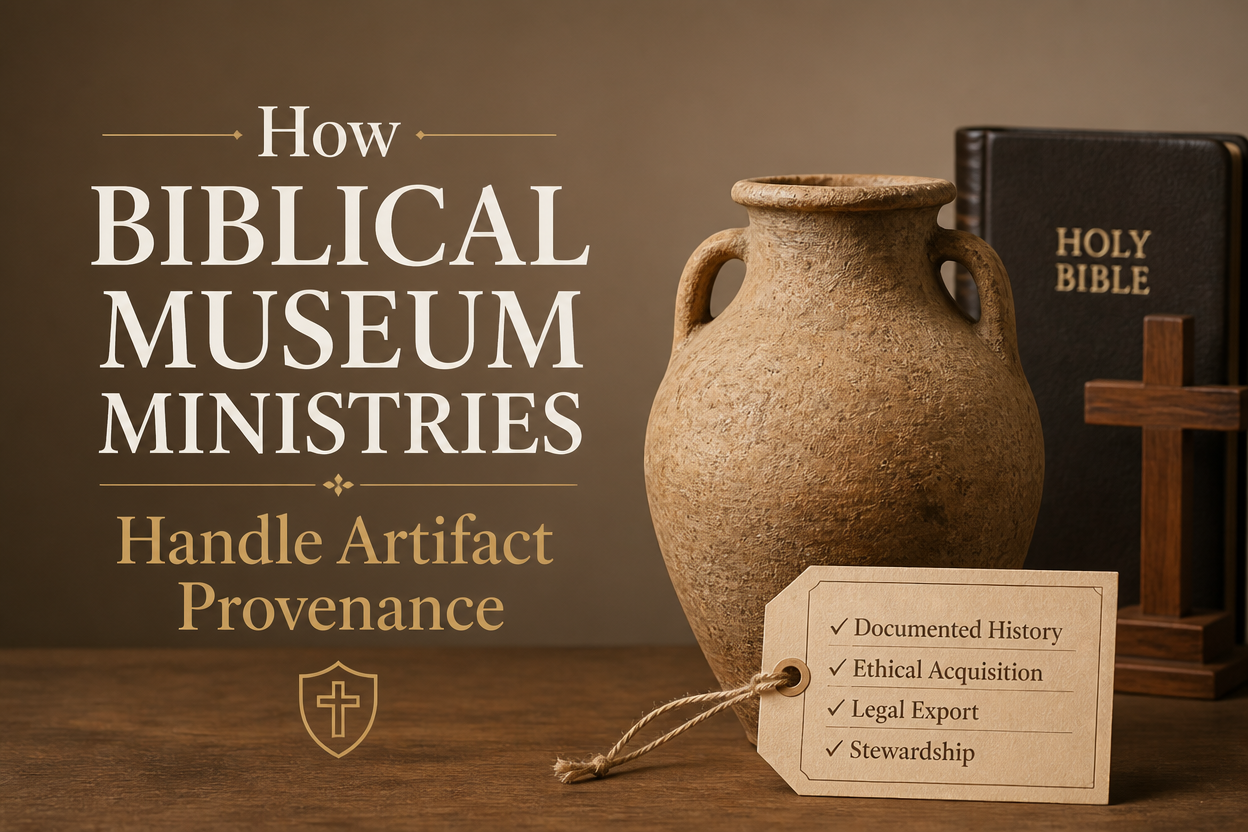
How biblical museum ministries handle artifact provenance is not a specialist question reserved for curators and academics. It is a moral question about truth-telling, neighbor love, and whether Christian institutions will bear trustworthy witness when the market rewards speed, spectacle, and certainty.
Donors often give because they want Scripture’s world to be made tangible for the next generation. That desire is understandable. Yet the modern antiquities trade has been repeatedly linked to looting, fraudulent documentation, and the displacement of cultural heritage from vulnerable communities. A museum ministry can unintentionally become complicit in those harms if it treats provenance as paperwork rather than as an ethical discipline.
Provenance is a theological issue before it is a technical one
Truth-telling and the ninth commandment
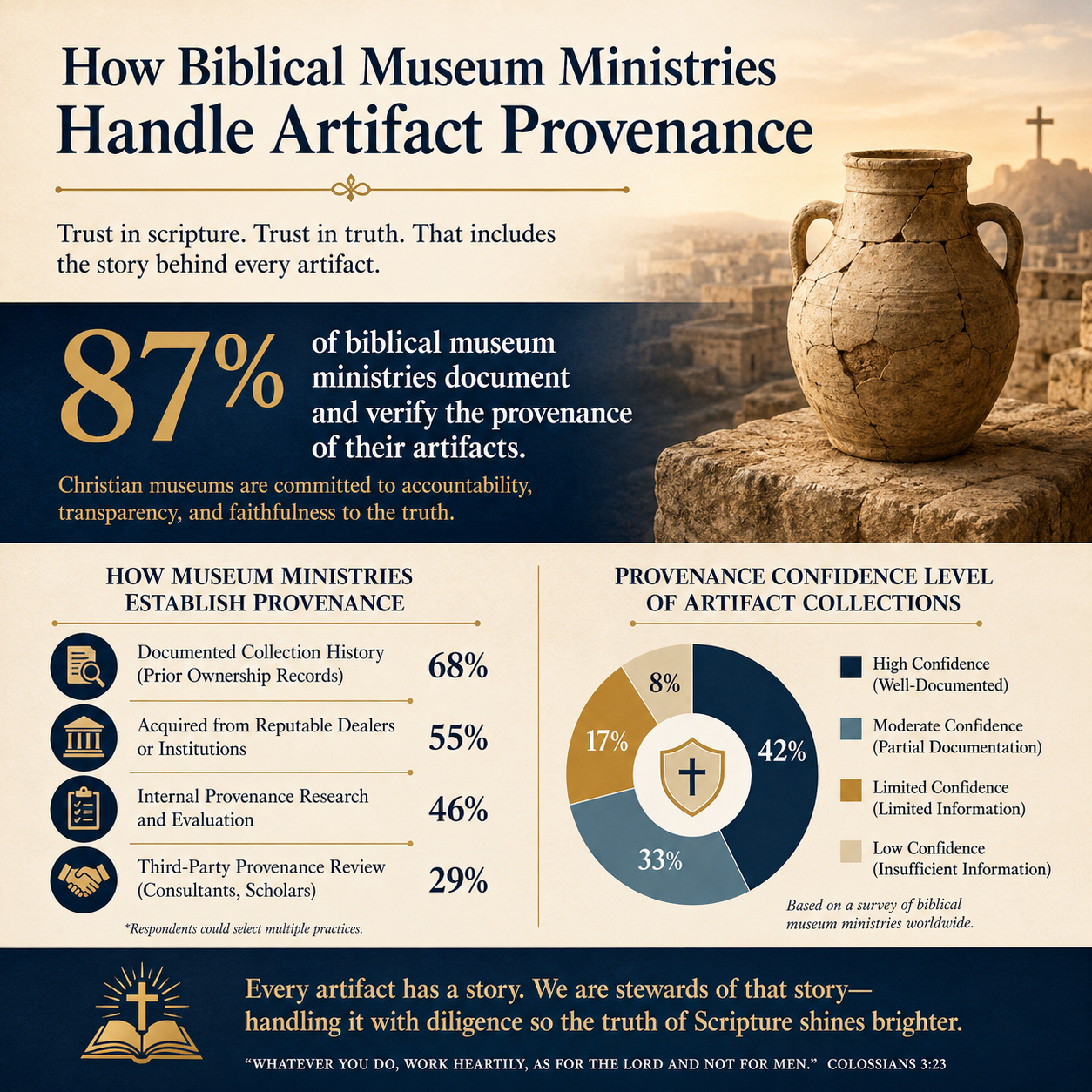
Provenance is the documented history of an object’s ownership and movement, ideally tracing from excavation or long-held collection to the present. For biblical museums, provenance is often discussed as “due diligence,” but biblically it is also a question of truthful speech and honest dealing. “You shall not bear false witness” is not limited to courtroom testimony; it shapes an institution’s posture toward claims, labels, fundraising, and public confidence.
The temptation in Bible-adjacent collecting is to let interpretive desire outrun verifiable evidence: to turn “possibly” into “certain,” to treat a plausible story as a documented chain of custody. Mature ministries treat uncertainty as a constraint to be respected, not an obstacle to be managed away. They reserve their strongest claims for the best-documented objects, and they build educational value around what can be responsibly said.
Justice for source communities
Scripture’s repeated concern for justice includes honest weights and measures, protection from exploitation, and the rejection of stolen gain. The antiquities market has long struggled with illicit excavation and trafficking, which can erase archaeological context and harm nations and local communities whose histories are removed from them. Christian donors do not need a museum ministry to be perfect; they need it to be upright, willing to restrain acquisition when evidence is thin, and willing to reverse course when new facts emerge.
What this means in practice is that provenance is not merely risk mitigation. It is an expression of neighbor love toward the living communities connected to the land, the sites, and the heritage in question.
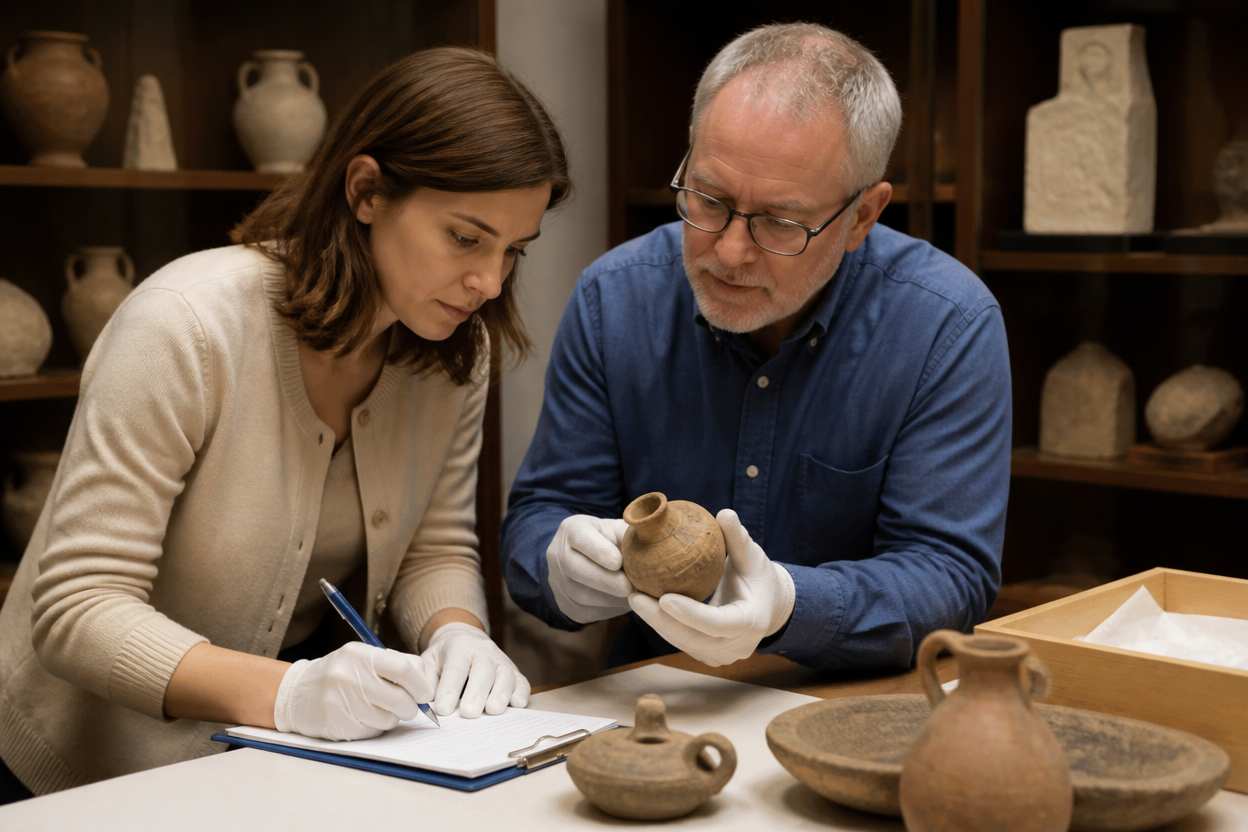
The field has had to reckon with looting, fraud, and public scandals
Why documentation gaps are not neutral
Many artifacts circulating on the market have gaps in their ownership history, particularly for the period after 1970. That date matters because the UNESCO 1970 Convention established a widely recognized international framework against illicit import, export, and transfer of cultural property, and it became a reference point for acquisition ethics in many institutions. A gap does not automatically prove wrongdoing, but it raises the likelihood that an object may have been illicitly excavated or exported, especially when the object type is commonly looted.
Responsible biblical museum ministries treat gaps as a reason to slow down, ask harder questions, and, in many cases, decline acquisition. That restraint is costly. It can mean fewer headline pieces and slower growth. It also preserves moral clarity and public credibility.
Forgery pressure in biblical materials
Biblical manuscripts and “inscribed” objects carry outsized fundraising and media value, which makes them attractive targets for sophisticated forgers. The scholarly world has repeatedly warned that objects without secure findspot documentation are particularly vulnerable to being forged or altered in ways that are difficult to detect. Donors should recognize that “spectacular” items can become liabilities if a ministry has not invested in the slow work of verification.
Public controversies in the broader museum and collecting world have underscored that even well-resourced institutions can misjudge provenance. The donor question is not whether a ministry can guarantee it will never face a contested object. The deeper question is whether the ministry has built habits of humility, disclosure, and corrective action that align with Christian integrity.
What credible provenance practice looks like inside a museum ministry
Acquisition policy with enforceable thresholds
Serious museum ministries begin with a written acquisitions policy that is more than aspirational language. It sets thresholds for what will be acquired, what documentation is required, who makes decisions, and what happens when documentation is incomplete. Strong policies treat provenance as a condition of acquisition, not merely an item on a checklist.
In our review work at Most Trusted, we consistently see that institutions with the strongest ethical posture do not rely on a single gatekeeper. They build multi-person review, clear documentation requirements, and a governing body that is willing to say no when an acquisition would introduce avoidable moral and reputational risk.
Research, authentication, and chain of custody
Provenance research can involve archives, dealer records, shipping documents, export permits, prior auction catalogs, and public databases of stolen or looted cultural property. Authentication is related but distinct: it uses material science and specialist scholarship to assess whether an object is genuine and whether it has been altered. The wisest ministries do both, because an authentic object can still have illicit origins, and a well-documented object can still be misdescribed if scholarship is weak.
Where feasible, mature institutions also document chain of custody once an artifact is acquired: storage conditions, conservation work, handling protocols, and any movement for exhibit or loan. That internal recordkeeping becomes part of integrity, because it demonstrates that stewardship did not begin at the moment the object entered the building.
- Non-negotiable documentation standards for ownership history and legal export where applicable
- Independent scholarly review for high-risk categories such as inscribed pieces and manuscript fragments
- Scientific testing when the object type warrants it and when results will be disclosed responsibly
- Conflict-of-interest controls for staff, board members, and donors involved in acquisitions
- Clear public labeling that distinguishes between evidence, inference, and devotional interpretation
Transparency is where donor confidence is either earned or forfeited
Public disclosure that respects complexity
Christian donors generally understand that not every question about the past can be answered with certainty. They do not need a museum ministry to project an air of infallibility. They need it to speak plainly about what is known, what is probable, and what is disputed. That includes making provenance information accessible when possible, describing the basis for dating and identification, and avoiding fundraising claims that outrun the evidence.
Transparency is also a discipline of resisting the urge to use ambiguous artifacts as apologetic “proof.” The Christian faith is grounded in history, but it does not require institutions to overclaim in order to be compelling. A museum that tells the truth carefully can still inspire reverence and confidence.
How governance shapes ethics
Because acquisition decisions can involve large sums and donor interest, provenance cannot be left to curatorial preference alone. Governance matters: clear authority lines, board oversight, minutes that reflect real deliberation, and policies that are actually enforced. Donors who care about institutional integrity should pay attention to whether a ministry’s board has the competence and courage to ask uncomfortable questions.
This is one place where the broader category of How Biblical Museum Ministries Preserve Artifacts matters for donor discernment. Preservation is not only about climate control and conservation labs; it is also about preserving moral credibility through transparent decision-making.
How donors can evaluate provenance practices without becoming specialists
Questions that surface integrity
Donors cannot audit every acquisition, and they should not be asked to. Yet donors can ask a small set of questions that reveal whether a museum ministry is serious about provenance or merely conversant in the vocabulary. The goal is not suspicion; it is stewardship. Jesus’ teaching about faithfulness in “little” and “much” presses Christian givers to care about how institutions handle trust, not only what they display.
Helpful questions include: Does the ministry publish an acquisition ethics policy? Does it describe how it evaluates provenance gaps? Does it disclose when an object’s origin is uncertain? Does it have an established process for claims and disputes? Does it have relationships with qualified outside scholars and conservators who are free to disagree?
Where independent verification fits
Because donors sit at a distance from day-to-day operations, independent evaluation can provide a more reliable line of sight. Most Trusted exists to help donors give with confidence by evaluating Christian nonprofits against The Most Trusted Standard, a 15-criteria framework spanning Faith Foundation, Financial Integrity, Governance and Leadership, and Transparency and Effectiveness. For museum ministries, provenance practice touches several of those criteria at once: governance controls, truthful public communication, and the alignment between stated mission and operational choices.
Across our verification work, we find that ministries able to sustain public trust over time tend to treat ethical safeguards as part of their mission rather than as constraints imposed from outside. They expect scrutiny. They document decisions. They correct errors promptly. They do not confuse donor enthusiasm with moral permission.
For donors seeking a broader view of the field, Biblical Museum Ministries is a useful starting point for understanding how different institutions approach stewardship, scholarship, and public accountability.
FAQs for How biblical museum ministries handle artifact provenance
Is it acceptable for a biblical museum to display an artifact with incomplete provenance?
It depends on the nature of the gap, the object type, and how the ministry communicates. Some objects have partial histories for reasons that are not illicit, especially items long held in older private collections. The ethical failure usually emerges when incomplete provenance is hidden, when labels overstate certainty, or when the ministry acquires high-risk material without sufficient documentation. A responsible museum can display contested or uncertain items if it clearly discloses what is known, avoids sensational claims, and can demonstrate that it did not incentivize looting through its purchasing practices.
What does a responsible museum ministry do if new evidence suggests an artifact was stolen or illicitly exported?
Responsible practice includes pausing display if appropriate, initiating a documented review, and engaging competent legal and scholarly counsel. If a credible claim is established, the ministry should cooperate with lawful authorities and pursue restitution or repatriation consistent with applicable law and ethical standards. Donors should look for ministries that have a written process for claims and that treat corrective action as part of Christian witness, not as a public-relations failure to be minimized.
Stewardship that tells the truth
Biblical museum ministries are entrusted with more than artifacts. They are entrusted with credibility: the credibility of scholarship, the credibility of Christian speech, and the credibility of institutions that ask the church to give. Provenance is one of the clearest places where that credibility is tested, because it requires restraint, humility, and transparent truth-telling when certainty would be more marketable.
Donors who care about faithful witness should look for museums that can withstand scrutiny, disclose complexity without fear, and make acquisition decisions that honor both the past and the living neighbors connected to it. That posture is not ancillary to the mission. It is part of what it means to serve the truth.



