
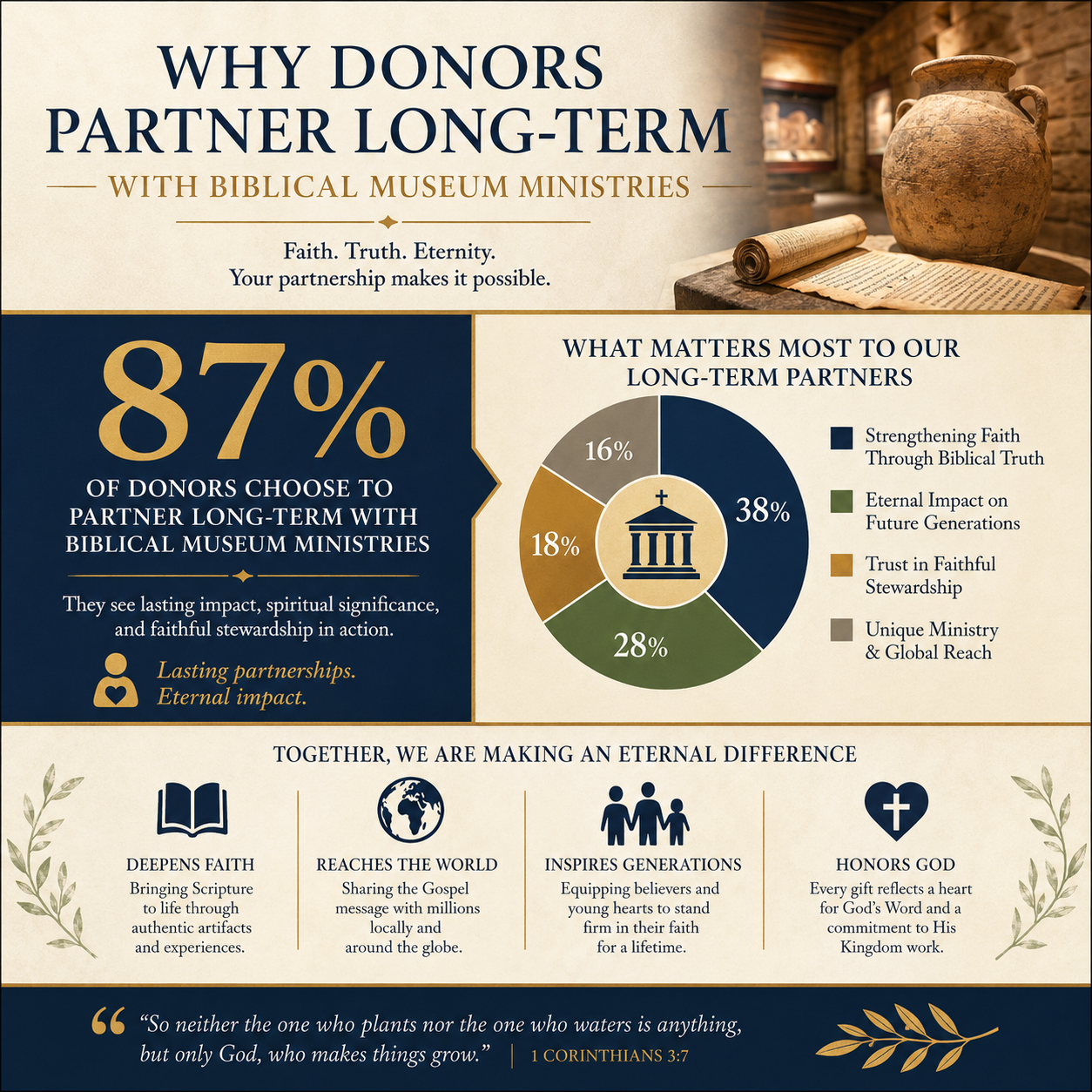
Why donors partner long-term with biblical museum ministries is ultimately a question of trust, endurance, and spiritual formation. These ministries do not merely display artifacts; at their best, they help the church love the God who has spoken and acted in history, and they do so through institutions that require patient capital.
Long-term partnership is not sentimental loyalty. Mature Christian donors remain when they see a ministry’s theological seriousness, operational discipline, and public credibility moving in the same direction over time. That alignment is difficult to manufacture and costly to maintain, which is precisely why it becomes a signal worth supporting.
Long-term donors are funding formation, not only programming
Biblical museum work sits at the intersection of catechesis, scholarship, and public witness. Donors who stay for decades typically understand that museum impact accrues slowly: collections are built, research is vetted, exhibits are refreshed, and educational ecosystems mature. The return is not only attendance; it is strengthened confidence that Christianity is anchored in real places, languages, and cultures.
Embodied history serves a church formed by Scripture
Christian faith is not a set of timeless principles detached from the world. Scripture presents God’s redemption as a sequence of acts in time, culminating in the incarnation, death, and resurrection of Jesus Christ. Donors partner long-term with ministries that treat historical inquiry as a servant of discipleship rather than a rival to it, offering visitors a way to see continuity between the biblical text and the world in which it emerged.
The significance is pastoral as much as intellectual. Many churches are contending with biblical illiteracy, contested authority, and the quiet drift of congregations toward a thin moralism. A museum ministry that equips families, pastors, and students to engage Scripture with confidence offers a durable form of service to the church.
Public credibility matters in a skeptical age
Museums operate in a public marketplace of claims. They are judged by standards that include provenance, conservation practice, interpretive integrity, and educational value. Donors who think institutionally recognize that credibility takes years to build and can be lost quickly. When a museum ministry handles contested questions with care, it not only protects its own reputation; it provides a model of Christian seriousness in the public square.
Many donors also understand that museums have disproportionate influence on young adults and educators, shaping what is considered plausible about the Bible. That influence is one reason donors explore the broader field of Biblical Museum Ministries before making sustained commitments.
The field rewards patient capital because the work is intrinsically long-horizon
Museum ministries rarely flourish through one-time gifts alone. Collections acquisition, conservation infrastructure, scholarly partnerships, and exhibit fabrication demand stable funding over multiple budget cycles. Long-term donors partner because they see that intermittent giving creates fragility, while steady support enables responsible planning.
Collections stewardship requires continuity
Whether a ministry holds manuscripts, inscriptions, ceramics, or educational replicas, stewardship is never static. Environmental controls, conservation expertise, and secure storage are ongoing responsibilities. When donors understand this, they often shift from thinking like event sponsors to thinking like stewards of a cultural trust.
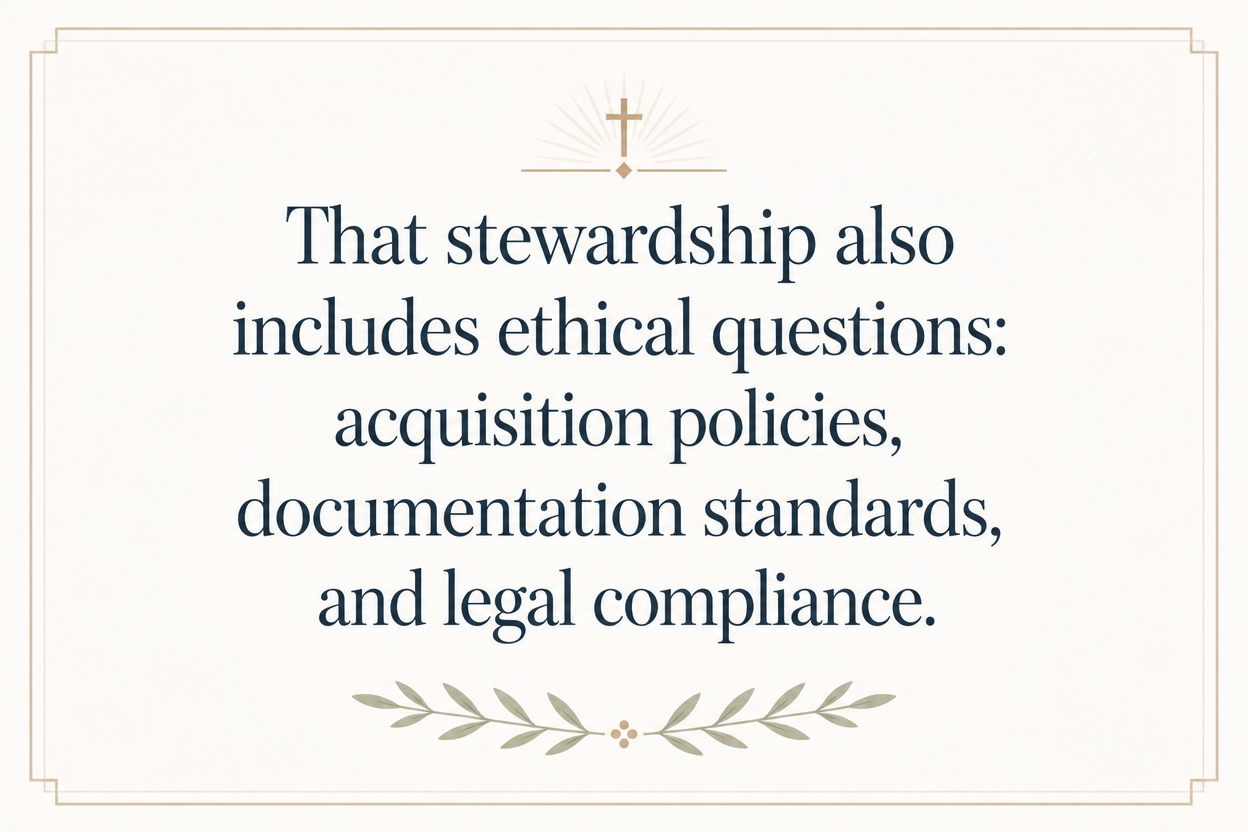
That stewardship also includes ethical questions: acquisition policies, documentation standards, and legal compliance. A mature donor does not assume that good intentions substitute for institutional discipline. They look for evidence that a ministry’s practices are designed to withstand scrutiny.
Educational impact is built through repeated exposure
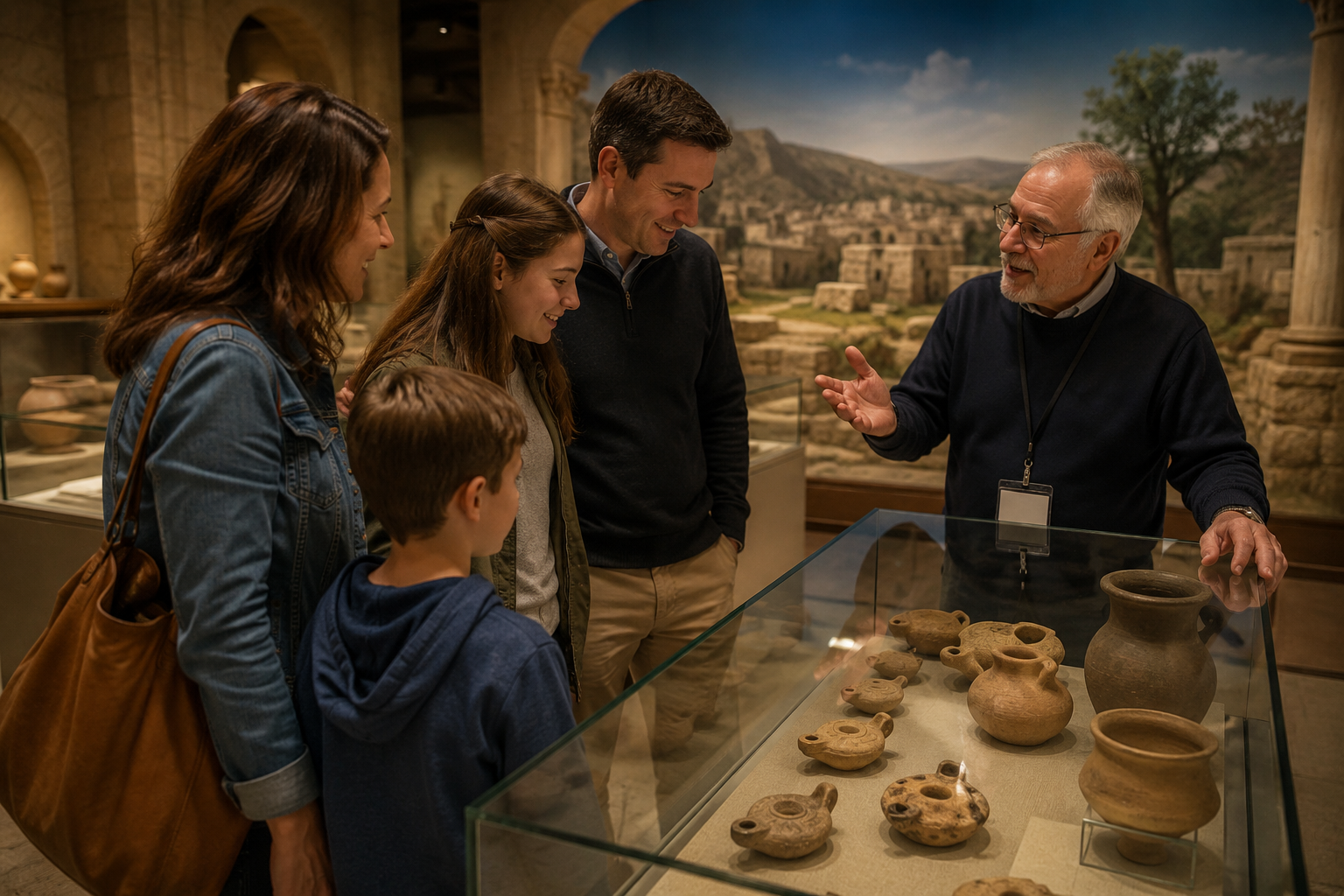
Most museum learning is cumulative: school partnerships deepen, docent programs improve, curriculum gets refined, and congregational relationships multiply. Donors who want more than a single high-attendance moment tend to remain when they see coherent educational strategy sustained over time.
For donors evaluating whether a ministry can carry a long horizon responsibly, verification work becomes a practical form of discernment. At Most Trusted, we evaluate ministries against The Most Trusted Standard, a 15-criteria framework across Faith Foundation, Financial Integrity, Governance and Leadership, and Transparency and Effectiveness.
Long-term partners want integrity under scrutiny, not performative certainty
Biblical museum ministries operate in a space where claims can be contested and mistakes can be costly. Christians genuinely disagree about how to balance devotional aims with academic norms, and even well-run institutions can face complex questions about interpretation, sourcing, and public communication. Long-term donors remain when a ministry demonstrates humility, procedural rigor, and clear accountability.
Provenance and acquisition ethics are not secondary issues
The last decade has taught the museum world that documentation gaps and acquisition shortcuts can unravel public trust. In the wider museum sector, the return of looted or illicitly traded artifacts has become a persistent issue, shaped by conflict, black markets, and changing legal frameworks. Donors who stay for the long term tend to support ministries that establish strict policies, submit to external expertise, and disclose what they can responsibly disclose.
These concerns are not limited to explicitly religious institutions. The scale of cultural property displacement is well documented; for example, UNESCO has repeatedly addressed illicit trafficking in cultural property as a global challenge, especially in conflict settings UNESCO. Wise donors ask whether a ministry’s acquisition and loan practices are designed to avoid complicity and to protect the integrity of the collection.
Interpretation must be both faithful and careful
Some museum visitors arrive with suspicion that any Christian institution will ignore evidence that complicates a preferred narrative. Others arrive with suspicion that scholarship will dissolve faith into mere history. A credible biblical museum ministry resists both distortions: it presents the Bible with theological conviction while acknowledging genuine interpretive questions, textual transmission history, and archaeological debates.
Donors who remain over time usually do not require a ministry to eliminate all ambiguity. They want it to tell the truth, to correct errors promptly, and to avoid overclaiming. That posture is not weakness. It is a form of moral seriousness befitting institutions that speak about sacred texts.
Strategic donors partner where governance and finances support the mission
Long-term partnership is an exercise in stewardship. Mature donors increasingly ask not only whether a ministry’s message is compelling, but whether its structure can faithfully carry that message for decades. Governance quality, financial discipline, and transparency are not administrative details; they are part of the ministry’s moral witness.
Financial integrity protects the work donors are trying to advance
Museum ministries often face real cost pressures: specialized staff, facility upkeep, conservation materials, security, and exhibit cycles. Donors who understand these dynamics are less prone to simplistic overhead assumptions and more attentive to whether spending aligns with mission and whether leadership communicates costs honestly.
The broader nonprofit field has had to correct the idea that low overhead is the primary indicator of effectiveness. Leaders from Charity Navigator, GuideStar, and the BBB Wise Giving Alliance jointly argued that overhead ratios can mislead donors and can even starve organizations of capacity they need to serve well Charity Navigator. Sophisticated Christian donors apply that insight by asking whether a biblical museum ministry is adequately resourced for compliance, collections care, and educational excellence.
Governance is where donor confidence becomes durable
Boards that provide real oversight, conflict-of-interest management, and clear leadership evaluation make long-term partnership possible. So do executive teams that treat transparency as a discipline rather than a marketing posture. Across our verification work, we observe that ministries meeting The Most Trusted Standard tend to document decision-making, publish meaningful program information, and create channels for accountability that persist even when leadership changes.
Donors also stay when governance aligns with theological identity. A museum ministry that claims to serve the church but is governed in ways that reward celebrity, obscure decision rights, or resist correction will eventually strain even generous supporters.
Enduring partnership grows from aligned expectations and shared responsibility
Long-term donors do not merely give; they commit to a relationship with clear expectations. For biblical museum ministries, that relationship often includes giving toward capital projects, underwriting scholarship, supporting school programming, or sustaining collections care. The best partnerships name the trade-offs openly: restricted gifts can limit flexibility, but unrestricted support can feel less tangible; scholarly candor can invite criticism, but defensiveness erodes credibility.
What prudent donors clarify before committing for the long term
These questions tend to separate enduring partnerships from fragile ones:
- How does the ministry articulate its doctrinal commitments and its approach to contested questions?
- What acquisition and loan policies govern provenance, documentation, and legal compliance?
- How does the ministry measure educational outcomes beyond attendance?
- What financial statements, annual reports, and governance disclosures are available to donors?
- Who holds decision authority for exhibitions, messaging, and institutional risk management?
Verification supports discernment without replacing spiritual judgment
Donors often ask whether third-party verification can resolve every uncertainty. It cannot, because some questions are theological, contextual, or prudential rather than technical. Verification can, however, reduce preventable risk by clarifying whether an organization meets basic standards of faith alignment, financial integrity, governance practice, and transparency.
That is why many donors engage Most Trusted when they are considering multi-year commitments. The Most Trusted Standard is designed to surface not only what a ministry claims but what its policies, disclosures, and leadership practices indicate over time. Donors who want to understand the specific considerations involved in this giving context often begin with Donor Partnership with Biblical Museum Ministries.
FAQs for Why donors partner long-term with biblical museum ministries
Do biblical museum ministries mainly serve tourists, or do they strengthen the church?
They can do both, but the ministries that earn sustained donor partnership usually demonstrate clear service to the church: curricula for schools and congregations, training for educators, and exhibits that support biblical literacy without sensationalism. Tourism can be a legitimate channel, yet long-term donors tend to look for evidence that the ministry’s public-facing work remains accountable to its stated Christian purpose.
What risks should donors weigh before making a multi-year commitment?
The most common risks involve governance weakness, inadequate transparency, and reputational exposure tied to acquisition ethics or public claims that overreach the evidence. Donors can reduce those risks by reviewing financial disclosures, board practices, conflict-of-interest policies, and the ministry’s approach to provenance and scholarly accountability. Long-term support is most prudent when a ministry can withstand scrutiny without becoming defensive or opaque.
Long-term partnership is a form of stewardship with institutional consequences
Biblical museum ministries reward long-term donors because the work is designed for endurance: careful stewardship of objects, honest interpretation of history, and patient formation of communities. Donors remain when a ministry’s theological commitments, governance, and transparency reinforce one another over time. That alignment does not eliminate every tension, but it does make sustained generosity a rational act of Christian stewardship rather than a leap of sentiment.



