
How Bible translation changes lives is not a sentimental claim; it is a theological and historical assertion about what God does when his Word is heard, understood, and received in the language of a people. The church has long treated Scripture not as a religious accessory but as the ordinary means by which the Spirit convicts, comforts, corrects, and builds up the saints (2 Timothy 3:16–17). Translation is where that conviction meets the realities of language, literacy, power, and trust.
Christian donors often ask for impact that can be verified without being reduced. That instinct is sound. The fruit of Scripture is measurable in some dimensions and inscrutable in others, and mature stewardship requires the humility to hold both. At Most Trusted, our work in verification does not treat Bible translation as above scrutiny, but it does treat it as a ministry category with unique timelines, risks, and evidentiary patterns.
Translation is not a technical service but a theological act
God speaks in human language
The Christian faith is not built on private mystical experience but on public revelation: God speaks, and his people hear. Scripture presents God’s Word as intelligible speech addressed to real communities in real settings. The incarnation itself dignifies the particularity of human language and culture. When the church translates Scripture, it is not updating a product; it is extending access to the same apostolic Word across linguistic boundaries.
This theological claim has practical consequences. A credible translation ministry will treat translation as both linguistic precision and ecclesial responsibility. That typically means a process that includes trained translators, careful exegesis, community testing, review by mother-tongue speakers, and meaningful engagement with local churches. Donors should not be surprised that the most faithful work is slow, and that “speed” is not a virtue when it produces error or mistrust.
Clarity is not the enemy of reverence
Some Christians worry that translation into heart languages risks losing sacredness. The New Testament itself pushes in the opposite direction. At Pentecost, the sign was not that everyone heard one holy language, but that “each one was hearing them speak in his own language” (Acts 2:6). The miracle was intelligibility. Translation work that honors meaning, genre, and theological precision can deepen reverence because the hearer is no longer guessing at what God has said.
Christians genuinely disagree about specific translation philosophies—formal equivalence, functional equivalence, and various hybrid approaches—because each carries trade-offs. Mature ministries acknowledge those trade-offs explicitly, invite appropriate external review, and choose methods that match the linguistic realities of the target language rather than donor preferences in English.

Lives change first where understanding becomes possible
Comprehension reshapes discipleship
When Scripture is accessible in a language people actually use for daily life, discipleship becomes less dependent on a gifted intermediary. That does not diminish the church’s teaching office; it strengthens it by grounding preaching, catechesis, and pastoral care in shared texts that ordinary believers can test and revisit. It also changes household faith. When parents can understand Scripture, family worship is no longer an imported practice managed by outsiders; it becomes a local pattern sustained over time.
Translation ministries often describe this as “ownership,” and the language can sound like branding. Yet the underlying idea is sound: sustainable discipleship requires a community that can read, hear, and internalize Scripture without perpetual external scaffolding.
Access is broader than printing Bibles
The modern translation movement has had to reckon with the practical barriers that sit downstream from a finished text. Literacy, audio formats, disability access, distribution channels, and security concerns in closed contexts all shape whether a translation actually reaches people. Digital platforms can help, but they also introduce surveillance and control risks that donors may not see.
Even basic global literacy constraints matter for impact expectations. UNESCO has estimated that hundreds of millions of adults worldwide still lack basic literacy skills, which is why audio Scripture, storying approaches, and oral Bible translation have become central to contemporary practice UNESCO. A donor’s question is not merely “Is a translation complete?” but “Can people actually receive it in the form they can use?”
Impact should be evaluated with both spiritual seriousness and empirical discipline
What is measurable and what should not be forced into metrics
Some outcomes are observable: the completion of translation milestones, the training of local translators, the production of audio editions, and the adoption of texts by local churches. Other outcomes—repentance, perseverance, reconciliation—are real but not reducible to dashboards without distorting the thing being measured. Christian donors do not serve the church by demanding the kind of attribution models that may be appropriate in commercial settings but are misaligned with spiritual formation.
What this means in practice is that responsible ministries should provide evidence in layers: process integrity, outputs, adoption indicators, and credible stories grounded in identifiable contexts. They should also be candid about what cannot be claimed. The desire for impressive conversion counts can tempt ministries to exaggerate or to credit translation for changes better attributed to local evangelism and church planting.
Translation timelines require a different stewardship lens
Bible translation is often multi-year work. That is not inefficiency; it is the cost of accuracy, testing, and community trust. Donors who prefer short reporting cycles can still practice disciplined giving, but it requires patience and a willingness to evaluate progress markers rather than only end-state results.
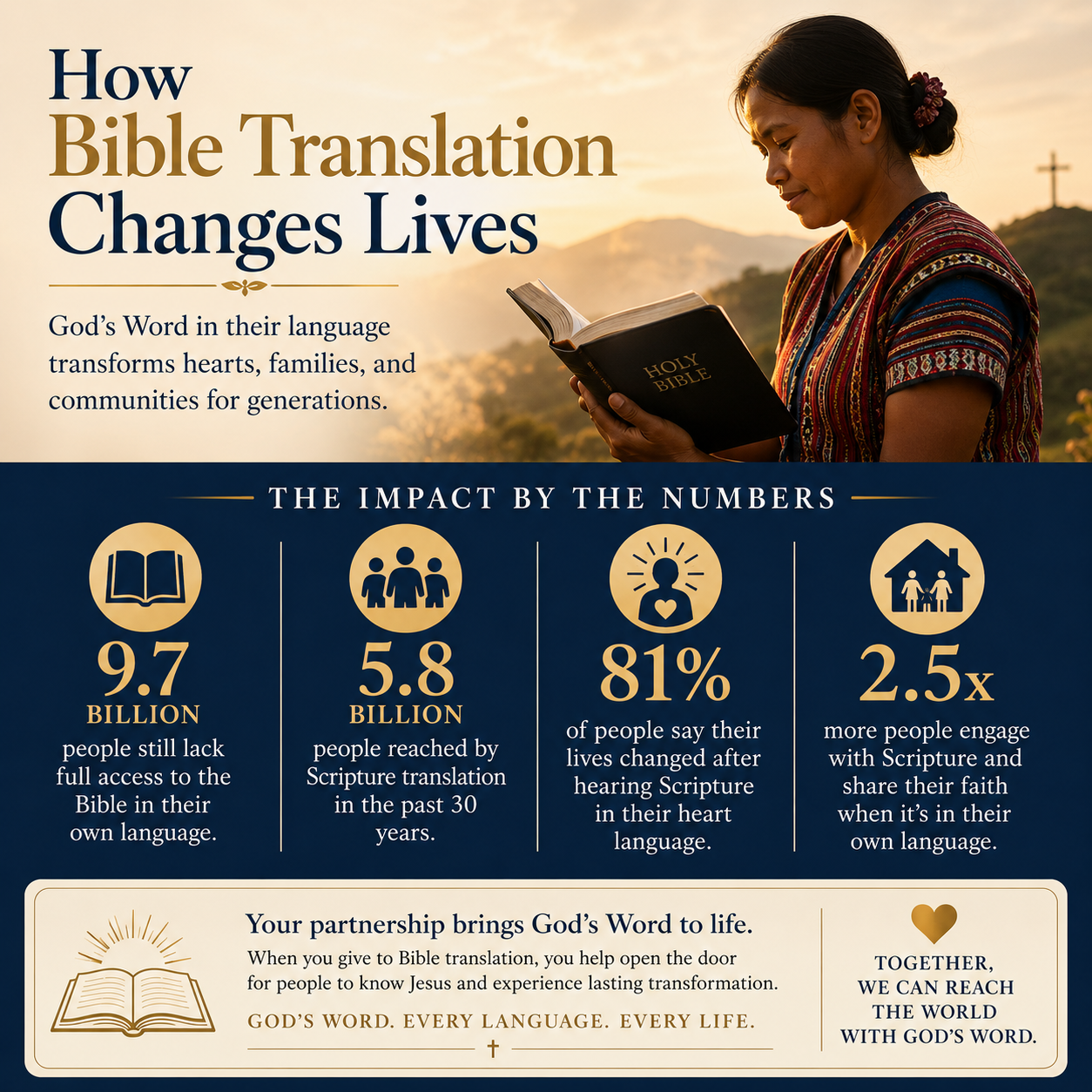
Across the broader field, the scale of remaining translation need is often summarized by the idea of “languages without Scripture.” The most widely cited estimates come from organizations that track language data and translation status, such as SIL and its Ethnologue research ecosystem SIL Global. Donors should treat any single number carefully, because definitions vary: “having Scripture” may mean a complete Bible, a New Testament, or selected portions, and the pastoral significance of each differs by context.
- Milestones achieved against a published translation plan and timeline
- Evidence of qualified review processes and community checking
- Local church involvement and adoption, not only external distribution
- Language-appropriate delivery, including audio where literacy is low
- Clear, bounded claims about outcomes, with appropriate humility
Healthy translation movements are marked by local authority and accountable governance
Local leadership is not optional
The history of missions includes both remarkable faithfulness and real harm when outsiders controlled resources and decisions without accountability to local believers. Bible translation is not immune. A translation that is not trusted by local churches, or that is perceived as imposed, may exist on paper without bearing fruit in the life of a community.
Credible ministries increasingly structure translation teams to ensure mother-tongue speakers are central, and that the work is accountable to local church bodies where possible. The harder question is how Western funding patterns can unintentionally distort local priorities. Financial dependency can pressure leaders to promise faster outcomes or to accept methods they would not choose if they held the purse strings.
Verification matters because the work is spiritually consequential
For donors, the question is not whether a ministry uses spiritual language; it is whether the ministry’s practices warrant trust. This is where independent verification can serve the church. At Most Trusted, we evaluate ministries against The Most Trusted Standard, a 15-criteria framework spanning Faith Foundation, Financial Integrity, Governance and Leadership, and Transparency and Effectiveness. Translation ministries that meet these criteria tend to show a disciplined relationship between mission claims and operational realities: clear doctrinal commitments, appropriate board oversight, responsible financial reporting, and truthful communication about progress and setbacks.
Donors who want to give with confidence should also understand the broader ecosystem. Translation work often involves partnerships—between translation agencies, local denominations, academic linguists, and distribution platforms. Partnerships can be wise stewardship, but they complicate accountability. A mature donor asks who holds final authority, who owns the text, how disputes are resolved, and how safeguarding and security are handled for local believers in high-risk contexts. Many of these questions intersect directly with Bible Translation Ministries as a field, not only with one organization.
Wise donors support translation work that is truthful, patient, and church-centered
What faithful support can look like
Translation can be underfunded because it is less visible than construction projects or relief distributions. Yet it often undergirds everything else: preaching, theological training, children’s ministry, and long-term discipleship. Donors who care about sustainable Christian witness should consider translation as foundational infrastructure for the life of the church.
Support should be structured in ways that reduce pressure to overpromise. Multi-year commitments tied to clear milestones can be more faithful than one-time gifts tied to dramatic stories. Funding for training and capacity-building often produces more durable impact than funding only for deliverables that photograph well.
Questions that protect both the donor and the ministry
Serious donors do not ask questions because they are suspicious; they ask because they understand stewardship and the reality of temptation. The following questions tend to clarify whether a translation ministry is prepared to be accountable without being performative:
- Who are the mother-tongue translators, and what training and review do they receive?
- What translation philosophy is used, and how are theological terms handled in the target language?
- How do local churches participate, and what evidence exists of adoption and trust?
- What are the ministry’s most common reasons for delay, and how are delays communicated?
- What financial reporting is available, and how are restricted funds handled?
Many donors also want a clearer view of how ministries define and report impact over time. That is a legitimate desire, and it is addressed more directly in How Bible Translation Ministries Measure Impact, where the emphasis is on verifiable practices rather than persuasive narratives.
FAQs for How Bible translation changes lives
Does Bible translation itself cause church growth?
Translation is rarely the sole driver of growth, and ministries should be cautious about claiming direct causation. Scripture ordinarily works through preaching, evangelism, discipleship, and the gathered life of the church. Translation changes the conditions of possibility: it makes durable teaching, correction, and worship accessible in a community’s own language. Wise donors expect translation ministries to describe contribution rather than claim exclusive credit.
What should donors watch for when ministries report translation impact?
Donors should look for integrity in both process and claims: clear milestones, credible review practices, local church adoption, and delivery formats suited to literacy realities. They should also watch for overconfident numbers, vague attribution, or stories that cannot be anchored to identifiable communities and partners. The most trustworthy ministries speak plainly about constraints—security, politics, literacy, and funding pressures—without using them as excuses.
Translation changes lives because it changes what can be heard and obeyed
Scripture’s transforming power is not a theory the church tests; it is a promise the church receives. Bible translation changes lives in the most basic way: it makes the Word of God present and intelligible where it was previously distant or mediated. For donors, the calling is to support this work with patience, rigor, and a refusal to trade truth for inspiring claims. Ministries worthy of trust will welcome that posture, because they understand that the stakes are not only organizational credibility but the faithful transmission of God’s Word to his people.



