
Multi-year funding is not a luxury for Bible translation ministries; it is often the difference between faithful completion and costly disruption. The work is slow because it is pastoral, linguistic, and communal at once, and it carries obligations to local churches that cannot be met on a twelve-month fundraising horizon.
Christian donors frequently prefer annual decisions because they feel prudent and responsive. Yet the very characteristics that make Bible translation trustworthy—careful exegesis, community checking, testing for comprehension, and long-term partnership with local believers—are precisely what make short-term funding a poor fit. Stewardship is not only about avoiding waste; it is also about sustaining the conditions under which durable fruit can grow.
Bible translation is a long obedience with many dependent steps
Translation is a process, not a product order
A serious translation project is a chain of interdependent work: language analysis, orthography and literacy work where needed, drafting, review, back-translation, consultant checks, community testing, revision, publication, and distribution. These steps cannot be compressed without risking accuracy or acceptance. When funding breaks, teams do not simply “pause.” They lose trained staff, vendor relationships, and the trust that makes community review possible.
Theologically, this is an unsurprising dynamic. Scripture itself depicts patient formation: “Let us not grow weary of doing good, for in due season we will reap, if we do not give up” (Galatians 6:9). Bible translation ministries embody that “due season.” The time horizon is not an inefficiency to be eliminated; it is often the cost of doing the work with integrity.
Human capital is fragile when support is volatile
Translation depends on people with rare skills: mother-tongue speakers trained in translation principles, exegetical advisors, literacy specialists, and project managers who can coordinate teams across geographies. When support is renewed year to year, ministries are incentivized to carry fewer long-term commitments, limit training pipelines, and delay hiring until funds are in hand. The result is predictable: momentum slows, the work becomes more expensive, and local partners bear the relational cost.
Across our verification work at Most Trusted, we observe that ministries meeting The Most Trusted Standard tend to name their staffing model clearly: how they recruit, train, retain, and supervise translators and reviewers over multiple years. Where this clarity is missing, the risk is not merely inefficiency; it is instability that can compromise quality.
Short-term funding quietly shapes theology, governance, and decisions
Annual fundraising pressures can distort incentives
Most translation leaders want to report tangible progress each year, and donors understandably want to see evidence of impact. The harder question is how a ministry behaves when a complex linguistic or theological issue slows the draft. If the budget depends on showing visible output every twelve months, teams may feel pressure to prioritize speed, publication, or visibility over the careful review that protects communities from error and protects Scripture from mishandling.
This is not an accusation; it is an incentive structure. Christians genuinely disagree about the right balance between speed and precision, and the field has had to reckon with real debates over translation philosophy, review rigor, and community authority. Multi-year funding does not settle those debates, but it reduces the temptation to let fundraising timelines make theological decisions by default.
Governance works best when leaders can plan beyond the next appeal
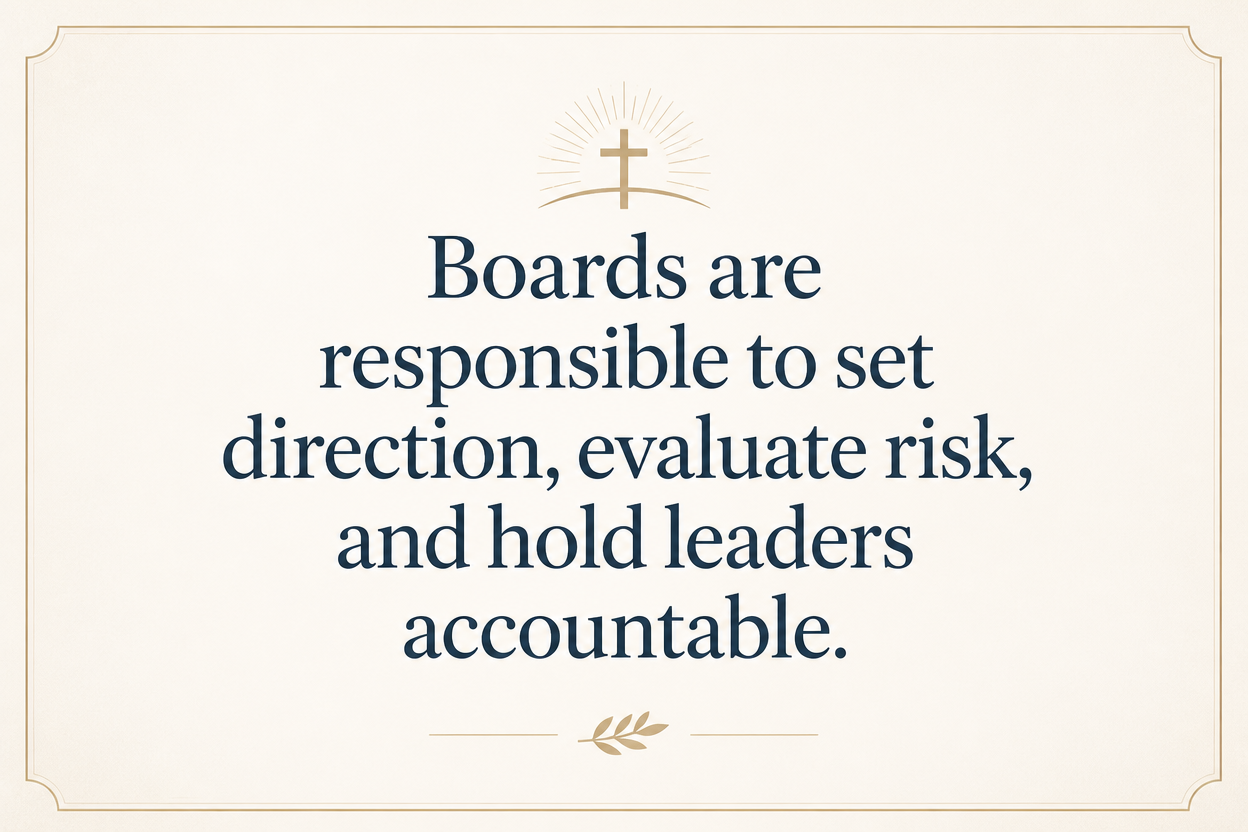
Boards are responsible to set direction, evaluate risk, and hold leaders accountable. When the budget is perpetually uncertain, governance becomes reactive. Strategic planning collapses into short-term cash management, and leaders may avoid necessary investments—training, security protocols, technology, or external audits—because they do not “fit” a single fiscal year.
In our evaluation of Bible Translation Ministries, we look for evidence that the ministry’s board and leadership can speak coherently about long-range plans, risk management, and program integrity. A multi-year revenue base makes those responsibilities meaningfully possible.
The economics of translation are lumpy, and annual giving rarely matches them
Costs come in waves, not in steady increments
Some expenses are predictable: salaries, consultant support, local travel, and ongoing community review. Others are irregular and substantial: major training events, specialized software licensing, large print runs, audio production, or the development of literacy materials for languages without a robust written tradition. Annual funding that rises and falls can force ministries to delay these pivotal investments, even when they are essential to the project’s long-term success.
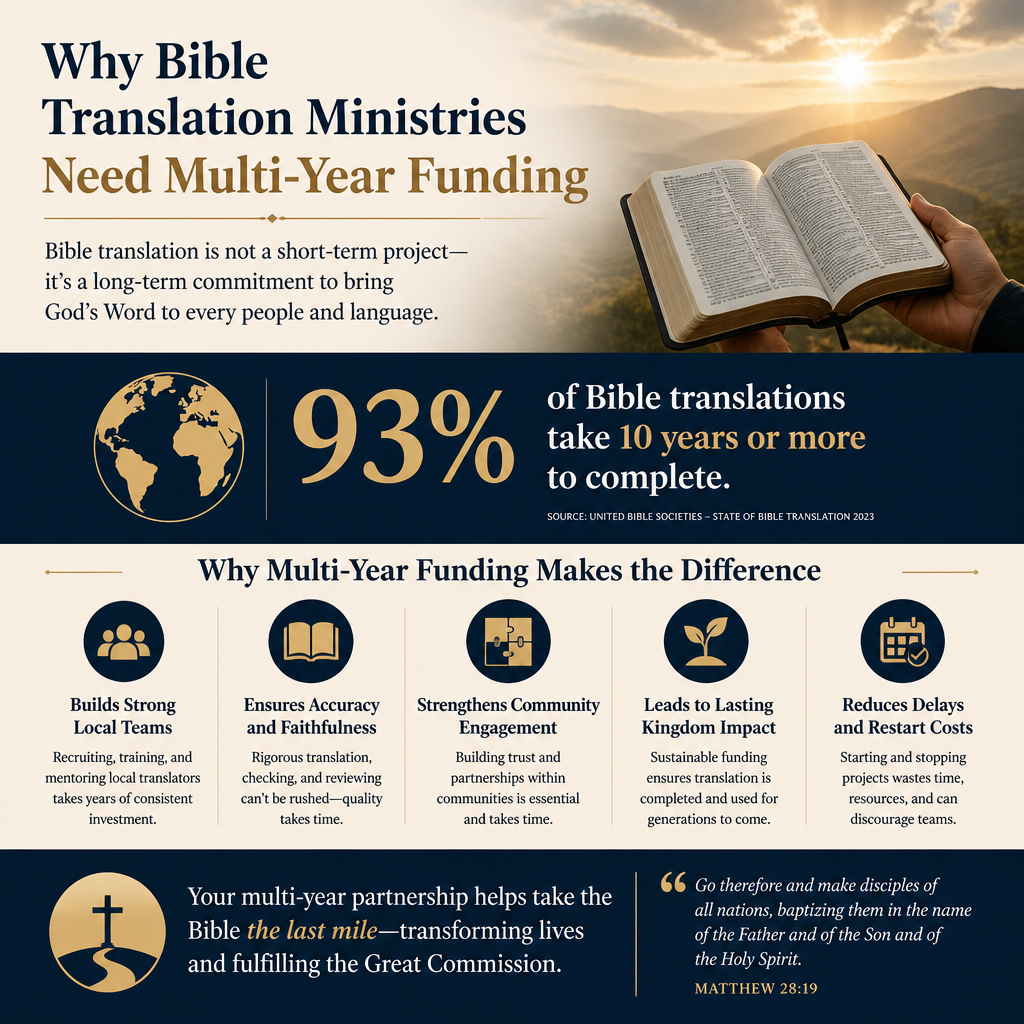
Multi-year commitments create room to align the budget with real project milestones rather than with the donor calendar. That alignment is not merely administrative. It is how ministries avoid the “start-stop” pattern that consumes time and erodes trust with local churches.
Cash flow stability reduces hidden waste
Donors sometimes assume that shorter commitments reduce waste. In practice, volatility often increases it. Recruiting and training new team members because prior staff could not be retained is expensive. Rebuilding community engagement after a pause is relationally costly. Re-negotiating contracts and restarting logistics can consume months that do not translate a single verse.
Philanthropy research has repeatedly shown that many nonprofits are structurally pressured toward underinvestment and fragility when funding is restricted or short-term. For a classic articulation of this “nonprofit starvation cycle,” see Stanford Social Innovation Review’s discussion of how overhead constraints can undermine effectiveness Stanford Social Innovation Review. Bible translation is not exempt from these dynamics; it may be especially vulnerable because quality depends on long-term, skilled labor.
Multi-year funding protects local ownership and long-term Scripture engagement
Translation is a covenantal partnership with local believers
Healthy translation work treats local churches and language communities as partners, not as recipients. That partnership includes shared decision-making, community checking, and ongoing Scripture engagement so that a translation is not merely published but actually received and used. Short-term funding can subtly re-center the project around outside timelines and donor expectations, because the ministry must keep the fundraising engine running.
Multi-year funding is one way donors can honor local agency. It tells local partners, in effect, that we will not disappear if progress is slower than expected, if political conditions change, or if the community requires more review time to reach confidence.
Distribution and engagement are not afterthoughts
Donors often focus on the moment of publication. Yet the Christian aim is not “a book delivered”; it is the Word of God heard, understood, and obeyed. That requires teaching, audio formats for oral cultures, durable access strategies, and collaboration with churches for long-term discipleship. Those efforts are rarely funded well if donors treat translation as a one-time deliverable.
Even in settings where literacy rates are rising, Scripture engagement can take years to mature. For perspective on global literacy measurement and the slow work involved in building reading proficiency across populations, see UNESCO’s literacy resources UNESCO. Ministries should not use literacy statistics as marketing, but donors should understand that translation and engagement often move at the pace of real human learning.
What discerning donors should ask before making a multi-year commitment
Multi-year funding is not blind trust
Longer commitments should be paired with clear expectations, measurable milestones, and governance safeguards. Mature generosity does not confuse faith with naiveté. What this means in practice is that donors can offer stability while still requiring transparency.
When donors evaluate ministries, we recommend questions that reveal whether multi-year funding will be stewarded with integrity. The goal is not to micromanage translation decisions but to ensure the ministry is competent, accountable, and spiritually grounded.
- What is the ministry’s translation philosophy, and how does it safeguard accuracy and clarity for the intended audience?
- How are local church leaders and community reviewers involved, and what authority do they have in revisions?
- What are the project’s major milestones for the next 24 to 60 months, and what would cause a timeline revision?
- How does the ministry protect staff and local partners in sensitive contexts, and how does it report on risk responsibly?
- What financial reporting is available, and does the ministry explain how donor funds connect to program outcomes?
Verification helps donors distinguish stability from complacency
Some donors worry that multi-year funding reduces urgency. That concern is understandable. The answer is not to return to annual volatility, but to support ministries that can demonstrate discipline: clear strategy, strong governance, transparent reporting, and credible measures of progress.
Most Trusted exists to serve that discernment. We evaluate Christian nonprofits against The Most Trusted Standard, a 15-criteria framework spanning faith commitments, financial integrity, governance and leadership, and transparency and effectiveness. Donors who want a broader view of the field can explore Bible Translation Ministries as a category, and those focused on financial models can review How Bible Translation Ministries Are Funded to see common funding patterns and the questions they raise.
FAQs for Why Bible translation ministries need multi-year funding
Is multi-year funding only appropriate for large, established Bible translation organizations?
No. Smaller and newer organizations may need stability even more, but they should be asked for proportionate evidence of readiness: qualified translation and review processes, accountable leadership, credible local partnerships, and transparent financial reporting. Multi-year commitments can be structured with milestone-based disbursements, so stability does not mean lack of accountability.
How can donors structure multi-year giving without losing flexibility?
Many donors use a written pledge with annual review points, or fund a defined set of project milestones over two to five years while requiring regular reporting. Some pair unrestricted support for core operations with a designated amount for a specific language project. The key is to provide predictable cash flow while keeping expectations clear and governance respected.
Why long-term commitments fit the moral logic of the work
Bible translation ministries ask communities to trust that the words they receive truly carry the meaning of the Word God has given. That trust is earned through rigor, humility, and time. Multi-year funding matches that moral logic. It honors the patient labor required for accuracy, protects local ownership, and reduces the hidden waste that comes from instability.
For Christian donors, the question is not whether a multi-year commitment feels comfortable. The question is whether it is faithful to the nature of the work and to the people who will live under its fruit for generations.



