

How Bible engagement ministries share impact updates shapes whether donors can give with confidence or only with hope. Because Scripture itself calls God’s people to steward resources wisely, the question is not whether updates feel inspiring, but whether they are truthful, intelligible, and tethered to the ministry’s actual work and accountability.
In Bible engagement, the temptation is subtle: to confuse distribution with discipleship, attention with transformation, and moving stories with representative outcomes. Mature donors know that God measures fruit in ways a spreadsheet cannot, yet they also know that the Church has suffered when ministries treated transparency as optional. Impact updates are one of the primary places where trust is either strengthened or quietly eroded.
Impact updates are a stewardship practice before they are a marketing practice
Scripture’s categories for faithfulness include honesty and careful witness
Christian ministry communication is not morally neutral. Scripture’s warnings about deceptive weights and measures and its insistence that our “yes” be “yes” speak directly to how ministries represent results, costs, and constraints. Impact reporting is not merely a donor service; it is part of a ministry’s witness. When updates are selective, exaggerated, or ungrounded, the damage is not only financial. It is spiritual and ecclesial.
At the same time, Bible engagement has distinct complexities. Growth in biblical literacy, conviction, repentance, perseverance, and love for neighbor does not map neatly onto a single metric. Christians genuinely disagree about what “success” should mean in discipleship-oriented work: depth versus breadth, church-centered formation versus para-church programming, or measurable outcomes versus long-term faithfulness. These tensions do not excuse vagueness; they require clarity about what the ministry is claiming.
What donors are actually asking for is credible specificity
Most donors are not asking for perfection. They are asking for coherence: a ministry’s stated theory of change, its programs, its reported outputs and outcomes, and its finances should align. The most trustworthy updates name both what is encouraging and what is unfinished, and they describe the guardrails that keep enthusiasm from becoming overclaim.
This is one reason we built Most Trusted as an independent verification service for Christian nonprofits. Across our verification work, we observe that ministries that meet The Most Trusted Standard tend to treat impact updates as an extension of governance, financial integrity, and theological seriousness, not a seasonal fundraising artifact.

Strong updates distinguish outputs from outcomes without disparaging either
Outputs show activity and reach
Bible engagement ministries frequently have legitimate, reportable outputs: Scripture portions translated, Bibles distributed, study guides produced, small groups convened, training sessions delivered, reading plans completed, or app downloads. These are not trivial. They describe what the ministry actually did with donor resources.
The danger comes when outputs are framed as if they were spiritual outcomes. “We distributed 50,000 Bibles” is not the same claim as “50,000 people are now reading Scripture,” and that is not the same as “50,000 people are being formed into disciples.” Ministries earn trust when they keep these categories distinct and explain how one is expected to lead to the next.
Outcomes require defined indicators and patient humility
Outcomes can be measured, but they require more careful design: pre- and post-assessments of biblical knowledge, retention of Scripture reading habits over time, participation persistence in groups, reported behavior change, or church connection. Even then, causality is difficult. A ministry may contribute to growth without being the primary driver, and spiritual formation often unfolds over years.
Donors can handle that complexity. What they cannot responsibly support is a ministry that implies certainty where none exists. In practice, the most credible updates include a few well-chosen indicators and then interpret them cautiously. They name limitations in data collection, response bias, and what the ministry cannot see.
For donors who want a broader view of how Bible engagement ministries think about mission and accountability, we maintain a dedicated resource on Bible Study and Engagement Ministries that reflects patterns we see across the field.
Responsible Bible engagement reporting includes narrative, but refuses manipulation
Stories should be representative, not merely dramatic
Testimonies belong in Christian impact communication because God works in particular lives, not only in aggregate numbers. Yet stories can also become a form of pressure: the most emotionally intense account becomes the implied norm, and donors are left to assume that every gift produces similar results.
Trustworthy ministries use narrative to illuminate the work without turning people into fundraising assets. They protect dignity through informed consent, appropriate anonymity, and cultural humility. They also place stories alongside data so that a donor can see whether a testimony is typical, exceptional, or still in progress.
Ethics in communication is part of effectiveness
In Christian ministry, “effectiveness” cannot be reduced to outcomes alone. Means matter. Reporting that trades on shame, sensationalizes trauma, or implies that donors are rescuers rather than partners in God’s work may raise money, but it forms the Church poorly.
Many ministry leaders have been influenced by the When Helping Hurts framework articulated by Steve Corbett and Brian Fikkert, which critiques approaches that inadvertently reinforce dependency or savior narratives. The same moral logic applies to storytelling: if communication practices distort the donor’s posture or the recipient’s dignity, the ministry is not only risking reputation; it is violating a biblical vision of neighbor love.
Donors should expect transparency about money, governance, and trade-offs
Financial clarity is not reducible to overhead ratios
Some donors still ask for a single “overhead percentage” as the proof of trustworthiness. The sector has rightly pushed back on that simplification. The “Overhead Myth” letter signed by GuideStar, Charity Navigator, and the BBB Wise Giving Alliance warned that overhead ratios are a poor proxy for performance and can pressure nonprofits to underinvest in systems and people that protect mission integrity GuideStar.
Nevertheless, transparency about money is non-negotiable. Bible engagement ministries should explain major expense drivers such as translation work, technology development, curriculum production, staff training, safeguarding, and field partnerships. Mature donors are willing to fund infrastructure when it is clearly tied to faithful execution and accountability.
Governance and risk are part of impact
Impact updates often omit governance, as if boards, controls, and ethics are administrative distractions from “real ministry.” That omission is costly. A Bible engagement ministry operating internationally may face risks related to partner selection, restricted contexts, data privacy for app users, or the safety of local believers. Donors should not be asked to fund expansion without understanding how these risks are managed.
Across The Most Trusted Standard, we treat governance and leadership health as inseparable from effectiveness. A ministry can distribute materials at scale and still fail its calling if it lacks accountability structures, tolerates conflicts of interest, or cannot answer basic questions about decision-making and oversight.
- Clear claims that separate outputs, outcomes, and hopes for long-term fruit
- Defined indicators that match the ministry’s actual programs and target populations
- Financial transparency that explains major costs without hiding behind simplistic ratios
- Risk disclosure appropriate to the context, including safeguarding and partner integrity
- Learning posture that reports what did not work and what is being changed
Practical formats ministries use and what donors should look for
Annual reports and audited financials
The annual report remains the most common vehicle for consolidated impact updates. Strong reports integrate program results, financial statements, and governance highlights rather than treating them as separate worlds. When a ministry claims significant scale or handles complex funding, donors should look for audited financials and clear notes about accounting practices and restricted funds.
Donors should also expect consistency over time. A ministry that changes metrics every year without explanation may be chasing what is most flattering rather than what is most faithful. Stability in reporting categories, coupled with thoughtful refinement, is often a sign of maturity.
Field updates and digital dashboards
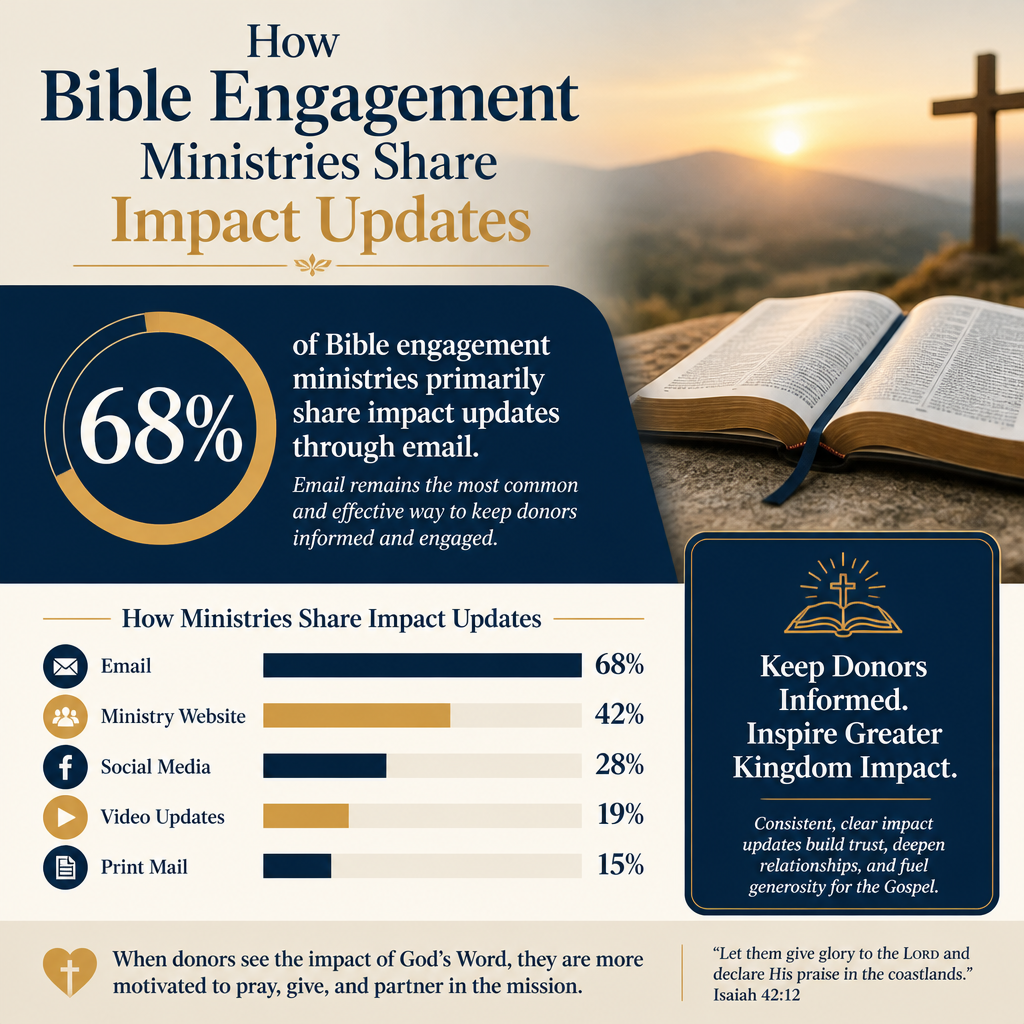
Quarterly field updates can deepen trust when they report progress against specific objectives, not merely travel narratives or highlights. Digital dashboards can be helpful when they are interpreted responsibly and do not tempt the ministry to equate web analytics with spiritual engagement. App-based ministries, for example, may report active users or reading plan completions, but donors should still ask how those signals relate to discipleship and church connection.
For donors evaluating the credibility of various approaches to measurement and reporting, we maintain resources on How Bible Study and Engagement Ministries Measure Impact that reflect what we examine when we verify ministries against The Most Trusted Standard.
FAQs for How Bible engagement ministries share impact updates
Should Bible engagement ministries report conversion numbers or discipleship outcomes?
They should report what they can responsibly know, and they should be explicit about how they know it. Conversion claims are especially prone to overstatement because attribution is difficult and definitions vary across contexts. Discipleship outcomes can be reported through defined indicators such as sustained Scripture engagement, participation persistence, or demonstrated learning, but ministries should describe limitations, sampling, and how they avoid inflating results.
What is a reasonable level of detail for donors who cannot evaluate complex data?
A strong update offers layered transparency: a clear summary for most readers, with access to deeper documentation for those who want it. Donors should be able to understand the ministry’s core claims, major expenditures, and governance safeguards without specialized expertise, while still having the option to review audited financials, methodologies, and program evaluations when warranted.
Trustworthy impact updates tell the truth with the patience discipleship requires
Bible engagement ministries serve the Church when they report impact with reverence for truth, respect for people, and clarity about what can and cannot be measured. Donors, in turn, are freed to give not on sentiment alone but on credible evidence aligned with biblical stewardship. The ministries most worthy of sustained support are rarely those with the most dramatic numbers; they are those willing to make careful claims, show their work, and submit their story to accountability.



