
How Bible distribution ministries deliver Bibles safely is not a secondary operational concern; it is a theological and pastoral question with real human consequences. When Scripture crosses borders and checkpoints, ministries must weigh speed against discretion, visibility against protection, and donor expectations against the lived risk of local believers.
Christian donors often want a clear story: the Bible printed, shipped, and placed into grateful hands. In many places that story is substantially true. In others, the work resembles a supply chain designed under moral constraint, where one imprudent decision can expose pastors, house churches, and recipients to surveillance, job loss, imprisonment, or violence. The ministry that loves the Word must also love the people who receive it.
Safety begins with a sober theology of risk and responsibility
Scripture commends bold witness, and the church has never advanced without courage. Yet the New Testament also assumes prudence: Jesus instructed his disciples to be “wise as serpents and innocent as doves” (Matthew 10:16). Bible distribution ministries live in that tension. Reckless exposure can become a form of presumption, especially when the cost is paid by local Christians rather than visiting teams or distant donors.
Risk is not evenly distributed
In restricted contexts, the most significant risk frequently falls on nationals: the pastor who stores cartons, the believer who carries copies to a village, the worker whose phone is searched at a checkpoint. Donors may be insulated from these realities, but ministries should not be. Mature organizations can articulate who bears which risks and what safeguards are in place.
Legal categories are morally significant but not morally final
Some nations permit importation of Bibles for personal use while restricting distribution; others ban certain translations or require registration. Law is not identical to justice, but legal exposure has predictable consequences for vulnerable communities. Responsible ministries distinguish between ordinary civil compliance, wise discretion, and actions that knowingly trigger persecution. Christians genuinely disagree about where prudence ends and compromise begins, which is why credible ministries explain their posture rather than trading on ambiguity.
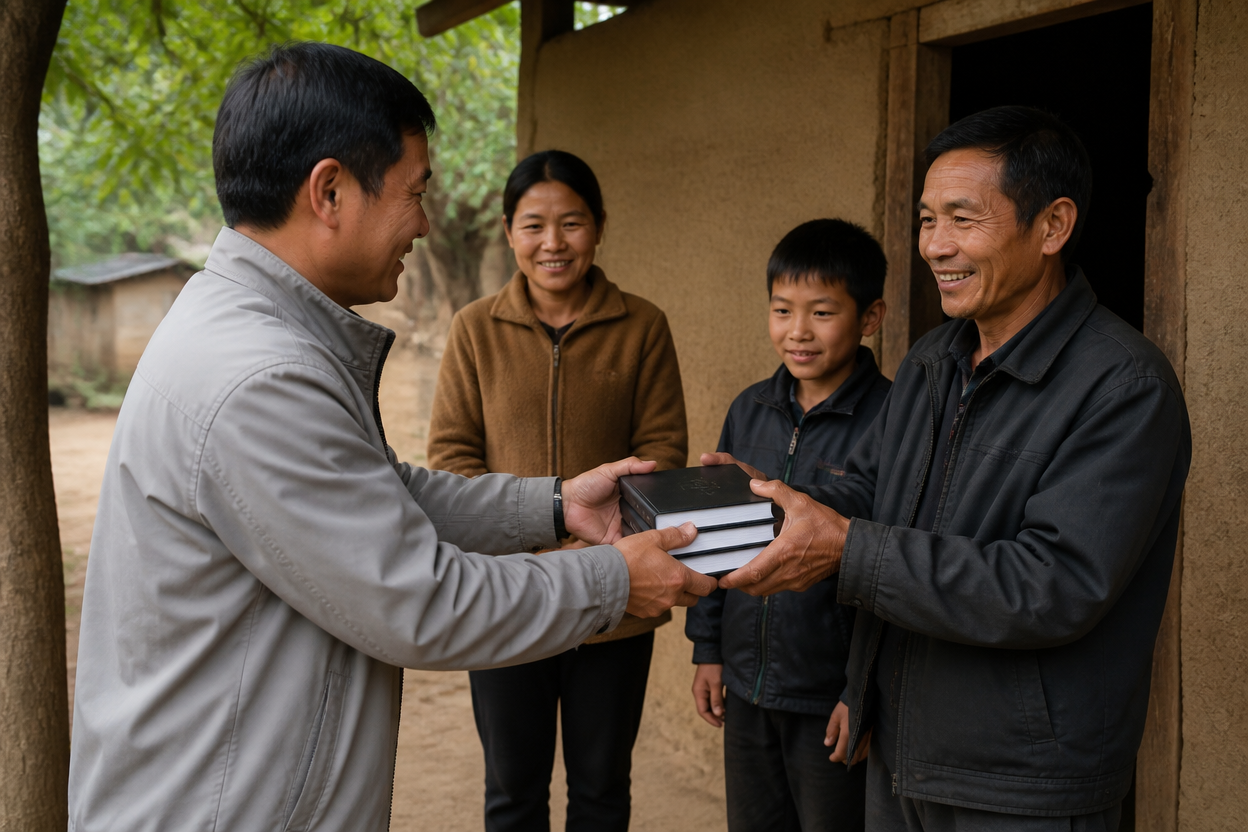
Secure distribution is a disciplined logistics problem with a pastoral goal
Many donors assume Bible distribution is primarily a printing problem. In practice, safe delivery is often a sequencing problem: how materials move, who touches them, where they pause, and what records exist. Even in open countries, theft and diversion are real; in restricted countries, visibility itself can be the danger.
Ministries often combine multiple delivery channels
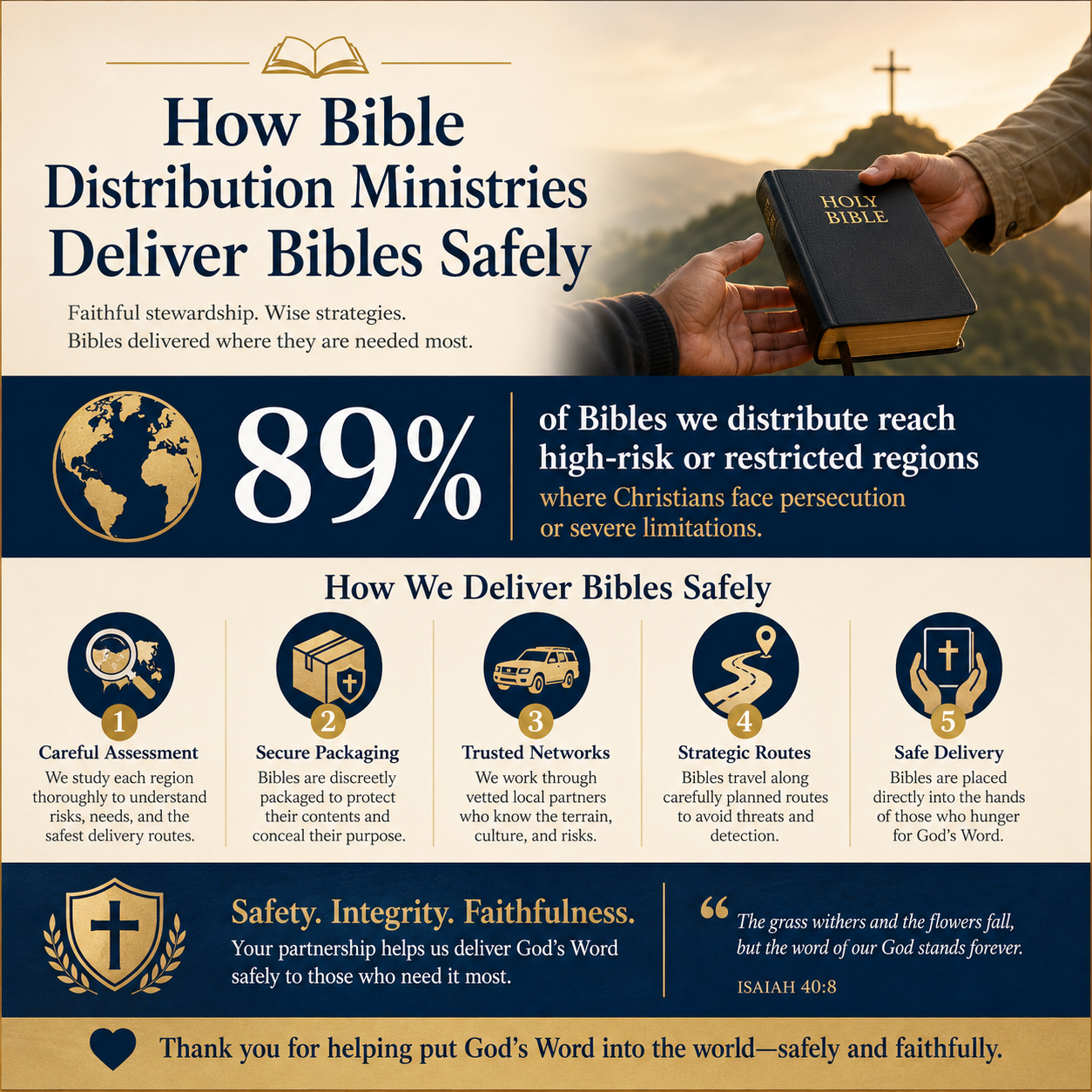
No single method works everywhere. Organizations commonly blend legal importation, local printing where permitted, partnerships with in-country churches, and discreet last-mile delivery. Each approach has trade-offs in cost, speed, and exposure. Local printing can reduce border risk but may increase exposure to domestic monitoring. Importation can be efficient but creates chokepoints.
Chain of custody matters because people matter
In high-risk settings, “tracking” cannot mean a donor-facing dashboard that reveals names, addresses, or routes. Yet accountability still matters. The best ministries maintain internal controls—batch numbers, restricted access storage, dual-signature release processes—while protecting identities. Safety-focused accountability is not the same as publicity.
- Need-based allocation informed by vetted local church networks rather than open sign-up lists
- Compartmentalization so no single worker holds full route or recipient information
- Secure storage with controlled access, especially when shipments arrive in bulk
- Low-profile transport that avoids predictable patterns and unnecessary markings
- Documentation discipline that satisfies governance without creating a searchable map of believers
Local partnership is the core safety mechanism and the core ethical question
Safe Bible delivery is rarely accomplished by outsiders acting alone. It is sustained by local churches and trusted Christian leaders who understand language, custom, and pressure points. This is where donors should ask the most careful questions, because partnership can either honor local agency or unintentionally instrumentalize it.
Vetting partners without endangering them
Vetting is essential, but it must be conducted in a way that does not create incriminating records. Mature ministries rely on layered verification: reputation within a recognized church network, historical reliability, doctrinal clarity, and demonstrated capacity to distribute discretely. They also avoid pressuring partners to produce photos or stories that could be used against them.
Avoiding the temptations of donor-driven storytelling
Christian fundraising often rewards vivid detail. In restricted contexts, vivid detail can be a threat. Ministries should be willing to disappoint donors who want names, faces, GPS points, and dramatic narratives. Safety sometimes requires general reporting, delayed reporting, or anonymized reporting. This is not evasiveness; it is love of neighbor expressed as restraint. For donors seeking a broader view of the field, our coverage of How Bible Distribution Ministries Reach the World names common models without asking ministries to compromise the people they serve.
Digital distribution expands access but introduces surveillance risk
Smartphones have widened the reach of Scripture through audio Bibles, apps, and offline files. Yet digital reach is not synonymous with digital safety. Where phones are monitored, data is subpoenaed, or platforms are filtered, the same tools that deliver Scripture can expose the listener.
Threat models differ by country and by user
In some places the primary concern is platform blocking; in others it is device searches, social graph mapping, or informant networks. Ministries that distribute digital Scripture responsibly articulate a threat model: who could be harmed, how, and what mitigation is realistic. They may use offline sharing methods, minimal-data apps, or content designed to function without persistent accounts.
Printed Bibles remain essential where digital trails are dangerous
It is tempting to assume digital is always safer. For some believers, a phone is more searchable than a book, and a flagged app may carry more risk than a discreetly stored printed Bible. Printed distribution also supports congregational reading and pastoral teaching in ways that audio-only solutions may not. Safety requires choosing the medium that best fits local reality, not the medium that best fits donor assumptions.
What donors can verify without putting people at risk
Safety claims are easy to make and hard to verify from a distance. Donors who want to give faithfully should not settle for either cynicism or naivety. The goal is credible assurance: evidence of competence, integrity, and spiritual seriousness without demanding disclosure that endangers the church.
Ask for controls and governance, not sensitive details
Across our verification work at Most Trusted, we find that ministries that take safety seriously can usually describe their controls at a principle level: how decisions are made, how partners are vetted, how distribution is audited, how incidents are handled, and how staff are trained. They do not need to disclose the name of a restricted-country pastor to demonstrate that a board reviews risk policies.
Some donors default to overhead ratios as a proxy for efficiency, which can pressure ministries to underinvest in security, training, and compliance. The charitable sector has pushed back on that simplistic measure; Charity Navigator, Candid, and the BBB Wise Giving Alliance jointly warned against judging nonprofits primarily by overhead because it can mislead donors and incentivize harmful underinvestment in core capacity Charity Navigator.
Look for evidence of effectiveness that fits the mission
Counting distributed units can be a legitimate metric, but it is not the only one and is not always the safest one to publicize. Mature ministries also attend to appropriate outcomes: Scripture engagement, pastoral training accompanying distribution, and durability of local access over time. Where reporting must remain limited, donors can still evaluate seriousness through audited financial statements, clear program descriptions, and an articulation of how the ministry learns from setbacks.
One reason donors care about safety is that the cost of failure is not theoretical. The U.S. Commission on International Religious Freedom continues to document significant restrictions and punishments related to religious practice in multiple countries USCIRF. While those reports are not Bible-distribution-specific, they help donors understand why discretion is sometimes a moral requirement rather than a preference.
For donors assessing organizations in this space, we recommend using a framework that holds together theological faithfulness and institutional competence. At Most Trusted, we evaluate ministries against The Most Trusted Standard, which examines faith foundation, financial integrity, governance and leadership, and transparency and effectiveness. The point is not to replace spiritual discernment with paperwork; it is to honor stewardship with verifiable evidence.
Donors who want to compare ministries serving this cause can also consult our broader work on Bible Distribution Ministries, where we frame recurring questions of trust, safety, and measurable impact.
FAQs for How Bible distribution ministries deliver Bibles safely
Why do some Bible distribution ministries share fewer photos and stories than other missions work?
In restricted settings, identifiable photos, specific locations, and names can expose recipients and local pastors to surveillance or retaliation. Responsible ministries often report in aggregated or anonymized ways, sometimes with time delays, to protect the church. A donor should expect clear accountability for funds and clear descriptions of methods, but not disclosures that function as a map for hostile authorities.
Is digital Bible distribution always safer than shipping printed Bibles?
No. In some contexts, a phone can be searched, apps can be monitored, and digital footprints can be traced in ways a discreetly stored printed Bible cannot. In other contexts, digital delivery may reduce border risk and expand access quickly. Safe ministries choose the medium based on local threat models and pastoral realities, not on what appears most modern or easiest to report.
Safety is part of faithfulness
Delivering Bibles safely is not only about avoiding loss; it is about refusing to treat the global church as a means to a fundraising end. The Word of God is worth sacrificial effort, and the people of God are worth patient prudence. Donors can insist on both: courageous mission and credible safeguards, pursued with the seriousness the gospel deserves.



