
Accountability in Bible translation ministries is not a secondary concern for careful Christian donors; it is part of obedience. When Paul gathered relief for Jerusalem, he insisted on transparent administration “so that no one should blame us” and so that the gift would be handled “honorably not only in the Lord’s sight but also in the sight of man” (2 Corinthians 8:20–21). Bible translation work carries even higher theological stakes, because it places Scripture into the hands of the church and the unreached in a particular language and form. That combination of spiritual weight, cross-border operations, and long timelines makes accountability both essential and complicated.
Donors often ask for a single sign of trustworthiness: a familiar logo, a charismatic founder, a moving story from a remote people group. Those signals are not meaningless, but they are not accountability. Durable accountability is multi-layered: spiritual, doctrinal, financial, governance-based, and programmatic. At Most Trusted, we evaluate ministries against The Most Trusted Standard, a 15-criteria framework that helps donors test whether a ministry’s claims can be verified and whether its practices align with historic Christian integrity.
Accountability begins with doctrine and translation philosophy
Faithful translation is not only a technical matter
Bible translation is a ministry of words, and Scripture treats words as morally consequential. James warns that the tongue can “set on fire the entire course of life” (James 3:6), and Jesus teaches that people “will give account for every careless word” (Matthew 12:36). For a translation ministry, this means accountability begins with fidelity to the gospel and with clarity about how the ministry understands translation itself.
In practice, donors should expect a ministry to publish (and actually govern by) a doctrinal statement, a statement on Scripture, and a translation philosophy. Formal membership in credible networks can matter here when those networks have meaningful standards. For example, many translation agencies align with the Lausanne Covenant and its missiological commitments, including the centrality of Scripture and the global church’s role in mission (Lausanne Movement).
Who decides what counts as accurate
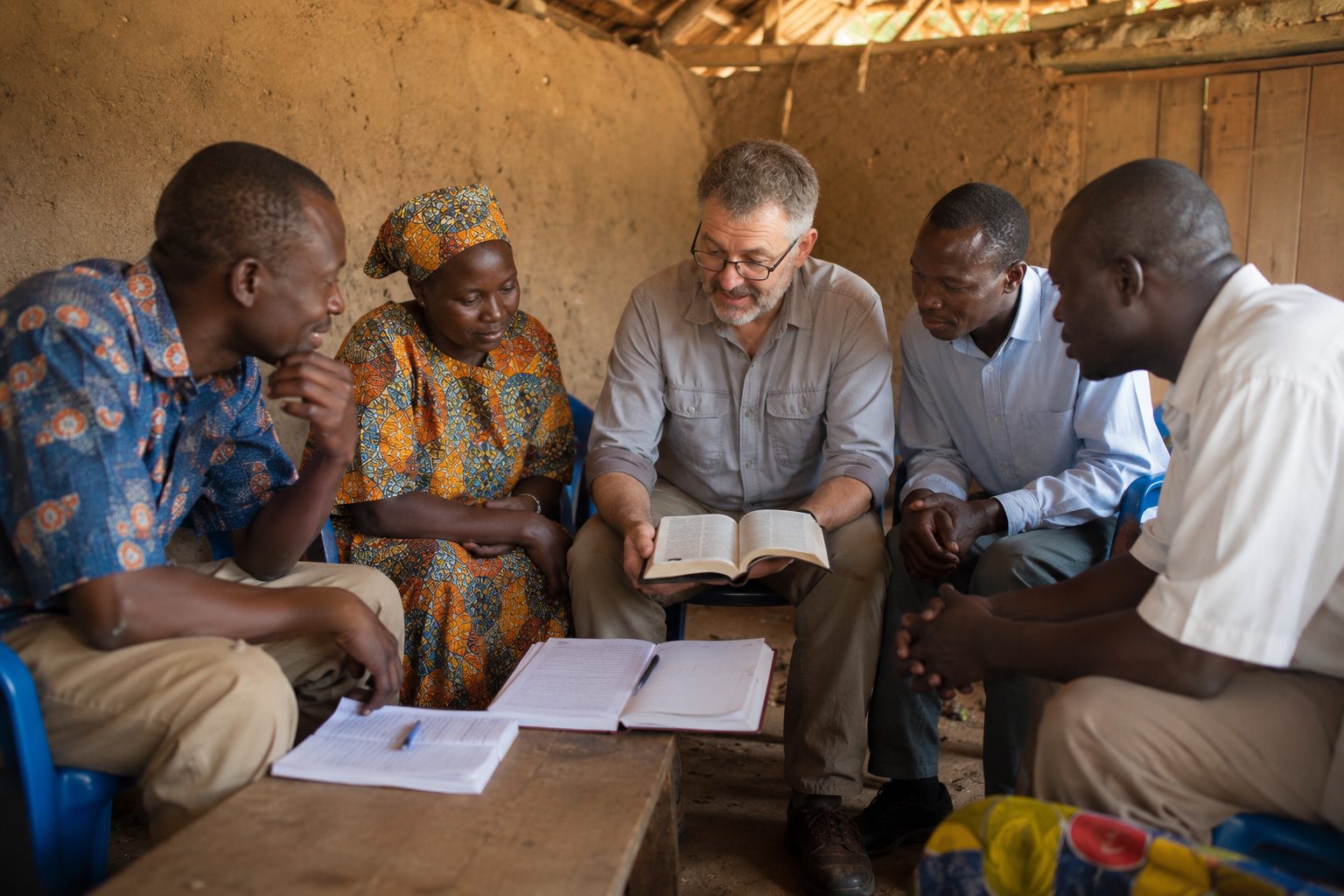
Christians genuinely disagree about some translation decisions: formal equivalence versus functional equivalence, how to render key terms in Muslim-majority contexts, and the line between comprehension and interpretive paraphrase. Because these are contested, trustworthy ministries do not hide their decision-making. They document it. Donors should look for evidence that translation choices are reviewed by qualified scholars and, importantly, by mother-tongue speakers within a church context rather than by outsiders alone.
Accountability here is not merely academic credentialing. It is ecclesial humility. A translation that cannot be received by local pastors and tested in local worship is difficult to defend as a long-term gift to the church. Where a ministry is working through local Bible societies or church networks, donors should expect to see those partnerships described with specificity, including the local bodies that have authority to approve a text.
Governance is where accountability becomes enforceable
Boards matter because spiritual work still needs oversight
Many failures in Christian nonprofit life are not initially doctrinal; they are governance failures that later become spiritual crises. A ministry can begin with sincere motives and drift into unaccountable decision-making, undisclosed conflicts of interest, and founder-centered control. Translation work is especially vulnerable because it often happens far from donor scrutiny and can be framed as too “sensitive” to disclose.
Donors should look for a board that is meaningfully independent, meets regularly, and can demonstrate oversight of executive compensation, related-party transactions, and risk management. The Internal Revenue Service’s governance guidance for nonprofits is not a substitute for Christian integrity, but it provides a concrete baseline for questions that responsible boards should be asking (IRS Charities and Nonprofits).
Conflict of interest is not a technicality
In translation ministries, conflicts of interest can be subtle: consulting arrangements with insiders, printing or software contracts awarded to friends, travel reimbursements with weak documentation, or decisions routed through a small inner circle “for security.” Those practices may not always be illegal, but they erode trust and can quietly redirect donor resources away from the mission.
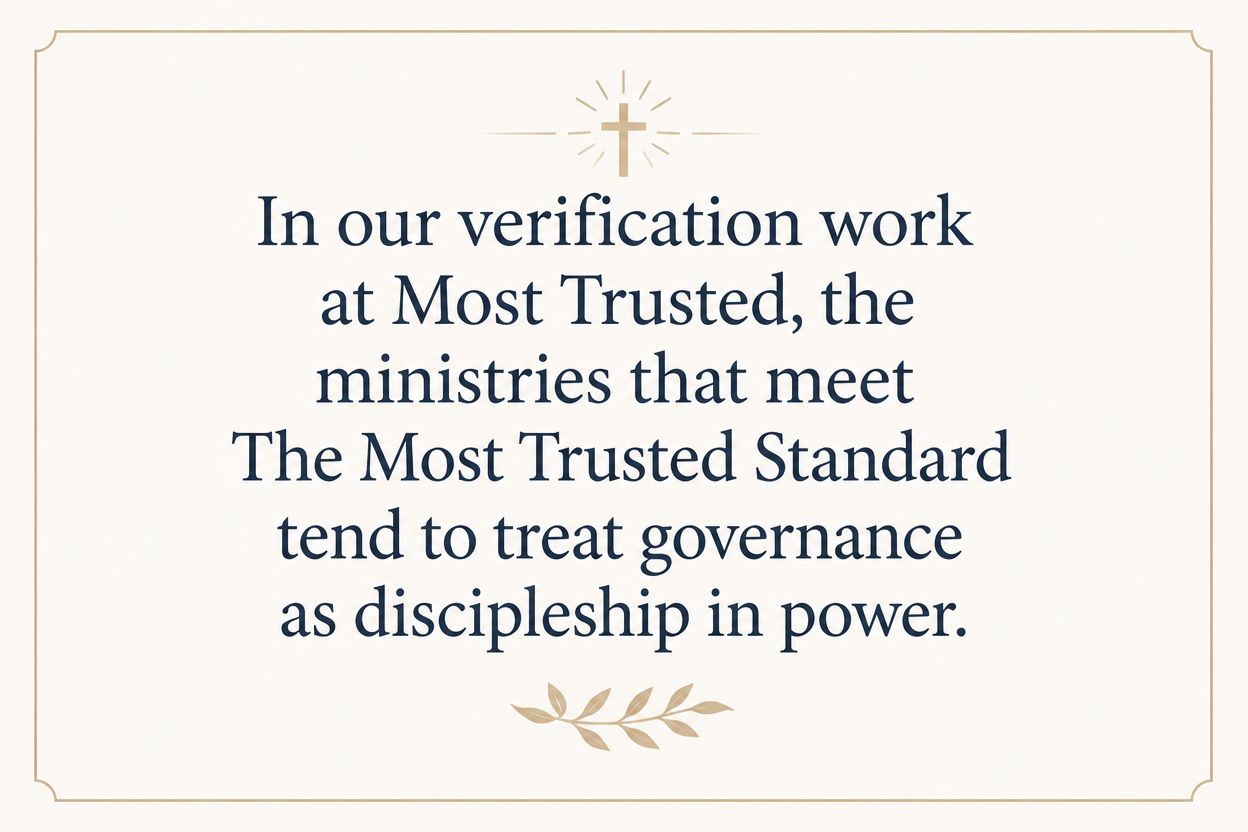
In our verification work at Most Trusted, the ministries that meet The Most Trusted Standard tend to treat governance as discipleship in power. They are not satisfied with assurances. They can show policies, minutes, and decision trails that reflect sober leadership. That is what allows donors to give freely without naïveté.
Financial integrity is more than an overhead ratio
Why donors should be wary of simplistic efficiency claims
Translation ministries sometimes promote unusually low overhead as proof of integrity. Mature philanthropic practice has rejected that as a primary measure of effectiveness. The “Overhead Myth” statement—signed by leaders from GuideStar (now Candid), BBB Wise Giving Alliance, and Charity Navigator—argues that focusing on overhead alone can incentivize underinvestment in systems that protect mission integrity (Candid).
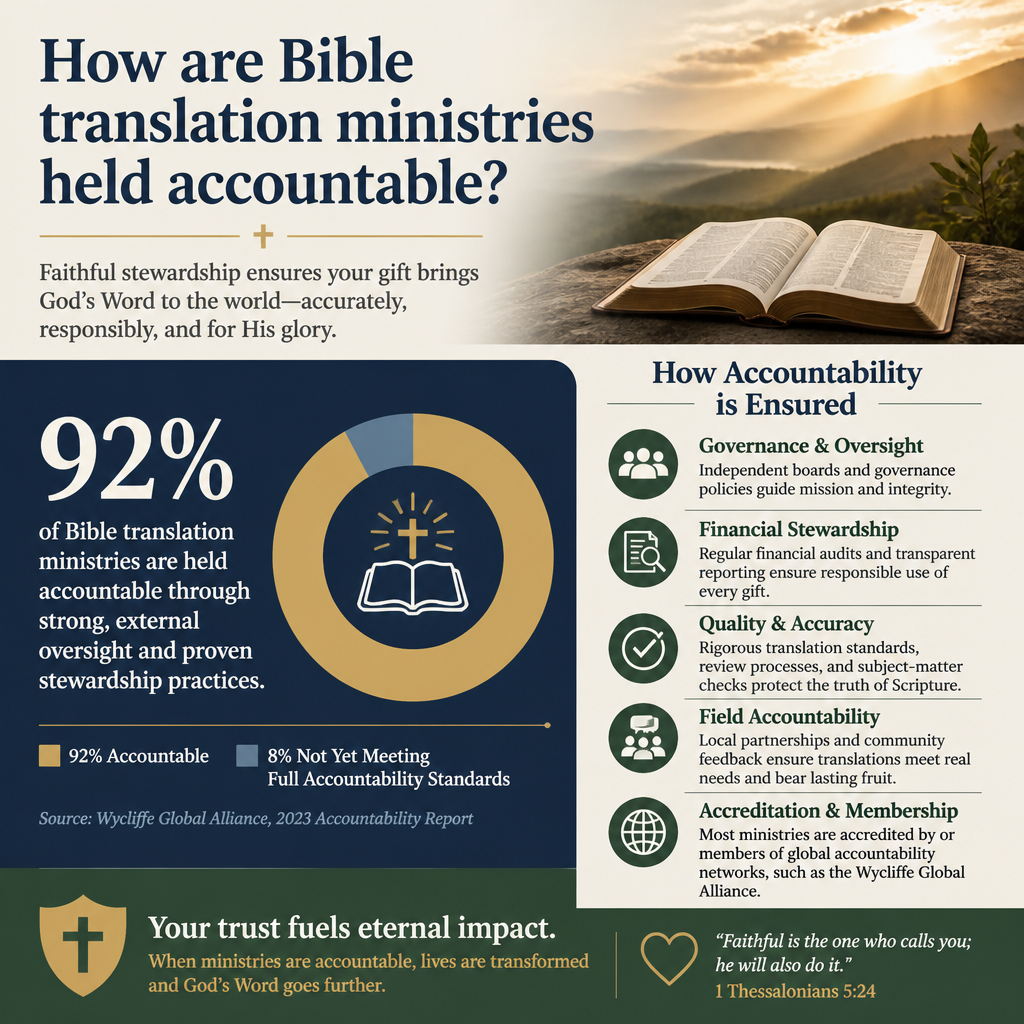
Financial accountability in translation work requires donors to ask different questions. Is there an independent audit or review when scale warrants it? Are financial statements available? Does the ministry consolidate foreign affiliates appropriately? Are restricted gifts used according to donor intent? These are not legalisms. They are the practical outworking of 2 Corinthians 8:21.
Cross-border ministry increases complexity
Most translation work involves cross-border funding, local implementing partners, and security constraints. Those realities create real tension: donors deserve meaningful transparency, and local believers may face risk if names and locations are broadcast. Responsible ministries do both: they protect people while still providing verifiable reporting to appropriate stakeholders, including boards and qualified third-party reviewers.
Donors should not demand that sensitive details be posted publicly. They should expect that an accountable ministry has internal controls, partner vetting, and documentation that can be reviewed under appropriate confidentiality. The absence of any verifiable financial discipline, however, should be treated as a warning rather than as “security.”
Transparency and effectiveness require credible evidence
What measurable progress looks like in translation
Translation is long-horizon work. A ministry can do faithful work for years before a New Testament is completed, printed, and received by churches. That makes it easy to fill donor communications with inspiring stories while offering little evidence of progress or outcomes. Accountability requires that ministries name milestones and report against them.
Global translation progress is documented by established field institutions. For instance, the status of languages with Scripture portions and the remaining need is tracked through the Wycliffe Global Alliance and partner organizations, though numbers vary by methodology and definitions. Donors should expect a ministry to describe how it defines a “translation started,” what qualifies as “published,” and how Scripture engagement is supported after publication.
Translation without Scripture engagement can become a stranded asset
Printing a New Testament is not the same as forming a Bible-saturated church. Literacy, audio Scripture, discipleship materials, and local leadership training often determine whether a translation becomes living Scripture in the community. Christians genuinely disagree about how far a translation agency’s mandate should extend into engagement work, but the accountability question remains: what is the ministry’s theory of change, and does reporting match it?
For donors, the simplest test is coherence. If a ministry claims its aim is “church growth” or “discipleship transformation,” it should report more than translation progress. If it claims its aim is “Scripture access,” it should show distribution pathways, partnerships, and responsible stewardship of intellectual property and licensing. Clear claims with verifiable reporting are a form of honesty.
How donors can practice intelligent trust
Questions that protect both mission and conscience
Most donors are not positioned to audit a ministry or to evaluate translation decisions in Hebrew and Greek. Accountability does not require becoming a specialist; it requires asking questions that surface whether a ministry has submitted itself to meaningful oversight. The point is not suspicion. The point is stewardship shaped by Scripture’s insistence on integrity in handling resources dedicated to the Lord.
Across our verification work, we find that donors gain clarity when they ask a short set of disciplined questions and insist on documented answers. The questions below are not exhaustive, but they tend to reveal whether accountability is real or merely asserted.
- Who has final authority over translation decisions, and what is the review process for accuracy and theological fidelity?
- What local church bodies or recognized leaders have formally received and approved the translation for use?
- Does the ministry provide recent financial statements and an independent audit or review when appropriate for its size?
- How does the board demonstrate independent oversight of compensation, conflicts of interest, and major contracts?
- What milestones define progress, and what evidence is provided that those milestones are being met?
Using third-party verification without outsourcing discernment
Third-party verification can help donors distinguish between ministries that are well-intentioned and those that are demonstrably accountable. At Most Trusted, our work is to evaluate Christian nonprofits against The Most Trusted Standard so donors can give with confidence grounded in evidence rather than impression. That includes faith commitments, governance practices, financial integrity, and transparent reporting that respects both donor stewardship and on-the-ground security realities.
For donors seeking broader context on the work itself, our coverage of Bible Translation Ministries describes the landscape and the kinds of claims ministries make. For donors focused specifically on ethical safeguards and oversight practices, Accountability and Ethics in Bible Translation Ministries addresses recurring risks and the markers of mature governance.
FAQs for How are Bible translation ministries held accountable
Should a Bible translation ministry publish its translations and review notes publicly
Public access can strengthen credibility, but it is not always prudent or possible. In restricted contexts, releasing names, locations, or partner details can put local believers at risk. The more reliable expectation is that a ministry can demonstrate a real review process, qualified oversight, and documented decision-making that can be examined by appropriate parties under confidentiality.
What should donors do if a ministry says it cannot share financial details for security reasons
Some confidentiality is legitimate, but complete opacity is not. Donors can ask for summarized financial statements, proof of independent oversight, and a clear explanation of what cannot be shared and why. A trustworthy ministry will distinguish between protecting people and avoiding accountability, and it will provide alternative forms of verification rather than insisting on unquestioning trust.
Accountability serves the church and honors the gift
Bible translation ministries are held accountable when they submit their doctrine, their governance, their finances, and their results to inspection that is proportionate to the stakes. Scripture commends generous giving, and it also commands honorable administration. Donors do not have to choose between zeal for the Great Commission and sober stewardship; the most faithful giving holds both together.



