
How Bible translation ministries handle donor privacy is not an administrative side issue. It is a stewardship question that touches conscience, security, and trust: whether a ministry receives gifts as a sacred trust, or treats donor data as a convenient asset. Christian donors are not only asking whether a ministry is effective. They are asking whether their name, their giving pattern, and their faith commitments will be guarded with integrity.
The Bible does not give a modern data privacy statute, but it does give moral categories that apply with force. Love “does not insist on its own way” (1 Corinthians 13:5), and stewardship requires faithfulness with what is entrusted (Luke 16:10). Donor information is entrusted. It can also carry real risk, especially when giving intersects with contested cultural issues or with work in sensitive contexts. The ministries that handle donor privacy well treat it as both a moral obligation and a practical safeguard for mission.
Donor privacy is stewardship, not preference
Why privacy is a discipleship issue
Most Christian donors understand that giving is worship, not merely transaction. That is precisely why privacy matters. A donor’s identity can reveal patterns of conviction and ecclesial affiliation; it can expose family finances; it can create vulnerability to manipulation or pressure. In Scripture, the concern is not secrecy for its own sake, but integrity and freedom in obedience. Jesus warns against giving “in order to be seen by others” (Matthew 6:1–4). Ministries should not create systems that turn a donor’s faithfulness into a means of social signaling or internal status.
Privacy is also an aspect of justice. Vulnerable people bear more risk from exposure than well-resourced people. A widow giving sacrificially should not be targeted by relentless solicitation because a database flagged her as a “high propensity” donor. A pastor in a small community should not have giving patterns shared in ways that create local pressure. The moral question is straightforward: will a ministry handle information in a way that protects the weak and honors the giver?
What donor privacy includes in practice
“Privacy” is often reduced to whether an organization sells an email list. Serious donor privacy includes broader categories: how a ministry collects, stores, uses, shares, and retains information; how it honors donor intent; and how it governs staff access. For Bible translation ministries, privacy also intersects with field operations, since translators and local partners may serve in environments where Christian work is politically or socially sensitive.
Across our verification work at Most Trusted, we observe that clarity is the first test. Ministries that meet The Most Trusted Standard tend to describe their data practices in plain terms rather than hiding behind vague assurances. Donors do not need legalese; they need truthful commitments that can be evaluated.

The real risks are higher than donors often assume
Identity, faith, and security in a digital economy
Donor data is valuable. It signals capacity, interests, and relationships. It also becomes part of a broader data economy where information is aggregated and repurposed in ways donors did not foresee. Even when a ministry is not “selling lists,” it may be using vendors for payment processing, email marketing, analytics, donor management systems, and wealth screening. Each integration adds access points, and each access point increases risk if governance is weak.
Digital giving has expanded rapidly, and with it the surface area for cybersecurity threats. The FBI’s Internet Crime Complaint Center reported recorded losses from cybercrime in the billions of dollars annually, a reminder that nonprofit databases sit in the same threat landscape as any other sector. FBI IC3
Sensitive contexts add additional moral weight
Bible translation often requires long-term presence, language research, and collaboration with local believers. In many contexts, public association with Christian activity can carry consequences for workers and communities. Some ministries use “creative access” approaches in restricted environments; Christians genuinely disagree about aspects of these strategies, but most agree that reckless exposure is irresponsible. Donor privacy is not identical to field security, yet they overlap when donor communications, receipts, or public acknowledgments reveal locations, partners, or project names that increase risk.
The harder question is whether a ministry is disciplined enough to limit what it collects in the first place. Data minimization is a security principle and a moral posture: do not gather what you cannot protect, and do not retain what you no longer need.
What trustworthy privacy practices look like in donor-facing terms
Clear commitments and limited use
For donors, the most practical question is simple: what will this ministry do with our information? A trustworthy ministry answers with specificity. It will state whether it shares data with affiliates, peer ministries, denominational partners, or contractors. It will explain how donors can opt out of communications. It will distinguish between transactional emails (receipts, confirmations) and marketing emails (appeals, newsletters). It will not punish donors for choosing quiet faithfulness over frequent engagement.
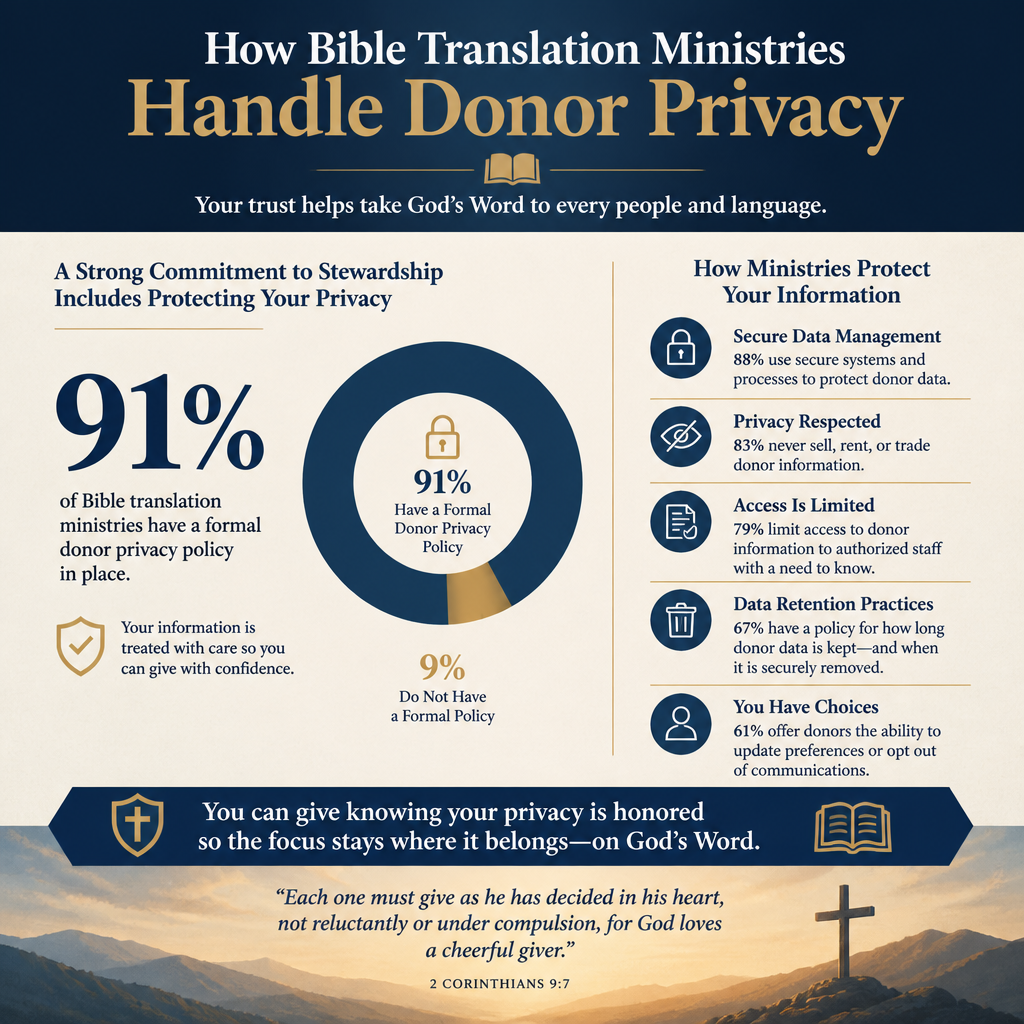
Donors should also look for explicit statements about list sharing. The direct marketing economy has normalized renting and exchanging lists, and even well-meaning ministries can drift into practices that donors would not expect. A strong privacy posture typically includes a plain commitment not to sell or rent donor information, paired with transparent explanation of necessary service providers (payment processors, email platforms) that may handle data under contract.
Reasonable boundaries around recognition and influence
Many Bible translation ministries honor major donors publicly, and there can be legitimate reasons: gratitude, accountability, and inspiring generosity. Yet public recognition can also create distortions—status hierarchies, implicit influence, or pressure on staff to cater to a small number of large givers. Scripture’s warning about favoritism is unambiguous (James 2:1–9). Privacy practices should protect donors from spiritual harm as well as practical harm, including the subtle temptation to give for recognition or to treat giving as leverage.
In practical terms, a ministry that handles privacy well will offer recognition as an option rather than an expectation, and it will separate donor services from programmatic decision-making. The healthiest organizations can say “thank you” without granting governing authority to money.
- Written privacy policy that states what is collected, why, and with whom it is shared.
- Opt-out controls that are honored promptly for email, mail, and phone.
- Data minimization so unnecessary fields are not collected “just in case.”
- Vendor discipline with contracts that limit use and require security safeguards.
- Staff access controls so only those who need donor data can view it.
For donors who want a broader framework for evaluating ministries beyond privacy alone, our work at Most Trusted sits within Bible Translation Ministries, where we look at faith commitments, integrity safeguards, and transparency practices in a unified way.
How privacy intersects with financial integrity and governance
Privacy is a governance question before it is a technology question
Ministries often treat privacy as “IT’s responsibility.” That is rarely sufficient. Donor privacy is a governance issue because it depends on policy, oversight, and culture. A ministry can purchase reputable software and still mishandle information through poor internal discipline: forwarding spreadsheets, leaving access open for convenience, or allowing informal sharing across departments.
Board oversight matters here. A board that asks only about revenue growth can unintentionally incentivize aggressive data practices: wealth screening without disclosure, excessive segmentation, or constant solicitation. A board that understands stewardship will ask how donor information is protected, what incidents have occurred, and what controls are in place to prevent recurrence.
The compliance baseline is not the moral ceiling
Donors will encounter references to legal frameworks such as state privacy laws and, for some ministries with international donors, the European Union’s GDPR. These laws create real requirements, and responsible organizations take them seriously. But legal compliance is not the same as Christian ethics. A ministry can be technically compliant while still acting in ways that feel manipulative or intrusive—especially when data is used to pressure giving rather than invite generosity.
The broader accountability questions belong within Accountability and Ethics in Bible Translation Ministries. Donor privacy is one strand of the same moral fabric: whether ministries are governed in ways that resist temptation, honor donors, and protect the mission from scandal.
How donors can evaluate privacy claims without cynicism
Questions that reveal maturity
Many donors have learned to distrust vague promises. The response should not be cynicism, but disciplined inquiry. A mature ministry will not be offended by serious questions; it will welcome them as part of faithful stewardship. Donors can ask for the privacy policy, request a clear explanation of sharing practices, and inquire about how the ministry trains staff to handle data.
Several questions tend to distinguish ministries with disciplined privacy practices from those that are improvising:
Do they state plainly whether donor data is sold, rented, or shared? “We value your privacy” is not an answer.
Do they disclose third-party processors and platforms? Few ministries run their own payment systems; transparency about vendors signals maturity.
Do they limit what they collect? Asking for unnecessary data often signals a fundraising-first posture rather than a stewardship-first posture.
What to do when privacy is unclear
If a ministry’s privacy approach is unclear, donors can take practical steps: give through methods that reveal less information, limit optional fields, and opt out of non-essential communications. Donors can also request anonymity for recognition purposes. A ministry’s response to such requests is revealing. Organizations that view donors as partners in mission will treat restraint as reasonable. Organizations that view donors primarily as revenue sources will often resist or delay.
At Most Trusted, our verification work is built for this moment. Donors are navigating a crowded ministry landscape, and trust is earned through verifiable practices. The Most Trusted Standard presses beyond sentiment into evidence: policies, governance, financial integrity, transparency, and ethical safeguards that can be evaluated rather than merely asserted.
FAQs for How Bible translation ministries handle donor privacy
Do Bible translation ministries sell or share donor lists?
Some ministries explicitly commit not to sell or rent donor information, while others permit certain forms of sharing with affiliates or service providers. Donors should not assume either direction. The most trustworthy practice is a clear, public statement describing whether information is sold, rented, shared, or only processed by vendors under contract. If the policy is vague, donors should ask for written clarification before giving.
Does giving online increase privacy risk compared with giving by check?
Online giving can increase exposure because it relies on third-party processors and creates more data points for storage and transmission. That does not mean online giving is inherently irresponsible; reputable processors invest heavily in security. The key question is whether the ministry governs access, limits what it collects, uses vendors responsibly, and retains data only as long as needed. Donors who want to reduce risk can still give online while limiting optional information and opting out of non-essential communications.
A faithful ministry treats donor information as entrusted property
Christian donors give because they believe the Word of God should be available in every language, and because they understand generosity as obedience to Christ. Bible translation ministries honor that obedience when they guard donor privacy with the same seriousness they apply to financial controls and doctrinal clarity. Privacy is not secrecy. It is stewardship: limiting what is collected, protecting what is held, and refusing to treat a donor’s identity as a commodity. Trust is sustained when these commitments are stated plainly and practiced consistently.



