
How Christian financial service ministries share impact reports
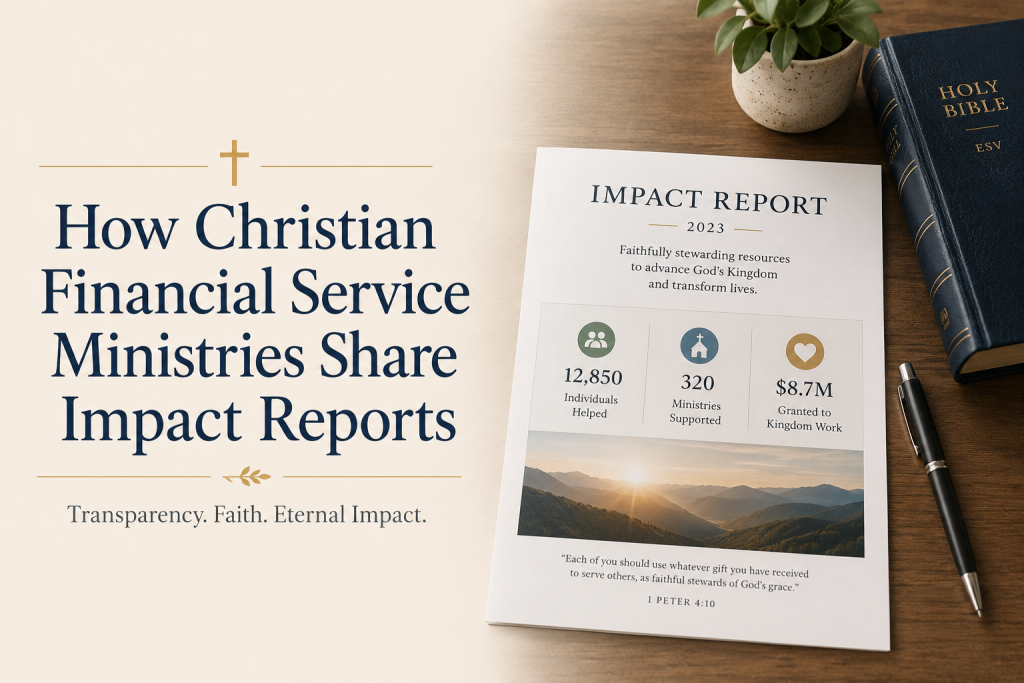
How Christian financial service ministries share impact reports is not a cosmetic communications question. It is a theological and fiduciary question about stewardship, truthfulness, and the obligations that come with handling other people’s money in the name of Christ. Donors are not merely purchasing outcomes; they are entrusting resources that Scripture treats as weighty, accountable, […]
How Christian financial service ministries measure impact

How Christian financial service ministries measure impact determines whether donor dollars restore families or merely rearrange symptoms. For Christian donors, the burden is not only to fund good intentions, but to fund outcomes that align with biblical stewardship and with the dignity of those served. Financial discipleship and relief ministries operate in a field with […]
Why ministry receipts show fair market value

Why ministry receipts show fair market value is not a cosmetic accounting choice. It is how a ministry communicates—under law and under Christian ethics—what a donor actually gave, what the donor received, and what portion of the payment is properly treated as a charitable contribution. For Christian donors, the question usually arrives with a practical […]
When Christian financial service ministries send tax receipts

When Christian financial service ministries send tax receipts, they are doing more than closing an administrative loop. They are making an implicit claim about what kind of gift was received, what the donor may properly deduct, and what level of accountability the ministry is prepared to provide. For Christian donors trying to give with both […]
What to do if a donation receipt is missing

What to do if a donation receipt is missing is not merely an administrative question. For Christian donors, it sits at the intersection of stewardship, accountability, and the ordinary discipline of telling the truth about our finances. Most missing-receipt situations are resolved without conflict. Yet the process matters. A ministry’s willingness and ability to document […]
What donation records donors need to keep

What donation records donors need to keep is a stewardship question before it is a tax question. Christians give not merely to satisfy a line on a return, but to honor the Lord with integrity, to protect the ministries we support, and to avoid preventable confusion when memory fades and leadership changes. Tax law sets […]
How to handle non-cash gifts to Christian financial service ministries

Handling non-cash gifts to Christian financial service ministries requires the same spiritual seriousness as any other act of generosity, and a higher level of practical care than many donors expect. A donated vehicle, appreciated stock, a complex asset held in a donor-advised fund, or even cryptocurrency can become either a clean act of stewardship or […]
How to claim Christian financial service ministry donations on taxes
Claiming Christian financial service ministry donations on taxes is straightforward in principle: the IRS allows a charitable deduction only for gifts to qualified organizations, and only when a donor can substantiate the gift. The complexity is that many Christian financial service ministries sit close to the boundary between “charitable contribution” and “payment for services,” and […]
How to give to Christian financial service ministries tax-wisely

Tax-wise giving to Christian financial service ministries is not primarily about getting the largest deduction. It is about ordering resources faithfully while honoring the legal and moral boundaries that govern charitable giving. Mature donors are right to ask how to give in ways that strengthen a ministry’s long-term capacity without confusing charity, commerce, and personal […]
How to give stock to Christian financial service ministries

How to give stock to Christian financial service ministries is not primarily a technical question. It is a stewardship question with tax implications, governance implications, and discipleship implications, because it asks what we do with assets God has entrusted to us and how carefully we attend to the integrity of the organizations that receive them. […]