

Handling non-cash gifts to Christian financial service ministries requires the same spiritual seriousness as any other act of generosity, and a higher level of practical care than many donors expect. A donated vehicle, appreciated stock, a complex asset held in a donor-advised fund, or even cryptocurrency can become either a clean act of stewardship or a source of confusion, compliance risk, and preventable strain on the ministry receiving it.
Scripture does not treat giving as a merely technical exchange. “Each one must give as he has decided in his heart, not reluctantly or under compulsion” (2 Corinthians 9:7). That posture of freedom does not excuse inattention. Christians are called to “do what is honorable… in the sight of all” (Romans 12:17), which includes honoring tax law, honest valuation, and clear documentation. Non-cash gifts test whether our generosity is both warm-hearted and well-ordered.
Why non-cash gifts are spiritually meaningful and operationally demanding
Christian stewardship includes administrative faithfulness
Non-cash giving often reflects mature stewardship. Appreciated assets can allow a donor to give more, avoid capital gains in many cases, and align long-term wealth with kingdom priorities. Yet the moral weight of stewardship includes the unglamorous work of accuracy, prudence, and truthfulness. When a donor or ministry treats paperwork as a nuisance, the result is rarely neutral; it tends to become a hidden cost borne by staff, auditors, or donors later.
Christian financial service ministries sit in a particularly sensitive space because they often handle funds, counseling, debt relief, lending, microenterprise, or financial education. Donors rightly expect an elevated commitment to integrity. In our verification work at Most Trusted, we see that the ministries that meet The Most Trusted Standard tend to treat non-cash gifts not as a fundraising trick, but as a fiduciary responsibility with clear policies, competent review, and disciplined documentation.
Why these ministries face distinct complexity
Financial service ministries are frequently asked to accept assets that are “financial” in nature but operationally awkward: restricted securities, closely held business interests, real estate with unclear title, or property that has sentimental value to the donor but high disposal costs to the ministry. The harder question is not whether a gift is generous, but whether receiving it helps the ministry pursue its mission without absorbing disproportionate risk or administrative burden.
For donors who want deeper context on the ministry landscape and the distinct missions in this space, see Christian Financial Service Ministries.

Know what the IRS requires and what it does not
Receipts acknowledge gifts but do not assign value
Many donor frustrations begin with a misunderstanding: for most non-cash gifts, the ministry’s receipt should describe what was donated, confirm the date received, and state whether goods or services were provided in exchange. It generally should not assign a dollar value to non-cash property. That valuation responsibility typically rests with the donor, often with help from a qualified appraiser when required.
The IRS is explicit that taxpayers must substantiate charitable contributions and that additional requirements apply for noncash gifts over certain thresholds. Donors should consult the IRS guidance on substantiation and recordkeeping for charitable contributions at IRS Charitable Contributions Substantiation and Recordkeeping.
When Form 8283 and qualified appraisals become necessary
Noncash gifts can trigger Form 8283 and, for larger or more complex gifts, a qualified appraisal. Donors sometimes assume the ministry “handles all that,” especially when the ministry is financially sophisticated. That assumption can put both parties at risk. The ministry typically has a role in acknowledging receipt and, in some cases, signing the donee acknowledgement portion of Form 8283, but the donor bears the burden of valuing the property appropriately and meeting IRS substantiation rules.
What this means in practice is that donors should decide early whether they are willing to bear appraisal costs and timing constraints. A gift that feels straightforward on Sunday can become urgent by year-end, when appraisers and ministry finance teams are already under strain.
Choose gift types that serve the ministry rather than complicate it
Appreciated securities are often the cleanest non-cash gift
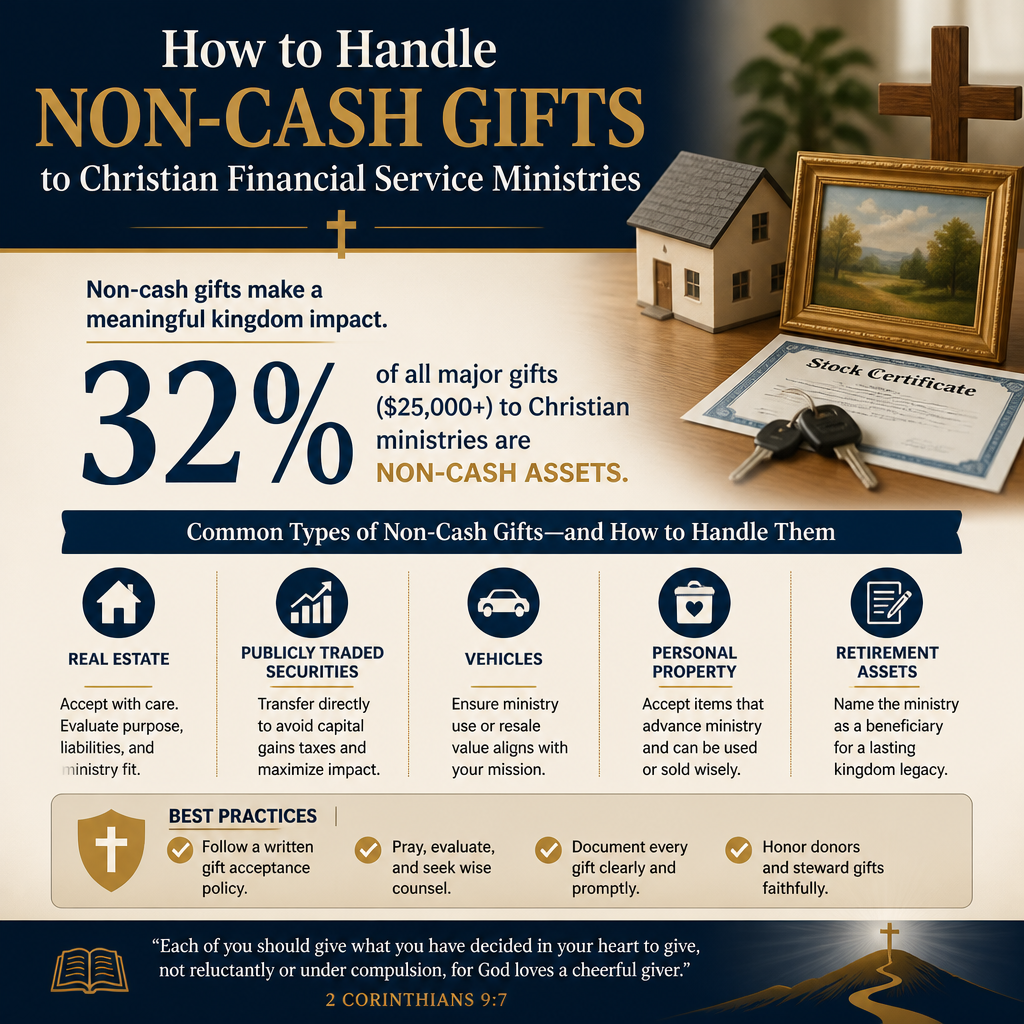
For many Christian financial service ministries, publicly traded appreciated securities are among the most straightforward non-cash gifts. They are easier to liquidate, simpler to acknowledge, and usually impose less operational burden than tangible property. The donor’s charitable intent is also easier to honor because the asset converts quickly into usable funds without extended holding risk.
The trade-off is that donors and ministries must coordinate transfer instructions carefully, especially near year-end. A gift is generally complete when the asset is transferred, not when the donor initiates the transfer. A prudent donor confirms receipt in writing and retains brokerage confirmations alongside the ministry’s acknowledgement.
Property and “special assets” require clear acceptance policies
Vehicles, real estate, collectibles, and other tangible property often arrive with hidden complexity: storage, repair, title transfer, insurance, environmental risk, and the possibility that the resale value is meaningfully lower than the donor’s assumptions. For ministries, accepting a gift without a disciplined review can create a stewardship problem: scarce staff time is diverted from mission to manage disposal.
Special assets such as closely held business interests and certain partnership units can introduce legal constraints, unrelated business taxable income considerations, and reputational risk if the underlying business conflicts with the ministry’s convictions. Christians genuinely disagree about how directly a ministry should police the moral character of every underlying asset. Even so, ministries should be able to articulate a consistent policy rooted in conscience, governance, and mission.
- Ask whether the ministry has a written gift acceptance policy for non-cash gifts.
- Confirm whether the ministry intends to hold or promptly liquidate the asset.
- Clarify who pays for appraisal, title work, storage, or other transaction costs.
- Request a clear written acknowledgement describing the property without assigning value.
- Discuss timing early, especially if the gift is year-end sensitive.
Documentation that protects both donor and ministry
What a strong acknowledgement letter usually includes
A credible non-cash gift acknowledgement is simple, factual, and complete. It should identify the ministry, describe the item or asset received (without valuation), state the date of receipt, and confirm whether the donor received any goods or services in exchange. If something was provided, it should include a good-faith estimate of its value. This is not mere compliance. It is a form of truth-telling that protects the donor’s conscience and the ministry’s public witness.
Donors should retain both the ministry’s letter and their own supporting records (brokerage statements, closing documents, appraisals, photographs for certain property, and any correspondence that clarifies restrictions). The IRS places substantial weight on contemporaneous written acknowledgements for certain gifts, and the safest practice is to obtain the acknowledgement promptly rather than waiting for annual year-end statements.
Restrictive language can unintentionally distort the gift
Many donors prefer restricted gifts because they want their generosity to reach a specific program. That desire is often understandable and sometimes wise. Yet overly narrow restrictions can harm the ministry’s ability to serve people well, especially in financial service work where client needs vary and economic cycles change. A debt relief ministry may face surges in demand during downturns; a job training program may need to shift curriculum; a counseling service may need to invest in secure infrastructure. Restrictions that sound faithful can become rigid burdens.
For donors, the best practice is to ask whether a restriction is necessary to fulfill your intent, and whether the ministry has the governance discipline to honor restrictions without impairing effectiveness. For ministries, the best practice is to accept only restrictions they can administer with integrity over time.
How to evaluate whether a ministry can receive non-cash gifts with integrity
Signals of mature governance and financial integrity
Non-cash gifts reveal the quality of a ministry’s internal controls. A ministry can be spiritually sincere and still operationally fragile. Donors who give non-cash assets should look for evidence of competent oversight: documented policies, finance leadership with relevant expertise, board-level accountability, and an audited financial posture when scale warrants it. The point is not bureaucracy; the point is faithfulness in handling resources set apart for the Lord’s work.
Across our verification work, we observe that ministries aligned with The Most Trusted Standard usually show clarity in three areas: how gifts are approved, how risks are evaluated, and how proceeds are recorded and reported. They do not improvise under pressure. They also communicate limitations plainly, including when they must decline certain asset types.
Transparency that serves donors without turning ministry into a transaction
Donors sometimes ask for detailed confirmation of “where the gift went” in a way that treats ministry as a ledger line. At the same time, ministries can hide behind spiritual language when donors request reasonable clarity. Scripture condemns both manipulation and concealment. “We have renounced disgraceful, underhanded ways. We refuse to practice cunning or to tamper with God’s word” (2 Corinthians 4:2). In financial service ministry, credible transparency is part of the witness.
When donors want to compare reporting practices and receipt expectations across ministries, see Tax Receipts and Reporting for Donations to Christian Financial Service Ministries.
FAQs for How to handle non-cash gifts to Christian financial service ministries
Should the ministry tell us the dollar value of a non-cash gift on the receipt?
Typically, no. A ministry’s acknowledgement should describe the donated property and confirm whether goods or services were provided in exchange, but it generally should not assign a value to non-cash property. The donor is usually responsible for valuation and for meeting IRS substantiation requirements, including a qualified appraisal when required. When in doubt, consult IRS guidance and a qualified tax advisor for your specific circumstances.
What if the ministry declines a non-cash gift we believe would help?
Declining a gift is not necessarily ingratitude; it can be prudent stewardship. Real estate with unclear title, vehicles with high disposal costs, or complex business interests can impose risk disproportionate to the benefit. A ministry that can explain its gift acceptance policy, its risk concerns, and any alternative ways to support the mission is often demonstrating governance maturity rather than reluctance to receive generosity.
A disciplined approach honors both generosity and truth
Non-cash gifts can be an excellent way to strengthen Christian financial service ministries, particularly when the gift type is readily transferable and the documentation is clear. The faithful aim is not merely a completed transaction, but a gift that can be received without confusion, recorded without distortion, and applied to mission without hidden cost. That combination of generosity and order is not secular administrative virtue. It is a form of honesty before God and neighbor.



