
Why ministry receipts show fair market value is not a cosmetic accounting choice. It is how a ministry communicates—under law and under Christian ethics—what a donor actually gave, what the donor received, and what portion of the payment is properly treated as a charitable contribution.
For Christian donors, the question usually arrives with a practical edge: “Why does my receipt show a value for the event ticket?” “Why did the ministry reduce my deductible amount when I received a book or counseling session?” The answers sit at the intersection of IRS rules, clear financial reporting, and a biblical commitment to truthfulness in our dealings.
Fair market value is the boundary between gift and benefit
What fair market value means in plain terms
Fair market value is a standard way to describe what something would sell for in an arm’s-length transaction—what an informed buyer would pay and an informed seller would accept. On a ministry receipt, fair market value is usually applied to the goods or services a donor received in exchange for a payment: a banquet meal, event admission, merchandise, a conference registration, or similar benefits.
The IRS treats these transactions as “quid pro quo” contributions: part contribution, part purchase. When donors receive goods or services in return for a payment, the charitable contribution is generally the amount that exceeds the value of what was received. This is not a ministry deciding to be “strict.” It is a basic boundary line between a gift offered freely and a benefit received.
Why Christian donors should care beyond tax deductibility
Christian stewardship is not reducible to tax outcomes. Still, tax receipts shape donor trust and shape what ministries implicitly teach about giving. A receipt that blurs purchase and gift can quietly form donors to think of giving as a transaction: pay, receive, repeat. Scripture pushes in the opposite direction. “Each one must give as he has decided in his heart, not reluctantly or under compulsion” (2 Corinthians 9:7). That principle is not negated by benefits; it is clarified by naming them honestly.
Fair market value on receipts, when done carefully, helps donors distinguish generosity from consumption. It keeps the ministry from implicitly marketing a “deal” under the banner of charity.

IRS quid pro quo rules require ministries to disclose benefits
The disclosure requirement for larger payments
For payments of more than $75 where a donor receives goods or services, the IRS generally expects a written disclosure that estimates the value of those goods or services and reminds the donor that only the amount above that value may be deductible. This is one reason donors see fair market value on event receipts. The ministry is fulfilling a disclosure duty meant to prevent confusion and inconsistent claiming. The IRS explains the rule in its charitable contribution guidance on IRS.gov.
This does not mean every receipt must list a value in every circumstance. Some small benefits may be treated as “insubstantial,” and the IRS provides specific thresholds and conditions for that exception. But where a donor receives a meaningful benefit, the more transparent path is usually to state a reasonable value.
What counts as a benefit and what does not
In practice, benefits include tangible items and direct services: meals, entertainment, merchandise, training, and similar value conveyed to the donor. Benefits do not include purely intangible religious benefits in the way the IRS uses that term. For example, a donation to support worship services does not create a “benefit” that reduces deductibility simply because the donor attended worship. The line is not “did the donor receive something spiritually meaningful?” The line is “did the donor receive a measurable good or service in return for payment?”
This distinction matters for Christian financial service ministries, where offerings may be connected to member materials, events, or support services. Ministries should not over-assign fair market value to spiritual formation itself. They should assign value to concrete goods and services that are properly comparable to market offerings.
Fair market value protects donor integrity and ministry credibility
Receipts are part of a ministry’s public truth-telling
Receipting is a spiritual act in the sense that it is a form of truth-telling. Ministries that handle donor funds are not merely complying with a federal requirement; they are bearing witness that “honest scales and balances belong to the LORD” (Proverbs 16:11). Donors sense the difference between careful, consistent documentation and improvised paperwork that changes when questions arise.
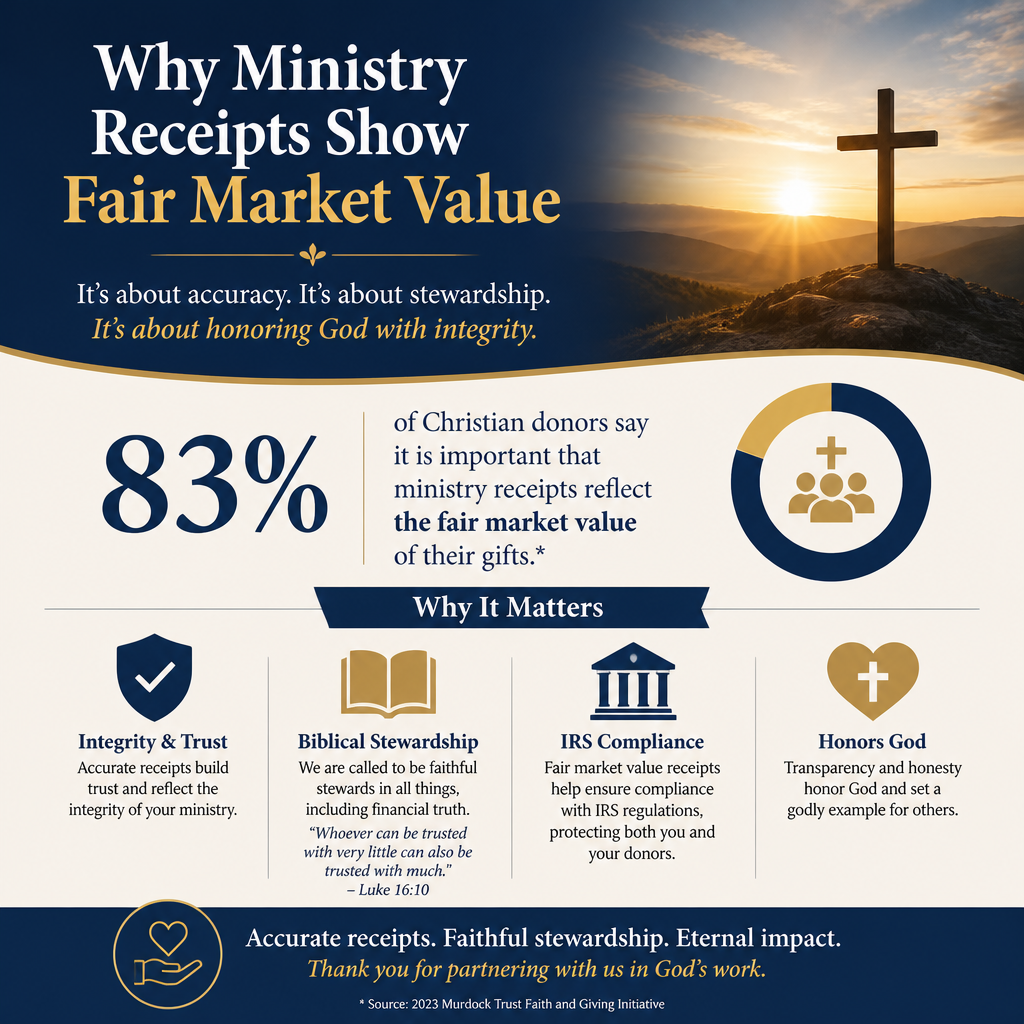
Across our verification work at Most Trusted, we observe that ministries with strong financial integrity tend to treat receipting as a governance practice, not as a back-office afterthought. They define valuation methods, document how values are determined, and apply the policy consistently across events and donor segments. That consistency becomes a quiet but powerful marker of seriousness.
Fair market value lowers the risk of miscommunication
Many donor frustrations are not about the rule itself; they are about surprise. Donors attend a gala, see an appealing “ticket price,” and later discover the deductible amount is smaller. Ministries can reduce confusion by making the fair market value explicit before the donor pays, not only after.
A straightforward approach often includes:
- Stating the estimated fair market value of meals, admission, or items on the event page and registration form
- Separating “ticket price” from “additional gift” in the checkout flow
- Issuing receipts promptly with clear language about deductible amounts
- Using a documented method for valuing meals, books, or merchandise
- Training staff to answer donor questions without defensiveness
When these practices are absent, donors can begin to wonder what else is being handled casually. In a sector that depends on trust, small ambiguities accumulate.
How ministries reasonably estimate fair market value
Common valuation methods that hold up under scrutiny
Fair market value is not always mathematically precise. It is a good-faith estimate grounded in observable comparisons. Ministries frequently use one of several reasonable methods, depending on the situation:
If the benefit is a meal at a banquet, the ministry may use the per-plate catering cost (excluding purely charitable program components). If the benefit is a book or resource, the ministry may use the typical selling price to the general public. If the benefit is a conference, the ministry may compare to similar events in the same region and category. The goal is not to “maximize deductibility” or to “minimize donor disappointment.” The goal is to disclose a defensible value.
When donors want to understand how a number was set, the best ministries can answer plainly. They may not publish the full worksheet, but they can describe the method without evasion.
Where valuation becomes ethically delicate
Some benefits are hard to value because they mingle spiritual care, member support, and concrete services. Christian financial service ministries sometimes offer educational resources, member communications, prayer support, advocacy, or community gatherings. Donors and ministry leaders can disagree, in good faith, about whether a particular benefit is a “good or service” in the IRS sense, and whether an “insubstantial benefit” exception applies.
What this means in practice is that ministries should be cautious about two errors in opposite directions. One error is overstating fair market value in a way that treats pastoral care or spiritual formation as a market commodity. The other error is understating fair market value in a way that effectively turns a purchase into a receiptable “gift.” Both can damage integrity. When complexity is real, donors have reason to expect written policies and, when appropriate, advice from qualified tax counsel.
What donors should do when a receipt lists fair market value
Interpreting the receipt without anxiety
When a receipt shows fair market value, the ministry is usually telling you: “Part of what you paid was for something you received; the remainder may be deductible.” That is not an accusation of selfishness, and it is not a judgment on motive. It is an attempt to state the transaction truthfully.
If you gave $250 for a dinner event and the receipt shows $75 fair market value, that typically signals that $175 is the portion treated as a charitable contribution. If you also made an additional gift above the ticket price, a well-prepared receipt will separate those amounts clearly.
For donors who give to ministries connected to financial services, this clarity is part of the ministry’s witness. Christians should not fear careful accounting. We should expect it.
Questions donors can ask with confidence
Serious donors do not need to be adversarial, but neither should they be passive. Questions are often appropriate, especially when the fair market value appears inconsistent with comparable prices or with prior years. A few questions are usually enough:
What benefit did the ministry value, and what method was used? Was the value based on catering invoices, retail pricing, or comparable events? Does the ministry have a written receipting policy? If an “insubstantial benefit” exception is being used, what is the basis for that conclusion?
When donors want to evaluate a ministry’s overall integrity—not only the correctness of a single receipt—it helps to look at the broader discipline of reporting and transparency. That is a core reason we built Most Trusted’s verification work around The Most Trusted Standard, including criteria related to financial integrity, governance, and public transparency. For donors who want broader context on the ministry category itself, Christian Financial Service Ministries is a useful starting point for understanding how these organizations operate and how to assess them.
And when the question is specifically about documentation, acknowledgments, and the expectations donors can reasonably hold, Tax Receipts and Reporting for Donations to Christian Financial Service Ministries provides a category-level view of the recurring issues we see across the field.
FAQs for Why ministry receipts show fair market value
Does fair market value mean the ministry is saying part of my gift was not really a gift?
It means the ministry is distinguishing between the portion of your payment that purchased a good or service and the portion that qualifies as a charitable contribution under IRS rules. The ministry is not judging your motive; it is disclosing the transaction in a way that supports accurate donor reporting and consistent ministry accounting.
What if I disagree with the fair market value on my ministry receipt?
Ask how the value was determined and whether the ministry has a written valuation and receipting policy. In many cases the number reflects catering invoices, retail pricing, or comparable market rates. If the basis is unclear or inconsistent, donors may need to request clarification from the ministry and consult a qualified tax professional regarding their own return.
A receipt that tells the truth serves both Caesar and God
Fair market value on ministry receipts is a modest practice with large implications. It protects donors from confusion, protects ministries from avoidable compliance risk, and signals a commitment to truthful dealings that Scripture consistently commends. When Christian organizations handle money with clarity, they honor not only the tax code’s requirements but the deeper obligation to walk in the light.



