
What outcomes Christian adoption ministries report to donors shapes how Christians understand both the fruit and the risks of orphan care. Donors are not only funding services; they are funding a moral vision of family, permanence, and the church’s witness to God’s fatherly heart (Psalm 68:5).
Adoption and orphan care sit inside complex systems: child welfare law, trauma science, international regulation, poverty economics, and pastoral care. Christians genuinely disagree about where “adoption ministry” should concentrate—international adoption, domestic foster care, family preservation, or church-based support for adoptive families. Mature giving does not resolve these tensions by sentiment. It insists on clarity about what outcomes are being claimed, what outcomes are not, and what evidence makes those claims trustworthy.
Outcomes worth reporting begin with permanence and child wellbeing
Permanency is a moral outcome, not a marketing line
The most basic outcome adoption ministries can report is permanence: children moving from impermanence into enduring, legally secure family belonging. In domestic foster care systems, permanency is commonly tracked through adoption, reunification, or guardianship, with timelines that matter because instability has measurable costs for children.
Public agencies report these dynamics at scale. For example, the U.S. Administration for Children and Families publishes national foster care and adoption statistics each year through the AFCARS reports (Administration for Children and Families). Donors should not expect every ministry to mirror government reporting, but they can reasonably expect ministries to define “permanency” and to report how their work contributes to it in verifiable ways.
Child wellbeing requires trauma-informed measures
Adoption is not a single event; it is the beginning of a lifelong story shaped by grief, attachment, identity, and often complex trauma. Ministries that claim outcomes around “healing” should avoid vague spiritual language that cannot be tested. More credible reporting includes operational measures such as stability of placements, access to trauma-informed counseling, school engagement, and reduced crisis disruptions after placement.
Research on adverse childhood experiences has helped the church speak more truthfully about the long tail of early trauma. The original CDC-Kaiser ACE Study established a graded relationship between adverse experiences in childhood and later health and social outcomes (Centers for Disease Control and Prevention). Christian donors should not reduce children to risk scores, but we should expect ministries to operate with informed realism rather than triumphalism.

What donors should expect ministries to measure in family support
Pre-adoption preparation and informed consent
Many adoption-related breakdowns begin long before a child enters the home: families are underprepared for trauma, special needs, or cross-cultural identity formation; expectations are formed by glossy narratives; the costs of post-adoption care are minimized. Ministries serving adoptive families can report outcomes that reflect whether preparation is substantive: completion rates for training, the content covered, and follow-through on counseling referrals.
Because donors often underwrite scholarships, courses, or pastoral care, the question is not merely “How many families attended?” but “Did families become better equipped to love faithfully when the story becomes harder than expected?” The ministries that meet The Most Trusted Standard tend to define their training objectives, report participation and completion, and describe how they evaluate whether families gained durable skills.
Post-adoption stability and ongoing care
Churches and ministries sometimes treat adoption finalization as the finish line. It is not. Outcomes worth reporting include the durability of support over time: number of families receiving ongoing coaching, counseling subsidies delivered, respite care hours coordinated, and participation in support groups.
Where ministries report “placement stability,” donors should ask for definitions: What counts as a disruption? Over what time horizon is stability measured? What follow-up methods are used? Sophisticated reporting acknowledges that stability is influenced by factors outside a ministry’s control, while still taking responsibility for what can be strengthened—preparation, access to services, and sustained community.
- Clear definitions for each reported outcome
- Time-bound reporting windows rather than one-time snapshots
- Evidence of follow-up after placement or finalization
- Documented referral networks for trauma-informed care
- Mechanisms for listening to adoptees and birth families, not only adoptive parents
Ethical outcomes include birth-family dignity and family preservation
Reunification and kinship care are not ministry failures
The biblical command to care for vulnerable children does not require that every story end in adoption. In many cases, the best outcome is safe reunification or kinship care supported by the church. In the U.S. foster care system, reunification has historically been the most common permanency outcome in many years of reporting, which underscores how often the child welfare aim is restoration when safety permits (Administration for Children and Families).
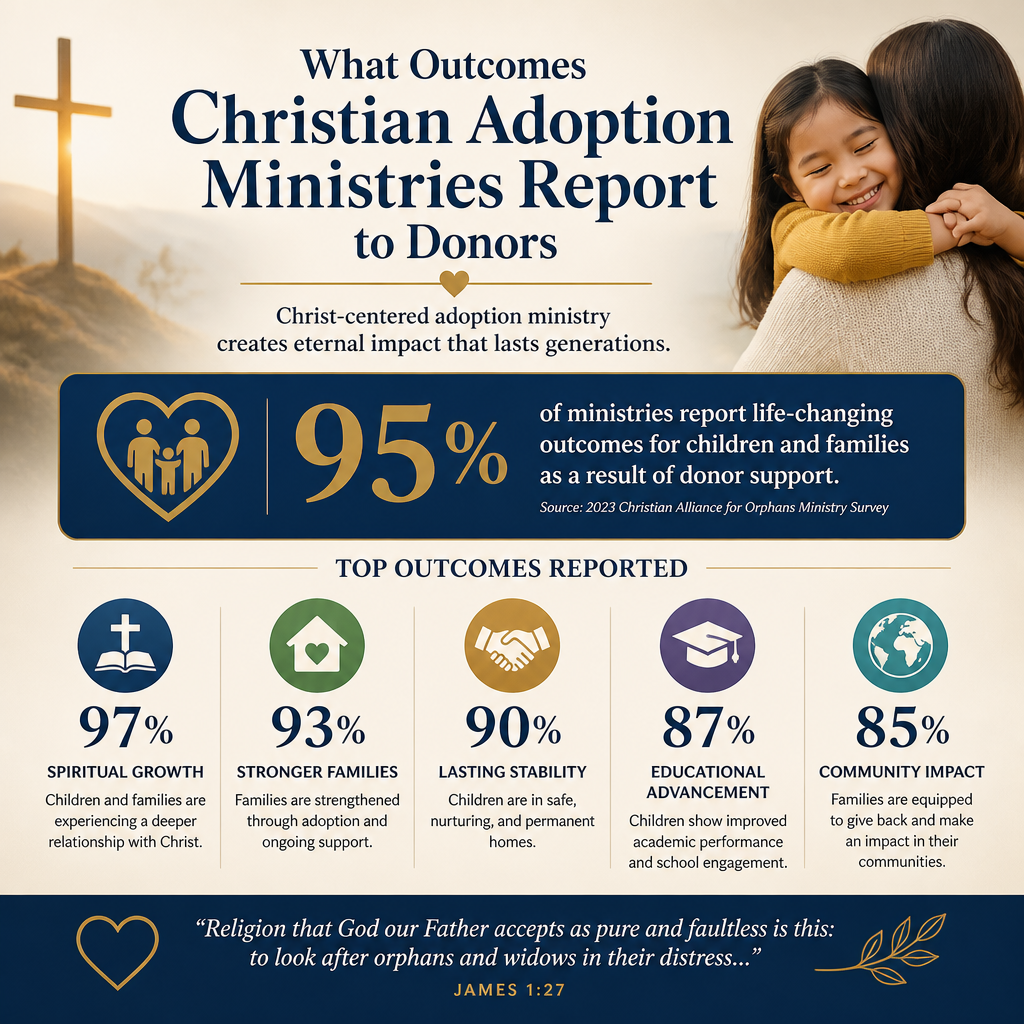
For donors, this requires a shift in what “success” means. If a ministry’s work strengthens a family so a child can safely remain with parents or relatives, that is a pro-child outcome. Ministries can report outcomes such as family preservation services delivered, material supports paired with case management, and connections to local churches for long-term stability.
Safeguards against coercion and commodification
Christians have had to reckon with grievous abuses: unethical pressure on vulnerable mothers, financial incentives that distort decisions, and in international contexts, practices that have at times crossed into child trafficking. Donors should expect ministries to report outcomes that include ethical compliance: documented consent processes, separation of financial assistance from decision-making, third-party oversight, and transparent fee structures.
Where ministries engage international adoption, additional outcomes matter: compliance with sending-country requirements, adherence to Hague Adoption Convention standards where applicable, and documented efforts to prioritize domestic solutions when appropriate. Ethical reporting does not merely assert integrity; it shows the controls that make integrity credible.
For donors who want broader context on how ministries define adoption-related work across the church, we maintain coverage of Christian Adoption Ministries with attention to both compassion and accountability.
Transparency outcomes donors can verify, not just admire
Financial reporting that matches the real cost structure
Adoption support is labor-intensive: counseling, training, case coordination, legal navigation, and pastoral care. Donors sometimes push ministries toward simplistic “low overhead” storytelling, which can starve the very capabilities that keep children safe and families supported. The more mature approach is transparency about how costs relate to outcomes.
The broader nonprofit sector has challenged the idea that overhead ratios alone indicate effectiveness. Charity Navigator, Candid (formerly GuideStar), and the BBB Wise Giving Alliance issued a joint statement warning against using overhead as the primary measure of a charity’s worth (Charity Navigator). Christian donors should treat this as permission to ask better questions: What outcomes are achieved for the resources spent, and are the financial statements consistent with the ministry’s claims?
Program integrity controls as reportable outcomes
Some of the most important “outcomes” are not the visible stories, but the quiet controls that prevent harm: background checks for volunteers, child safeguarding training completion, incident reporting procedures, and independent audits when appropriate. These are not bureaucratic distractions; they are stewardship. Jesus’ warning about causing “little ones” to stumble is sobering and concrete in its moral demand (Matthew 18:6).
Across our verification work at Most Trusted, we find that donors gain clarity when ministries report both fruit and safeguards in the same breath. Transparency and effectiveness belong together. A ministry that reports only heartwarming narratives trains donors to confuse inspiration with truth.
How to read reported outcomes through The Most Trusted Standard
Outcome claims should map to evidence and accountability
Not every adoption ministry will have the capacity of a government agency or a university research center. Still, outcome reporting should have internal integrity: a clear theory of change, defined metrics, documented data collection, and sober limits on what can be claimed. When ministries report “lives changed,” donors should ask: changed how, measured how, and compared to what baseline?
The Most Trusted Standard evaluates ministries across 15 criteria that press toward this kind of integrity: doctrinal seriousness, financial stewardship, governance, and transparent reporting of results. The point is not to impose secular technocracy on Christian compassion. The point is to protect vulnerable children and to honor donors whose giving is an act of worship.
Questions that clarify whether outcomes are trustworthy
When reviewing a ministry’s donor reporting, several questions reliably separate credible outcomes from aspirational language:
Does the ministry define its outcomes in operational terms? Are the reported numbers linked to documentation or audit trails? Are negative outcomes acknowledged—disruptions, placements that did not proceed, families that needed higher levels of care? Does the ministry report what it learned and changed? These are not adversarial questions. They are the questions of faithful stewardship.
Donors who want to compare how ministries describe the use of funds across program types can also review How Christian Adoption Ministries Use Donations, where we examine common budget lines and what responsible transparency tends to include.
FAQs for What outcomes Christian adoption ministries report to donors
Should Christian adoption ministries report numbers of adoptions completed?
They may report that figure when it reflects their actual role, but it should never stand alone as the headline outcome. A count of completed adoptions can obscure ethical questions, the wellbeing of children, and the long-term stability of families. More credible reporting pairs any “number served” metric with definitions, time horizons, and child-and-family support outcomes that continue after placement.
What if a ministry cannot measure long-term child outcomes?
Many ministries cannot responsibly track long-term outcomes without overreaching, and donor expectations should be proportionate. What they can do is report proximate outcomes they genuinely influence: training completion, access to trauma-informed care, follow-up contact rates, safeguarding compliance, and stability indicators within a defined period. They can also acknowledge limits plainly and describe partnerships with licensed providers or public agencies when deeper measurement is needed.
Stewardship requires outcomes shaped by truth and love
Christian donors give to adoption ministries because the gospel forms our imagination for family, belonging, and protection of the vulnerable. That same gospel also requires truthfulness: claims that can be tested, safeguards that can be verified, and a moral seriousness about power and vulnerability. The best donor reporting does not trade in sentiment. It reports outcomes that serve children, honor birth families, strengthen adoptive families, and withstand scrutiny.



