
What role local churches play in rescue mission care is not a sentimental question about “being supportive.” It is a theological and practical question about how Christ intends mercy ministry to be rooted, accountable, and spiritually substantive when serving neighbors facing homelessness, addiction, trauma, and profound poverty.
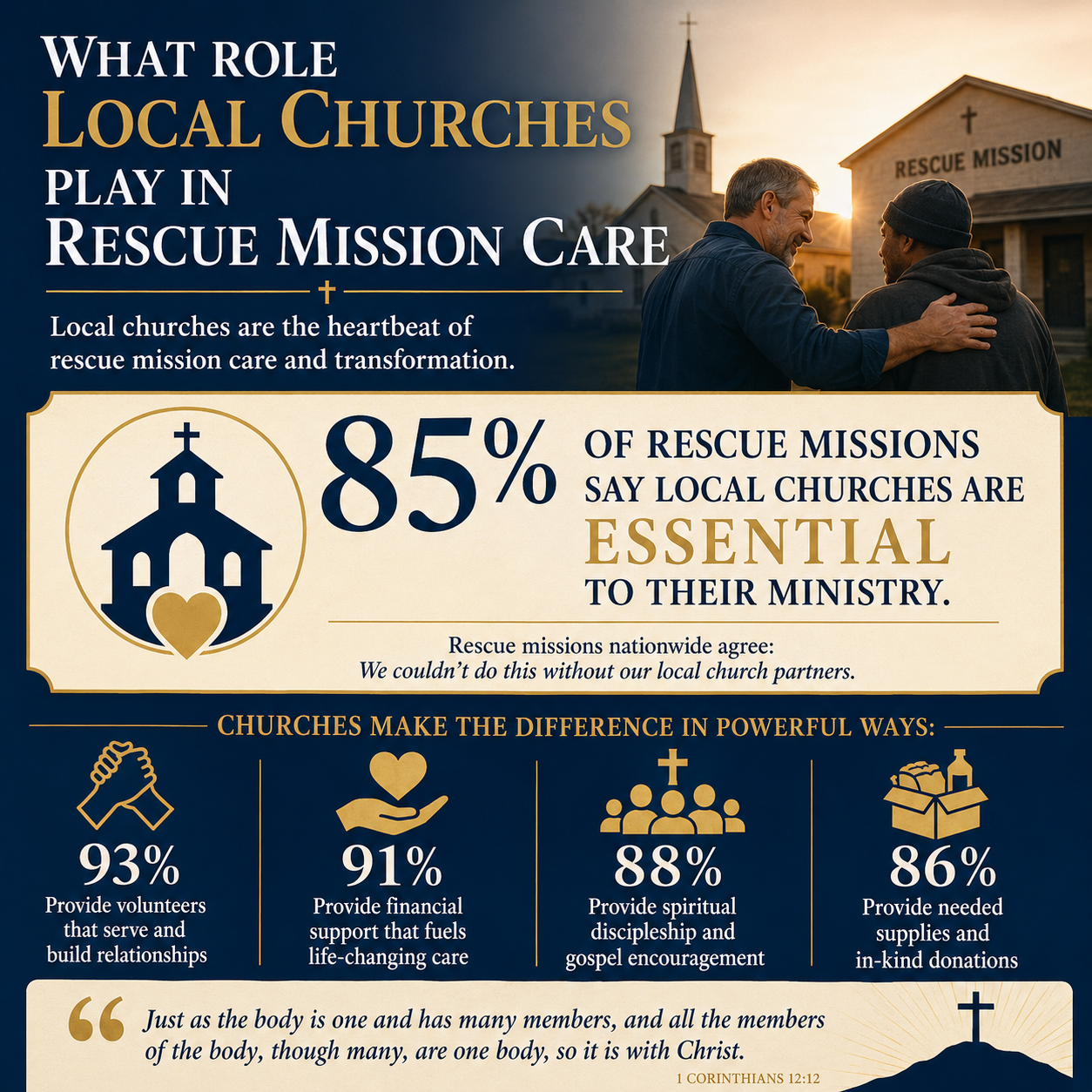
Rescue missions often carry a heavy operational load: overnight shelter, meals, case management, recovery programming, employment readiness, and partnerships with public systems. Local churches rarely have the same infrastructure. Yet the New Testament places the ordinary life of the church—Word, sacrament, prayer, disciplined love, and diaconal mercy—at the center of Christian witness. The strongest rescue mission ecosystems treat churches not as a fundraising audience, but as essential spiritual and communal partners.
Local churches provide the spiritual architecture rescue missions cannot replace
Gospel proclamation and pastoral care are not auxiliary services
Rescue mission care is often discussed in terms of beds and meals, but Christian ministry cannot finally be reduced to material triage. Jesus’ ministry joined proclamation and compassion; he announced the Kingdom and fed the hungry. When local churches participate meaningfully, they bring the ordinary means of grace that missions, by design, may not be positioned to offer at depth: sustained preaching, pastoral oversight, baptismal belonging, communion, and a community ordered by discipleship rather than by program enrollment.
This spiritual architecture matters precisely because many guests and residents are carrying moral injury, family rupture, criminal justice involvement, and long histories of distrust. Churches can offer a stable spiritual home that is not contingent on a shelter stay. They also help guard against a subtle drift in which “help” becomes primarily a set of services, and the gospel becomes merely an inspirational accent. Scripture does not permit that separation; James calls the church to a faith that acts, but it is still faith—directed toward the living God—rather than humanitarianism baptized with Christian language (James 2:14–17).
Churches help keep conversion and coercion distinct
Christians genuinely disagree about how explicitly faith should be integrated into shelter services and recovery requirements. The harder question is not whether the gospel should be present; it is how to ensure it is offered as good news rather than used as leverage. Local churches can strengthen integrity here by providing spiritual formation opportunities that are voluntary, relational, and sustained—Bible studies, mentoring, prayer, worship invitations—without tying access to food or safety to religious compliance.
When churches serve as genuine communities of discipleship, they make it easier for rescue missions to hold firm to Christian identity while also maintaining clear ethical boundaries. That is not a compromise; it is a disciplined form of love that refuses to manipulate the vulnerable.
Local churches supply durable relationships that outlast a program cycle
Belonging is a measurable form of protection
Homelessness is not only a housing problem. It is also a social isolation problem, a family rupture problem, and often a mental health and substance use problem. The research community has been frank that relationship networks are a key dimension of stability. For example, the U.S. Interagency Council on Homelessness has emphasized “social and community integration” as part of successful housing stability approaches in its federal guidance and frameworks U.S. Interagency Council on Homelessness.
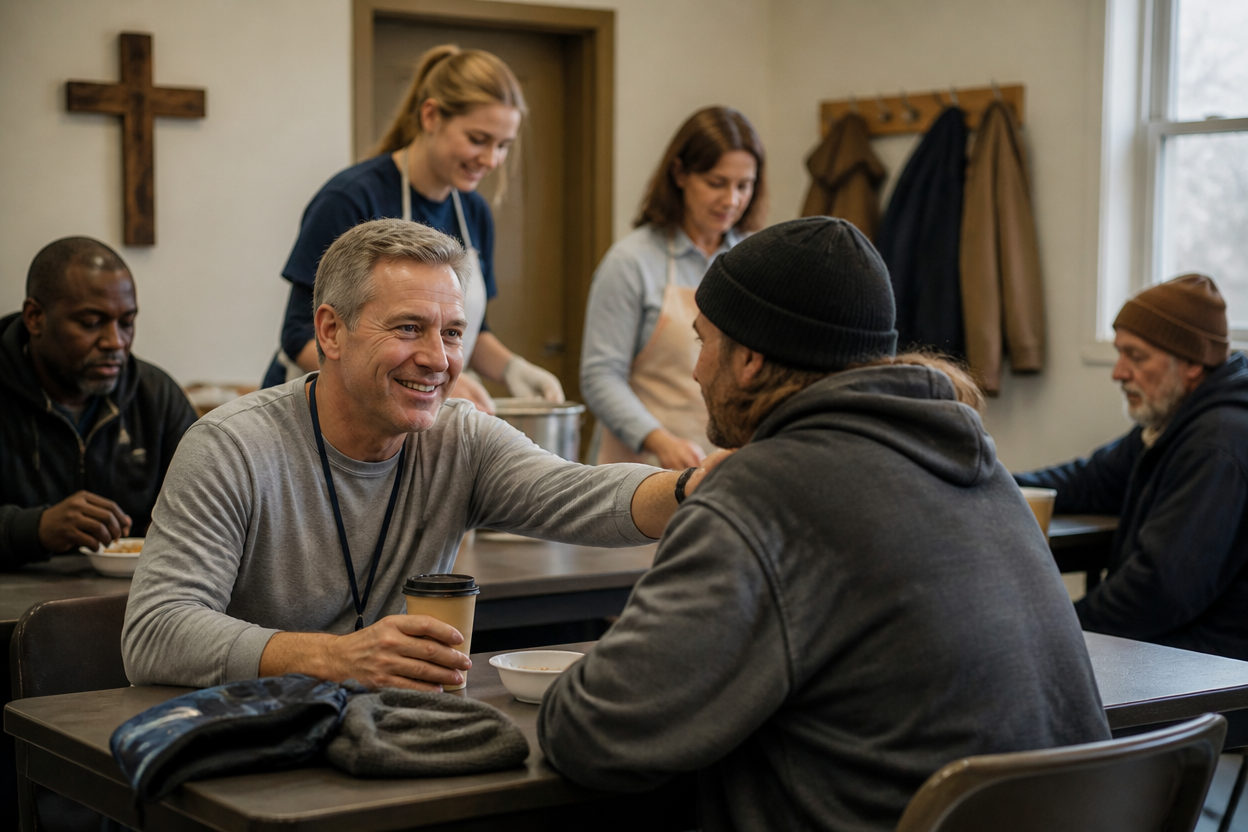
What this means in practice is that local churches can become the relational scaffolding that many rescue mission residents have never had: someone who answers the phone, rides along to court dates, helps rebuild family ties when appropriate, or simply eats a meal without an agenda. A mission can deliver excellent programming and still struggle to provide the long-range friendship that prevents relapse and returns to the street.
Congregations can accompany, not manage
One of the most common failures in mercy ministry is confusing short-term enthusiasm with long-term fidelity. The When Helping Hurts framework, articulated by Steve Corbett and Brian Fikkert, has shaped much of the field’s more mature thinking by naming how well-intentioned aid can undermine dignity and local agency when it creates dependency or paternalism. Churches are particularly prone to this when “service projects” become the primary mode of engagement.
A healthier church posture is accompaniment: walking with a person under the leadership of trained mission staff and licensed professionals where appropriate, while offering the kind of ordinary friendship that no case plan can replicate. This is where donors should pay attention: the most credible partnerships do not blur roles. They respect professional boundaries, trauma-informed practice, and the slow work of trust.
Local churches strengthen rescue mission care through accountable partnership
Governance and doctrine are linked, not separate
Rescue missions and churches occupy different institutional roles, but they should share a clear theological center. A mission that claims Christian identity should be able to articulate its statement of faith, how that faith shapes programs, and how leadership is held accountable to both doctrine and ethical practice. Local churches can reinforce this clarity by asking better questions than “How many meals?” They can ask: How is the gospel presented? How are guests protected from spiritual coercion? How does the ministry handle discipline, safety, and restoration with integrity?
At Most Trusted, our verification work evaluates ministries against The Most Trusted Standard, including criteria that touch faith foundation, governance and leadership, financial integrity, and transparency and effectiveness. Donors should expect rescue missions that welcome church partnership to also welcome scrutiny, because accountability is not hostile to mission; it is one way the church guards the integrity of its witness.
Churches can help prevent the extremes donors fear
Christian donors often carry two opposite anxieties. One is that the ministry has become “all services” with little explicit Christian substance. The other is that the ministry uses Christian language to excuse weak practice: thin safety protocols, untrained counseling, or unmeasured outcomes. Church leaders who understand both theology and the realities of homelessness can help missions avoid both extremes by encouraging strong pastoral care alongside professional competence.
Churches can also bring denominational resources—trained counselors, addiction recovery ministries, legal aid clinics, and benevolence structures—that complement a mission without competing with it. The goal is not ecclesial branding. The goal is coherent care under Christ.
Local churches broaden the care continuum beyond emergency shelter
From crisis response to long obedience
Emergency shelter is essential, but it is not the finish line. The public policy conversation often frames homelessness in terms of housing supply, behavioral health capacity, and income. Those factors are real, but rescue missions typically operate where these pressures converge at human scale: a person’s addiction relapse, a domestic violence escape, a lost job, a psychiatric crisis, an eviction. Churches can help move care from crisis response to durable formation—spiritual, relational, vocational, and communal.
The National Alliance to End Homelessness has consistently argued that homelessness is solvable when communities combine proven interventions with coordinated systems, not isolated efforts National Alliance to End Homelessness. Churches, at their best, become part of that coordinated system: offering transitional housing partnerships, hosting support groups, providing employment networks, and helping people re-enter community life without being defined by a program label.
Practical roles churches can play without displacing professionals
Some church engagement is unhelpful precisely because it ignores the complexity of trauma, addiction, and public systems. Mature partnership respects the expertise of rescue mission staff and community providers. In that spirit, churches can contribute in ways that are both meaningful and bounded:
- Volunteer teams trained for specific mission-defined roles, especially hospitality, meal service, and tutoring
- Mentoring and discipleship relationships coordinated with case management plans
- Employer networks and job placement advocacy for residents ready to work
- Transportation support for appointments, court dates, and reunification efforts
- Congregational “welcome pathways” into worship and community life that do not pressure or exploit
The common thread is cooperation under clear leadership, not improvised charity. Churches that insist on doing things “their way” often increase risk. Churches that submit to shared standards tend to deepen care.
For donors, the church mission relationship is a credibility signal worth testing
Healthy partnerships show up in verifiable practices
Christian donors want to give with both compassion and prudence. A mission’s relationship with local churches can be a meaningful indicator of credibility, but only if it is concrete. Donors should ask for evidence: memoranda of understanding with churches, training requirements for volunteers, pastoral care protocols, safeguarding policies, and clear theological commitments that are consistent with daily practice.
This is also where donors should resist simplistic heuristics. The “Overhead Myth” letter, signed by organizations including GuideStar and BBB Wise Giving Alliance, warned donors against treating low overhead as a proxy for effectiveness Candid Guidestar. The more relevant question is whether resources are aligned with mission: adequate staffing, proper training, safe facilities, and transparent reporting. Churches can either reinforce mature donor expectations or unintentionally pressure missions toward under-resourcing the very work donors claim to value.
Where Most Trusted fits
Many donors are trying to assess what cannot be fully seen from a newsletter: governance quality, financial controls, theological integrity, and whether reported outcomes correspond to reality. Most Trusted exists because Christian generosity deserves serious verification. When a rescue mission meets The Most Trusted Standard, donors gain a clearer view of how faith commitments translate into operational discipline and truthful communication—conditions that make church partnership stronger rather than merely more visible.
For broader context on the landscape, many donors also benefit from reading across Rescue Missions and Homeless Outreach, especially when evaluating how local church engagement interacts with public systems, housing models, and recovery pathways over time.
FAQs for What role local churches play in rescue mission care
Should local churches prioritize giving directly to rescue missions or building their own homelessness ministry?
The wiser priority depends on capacity and calling, but duplication is a frequent failure. Churches with limited expertise often serve best by partnering with established rescue missions and supplementing them with relational discipleship, volunteer service, and targeted supports. Churches that do build programs should do so with clear safeguards, trained leadership, and accountability to outcomes, not only activity. The aim is faithful care that increases stability for neighbors, not the expansion of church programming for its own sake.
How can donors tell whether a rescue mission is meaningfully connected to local churches?
Meaningful connection is visible in practices: shared volunteer training, clear pastoral care pathways, church-based mentoring that aligns with case management, and consistent theological clarity without coercion. Donors can ask how churches are involved beyond fundraising events, whether churches participate in governance or advisory structures, and how the mission reports both spiritual care and measurable outcomes. A mission that welcomes thoughtful questions and transparent documentation is typically better positioned for long-term credibility within Gospel-Centered Care in Rescue Missions.
The church is not an accessory to rescue mission care
Local churches play a role in rescue mission care that neither the state nor the nonprofit sector can replicate: forming people into communities of worship, repentance, stability, and neighbor-love under the lordship of Christ. Rescue missions, in turn, bring specialized capacity that most congregations do not have. When the relationship is ordered, accountable, and theologically clear, donors are not merely funding services; they are participating in a credible Christian witness to mercy that protects the vulnerable and honors the gospel it proclaims.



