
What Christ-centered case management looks like is not a softer version of secular social work with a prayer appended. It is a disciplined form of neighbor love that treats a person as a moral agent made in God’s image, offers concrete help without coercion, and keeps the gospel central without using it as a transaction for services.
For Christian donors, case management is often the unseen engine inside a rescue mission: the slow, relational work that turns a warm bed into a pathway toward stability. It is also where harm can be done when ministries confuse control with care, measure success only by compliance, or neglect the safeguards that protect both guests and staff.
Case management begins with a theological view of the person
Image-bearing, not a project
Christian mercy is not content with symptom relief. Scripture insists on the dignity of the person (Genesis 1:27) and the reality of sin and suffering in a fallen world (Romans 8:22–23). Christ-centered case management therefore resists two errors at once: reducing a guest to a bundle of needs, and romanticizing poverty as if it were merely a lack of opportunity.
In practice, this means the case plan is not something done to a guest, but constructed with a guest. The case manager expects setbacks, names responsibility without contempt, and refuses to collapse the person into their worst day. A mature ministry also recognizes that chronic homelessness can include serious mental illness, cognitive impairment, addiction, and trauma histories that complicate “standard” self-sufficiency timelines.
Mercy and truth held together
Christ-centered care speaks truthfully about realities like substance use, untreated psychosis, domestic violence, and predatory relationships. Yet it does so with the moral posture of the gospel: “We love because he first loved us” (1 John 4:19). The case manager is neither an enabler nor a prosecutor. The aim is repentance and restoration where sin is present, and protection and healing where victimization is present, without confusing those two categories.
Christians genuinely disagree about how explicit a ministry should be in its evangelism requirements, especially when beds are scarce and public funding is involved. Serious ministries do not dodge this complexity. They build policies that honor conscience, maintain clear Christian identity, and safeguard voluntariness in spiritual programming.

Good assessment is both clinical and pastoral
Whole-person intake without voyeurism
Case management that is worthy of donor trust begins with careful assessment. This includes housing history, income and benefits, legal barriers, health conditions, family systems, trauma exposure, and spiritual background. A Christian ministry should be able to explain why it collects each data point, how it secures it, and how it avoids turning intake into intrusive storytelling that re-traumatizes guests.
When assessment is shallow, the plan becomes generic and the outcomes become misleading. When it is overly invasive, the ministry violates dignity. The healthier pattern is structured tools, trained staff, and clear limits on what is required for entry versus what may be explored over time.
Trauma-informed care under the lordship of Christ
“Trauma-informed” language is now widespread, and not always used carefully. At its best, trauma-informed practice acknowledges how past harm shapes present behavior, and it prioritizes safety, predictability, and consent. A Christ-centered approach can adopt these insights without surrendering Christian moral clarity or implying that trauma eliminates responsibility.
Many rescue missions coordinate with public systems for behavioral health, detox, and disability services. Donors should not assume this compromises Christian identity. When done well, coordination is an expression of wisdom and humility: the mission remains pastorally present, while specialized clinicians provide treatment the mission is not equipped to deliver.
Plans should be concrete, time-bound, and relational
Goals that can be audited, not just admired
In our verification work at Most Trusted, the ministries that meet The Most Trusted Standard tend to define case management with measurable steps: documents obtained, appointments kept, sobriety supports engaged, reunification efforts pursued, job readiness milestones reached, lease-up plans prepared. Without these, donors are left with testimonies alone—valuable, but insufficient for governance and stewardship.
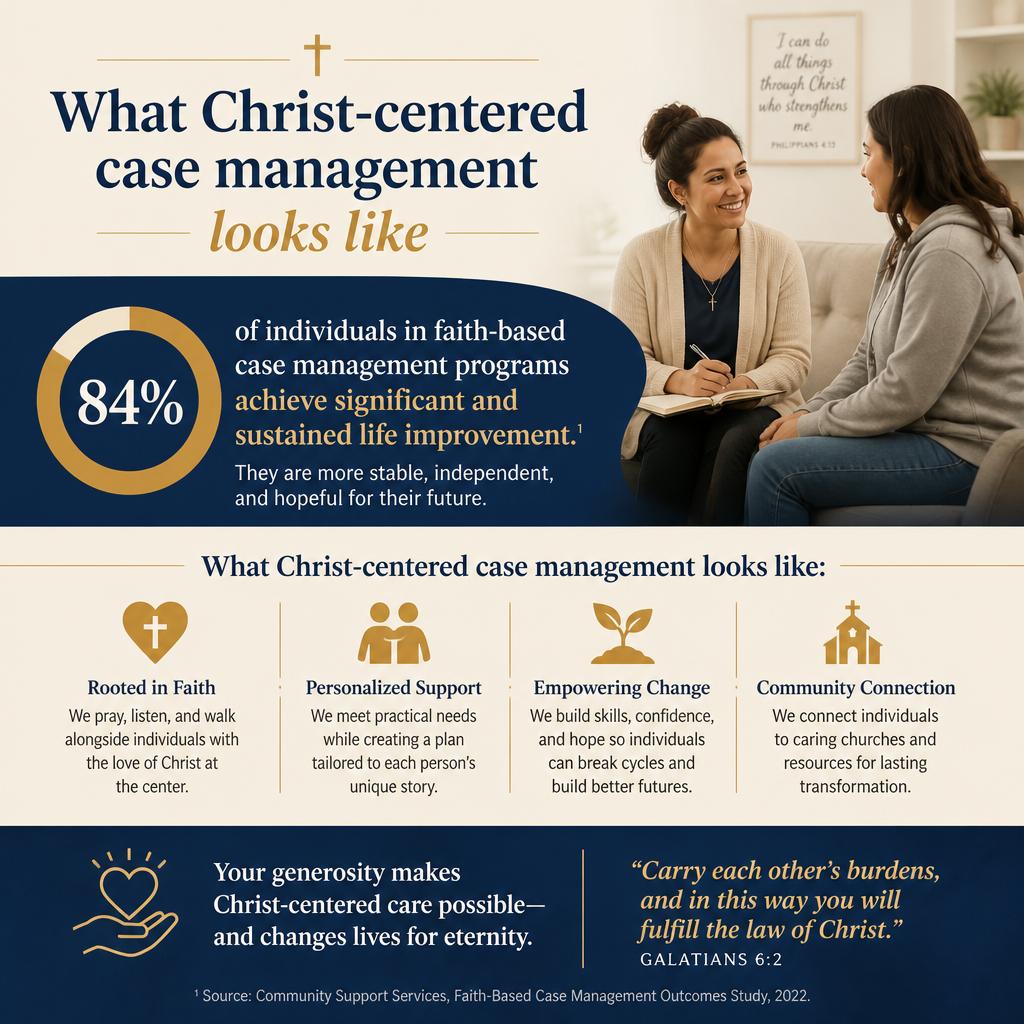
What this means in practice is that a case plan should specify responsibilities on both sides. The guest commits to clear actions. The ministry commits to specific supports, such as transportation assistance, coaching, referrals, and advocacy. The case manager holds the relationship steady as motivation rises and falls.
Rhythms of accountability that are not punishment
Accountability is often misunderstood in homeless outreach. If rules are merely punitive, they drive deception and churn. If rules are absent, chaos grows and the vulnerable are harmed. Christ-centered case management treats accountability as a form of love, ordered toward the neighbor’s good.
A balanced approach often includes a small set of shared expectations, consistent enforcement, and graduated responses. It also includes appeal processes and documentation, especially when decisions affect housing access or program standing. Donors should expect this level of seriousness when a ministry’s decisions have life-altering consequences.
- Written case plans with dates, milestones, and review intervals
- Documented referrals and follow-up, not merely “resource lists”
- Clear boundaries around safety, substances, and harassment
- Progress reviews that incorporate both staff input and guest voice
- Exit planning that begins early, including relapse and crisis contingencies
Collaboration and systems literacy separate care from chaos
Understanding the local housing and benefits landscape
Case management cannot substitute for housing supply, wages, or the complexity of public benefits. In many communities, the structural gap is real: the National Low Income Housing Coalition reports that the U.S. has a shortage of millions of affordable and available rental homes for extremely low-income renters, a constraint that shapes what even excellent programs can accomplish National Low Income Housing Coalition.
Strong case managers therefore become translators of systems: how to obtain identification, navigate Medicaid eligibility, pursue SSI/SSDI when appropriate, address warrants, and respond to landlord screening barriers. This work is often tedious, and it is precisely why it is effective. It addresses the bottlenecks that keep people stuck.
Coordinated entry and the limits of standardization
Many communities use “coordinated entry” systems to prioritize limited housing resources. Christians disagree about how well these systems work and how fair the prioritization algorithms are. The sober view is that coordinated entry can reduce duplication and improve targeting, but it can also feel impersonal and can privilege those who fit a narrow vulnerability profile.
A mission’s case management should be competent in these systems without being captive to them. The ministry should advocate for guests, document barriers, and maintain pastoral and relational care even when the public system’s pace is slow. Donors who care about outcomes should ask how the mission engages the community’s housing continuum and where it sees persistent breakdowns.
Those who want a wider view of this field can follow our coverage of Rescue Missions and Homeless Outreach, where we evaluate ministries operating within very different policy and housing environments.
Donor confidence requires verifiable safeguards and credible outcomes
Guardrails that protect guests, staff, and the gospel witness
Case management touches sensitive data, high-risk decisions, and vulnerable people. Donors should expect ministries to demonstrate strong governance and internal controls: background checks and training protocols, incident reporting, confidentiality standards, and clear separation of spiritual care from clinical roles when appropriate. A ministry’s Christian identity does not exempt it from the duty to be competent.
Across our verification work, we find that transparency matters as much as compassion. When a mission reports outcomes, it should define terms (for example, what counts as “graduation” or “housing placement”), avoid inflating short-term wins, and acknowledge limitations. The temptation to overstate results is real, especially when donors understandably want visible transformation.
Measuring what matters without treating people as metrics
Some outcomes are easier to count than others. A bed night is simple; sustained housing at 12 months is harder. Yet the direction of travel matters. The U.S. Department of Housing and Urban Development’s Annual Homeless Assessment Report remains a key national benchmark for understanding trends and definitions, and serious ministries should be conversant with its categories even when they critique aspects of the system U.S. Department of Housing and Urban Development.
For donors, the more instructive question is whether a ministry’s measurements align with its theology. If a mission claims to seek restoration, does it track reunification where safe, participation in local church life where desired, employment retention, relapse recovery plans, and stable housing? If it claims to prioritize dignity, does it publish privacy-respecting reporting that still allows for accountability?
We address these questions in our broader work on Gospel-Centered Care in Rescue Missions, where the central issue is not whether ministries “do good,” but whether they do good in ways consistent with Christian conviction and public trust.
FAQs for What Christ-centered case management looks like
Should a rescue mission require chapel attendance as part of case management?
Some missions integrate chapel and discipleship as program expectations; others keep spiritual programming explicitly voluntary, especially when partnering with public systems. What matters for donor confidence is clarity and integrity: the ministry should state requirements plainly, honor voluntariness where promised, and ensure that access to basic safety is not conditioned on professions of faith. Christ-centered care invites people to Christ without manipulating desperation.
What outcomes should donors look for in Christ-centered case management?
Donors should look for outcomes that reflect stable pathways: verified housing placements with follow-up, income stabilization, reduced crisis service use where measurable, reconnection to healthy family or community supports, and clear definitions for “success” and “exit.” Equally important are safeguards: documented policies, staff training, data privacy practices, and governance oversight that keeps case management accountable to mission and ethics.
What Christ-centered case management demands of ministries and donors
Christ-centered case management is demanding because it refuses both cynicism and sentimentality. It insists that a person is neither a problem to be managed nor a story to be marketed, but a neighbor to be served in truth and love. For donors, the call is to fund that slower work with discernment: supporting ministries that can show competent practice, theological integrity, and verifiable stewardship under The Most Trusted Standard.



