
Gospel-centered care in rescue missions is not a branding choice or an optional program layer. It is the organizing conviction that human need is both material and spiritual, and that lasting restoration ultimately requires reconciliation to God through Christ. Christian donors are right to ask how that conviction is expressed with integrity, without coercion, and with results that can be tested rather than merely asserted.
The harder question is not whether rescue missions should preach the Gospel. Scripture leaves little ambiguity about proclaiming Christ and loving neighbor in tangible ways (Matthew 28:19–20; James 2:14–17). The harder question is how a mission embodies Christian witness while protecting the dignity of guests, stewarding donor funds responsibly, and telling the truth about outcomes. Across our verification work at Most Trusted, we find that the strongest missions treat these as inseparable obligations rather than competing priorities.
What Gospel-centered care means when the lights are on and the beds are full
Rescue missions sit at an intersection of acute crisis and long-term complexity. Some guests need a hot meal and a safe place to sleep for one night. Others are recovering from trauma, addiction, serious mental illness, domestic violence, incarceration, or years of homelessness. A Gospel-centered mission does not reduce people to “clients” or “cases,” but it also does not sentimentalize need or ignore the realities that make homelessness difficult to exit.
Word and deed as a single moral responsibility
Historically, Christian rescue work has held proclamation and mercy together. That unity can be mischaracterized in two opposite ways: as if evangelism is a pretext for services, or as if services are a pretext for evangelism. Faithful missions resist both distortions. They offer food, shelter, hygiene, medical connections, and case management because every person bears God’s image (Genesis 1:27). They also offer the Gospel because sin and suffering are not finally healed by housing alone (Mark 2:17).
What this means in practice is that chapel, Bible study, pastoral counseling, and discipleship are not treated as an ornamental feature for donors. They are resourced, staffed, and governed with seriousness. At the same time, a well-run mission distinguishes between hearing the Gospel and being compelled to perform religion to receive basic care. Donors should expect missions to be clear about this line and disciplined in keeping it.
Dignity, consent, and the difference between invitation and pressure
Christians genuinely disagree about what conditions are appropriate for participation in explicitly Christian programming when someone is receiving services. The most defensible approach is transparent from the beginning: what is offered, what is expected in each program track, and what is never withheld. Many missions provide emergency shelter and meals without religious requirements, while offering voluntary spiritual care and a structured recovery program where discipleship is integral. That model can respect both religious freedom and program integrity, especially when the mission communicates it without euphemism.
Donors should pay attention to how a mission talks about guests. When language becomes transactional—“they must attend chapel to earn dinner”—it often signals deeper problems in theology and practice. Gospel proclamation is not barter. It is witness, given freely, alongside tangible mercy.
The baseline realities donors should not ignore
Homelessness is not a monolith, and the public conversation often collapses very different populations into one. The U.S. Department of Housing and Urban Development’s annual Point-in-Time count remains the most cited national snapshot of sheltered and unsheltered homelessness and is a useful baseline for donors trying to understand scope and trends, even with its acknowledged methodological limits U.S. Department of Housing and Urban Development.
Those counts do not tell a mission how to shepherd a traumatized person through relapse, reunite a family after estrangement, or help someone rebuild employability. But they do remind us that rescue missions operate within a system under strain, where local housing markets, behavioral health capacity, and addiction trends shape what is realistically possible.
How missions share the Gospel without reducing people to a metric
The Christian donor instinct is often to look for two kinds of evidence: faithfulness to the Gospel and fruit that is more than marketing. Both matter. The first is theological; the second is moral and operational. When missions conflate “decisions” with discipleship, or substitute religious language for measurable care, the result is usually disappointment for guests and disillusionment for donors.
Chapel and discipleship that treat people as moral agents
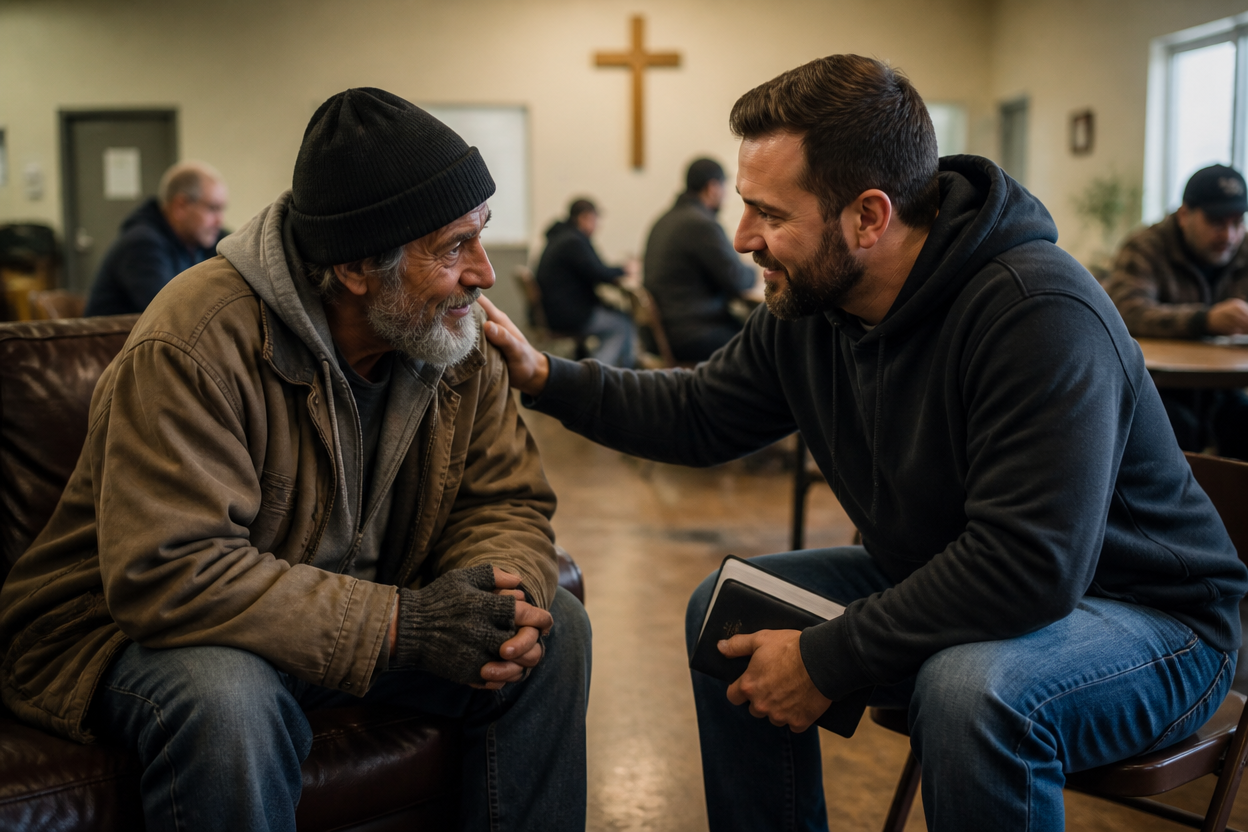
In healthy missions, chapel is not entertainment and not a disciplinary tool. It is a gathered space where the Word is preached, prayer is offered, and people are addressed as responsible image-bearers capable of repentance, faith, and change. Discipleship is then structured for the long work: spiritual formation, confession and accountability, healing from shame, and learning basic Christian practices in community.
Donors should expect thoughtful guardrails: trained staff or vetted volunteers, clear statements of faith, and trauma-informed practices that avoid spiritual manipulation. Missions that meet The Most Trusted Standard tend to document how spiritual programming is overseen, how volunteers are screened, and how teaching aligns with the ministry’s doctrinal commitments.
Christ-centered case management as pastoral realism
Case management is where theology becomes operational. A Christ-centered approach does not mean turning every conversation into a sermon. It means bringing a Christian view of the person to practical planning: the reality of sin and responsibility, the reality of suffering and victimization, the possibility of change, and the necessity of truth-telling. It also means refusing cynical minimalism. Many guests have been told, implicitly or explicitly, that no one expects anything of them. Biblical love does not settle for that.
At its best, case management coordinates concrete next steps—identification documents, treatment referrals, medical appointments, budgeting, debt resolution, child support issues, probation compliance, job readiness—while reinforcing spiritual supports and community connections. When Helping Hurts, articulated by Steve Corbett and Brian Fikkert, has shaped many missions’ thinking here: aid that is not paired with empowerment and mutual responsibility can unintentionally deepen dependency and shame Chalmers Center.
Reporting that resists both cynicism and hype
Some donors have been trained to judge ministries by a single number: “How many people did you save?” That question is understandable, but it can lead missions into shallow reporting. The more responsible approach reports multiple outcomes and acknowledges limits: shelter nights provided, meals served, program completion, employment placements, housing transitions, sobriety milestones, reconnections with family, and church engagement—without implying that any metric captures the secret work of the Holy Spirit.
Transparency is also tested in how missions speak about relapse, program exits, and involuntary discharges. A mission can uphold standards of safety and sobriety without pretending every story is linear. Mature donors should expect honest attrition data and thoughtful explanation rather than selective testimony.
What restoration looks like in relationships, work, and housing
Gospel-centered care is often most visible not in the chapel service but in the slow rebuilding of ordinary faithfulness. Many guests have fractured relationships, an employment history shaped by disruption, and a housing path complicated by evictions, poor credit, or criminal records. A mission’s care should be comprehensive enough to address these realities without assuming it can replace the role of family, church, and community institutions.
Rebuilding relationships without romanticizing reconciliation
Rescue missions frequently mediate family reconnection—between spouses, parents and children, adult children and aging parents. This work requires moral clarity and pastoral caution. Forgiveness does not always mean immediate reunion, and reconciliation is not always safe. In cases involving abuse, restraining orders, or ongoing addiction, a mission must honor legal and clinical boundaries while still holding out Christian hope and pursuing appropriate forms of restoration.
Donors should look for policies that protect vulnerable people: mandatory reporting practices, partnerships with domestic violence services when relevant, and staff training for trauma and boundaries. These are not distractions from Gospel ministry; they are part of loving neighbor truthfully.
Job readiness that is more than a resume workshop
Work is not salvation, but it is a sphere where discipleship becomes visible: honesty, reliability, reconciliation, patience, and responsibility. Effective job readiness includes practical training—interviewing, workplace norms, conflict management, appropriate dress, punctuality—and also addresses barriers such as transportation, legal issues, and untreated health needs.
Many missions operate social enterprises, thrift stores, or partnerships with local employers to create transitional employment. These models carry trade-offs: they can provide structure and experience, but they can also become mission-managed economies that do not translate into the broader labor market if not designed carefully. Donors should ask what percentage of participants move from transitional work into competitive employment, and how the mission verifies that outcome.
Housing pathways that acknowledge the system donors are funding
Christians often want a mission to “get people housed,” and missions should pursue that aim with urgency. But the path depends on local realities: rental prices, vacancy rates, available supportive housing, and eligibility rules. The field has also had to reckon with differing approaches—emergency shelter plus recovery programming, transitional housing, rapid rehousing, and supportive housing—and the fact that no single model fits every person.
Donors can ask whether a mission has clear partnerships and referral pathways rather than operating as an island. Coordination with Continuum of Care networks, treatment providers, and landlords can be the difference between an inspiring program and a durable exit from homelessness. These are operational questions, but they are also moral ones: stewardship requires building toward real, sustainable outcomes.
What Christian donors should verify before funding rescue mission care
Christian donors are often generous with rescue missions because the need is visible and urgent. That generosity deserves protection. The Christian public has also seen ministries fail through moral scandal, financial mismanagement, or exaggerated impact claims. Responsible giving does not mean suspicion toward every ministry; it means applying consistent standards so that trust is earned and maintained.
Faith commitments that are clear and govern the work
Gospel-centered care depends on a mission’s theological clarity. Donors should be able to find a statement of faith and see how it is expressed in program design, staffing, and partnerships. A mission should be explicit about what it means by “Gospel,” what church tradition it stands within, and how it handles doctrinal boundaries in teaching and counseling.
The question is not whether the mission uses Christian language. The question is whether its practices align with Christian claims about truth, repentance, grace, and human dignity. Vague religiosity rarely sustains the pressures of front-line crisis work.
Governance and financial integrity that match the moral weight of the work
Rescue missions handle funds given in the name of Christ and serve guests who are often vulnerable to exploitation. Donors should expect strong boards, independent audits or reviewed financial statements as appropriate to size, conflict-of-interest policies, and disciplined controls around cash assistance, gift-in-kind distribution, and restricted funds.
We also encourage donors to resist simplistic overhead assumptions. The nonprofit sector has repeatedly clarified that low administrative spending is not a proxy for trustworthiness or effectiveness. The Overhead Myth statement, supported by major charity evaluation leaders, makes the case that governance, evaluation, and infrastructure are necessary for real impact and accountability BBB Wise Giving Alliance.
Across our work at Most Trusted, we evaluate ministries against The Most Trusted Standard, a 15-criteria framework that examines faith foundation, financial integrity, governance and leadership, and transparency and effectiveness. For rescue missions, this framework helps donors distinguish between ministries that merely claim Gospel-centered care and those that can demonstrate it in doctrine, operations, and reporting.
Transparency that tells the truth about outcomes and limitations
Donors should look for public-facing clarity: program descriptions that specify what is offered, annual reports that include measurable outcomes, and narratives that do not treat guests as props. It is a warning sign when a mission cannot explain how it defines success or how it handles hard cases—relapse, program failure, chronic mental illness, or guests who choose to leave.
Healthy transparency also includes safeguarding: policies for protecting minors, handling allegations, and ensuring appropriate conduct in volunteer interactions. Missions that are serious about the Gospel are serious about holiness, which includes institutional righteousness—truthfulness, accountability, and protection of the vulnerable.
Gospel-centered care is verified in both doctrine and practice
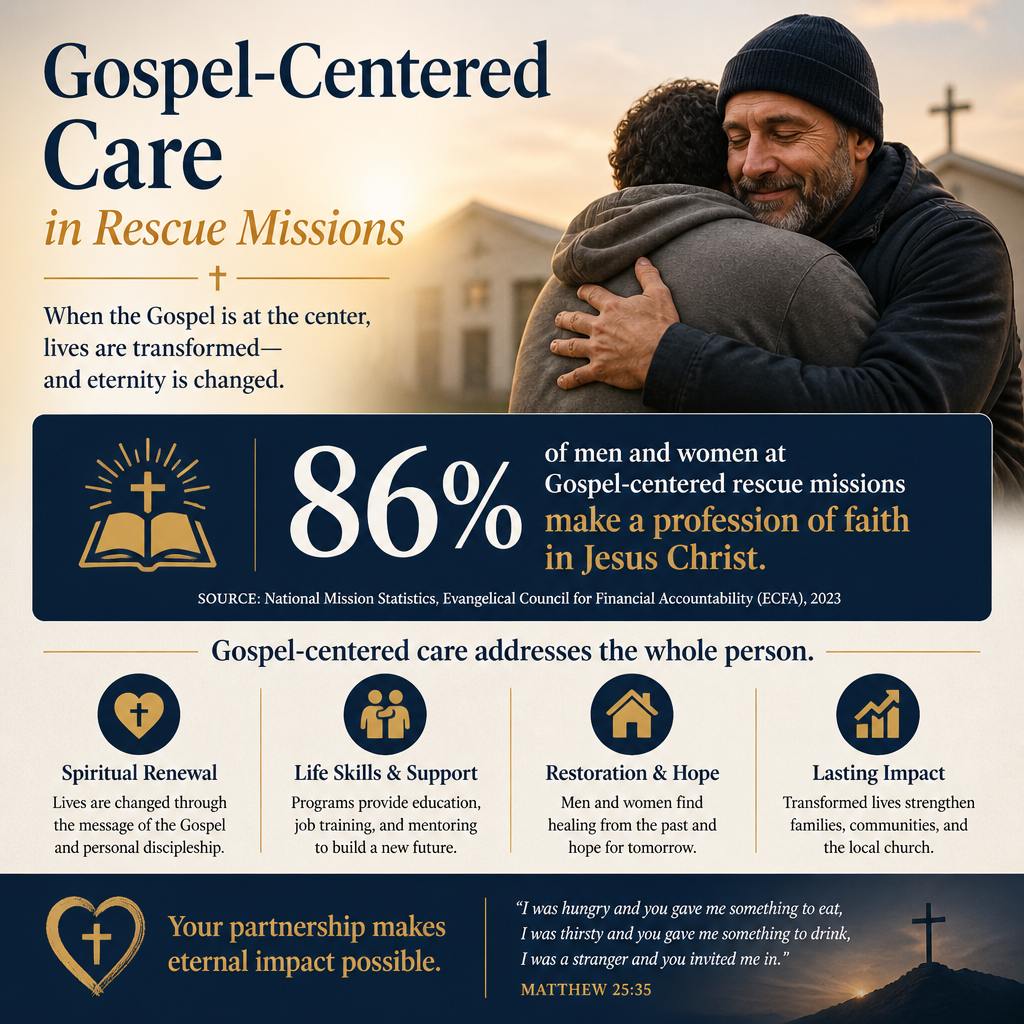
Gospel-centered care in rescue missions asks donors to hold two convictions together: Christ’s compassion for immediate need and Christ’s claim over the whole life. When a mission feeds the hungry, shelters the vulnerable, and proclaims repentance and forgiveness in Jesus’ name, it is doing work the church has recognized for centuries as faithful Christian witness.
For donors, the stewardship task is to fund missions where that witness is not merely spoken but governed, financed, safeguarded, and reported with integrity. For a broader view of how rescue mission programs fit within Christian homelessness outreach, we point donors to Rescue Missions and Homeless Outreach as the natural context for evaluating ministries and their models of care.



