
Why rescue missions include chapel and discipleship is not a branding decision. It is a theological claim about what human beings are, what suffering does to us, and what lasting change requires. For Christian donors, the question is rarely whether compassion matters; it is whether the compassion we fund is ordered toward the whole person and governed with integrity.
Modern homelessness is entangled with mental illness, addiction, trauma, family breakdown, economic displacement, and often a long history of institutional distrust. A meal and a bed can be decisive in a moment of crisis, but they do not by themselves answer the deeper questions of identity, agency, and hope that Scripture treats as spiritual before they are social. Rescue missions that include chapel and discipleship are making a wager that the gospel is not an accessory to care, but its defining center.
Chapel is a spiritual practice, not a program add-on
Rescue missions treat worship as part of human restoration
Christian ministry begins with God, not with outcomes. When a rescue mission schedules chapel, it is acknowledging that worship reorients disordered loves, and that disordered loves are not an abstract theological problem. They show up as despair, self-protection, and the numbing habits that often accompany street survival. Scripture describes the human heart as a worshiping center; the question is not whether we worship, but what we worship. A mission that omits worship can still do significant good, but it is no longer offering distinctively Christian care.
This is also why many missions resist framing chapel as mere “inspiration.” The word of God is not motivational content. It is, in the language of Hebrews, “living and active,” exposing what is hidden and calling a person into truth (Hebrews 4:12). In practice, chapel creates a regular rhythm where guests hear that they are made in God’s image, accountable before him, and not finally defined by what has been done to them or what they have done.
Chapel can protect dignity when it is not coerced
Christians genuinely disagree about the ethics of required chapel in settings where a person needs shelter. The concern is not trivial: if someone feels compelled to sit through worship to avoid the street, the mission risks instrumentalizing spiritual practices and violating conscience. Many missions have responded by distinguishing emergency services from longer-term residential programs, clarifying expectations before intake, and ensuring that material care is not dangled as a reward for outward religious compliance.
Donors should not accept vague assurances here. Good practice is observable: written policies, transparent program tracks, grievance mechanisms, and staff training that treats people as neighbors rather than projects. Across our verification work at Most Trusted, the ministries that meet The Most Trusted Standard tend to document these boundaries clearly and articulate why spiritual formation belongs in their model without making the vulnerable pay for it with silence.
Discipleship addresses what homelessness often exposes
Many root problems are relational and spiritual, not only material
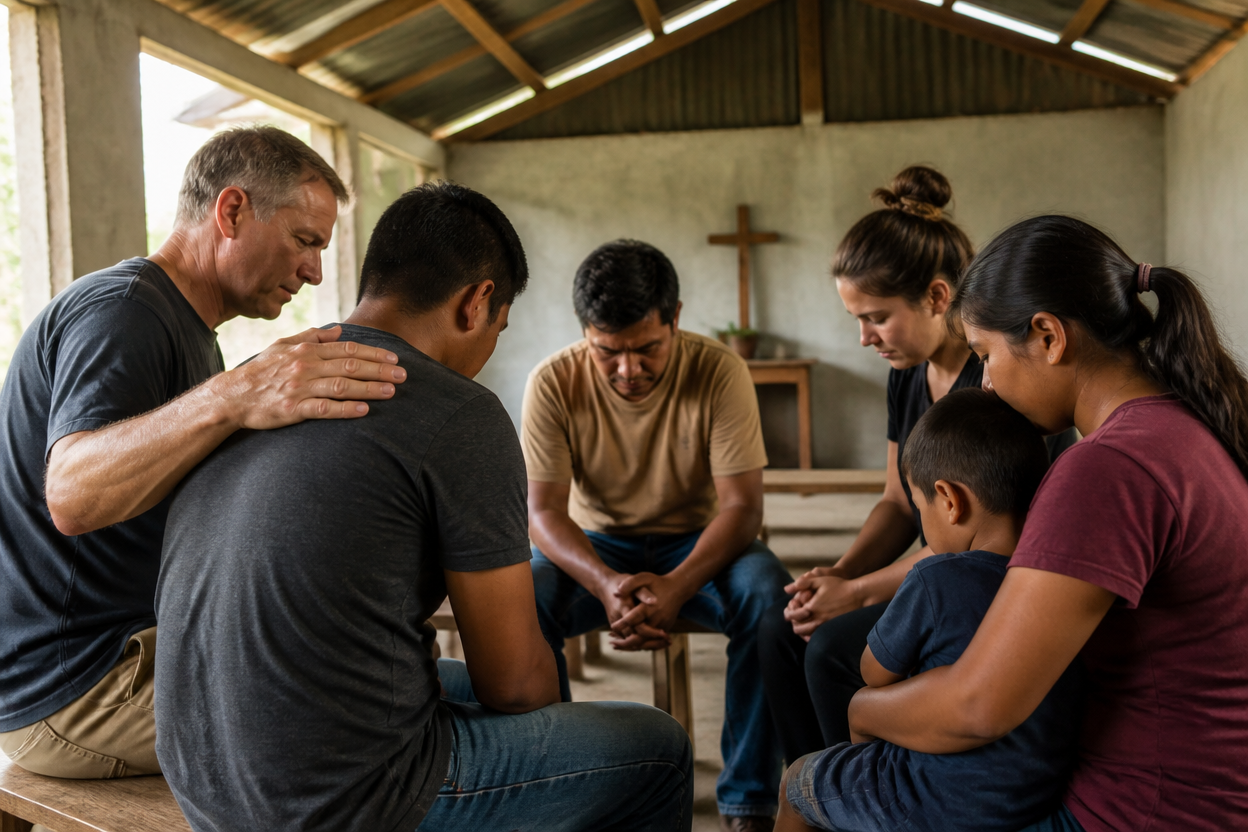
Some homelessness is primarily a housing affordability crisis. Some is driven by untreated psychiatric illness. Some is the aftermath of domestic violence. Many people experience overlapping causes. Yet across these scenarios, homelessness typically accelerates isolation and erodes trust, including trust in one’s own capacity to make and keep commitments. Discipleship is designed for precisely this terrain because it is not merely information transfer; it is relational formation toward a new way of life.
The New Testament describes salvation as reconciliation with God that produces reconciliation with others. When missions teach Scripture, invite confession and repentance, and pair guests with mature believers, they are addressing the interior life that so often governs exterior stability. This is not a denial of structural realities. It is an insistence that the human person is more than a bundle of needs to be met.
Addiction recovery has spiritual dimensions that are difficult to ignore
Rescue missions frequently serve men and women with substance use disorders. Treatment professionals recognize that long-term recovery commonly requires community, accountability, and a coherent framework for meaning and restraint. The field’s most famous recovery model is explicitly spiritual: Alcoholics Anonymous’ Twelve Steps include moral inventory, confession, amends, and reliance on a “Power greater than ourselves” Alcoholics Anonymous. Christian discipleship differs from AA in decisive ways, but it shares the sober recognition that addiction is not only a medical condition; it is also a captivity of desire and habit.
For donors, the practical implication is that a mission’s discipleship strategy should be examined with the same seriousness as its clinical and case-management strategy. A gospel-centered mission does not treat Bible study as a substitute for appropriate referrals, medication adherence, or licensed counseling where needed. It integrates spiritual formation with responsible care.
Chapel and discipleship can strengthen outcomes when they are accountable
Formation needs measurement, not just sincerity
Some donors worry that spiritual programming can become a convenient cover for weak operations. That concern is warranted. A mission can preach orthodox doctrine and still mishandle funds, neglect safeguarding, or overstate results. The answer is not to abandon chapel and discipleship; it is to require that spiritual care sits inside a transparent system of governance, financial integrity, and outcome reporting.
What this means in practice is that donors should look for a mission that can articulate what discipleship looks like on Tuesday morning: structured classes, mentoring relationships, clear participation expectations, and pathways to a local church. Just as importantly, the mission should be able to describe what happens when a resident relapses, violates rules, or declines spiritual participation in an emergency setting. Serious ministries name these tensions because the work is morally weighty and operationally complex.
Chaplains and mentors must be trained and supervised
Spiritual authority is real authority. Poorly supervised mentors can spiritualize trauma, pressure quick forgiveness, or treat complex mental illness as a simple faith deficit. Rescue missions that serve responsibly invest in training around trauma, boundaries, and safeguarding, and they maintain clear lines of accountability for anyone leading chapel, counseling, or one-on-one discipleship.
Donors can ask concrete questions and expect concrete answers. Healthy signals often include:
- Clear doctrinal commitments that inform teaching without creating a culture of pressure
- Written safeguarding policies for private counseling and mentorship
- Partnerships with local churches for long-term spiritual community after graduation
- Referral protocols for mental health and substance use treatment
- Transparent reporting on program participation and completion, with definitions that are not inflated
These are not merely best practices; they are expressions of love ordered by truth. “Let all things be done decently and in order” is a pastoral instruction that applies to ministry operations as well as worship (1 Corinthians 14:40).
Christian donors should examine the model, not only the message
Rescue missions sit at the intersection of mercy and discipleship
When Jesus fed the hungry, he did not stop with bread. He also proclaimed the kingdom, called for repentance, and formed disciples. The church’s works of mercy have always carried this dual character: tangible care and spiritual invitation. For donors, the challenge is discerning whether a mission’s model genuinely integrates both, or whether one function crowds out the other.
Some missions have been criticized for providing minimal services while emphasizing preaching. Others have drifted toward social service delivery that avoids explicit Christian witness. The more reliable ministries tend to state plainly what they are trying to accomplish and then align staffing, budgeting, and partnerships accordingly. When we evaluate ministries against The Most Trusted Standard, we do not treat “gospel-centered” language as sufficient evidence. We look for verifiable alignment between faith commitments and how the organization governs itself, handles money, and tells the truth about its work.
Transparency is a form of respect toward donors and guests
Christian donors are stewards. Stewardship requires more than generosity; it requires clarity. A mission should make it easy to understand what services are offered, what is required for participation, what outcomes are tracked, and how funds are allocated. When organizations are opaque, even if they are sincere, they invite confusion and distrust that harms the entire field.
For readers seeking broader context on the landscape of rescue mission work and the debates that shape it, we maintain ongoing coverage of Rescue Missions and Homeless Outreach that takes both mercy ministry and accountability seriously.
What to look for when a mission includes chapel and discipleship
Signs of integrity in spiritually integrated care
Chapel and discipleship can be a sign of theological health, but they are not automatically a sign of institutional health. Mature donors ask whether the mission’s spiritual life is paired with governance practices that resist moral hazard: leader-centered cultures, unreviewed spending, exaggerated transformation stories, and weak protections for the vulnerable.
A mission worth sustained support generally demonstrates several characteristics: it can explain its theology of dignity and change; it can show how spiritual programming is led and supervised; it has policies that protect guests from coercion and abuse; and it reports outcomes with humility, acknowledging setbacks as part of the work rather than hiding them. That combination is not common by accident. It reflects leadership that treats the mission field as accountable before God and answerable to the church.
Distinguishing evangelism from manipulation
The gospel is proclamation, invitation, and sacramental life in the context of the local church. It is not a tool for behavior management. Donors should be alert to language that suggests a mission is trying to produce “decisions” as program metrics, especially if the ministry cannot describe follow-up and pastoral care. The Great Commission forms disciples, not moments (Matthew 28:19–20).
On the other hand, donors should not be embarrassed by explicit Christian teaching in a Christian mission. The question is whether the teaching is faithful, whether it respects the person, and whether it is integrated into care that is competent and safe. Most Trusted’s work exists in part to serve donors who want to fund ministries that are both doctrinally serious and operationally trustworthy. Our coverage of Gospel-Centered Care in Rescue Missions reflects that conviction.
FAQs for Why rescue missions include chapel and discipleship
Is it ethical for a rescue mission to require chapel to receive services?
Christians genuinely disagree, and the ethics often depend on how the requirement is structured. A common distinction is between emergency services, where coercion concerns are highest, and voluntary residential programs, where expectations can be clearly disclosed in advance and chosen freely. Donors should look for written policies, transparent intake communication, and evidence that material care is not used to force outward religious compliance.
How can donors evaluate whether discipleship is producing real change?
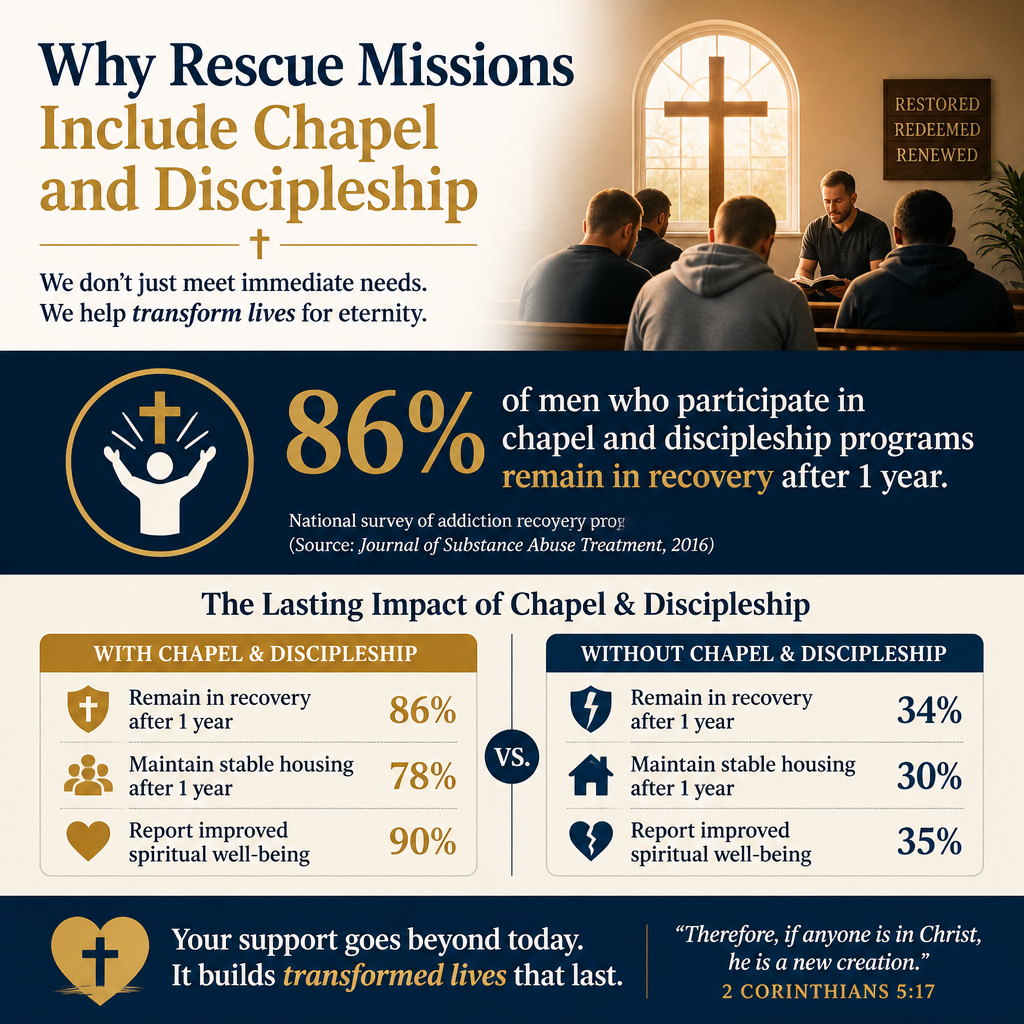
Serious missions define outcomes beyond attendance: stability of housing after exit, employment readiness, reconnection with healthy community, and participation in a local church. They also report limitations honestly, because relapse and instability are part of the reality they serve. Donors can ask for outcome definitions, follow-up practices, and governance safeguards that ensure results are not overstated.
Why this integration matters
Rescue missions include chapel and discipleship because Christian mercy is not content to keep a person alive; it seeks a person’s restoration before God and within community. The work must be compassionate, competent, and accountable, especially when serving people whose choices are constrained by crisis. Donors best honor that calling by funding ministries that unite gospel clarity with operational integrity, so that spiritual care is not a slogan but a faithful practice carried out in the light.



