

How donors can spot red flags in homeless outreach ministries is not a matter of cynicism; it is a matter of stewardship. Christian donors are often drawn—rightly—to ministries that meet people at the most exposed edge of need, where addiction, mental illness, domestic violence, and economic displacement intersect. The same urgency that makes the work holy also makes it vulnerable to confusion, exaggeration, and, at times, abuse.
Scripture does not pit mercy against discernment. The Good Samaritan does not ask for a quarterly report before binding wounds, but the New Testament repeatedly requires leaders to be “above reproach” and “not lovers of money” (1 Timothy 3). Discernment is not a substitute for compassion; it is one way love protects the vulnerable and honors the sacrifices donors make.
1. Start with mission clarity and theological honesty
What the ministry says it is doing
Healthy homeless outreach ministries can usually state, in plain terms, whom they serve, what services they provide, and what they expect of participants. The red flag is not modest scope; many faithful ministries do one or two things exceptionally well. The red flag is mission language that is grand, shifting, or emotionally freighted but operationally empty—especially when outcomes are promised that no responsible leader can guarantee.
Christians genuinely disagree about the best models for homelessness work: low-barrier shelter versus sobriety requirements, “Housing First” approaches versus programmatic transformation models, and the proper role of explicit evangelism in publicly funded environments. A trustworthy ministry names those tensions with humility and explains its convictions without caricaturing alternatives.
What the ministry implies about transformation
Some organizations promise “total life change” in ways that flatten the reality of trauma and the long arc of recovery. The gospel does transform, but ministries should not market sanctification as a predictable product. A sober view of homelessness recognizes both spiritual need and structural complexity. For example, a point-in-time count cannot capture all dimensions of housing instability, yet it remains a widely used indicator for system-level planning; HUD’s annual point-in-time and housing inventory reports explain both the value and limitations of the method (U.S. Department of Housing and Urban Development).
What this means in practice is that donors should look for theological honesty that does not exploit suffering for fundraising and does not confuse publicity with discipleship.

2. Examine governance and leadership accountability
Board independence and real oversight
In homeless outreach, founders often carry extraordinary burdens and build organizations through years of sacrifice. That can produce admirable courage—and also unhealthy concentration of power. A common red flag is a board that exists largely to affirm the founder, with few independent members and little evidence of oversight. Donors should expect documented governance practices: conflict-of-interest policies, board minutes, and clear authority for executive evaluation and, when necessary, discipline.
Another warning sign is leadership insulation: no meaningful way for staff, participants, or community partners to raise concerns without retaliation. A credible ministry will have clear complaint channels and a culture that treats concerns as a stewardship issue, not as disloyalty.
Related-party transactions and family systems
Homeless ministries often operate thrift stores, social enterprises, housing units, and contracted services. These complex operations can invite related-party transactions: leases from insiders, contracts to family-owned vendors, or “consulting” agreements that are difficult to evaluate. Not every related-party relationship is disqualifying, but undisclosed or poorly justified ones erode trust quickly.
We recommend asking direct questions: Who owns the property? Who sets compensation? Are there family members on payroll, and if so, how is supervision handled? Transparency on these matters is not a secular intrusion; it is a safeguard against partiality and scandal.
3. Follow the money with both rigor and fairness
Financial statements that a serious donor can actually read
Many donors still default to simplistic “overhead ratio” judgments. The charitable sector has repeatedly warned that overhead alone is a poor proxy for effectiveness, as emphasized by the “Overhead Myth” letter signed by GuideStar, Charity Navigator, and the BBB Wise Giving Alliance (Charity Navigator). A ministry can spend little on administration and still lack controls; it can spend more on administration and have strong systems that protect people and funds.
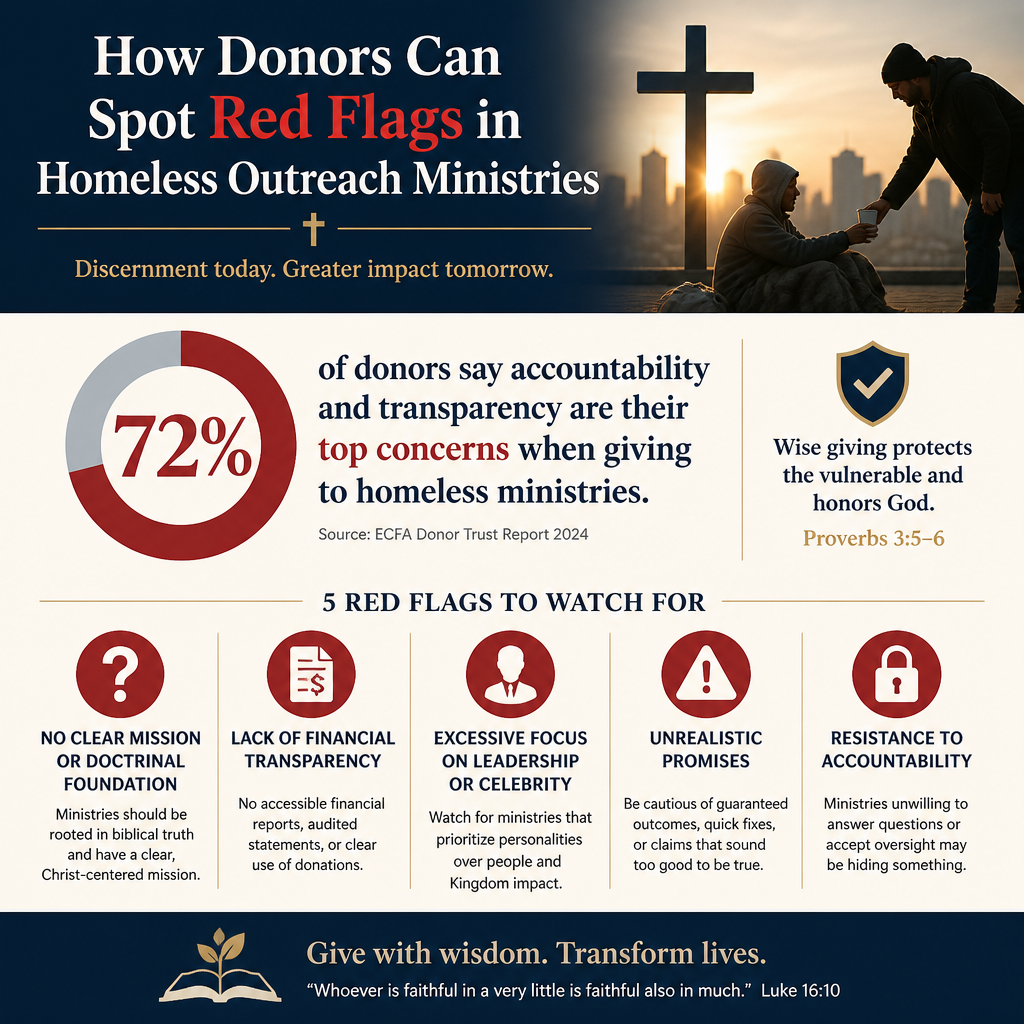
The question is whether financial reporting is clear, consistent, and appropriately reviewed. Larger organizations should generally provide audited financial statements. Smaller ministries may not be able to afford an audit, but they should still provide recent financials, a board-approved budget, and transparent explanations for major changes.
Common fundraising and spending red flags
Certain patterns show up repeatedly in troubled organizations: restricted gifts used for unrelated purposes, heavy reliance on a single charismatic fundraiser without internal controls, and emergency appeals that recur so frequently that “crisis” becomes the brand. Donors should also be cautious when a ministry emphasizes dramatic testimonies while providing little information about how funds support concrete services.
A short set of questions can surface real issues without assuming the worst:
- Does the ministry publish current financials and explain major expense categories plainly?
- Are restricted gifts tracked and honored, with clear policies for reallocation when necessary?
- Is leadership compensation set by an independent board process and documented?
- Does the organization carry appropriate insurance and maintain basic financial controls?
- Are fundraising claims specific enough to be verified and modest enough to be credible?
Across our verification work at Most Trusted, organizations that meet The Most Trusted Standard typically treat financial transparency as a form of discipleship: money is handled in the light, with sober language and durable controls.
4. Ask whether programs protect dignity and reduce harm
Trauma-informed care and participant safeguards
Homeless outreach sits near the front lines of trauma. Ministries regularly serve people with histories of violence, exploitation, and severe loss. Donors should look for evidence that staff and volunteers are trained to avoid re-traumatization: clear boundaries, appropriate supervision, and protocols for mental health crises. A red flag is a culture that prizes intensity—late-night counseling, unstructured “rescue” efforts, informal housing arrangements—without formal safeguards.
Safeguarding is not only about children. Adults experiencing homelessness are also vulnerable to coercion, manipulation, and sexual abuse. Ministries should have written policies, background checks appropriate to roles, and clear rules about transport, housing, and counseling interactions.
The ministry’s posture toward local systems
Some Christian donors prefer ministries that operate independently of government systems. Others value partnerships with coordinated entry, shelters, clinics, and workforce programs. The wiser question is whether the ministry understands the local homelessness ecosystem and can explain how it complements, rather than undermines, effective pathways to stability.
Red flags include hostility toward every other provider, refusal to coordinate when safety demands it, or claims that local agencies are uniformly corrupt without evidence. A faithful ministry can maintain theological convictions while still cooperating for the common good, especially where referrals, medical care, and safe shelter are at stake.
5. Demand measurable honesty without reducing ministry to metrics
Evidence of effectiveness that matches the ministry’s claims
Not everything that matters can be quantified, and not everything that can be quantified matters most. Yet donors should still expect a ministry’s claims to be proportionate to what it can reasonably track. If an organization says it “ends homelessness,” it should define what that means and how it verifies outcomes. If it says it “shares the gospel,” it should distinguish between attendance, professions of faith, baptism, church connection, and long-term discipleship.
For context, homelessness is not a single-cause problem and is often episodic; broad claims should be treated with care. The HUD annual homelessness assessment provides national-level trend reporting and methodological detail that helps donors understand why sweeping claims require careful definition (U.S. Department of Housing and Urban Development).
Transparency as a spiritual discipline
Christian organizations sometimes fear that transparency will invite criticism or distract from the mission. The deeper issue is whether the ministry sees truth-telling as integral to its witness. The ministries that earn enduring trust tend to publish policies, acknowledge failures, correct errors publicly, and avoid marketing that trades in insinuation.
Donors who want a wider view of how responsible ministries demonstrate candor, controls, and verifiable integrity can also track the patterns we emphasize across Accountability and Transparency in Rescue Missions. The goal is not suspicion; it is mature confidence rooted in evidence.
FAQs for How donors can spot red flags in homeless outreach ministries
Should Christian donors avoid ministries that accept government funding?
Not necessarily. Government funding can expand capacity, but it can also introduce constraints around explicitly religious programming and reporting requirements. The more important question is whether the ministry is transparent about funding sources, maintains clear boundaries between publicly funded services and explicitly religious activities where required, and demonstrates that theological convictions are not quietly traded for access or scale.
What is the single most reliable indicator that a homeless outreach ministry is trustworthy?
No single indicator is sufficient, but consistent transparency under scrutiny is one of the strongest signals. A trustworthy ministry can provide clear financials, explain governance structures, name program limitations, and show concrete safeguarding practices without defensiveness. That posture aligns with the biblical expectation that leaders be above reproach and that Christian witness be marked by truth.
A donor posture that honors both mercy and wisdom
Christian donors do not serve the poor by lowering standards for ministries that serve the poor. We serve by insisting that compassion be disciplined by truth, that urgency be governed by accountability, and that powerful stories be matched by verifiable practices. When donors apply careful scrutiny, they protect participants, staff, and the church’s public witness, and they strengthen the ministries that deserve long-term partnership.
For donors considering sustained support in this space, our broader work across Rescue Missions and Homeless Outreach reflects a simple conviction: faithful mercy and credible stewardship belong together, and the church should be able to demonstrate both.



