
When donors check rescue mission charity ratings, they are rarely looking for perfection. They are looking for faithful stewardship: clear evidence that a ministry’s compassion is joined to truth-telling, competent governance, and a spiritually serious understanding of human need.
Rescue missions sit at a demanding intersection of mercy and complexity. A single campus may provide emergency shelter, addiction recovery, meals, job training, and chaplaincy, often with high turnover and urgent, round-the-clock decisions. Ratings can help, but only if donors understand what a rating can and cannot measure, and how to corroborate it with verifiable evidence.
Start by defining what a rating should actually tell you
Most public “ratings” are proxies. They often measure financial ratios, the presence of basic policies, or responsiveness to requests. Those indicators matter, but they do not automatically answer the deeper Christian questions: Is this ministry truthful about outcomes? Does it honor the image of God in the people it serves? Does it demonstrate integrity when no one is watching?
Scripture binds mercy to honesty. “Whoever is faithful in very little is also faithful in much” (Luke 16:10). For donors, the “little” includes mundane governance practices: accurate reporting, conflict-of-interest controls, and clarity about how restricted gifts are used. A strong rating is best treated as an opening signal, not a conclusion.
What common watchdog ratings do well
Third-party watchdogs can quickly surface whether a charity is registered, files required forms, and discloses basic financial information. When a rescue mission is transparent and administratively competent, those facts usually leave a paper trail.
Where ratings often fall short for rescue missions
Rescue missions frequently combine church-like activities with social services. Theologically grounded discipleship and pastoral care can be central to their mission, but those components are not always easily captured in conventional outcome metrics. Conversely, a mission can report inspiring stories while avoiding hard questions about safety, relapse, staff conduct, or whether programs are built on evidence-informed practice. Ratings may not reach those realities without deeper verification.

Use public documents to corroborate the story a mission tells
Serious donors do not rely on marketing claims when public records are available. Rescue missions that are financially and operationally healthy can usually show consistent alignment between their public narrative, their filings, and their audited statements.
Read the Form 990 carefully when it exists
If a mission is required to file a Form 990, it is one of the most useful transparency tools available. You can review mission, programs, governance disclosures, compensation reporting, and the composition of the board. The IRS explains the Form 990’s purpose and public availability in its exempt organizations guidance at IRS Exempt Organizations.
Some rescue missions operate under church structures or as integrated auxiliaries and may not file a Form 990. That is not automatically a red flag, but it increases the donor’s responsibility to seek alternate evidence such as audited financials, annual reports with meaningful detail, and transparent governance practices.
Look for audited financials and test their credibility
An independent audit is not a spiritual credential, but it is a meaningful accountability mechanism. Many missions publish audited statements or can provide them upon request. Donors should confirm the auditor is a reputable independent firm and check whether the audit includes any significant findings or going-concern warnings.
When a mission does not publish audited statements, donors can still ask direct questions. A ministry that welcomes accountability will not treat basic financial inquiries as a threat.
Evaluate governance and leadership with more rigor than a scorecard can provide
Governance failures are among the most costly failures in Christian ministry because they often combine financial risk with moral and pastoral harm. Rescue missions are particularly vulnerable: they work with traumatized populations, staff often have direct access to donors and volunteers, and the ministry’s credibility can hinge on a small leadership team.
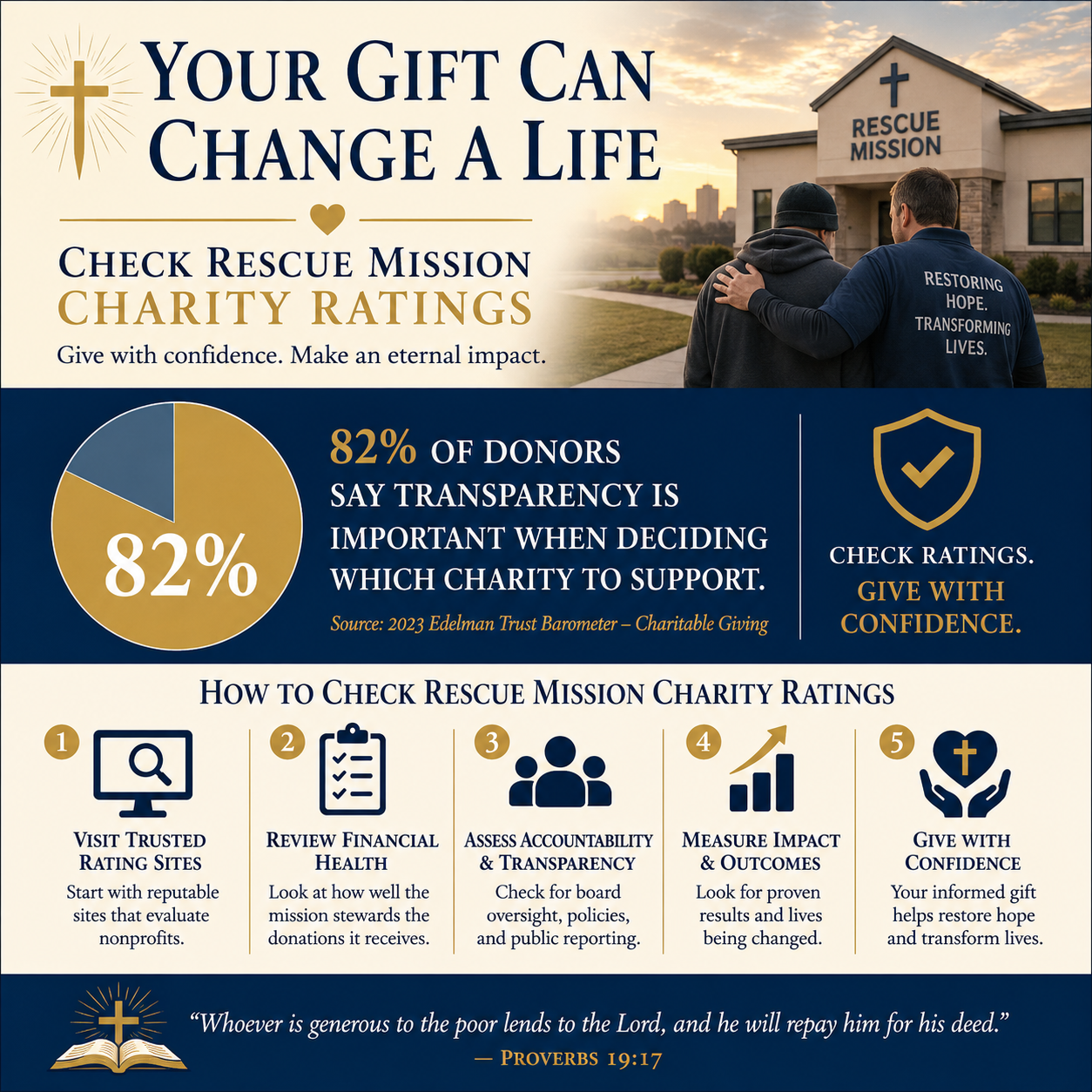
Independent charity-rating frameworks increasingly recognize that governance quality is not a soft concern; it is a safeguard. The BBB Wise Giving Alliance, for example, publishes charity accountability standards that include governance, effectiveness reporting, and financial oversight at BBB Wise Giving Alliance.
Board independence, competence, and spiritual maturity
We recommend donors look beyond whether a board exists and ask whether it governs. A mission’s website and filings can often show whether the board has independent members, term limits, and relevant expertise (finance, law, pastoral care, trauma-informed practice). For Christian donors, spiritual maturity and accountability also matter: Is there evidence of plurality, submission to counsel, and humility under scrutiny?
Conflict of interest and related-party transactions
Rescue missions sometimes grow out of a founder’s calling and personal network. That can be a gift to the Church, but it can also create related-party entanglements if not managed carefully. Donors should look for a clear conflict-of-interest policy, documentation of how conflicts are handled, and disclosure of material related-party transactions. These are areas where public ratings may not tell the full story unless they examine underlying records.
Ask whether outcomes are truthful, not merely inspirational
Rescue missions should tell stories. Jesus told stories. But donors should resist a false choice between compassion and measurement. The question is not whether a mission can produce a spreadsheet that proves transformation. The question is whether it speaks truthfully about what it can and cannot demonstrate.
In homelessness services, outcomes are difficult to track, and definitions matter. Public agencies often measure homelessness through standardized counts and administrative data, which can help donors understand the scale of need even if a particular mission’s work is more local and relational. The U.S. Department of Housing and Urban Development provides national reporting through its Annual Homeless Assessment Report at HUD Exchange.
What credible reporting tends to include
Across our verification work at Most Trusted, ministries that treat outcomes with integrity tend to distinguish between immediate outputs (meals served, nights of shelter) and longer-term outcomes (housing stability, sobriety support engagement, employment). They also clarify what is counted, over what timeframe, and with what limitations.
- Clear definitions for each reported metric
- Time-bound reporting rather than cumulative numbers that never reset
- Separation of programs so donors can see what different services accomplish
- Limitations stated plainly when follow-up data is partial or difficult to obtain
- Evidence of learning when outcomes fall short of goals
A caution about simplistic financial heuristics
Some donors still rely on a single “overhead” threshold to judge trustworthiness. The nonprofit field has had to correct that instinct because it can punish healthy investment in staffing, compliance, and evaluation. Charity Navigator, GuideStar, and the BBB Wise Giving Alliance jointly argued against overhead-only judgments in their “Overhead Myth” statement, published by GuideStar at GuideStar. Rescue missions, in particular, may require meaningful administrative capacity to ensure safety, compliance, and appropriate care.
Know when to seek deeper Christian verification
Christian donors often want more than fiscal credibility. They want to know whether a mission’s faith commitments are real, whether its leadership reflects biblical character, and whether its practices honor the dignity of those served. These are not questions most public rating systems are built to answer.
Most Trusted exists to serve that need by evaluating Christian nonprofits against The Most Trusted Standard, a 15-criteria framework spanning Faith Foundation, Financial Integrity, Governance and Leadership, and Transparency and Effectiveness. The goal is not to replace donor discernment; it is to strengthen it with documented evidence and consistent criteria.
What deeper verification can clarify for rescue missions
In rescue mission work, the most consequential risks are often relational and governance-related rather than purely financial. Verification can assess whether a mission has credible safeguarding practices, appropriate boundaries in counseling and discipleship contexts, a board that exercises real oversight, and a culture that welcomes accountability without spiritualizing secrecy.
How this fits within broader donor diligence
Donors who support missions over many years tend to build a discipline of review: periodic financial checks, regular re-reading of annual reporting, and direct questions when the public story and the public documents do not align. For additional context on the ministry landscape itself, we discuss the distinctive realities of Rescue Missions and Homeless Outreach in greater depth, including the program models and pressures that shape reporting.
When the focus is explicitly on disclosure, governance, and candor, the wider expectations that apply across the sector are addressed under Accountability and Transparency in Rescue Missions, where the ethical and practical stakes of donor confidence are especially clear.
FAQs for How donors can check rescue mission charity ratings
Is a high charity rating enough to trust a rescue mission?
A high rating is a helpful signal, but it is rarely sufficient. Many ratings emphasize financial ratios and basic disclosures, while rescue mission credibility also depends on governance maturity, safeguarding, and truthful reporting about outcomes. We recommend using ratings as a starting point, then corroborating with public filings, audited statements, and direct answers to specific questions.
What if a rescue mission does not file a Form 990?
Some missions are structured in ways that are exempt from filing a Form 990, including certain church-affiliated entities. That reality does not automatically indicate wrongdoing, but it does reduce what a donor can verify through public records. In those cases, donors should look for audited financial statements, transparent annual reporting, board accountability practices, and willingness to answer governance and financial questions with specificity.
A rating is a tool, not a substitute for discernment
Christian love of neighbor does not require naiveté about institutions, and Christian suspicion does not justify cynicism about sincere ministry. When donors check rescue mission charity ratings with wisdom, they honor both: compassion for those in crisis and stewardship of the resources God has entrusted to his people. The most reliable confidence comes when a ministry’s spiritual claims, financial records, governance practices, and public reporting tell the same truth.



