
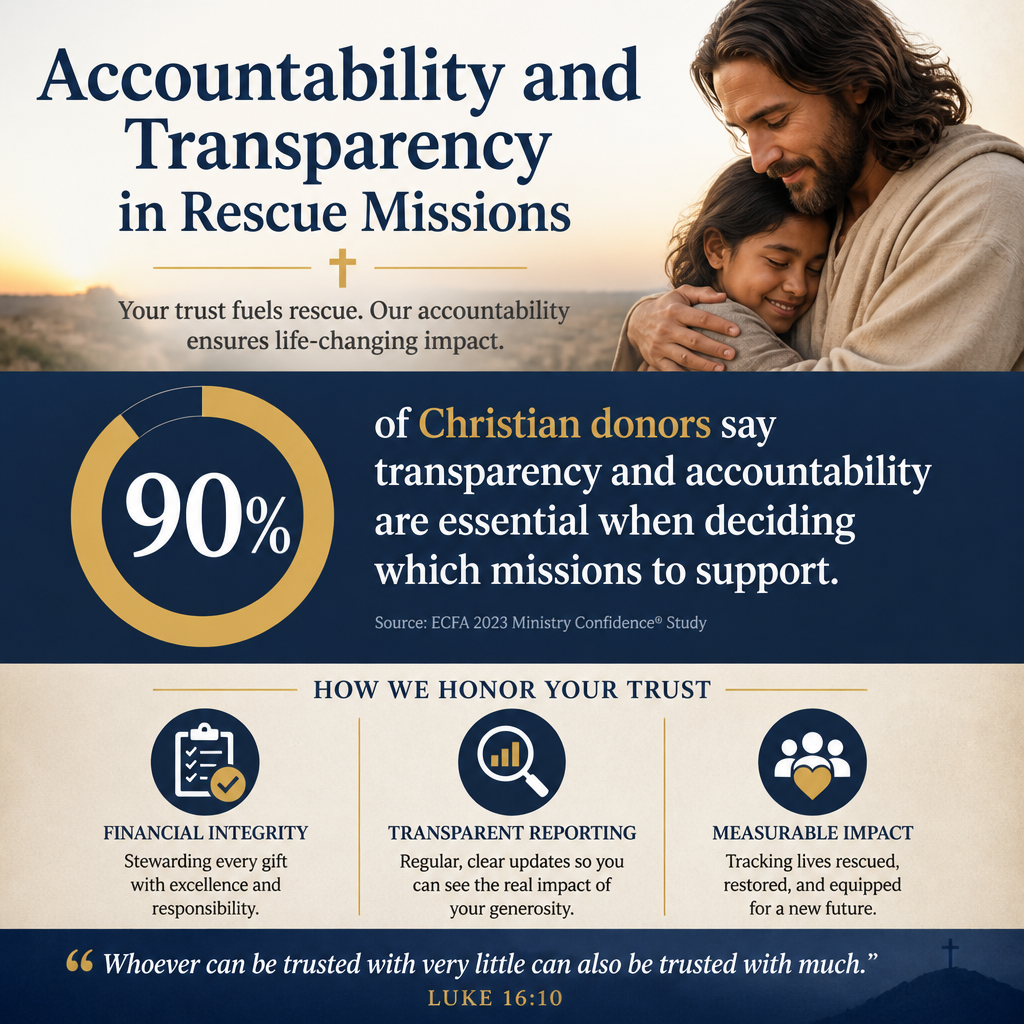
Accountability and transparency in rescue missions are not peripheral concerns for Christian donors; they are part of the moral substance of the gift. When a ministry asks the church to support gospel mercy among people in crisis, it is asking for more than dollars. It is asking for trust, and Scripture treats trust as weighty: “Moreover, it is required of stewards that they be found faithful” (1 Corinthians 4:2).
Rescue missions and homeless outreach operate where urgency is real and stories are often raw. That urgency can pressure ministries toward vague reporting, overly selective testimonies, and governance arrangements that would not endure scrutiny. Donors sense this tension instinctively: they want to respond quickly to need, but they also want evidence that the mission is protecting guests, handling funds with integrity, and measuring outcomes honestly. At Most Trusted, our verification work is built to serve that exact tension by evaluating ministries against The Most Trusted Standard, a 15-criteria framework across Faith Foundation, Financial Integrity, Governance and Leadership, and Transparency and Effectiveness.
Why accountability is a theological claim, not a donor preference
Christian mercy is never merely sentimental. Jesus’s warning that “from everyone who has been given much, much will be demanded” (Luke 12:48) applies to institutions as surely as to individuals. A rescue mission that receives the church’s resources is obligated to steward them in ways that can be examined, explained, and corrected.
Two failures distort accountability conversations. One is the reduction of faith-based ministry to mere social service, as if the gospel can be kept private while money is handled publicly. The other is a spiritualized exemption from scrutiny, as if “ministry” language can substitute for policies, documentation, and independent oversight. Mature donors recognize that a mission can be sincerely Christian and still be poorly governed; sincerity is not a control environment.
Mercy that cannot be examined becomes vulnerable to harm
Rescue missions serve people facing addiction, mental illness, domestic violence, trafficking, and chronic homelessness. Those realities do not excuse opacity; they raise the stakes. When policies are informal and decision-making is concentrated in one leader, guests can be harmed quietly and donors can be misled unintentionally or deliberately.
This is one reason the field has had to reckon with how “help” can unintentionally entrench dependency or displace local responsibility. The When Helping Hurts framework articulated by Steve Corbett and Brian Fikkert has shaped Christian conversations by naming how unexamined assistance can damage both giver and receiver, especially when material aid is disconnected from dignity, relationships, and accountability (When Helping Hurts).
Transparency is not the same as storytelling
Testimonies matter. They remind donors that guests are image-bearers, not case files. But transparency is more than compelling narrative. It is a consistent pattern of disclosing who governs the mission, how decisions are made, what programs cost, what outcomes are claimed, and what safeguards protect vulnerable adults.
Donors also deserve clarity about the difference between short-term relief and long-term transformation. A mission can provide meals and beds faithfully without claiming it “solves homelessness.” When ministries refuse inflated claims, they often earn deeper trust over time.
Accountability protects the church’s witness
Public scandals in Christian nonprofits do not stay contained. They erode confidence in Christian mercy itself and discourage generosity among believers who are already fatigued. Research on giving patterns consistently shows that trust is a central driver of philanthropy. When donors believe funds will be misused, giving declines.
For example, a national study found that Americans’ confidence in charities has declined over recent decades (Gallup). Rescue missions are not immune to broader institutional distrust, and Christian donors often carry the added grief of watching ministry language used to cover weak governance.

What donors should expect a mission to disclose and why it matters
Transparency is most meaningful when it is specific and repeatable: documents that can be read, numbers that can be reconciled, and policies that can be compared against actual practice. The goal is not to impose corporate bureaucracy on ministry. The goal is to ensure that compassion is expressed through structures that resist temptation and protect the vulnerable.
Financial documents that answer real questions
Christian donors should expect a rescue mission to make core financial materials accessible: recent audited financial statements if the mission is large enough to warrant an audit, annual reports with program and fundraising expenses, and a clear explanation of revenue sources. In the United States, most tax-exempt organizations must provide their Form 990 upon request, and many publish it online; it remains one of the most standardized windows into governance, compensation, and spending (Internal Revenue Service).
Donors often ask about “overhead,” but the more faithful question is whether spending aligns with mission effectiveness and appropriate controls. The nonprofit sector has cautioned donors against simplistic overhead ratios; major evaluators and standards bodies have urged donors to focus on outcomes and governance rather than treating administrative cost as inherently suspect (Charity Navigator). A rescue mission with strong financial integrity will be able to explain why it spends what it spends: staffing ratios, security needs, case management costs, compliance, and facility maintenance are not indulgences in a high-risk environment.
Program clarity that distinguishes services from claims
Missions frequently offer a mix of emergency shelter, residential recovery, job readiness, counseling, chaplaincy, and referrals. Donors should expect a mission to define each program, state the intended outcomes, and report results without exaggeration. “We served 50,000 meals” is an output; “we reduced recidivism” is an outcome that requires a defensible measurement approach.
The harder question is what counts as success in a gospel-shaped rescue mission. Christians genuinely disagree about the relative weight of material stability, sobriety, employment, church connection, and spiritual fruit. We recommend looking for ministries that name their assumptions plainly, measure what they can with integrity, and resist manipulating metrics to satisfy donors.
Safeguarding policies for vulnerable adults
Many donors are familiar with child protection policies. Adult safeguarding can be less discussed, even though the vulnerabilities are severe. Missions should be able to describe screening and training for staff and volunteers, boundaries for counseling relationships, incident reporting, and coordination with local authorities when necessary. Confidentiality is legitimate, but secrecy is not. A mission can protect guest privacy while still documenting that safeguards exist and are enforced.
Practical indicators include written policies, regular training, and a reporting mechanism that does not require going through the same individual who may be implicated. Where applicable, donors can ask whether the mission aligns with recognized safeguarding practices used in faith-based and humanitarian settings, adapted for local legal requirements.
Governance that is strong enough to correct the mission
Transparent financials do not compensate for weak governance. If the board is passive, conflicted, or dominated by a founder, accountability becomes performative. Rescue missions are especially vulnerable to “charismatic centralization,” where a gifted leader carries vision and fundraising while internal checks quietly atrophy.
What healthy board governance tends to look like
Strong missions usually have boards that meet regularly, maintain independent membership, document decisions, and provide real oversight of budgets, executive compensation, and risk management. Independence matters: boards largely composed of staff, close relatives, or financial dependents struggle to exercise correction. Donors should not be embarrassed to ask who sits on the board, how new members are selected, and whether there is a conflict-of-interest policy.
Accountability is also demonstrated by how a mission handles leadership transition. Ministries that are built around one personality often delay succession planning, which can create instability for guests and staff if a crisis occurs. A board that treats succession as stewardship signals long-term seriousness.
Compensation and related-party transactions require daylight
Christian donors frequently hesitate to discuss compensation, but Scripture’s insistence on integrity requires clarity. Missions should be able to explain how they set executive pay and whether they use comparability data. Related-party transactions—renting property from insiders, contracting with a board member’s company, employing family members—are not automatically improper, but they demand disclosure and documented board review.
When donors see evasiveness around these areas, it is often an early warning sign. Conversely, when a mission discloses compensation philosophy and conflicts policies in plain language, it usually reflects a culture that expects to be examined.
Why many missions limit cash handouts
Some donors worry that refusing direct cash to guests is unkind. The reality is more complex. Many missions limit cash assistance because it can be diverted toward addiction, increase theft risk on campus, or inadvertently intensify coercion among guests. These policies are not a lack of compassion; they can be a form of protection.
What donors should look for is not a single “correct” policy but a coherent rationale: the mission’s approach to material aid should be consistent with its case management model, local market realities, and the safety of guests and staff. When policies are explained openly, donors can evaluate them rather than guessing.
How donors can evaluate trustworthiness without cynicism
Christian donors are not called to suspicion; we are called to discernment. Discernment is patient, evidence-based, and willing to name both strengths and risks. A mission can have meaningful gospel fruit and still need governance reform. Donors can honor the good while insisting on what protects the good over time.
Questions that reveal substance
Some questions are unusually clarifying because they require a ministry to show its work:
- Can we review your latest audited financials or financial statements and your Form 990? If the mission is small, it may not have an audit, but it should still have reviewed statements and a transparent budget process.
- How does the board exercise oversight of the CEO or executive director? Look for documented evaluation, budget approval, and independent decision-making.
- What outcomes do you track, and what do you do when outcomes are not improving? Healthy ministries can name what is not working and what they changed.
- What safeguarding policies protect vulnerable adults, and how are incidents reported and handled? The answer should be policy-based, not personality-based.
These questions are not adversarial. They are the ordinary obligations of stewardship when the gifts of the church meet the vulnerabilities of the street.
Red flags that deserve attention
Across verification work, certain patterns recur when ministries are drifting:
- Unverifiable claims about transformation rates without definitions, denominators, or timeframes.
- Selective transparency that offers many stories but few documents.
- Founder control without independent board oversight, especially when combined with unclear compensation or related-party transactions.
- Defensive posture toward legitimate questions, framing inquiry as a lack of faith rather than a normal part of stewardship.
Not every red flag proves misconduct. Some indicate immaturity, lack of administrative capacity, or leadership exhaustion. But donors should treat these signals seriously because the people at greatest risk are usually guests with the least power.
Where Most Trusted fits
Many donors do not have the time or technical background to assess governance documents, financial controls, safeguarding policies, and program claims across multiple ministries. Most Trusted exists to do that work with editorial independence. Our team evaluates Christian nonprofits against The Most Trusted Standard and reports what can be verified, what is unclear, and what requires improvement.
For donors who are supporting street-level mercy, that kind of third-party verification can reduce the false choice between warm-hearted giving and careful diligence. It also gives stronger missions a way to demonstrate credibility without turning every donor conversation into a document exchange.
Accountability that strengthens mercy
Rescue missions at their best are a public testimony that the church does not avert its eyes from suffering. Accountability and transparency in rescue missions ensure that this testimony is not sustained by charisma, selective reporting, or institutional fragility, but by faithful stewardship. Donors can give with both compassion and clarity when ministries welcome scrutiny, disclose what is true, and build governance strong enough to protect guests and correct the mission when needed.
For donors investing in Rescue Missions and Homeless Outreach, the aim is not to find a flawless organization. The aim is to find ministries that treat trust as sacred, handle resources as stewards, and practice a form of mercy sturdy enough to endure the long obedience that homelessness ministry requires.



