
When donors ask what legal advocacy fits prison ministry mission, they are usually trying to honor two obligations at once: the clear command to remember those in prison and the equally Christian instinct to be careful with power, public controversy, and unintended consequences. Legal advocacy can be a work of mercy, but it can also drift into ideological branding, institutional capture, or a cause that no longer serves the people a ministry claims to love.
The New Testament does not separate “spiritual” care from the pursuit of justice as though one were holy and the other merely political. The same Scriptures that call us to visit those in prison also condemn partiality and abuse of authority. A donor’s task is not to avoid complexity; it is to fund ministries whose legal work is credibly tethered to the gospel, to the church, and to measurable good for real people.
Start with the mission boundary and the biblical mandate
Mercy and justice are not rivals, but they are not identical
Prison ministry typically carries a primary calling: presence, proclamation, pastoral care, discipleship, and reentry support. Legal advocacy is a secondary instrument that may serve that calling, but it should not quietly replace it. When legal work becomes the organization’s public identity, donors should ask whether the ministry still has a credible ecclesial center—local church partnership, a pastoral theology of sin and redemption, and practices of spiritual care that are not merely rhetorical.
Scripture gives moral clarity without giving modern policy blueprints. The prophets denounce unjust scales and corrupt courts; Proverbs warns against acquitting the guilty and condemning the innocent; Romans recognizes civil authority as accountable to God. A prison ministry can honor these threads by focusing its advocacy on due process, humane treatment, and the restoration of persons rather than on partisan alignment.
The donor question is not whether advocacy is permissible
The practical question is whether the proposed advocacy is a faithful extension of the ministry’s core work with incarcerated people and their families. Advocacy that is born from long-term presence behind bars tends to have a different tone and discipline than advocacy driven primarily by national media cycles. Across our verification work at Most Trusted, the ministries that meet The Most Trusted Standard tend to show an explicit chain from on-the-ground service to a carefully bounded legal agenda, with leadership able to explain what they will not do as clearly as what they will.

Distinguish charity care from legal advocacy and know where each belongs
Direct services address immediate harm that law often creates or fails to prevent
Much prison-adjacent suffering is “legal” in origin but not best addressed through litigation or legislation. Families need transportation for prison visits, help navigating phone and commissary systems, housing and employment after release, and trauma-informed pastoral care. A ministry can pursue justice by absorbing burdens that the system places on the poor without positioning itself as a legal reform organization.
What this means in practice is that some of the most mission-consistent legal engagement looks like legal navigation and referral rather than legal confrontation: expungement clinics in partnership with licensed counsel, assistance securing identification documents, or helping churches understand collateral consequences that block reintegration. These efforts keep the ministry close to persons and congregations, where Christian formation and accountability remain possible.
Formal advocacy requires governance discipline and legal clarity
When a ministry moves from serving needs to attempting to change laws, donors should expect a clear structure. In the United States, 501(c)(3) organizations may engage in limited lobbying but must avoid partisan campaign intervention; the rules are technical, and ignorance does not prevent penalties. The Internal Revenue Service’s overview of the restrictions is a useful baseline for donor due diligence: IRS Charitable organizations and lobbying.
Donors should also recognize that litigation and policy campaigns can be expensive, slow, and difficult to evaluate. If legal advocacy is central to a prison ministry’s plan, we recommend expecting a correspondingly serious approach to financial integrity, oversight, and evidence of impact—categories that sit at the heart of The Most Trusted Standard.
Five advocacy lanes that tend to fit prison ministry mission
Advocacy that protects personhood and due process
Some legal issues align closely with the church’s moral commitments because they concern basic human dignity and fair treatment under law. These include access to counsel, protection from coercion, and procedures that reduce the risk of wrongful conviction. Ministries that have chaplains, volunteers, and reentry staff regularly encounter people whose cases were shaped by poverty, addiction, mental illness, and inadequate representation; advocacy aimed at due process is often an extension of pastoral proximity rather than a detour from it.
Because these are contested arenas, responsible ministries avoid sweeping claims and instead cite specific reforms, narrow goals, and credible partners. Donors should look for partnerships with Christian legal aid groups, local bar associations, or clinical programs, and for a sober awareness that the state also has a legitimate mandate to restrain evil and protect victims.
Advocacy that reduces family separation and collateral damage
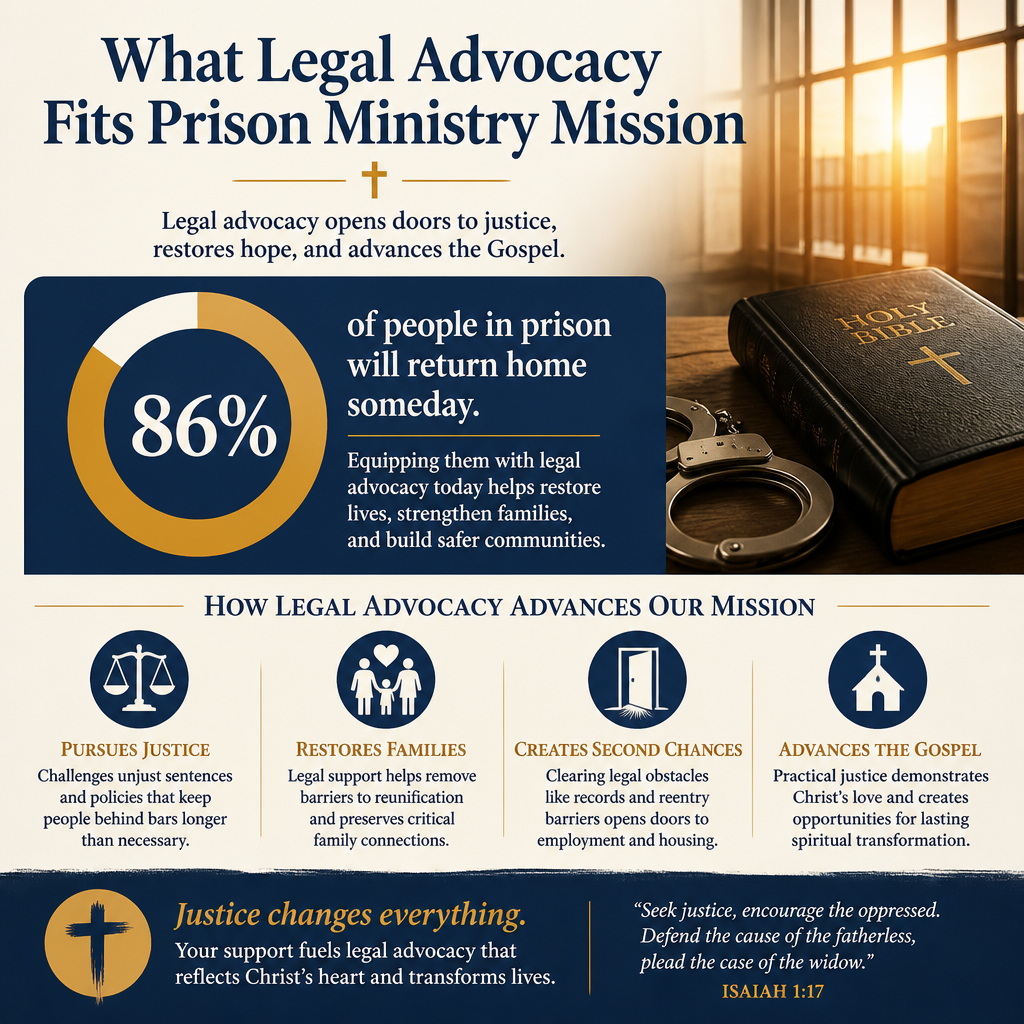
Prison does not only punish individuals; it strains spouses, parents, and children. That is one reason prison visitation sits in Matthew 25 among the central works of mercy: the church is called to go where suffering concentrates, including the suffering of families. Advocacy that targets barriers to family contact—reasonable visitation policies, access to communication at non-exploitative rates, or humane conditions that allow meaningful contact—often fits a ministry’s pastoral priorities.

Donors should also distinguish between advocacy to “make prison comfortable” and advocacy to prevent degradation. Christian ethics can affirm punishment while rejecting dehumanization. A ministry that cannot articulate that distinction is unlikely to sustain a faithful posture over time.
Advocacy that strengthens reentry and reduces barriers to work
Reentry is where the church’s pastoral and practical commitments meet: repentance, discipleship, restitution where possible, and a credible path into stable work and community. Legal advocacy in this lane typically addresses occupational licensing barriers, access to IDs, expungement or record-sealing pathways, and fair-chance hiring practices. These are not “soft on crime” slogans; they are institutional conditions that make stable reintegration more attainable.
The U.S. Department of Justice’s National Institute of Justice summarizes the scale of reentry as a national reality, noting that “each year, more than 600,000 individuals return home from state and federal prisons.” Source: National Institute of Justice. Donors can reasonably expect ministries to connect their advocacy priorities to this kind of public baseline and then explain what they can actually influence in their own geography.
Advocacy that improves access to treatment and mental health care
Many incarcerated men and women are carrying addiction disorders and serious mental illness. While the church offers spiritual care no clinical program can replace, legal advocacy may be appropriate when it aims to expand treatment access, diversion for appropriate cases, or continuity of care upon release. The ethical concern here is not only compassion but public safety: untreated illness is a driver of instability, victimization, and recidivism.
Donors should insist on precision. “More treatment” can mean anything from evidence-based programs to unaccountable facilities. Ministries that handle this well describe the specific interventions they support and the safeguards they expect, including trauma-informed care and clear boundaries between pastoral counsel and clinical practice.
Advocacy that promotes religious liberty and pastoral access in correctional settings
Some advocacy is simply about ensuring that chaplains, volunteers, and churches can do the work to which they are called—access for pastoral care, the ability to provide Bibles and discipleship materials consistent with facility rules, and nondiscrimination in faith-based programming. This is not a plea for privilege; it is a request for the state to respect constitutionally protected free exercise and to recognize that spiritual care can support institutional order and rehabilitation.
When this advocacy is done well, it is collaborative rather than inflammatory. It seeks clear policies and consistent procedures, not antagonism with correctional leadership. Donors should view this as a maturity signal: prisons are complex institutions, and durable change often requires patient relationship as well as principled firmness.
A donor checklist for mission-aligned legal advocacy
- Clear scope: the ministry defines 2–4 specific legal objectives and declines to speak on everything.
- Proximity: the agenda arises from sustained ministry with incarcerated people and families, not only from national advocacy trends.
- Competence: licensed legal partners, compliance processes, and accurate public claims.
- Church embeddedness: local congregations are not an afterthought but a primary context for discipleship and reentry.
- Measurability: a credible theory of change and reporting that distinguishes outputs from outcomes.
Risks donors should name without cynicism
Advocacy can become identity, and identity can become captivity
Legal reform spaces have strong incentives toward tribal signaling, media escalation, and simplified narratives. Christians genuinely disagree about some criminal justice policies, and not all disagreement is bad faith. A prison ministry that equates the gospel with one political program will eventually narrow its coalition, lose pastoral breadth, or both.
The risk is not only reputational. It is also spiritual: a ministry can begin to treat people as symbols for a cause rather than neighbors to be loved. Donors should watch for language that preserves moral agency—repentance, responsibility, reconciliation—alongside the insistence that systems can be unjust and must be reformed.
Litigation and lobbying demand transparency and governance strength
Advocacy budgets can be hard to interpret. Staff time may be allocated across programs, legal consulting can be embedded in general expenses, and “education” can shade into lobbying. Donors should expect board oversight, audited financials when scale warrants, and clear reporting about what funds were used for and what changed as a result.
This is where independent verification matters. Most Trusted evaluates ministries against The Most Trusted Standard, including financial integrity, governance, and transparency. That work does not tell donors what policies to support; it helps donors identify whether a ministry is structurally capable of doing its stated work with honesty, competence, and accountability.
How donors can evaluate a prison ministry legal agenda
Ask for a theory of change that honors the person and the public
Effective legal advocacy is not merely a list of grievances. It should specify the intended beneficiary, the mechanism of change, and the expected outcome, with a sober sense of time horizon. For example: “We advocate for record-sealing reforms in our state because our reentry partners can place men in stable employment when background barriers are reduced, and stable employment is a protective factor against reoffending.” That is a claim a donor can test over time.
When donors want to understand the broader ministry landscape around incarceration and reentry, we recommend engaging the wider context of Prison and Post-Prison Ministries so that legal advocacy is evaluated alongside evangelism, pastoral care, and reintegration support rather than in isolation.
Look for reporting that respects complexity rather than inflating certainty
Some outcomes are countable: clinics held, people served, IDs secured, expungement petitions filed, policy meetings conducted. Others are harder: reduced recidivism, improved family stability, fewer technical violations. Ministries should not claim more than they can measure. When they cite research, they should link to it directly and distinguish general evidence from their own results.
For donors particularly focused on how legal engagement fits within Christian nonprofit practice, Legal Advocacy and Prison Ministry Reform is a useful lens for comparing models that range from quiet legal aid partnerships to formal policy coalitions.
FAQs for What legal advocacy fits prison ministry mission
Should a prison ministry do lobbying at all?
It can, but donors should expect it to be narrowly defined, legally compliant, and clearly subordinate to the ministry’s pastoral and service mission. In a 501(c)(3) context, lobbying must remain limited and nonpartisan, with appropriate tracking and oversight. The question is less “whether” than “how disciplined and transparent” the ministry is in pursuing specific reforms.
How can donors tell whether advocacy is truly Christian rather than merely ideological?
Mission-aligned Christian advocacy keeps the person at the center, tells the truth about sin and responsibility without denying systemic injustice, and remains accountable to the church rather than to a political tribe. Donors can test this by reading the ministry’s public statements, examining who governs it, and asking for evidence that the legal agenda arises from sustained relationships with incarcerated people, victims’ families, and local congregations.
Funding legal advocacy with confidence
Legal advocacy fits prison ministry mission when it protects human dignity, strengthens families, removes unnecessary barriers to reentry, and preserves pastoral access—without allowing political identity to replace Christian witness. Donors need not choose between mercy and prudence; faithful stewardship asks for both. The ministries most worthy of support can describe their legal work with precision, submit it to strong governance, and report its results without exaggeration, because they understand that truthfulness is not only a compliance obligation but a Christian discipline.



