
Funding legal counsel for reentry is one of the most strategic ways Christian donors can reduce harm, restore families, and protect the vulnerable. The question is not whether legal barriers exist for people returning from prison; the harder question is whether our giving will underwrite competent, ethical representation that removes those barriers without creating dependency or avoiding moral accountability.
Scripture’s concern for justice is neither abstract nor optional. “Seek justice, correct oppression” (Isaiah 1:17) names a public duty, not merely a private virtue. For returning citizens, legal counsel often determines whether a person can work lawfully, regain custody, obtain housing, or clear a record that keeps them effectively shut out of ordinary life. When counsel is absent, reentry becomes a revolving door of technical violations, destabilized families, and preventable re-incarceration.
Why legal counsel is a reentry ministry issue
Reentry is frequently blocked by law, not only by willpower
Churches rightly emphasize repentance, discipleship, and community. Yet many reentry failures are driven by structural barriers that spiritual formation alone cannot resolve: unpaid court debt, suspended driver’s licenses, old warrants, expungement eligibility, child support modifications, occupational licensing exclusions, immigration consequences, and housing denials. Legal counsel does not replace pastoral care; it clears obstacles so that formation can bear fruit in ordinary responsibilities.
What this means in practice is that donors should treat civil legal aid and reentry legal services as part of Christian mercy and justice, not as a specialized add-on. The incarcerated person Jesus names in Matthew 25 is not a disembodied soul. He is a neighbor whose return to the community can be either safeguarded or sabotaged by paperwork, hearings, and deadlines.
Public systems rarely provide counsel for the problems that matter most
Criminal defense is constitutionally protected, but most reentry legal problems are civil. Eviction, family law, driver’s license restoration, consumer debt, record clearance, and benefits eligibility can determine whether a person remains stable. Yet civil legal representation is not guaranteed. The Legal Services Corporation has documented that low-income Americans receive inadequate or no legal help for a large share of substantial civil legal problems in its national justice gap research.
Christian donors often assume “someone else covers that.” In many communities, no one does. Funding counsel is often the only way to move from sincere intentions to durable outcomes.

Where legal counsel makes the biggest difference after incarceration
Record clearance, rights restoration, and occupational access
Record-related barriers can function as lifetime punishment long after a sentence has been served. Many states provide some pathway to expungement or sealing for eligible offenses, but those pathways are complex and easy to miss. Competent counsel can determine eligibility, prepare filings, and prevent avoidable errors that reset the clock. When done well, record clearance is not “erasing consequences.” It is aligning consequences with the limits the justice system itself recognizes, so that a person who has satisfied the law is not indefinitely barred from lawful work.
Occupational licensing is a frequent choke point. The Institute for Justice has documented how licensing restrictions can exclude people with records from trades that are otherwise realistic entry points into stable work. Donors should not assume every restriction is unjust; some safeguards are legitimate. Counsel helps distinguish the two and pursue lawful relief where available.
Family stability, child support, and reunification
Reentry is often a family question before it is an employment question. Legal counsel can help a returning parent pursue visitation, modify child support orders when income has changed, navigate protective orders appropriately, and comply with court requirements without triggering avoidable violations. These cases demand moral seriousness. Some relationships cannot safely be restored, and counsel must not become a tool for coercion or denial. The best legal ministries work in close coordination with pastoral care and trauma-informed support so that justice and protection are both honored.

Donors who care about children should pay attention here. When counsel helps a parent reestablish lawful, supervised, and stable connection, churches often see long-term reductions in crisis needs that would otherwise fall on congregations: emergency housing, benevolence requests, and repeated interventions.
How to fund legal counsel without subsidizing dysfunction
Fund the work, not only the case
Legal services are expensive because they are labor-intensive and governed by professional obligations. Some donors respond by restricting gifts to “direct client hours” while refusing to fund supervision, training, malpractice coverage, case management, or data systems. That instinct is understandable, but it is often counterproductive. The “Overhead Myth” letter—signed by Charity Navigator, Candid, and the BBB Wise Giving Alliance—warned donors against simplistic overhead ratios that can punish healthy capacity and reward underinvestment in quality.Candid
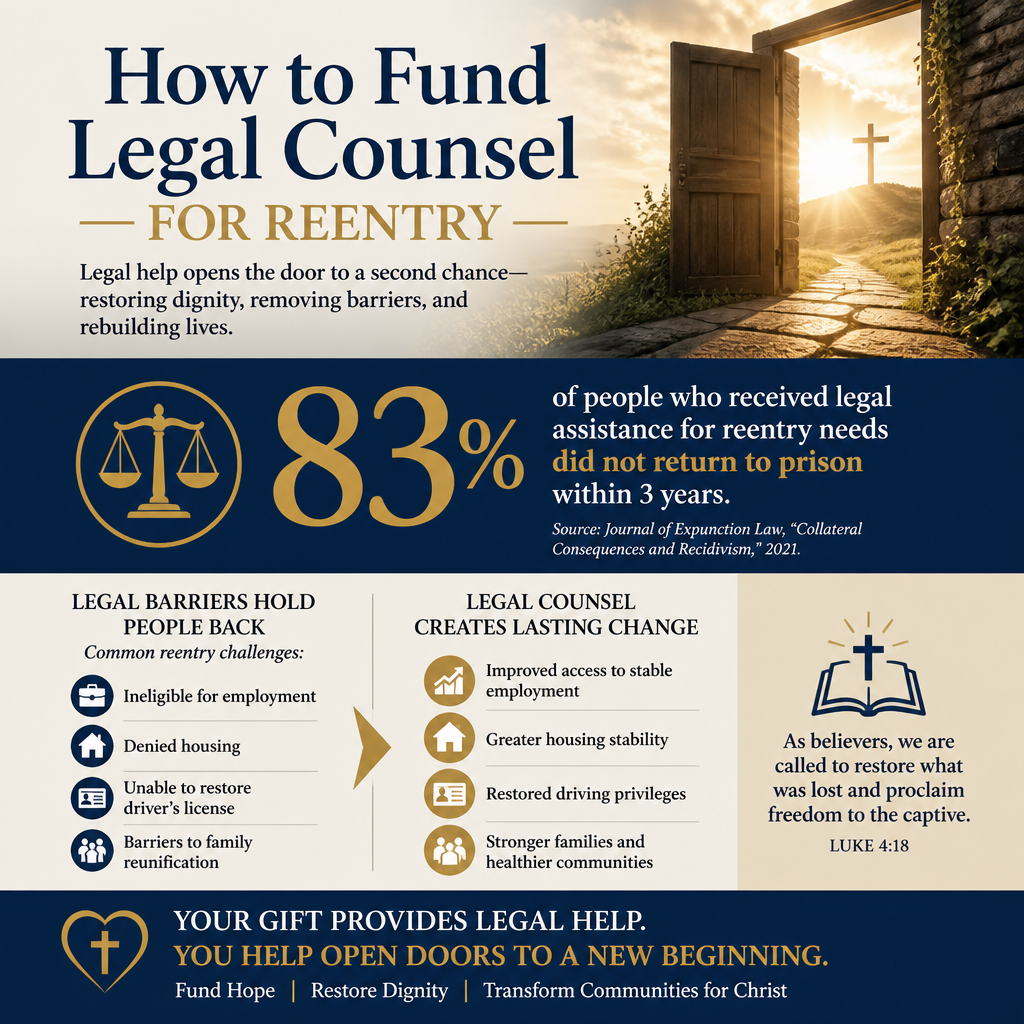
The harder question is what you are purchasing: a few heroic hours, or a reliable program that can serve clients well and withstand scrutiny. Legal counsel for reentry should be funded as professional service, not as improvised volunteerism.
Use a due diligence frame that respects both mercy and accountability
Across our verification work at Most Trusted, we observe that durable ministries do not treat compassion and rigor as opposites. They define a client population clearly, set boundaries, document outcomes, and report finances in a way that can be understood by donors. They also operate with a coherent theology of justice that does not confuse advocacy with partisan identity.
For donors, a practical way to sustain this balance is to ask for evidence along four lines that align with The Most Trusted Standard: faith foundation, financial integrity, governance and leadership, and transparency and effectiveness. We are not looking for perfection; we are looking for truthfulness, consistency, and mature controls in a field where mishandled cases can cause significant harm.
- Competence: Who provides the counsel, and what is the supervision structure for complex cases?
- Boundaries: What cases are declined, and how does the ministry protect victims and children?
- Coordination: How does legal work integrate with church-based discipleship, employment support, and housing navigation?
- Controls: What financial controls, conflict-of-interest policies, and confidentiality protections are in place?
- Evidence: What outcomes are tracked beyond stories—case resolutions, time to resolution, and downstream stability indicators?
Giving models that match how legal work actually functions
General operating support for a specialized reentry legal clinic
If a ministry has a focused reentry legal clinic with licensed attorneys, supervision, and a consistent referral pipeline, unrestricted or lightly restricted support is often the strongest gift. It allows the clinic to absorb the reality of legal work: cases take longer than predicted; crises arrive without notice; a single hearing can change a plan. This kind of support also reduces the temptation to cherry-pick easy cases for better-looking metrics.
Donors who want greater specificity can fund capacity: an additional staff attorney, a supervising attorney, a paralegal, or an intake coordinator who ensures people are triaged quickly and not lost in the system. If your giving is connected to prison and post-prison ministry broadly, we encourage donors to stay engaged with the wider ecosystem of services described in Prison and Post-Prison Ministries, where legal aid fits alongside discipleship, employment, and family support.
Casework support through partnerships with legal aid and churches
In many cities, the most effective reentry legal support is not a standalone Christian law office. It is a partnership: a church-based reentry ministry identifies needs, a secular legal aid organization provides counsel, and the church supplies relational support, transportation, job connections, and accountability. Christians genuinely disagree about funding models that involve public or secular partners. The concern is understandable: theological clarity matters, and partnerships can drift. Yet the reality of the justice gap means that some of the most competent counsel is located in mixed environments.
For donors, the question is whether the partnership is principled. A church should not outsource pastoral responsibility. A legal aid partner should not be asked to preach. Each should do its work well, with clear boundaries and transparent reporting.
What to verify before you fund reentry legal counsel
Governance, ethics, and the non-negotiables of legal practice
Legal ministries sit at the intersection of donor expectations, client vulnerability, and regulated professional duties. That creates unique risk. Donors should ask whether the ministry has a board with relevant oversight capacity, documented policies for conflicts of interest, and clear confidentiality practices. If the organization provides legal representation, confirm that attorneys are licensed in the jurisdiction, that supervision is real, and that malpractice coverage is carried where appropriate.
Pay attention to how the ministry speaks about clients. A mature organization neither romanticizes “second chances” nor reduces people to their worst act. It tells the truth about crime, harm, restitution, and the slow work of rebuilding trust.
Transparency about outcomes that are morally serious
Not every legal win is a kingdom win. Some outcomes may be lawful but unwise; some are wise but not immediately measurable. The best ministries report outcomes with humility and precision: how many clients were served, what kinds of cases were handled, what proportion were resolved favorably, and what limitations constrained services. Donors should be cautious of ministries that promise guaranteed outcomes, dismiss the complexity of reentry, or use a few dramatic stories as a substitute for credible reporting.
When evaluating organizations focused on statutory change or litigation strategy, donors should also examine whether advocacy methods align with Christian ethics. The category of work often involves coalition-building, media strategy, and long timelines. If your interest is specifically legal advocacy within prison ministry reform, we recommend careful comparison within Legal Advocacy and Prison Ministry Reform, where donors can assess how organizations frame justice, power, and the common good.
FAQs for How to fund legal counsel for reentry
Should Christian donors fund legal aid for people who have committed serious crimes?
Christian ethics does not deny the gravity of serious crime, nor does it treat consequences as optional. Yet Scripture also insists that punishment is not God’s final word over a person’s life, and that justice must be administered without partiality. Funding legal counsel for reentry is not funding the offense; it is funding lawful access to work, family obligations, and stable community life after a sentence has been served. A prudent donor also expects strong safeguards: victim protection, clear case-selection criteria, and coordination with supervision requirements.
Is it better to fund direct representation or policy reform work?
Both can be faithful, and they serve different time horizons. Direct representation often produces immediate, concrete outcomes for a person and family. Policy reform can remove barriers for thousands but typically involves longer timelines, contested public debates, and less predictable results. Donors should align funding with calling and competence: some organizations are excellent clinics and should not be pushed into advocacy; others are principled reform organizations and should not be judged by clinic-style metrics.
Funding counsel as a form of neighbor love
Legal counsel for reentry sits close to the biblical demands of justice: truthful judgment, protection of the vulnerable, and a path back to ordinary faithfulness after wrongdoing. The Christian donor’s task is to fund it without sentimentality and without cynicism—to insist on professional competence, transparent reporting, and moral clarity, while remembering that restoring a life often requires more than goodwill. When reentry counsel is funded wisely, churches are not merely reacting to crisis; they are participating in repair.



