
How prison ministries engage in policy work is often misunderstood by Christian donors because it sounds like a departure from discipleship into politics. Yet in Scripture, loving our neighbor includes seeking just weights and measures, resisting partiality, and pursuing the public good in ways consistent with the gospel. Policy work, when practiced with theological clarity and institutional restraint, can be an extension of prison visitation rather than a replacement for it.
The question for donors is not whether “policy” is spiritual enough, but whether a ministry’s policy engagement is faithful, accountable, and demonstrably ordered toward mercy and justice for people made in God’s image. Across prison and post-prison work, the most credible ministries treat policy as one tool among many: they proclaim Christ, care for victims and families, and address systems that reliably produce harm.
Why some prison ministries cannot avoid policy
Policy shapes the mission field
Prison ministry takes place inside a legal and administrative ecosystem: sentencing statutes, prison regulations, parole rules, visitation policies, and reentry barriers. A Bible study may be vibrant, but if a facility bans volunteers for minor procedural reasons, or if a state bars returning citizens from occupational licenses, the ministry’s pastoral labor is constrained by policy decisions outside the chapel room.
Donors sometimes assume that “staying out of policy” keeps a ministry purely spiritual. In practice, ministries already operate under policy; the only question is whether they will also speak when policy creates predictable, avoidable damage. The biblical pattern supports this kind of witness. The prophets addressed kings and courts; John the Baptist confronted unlawful power; Paul appealed to the rights of citizenship without confusing that appeal with the gospel itself.
Mass incarceration is not merely an individual moral problem
Christians rightly insist on personal responsibility, repentance, and restoration. The harder question is how to speak about structures without denying agency. Modern incarceration rates, however, are affected by policy choices that determine lengths of stay, supervision conditions, and reentry penalties. In the United States, the imprisonment rate remains high by international comparison, and it did not reach its late-twentieth-century scale by accident.
For donors seeking grounded context, the Bureau of Justice Statistics provides long-running national reporting on correctional populations and supervision, which is a useful baseline for understanding the scope of the field Bureau of Justice Statistics. Ministries that do careful policy work typically use these public data sources to describe the problem without sensationalism and to define what success can realistically mean.

What policy work looks like when it remains ministry
Casework patterns become credible public witness
The most disciplined prison ministries begin with what they actually see: recurring stories that are not merely tragic but systematic. Chaplains and volunteers notice patterns such as delayed access to medication, inconsistent disciplinary processes, or parole requirements that set people up to fail. When ministries document these patterns with appropriate privacy safeguards, they can credibly advise decision-makers on specific reforms without claiming to represent everyone.
What this means in practice is that a ministry’s policy engagement often starts as service: helping a person obtain identification documents, navigate child support arrears, or secure a stable home plan for parole. Over time, the same barriers appear again and again, and the ministry faces a stewardship question. If a simple administrative change would reduce harm for thousands, love of neighbor may require more than one-at-a-time problem solving.
Practice, policy, and pastoral care reinforce each other
When policy engagement is faithful, it does not displace evangelism, discipleship, or sacramental life. It strengthens them. People returning home often carry a deep sense that society has marked them permanently. A church-centered reentry ministry can preach forgiveness and new creation while also seeking reforms that make repentance and responsibility practicable: workable supervision conditions, access to treatment, and pathways to employment.
This integrated approach aligns with the moral logic of Matthew 25: visiting those in prison is not only a private act of compassion but a public testimony about the kind of kingdom Christ brings. The credibility of that testimony is strengthened when ministries can show that their policy priorities arise from sustained presence, not from slogans.
Common policy channels prison ministries use
Direct education and technical assistance
Many prison ministries engage policymakers in a nonpartisan, service-oriented way. They meet with corrections administrators to discuss volunteer access, programming, and religious accommodations. They provide legislators with briefings on reentry realities, sometimes alongside employers, treatment providers, and victims’ advocates. They submit written testimony on narrowly tailored bills, focusing on operational consequences rather than ideological signaling.
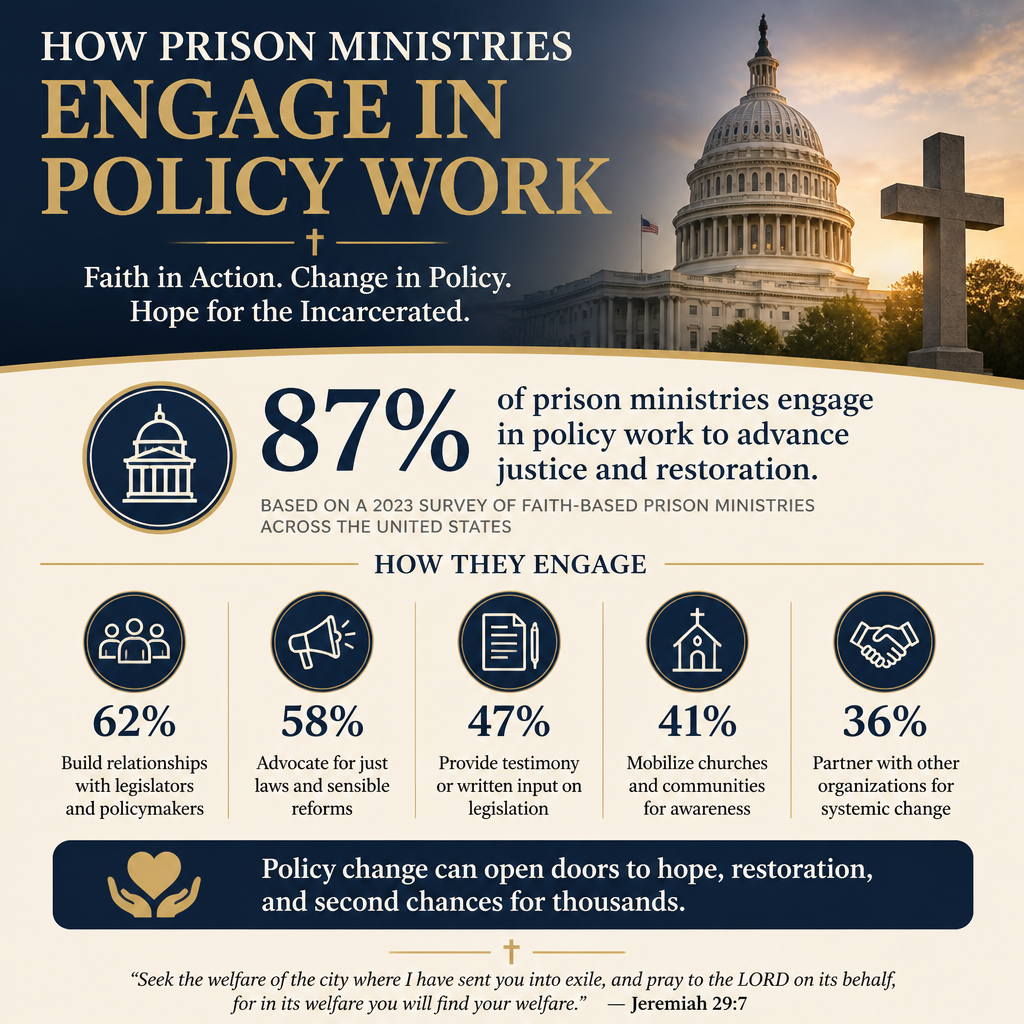
Some ministries also participate in advisory councils, task forces, and work groups convened by states or counties. These venues are often slow, imperfect, and politically constrained, but they can produce durable changes in practice. Donors should not expect quick wins; meaningful policy reform typically advances through persistence and careful coalition work.
Coalitions that include secular and interfaith partners
Christian donors sometimes worry that coalition work will dilute theological conviction. That risk is real when ministries treat “influence” as the goal. But coalitions are also a recognition of limits: criminal justice reform touches public safety, victims’ rights, mental health, and community stability. A ministry can collaborate on a specific reform while remaining explicit that its ultimate hope rests in Christ.
For donors who want to map the landscape of ministries working in this space, Legal Advocacy and Prison Ministry Reform is a useful category to compare approaches and claims. The most credible organizations name where Christians differ on policy questions and distinguish between prudential judgments and biblical absolutes.
Litigation support and religious liberty work
A narrower form of policy engagement involves religious liberty issues in correctional settings: access to worship, pastoral counseling, religious diets, and sacred texts. Some ministries refer cases to legal partners; others file amicus briefs. This work can be necessary, but it carries reputational and theological risks if framed as culture-war theater rather than as protection of conscience for incarcerated people of various faiths.
Donors should ask whether the ministry’s posture is pastoral and principled or merely combative. A serious ministry can defend religious exercise while also honoring legitimate safety concerns and the authority structures of prison administration.
Guardrails donors should expect from policy-engaged prison ministries
Clarity about what the ministry is and is not claiming
Policy work tempts ministries to overstate impact. Legislation is rarely attributable to one organization, and implementation is often uneven. The ministries that meet The Most Trusted Standard tend to describe their role with precision: “we provided testimony,” “we convened stakeholders,” “we trained volunteers,” “we monitored implementation,” and “we tracked defined outcomes.” They also distinguish between moral goals and policy mechanisms, acknowledging that two faithful Christians can agree on human dignity and disagree on sentencing design.
At Most Trusted, our verification work repeatedly surfaces a central credibility marker: whether a ministry can connect its policy claims to documented activities, clear financial reporting, and accountable governance. Policy engagement without these basics becomes advocacy theater, which is costly for donors and corrosive for public trust.
Nonpartisanship and donor integrity
Christian donors give to ministry, not to a political party. The field has had to reckon with how easily prison reform rhetoric can be captured by partisan agendas on both the left and the right. A ministry can take positions on policies that affect incarcerated people while refusing to function as a partisan apparatus.
Donors can reasonably expect several guardrails:
- Legal compliance with IRS rules regarding lobbying and political campaign activity for the organization’s tax status Internal Revenue Service.
- Board oversight of public policy positions, not ad hoc decisions by a charismatic leader.
- Transparent allocation of funds so supporters know what portion supports policy engagement versus direct services.
- Consistent theological framing that centers human dignity, repentance, restoration, and public safety.
- Protection of beneficiaries so incarcerated people are not used as propaganda or exposed through careless storytelling.
These are not bureaucratic niceties. They are moral commitments about truthfulness, stewardship, and the proper use of power.
How donors can evaluate whether policy work is faithful and effective
Ask for a theory of change that connects prison, church, and community
Some ministries treat policy work as an isolated function that grows because it attracts funding and attention. More credible organizations explain how policy engagement supports their pastoral and reentry aims. They can articulate what changes they seek, why those changes matter for discipleship and community stability, and how they will measure progress without manipulating numbers.
Recidivism is one commonly cited metric, but donors should be careful. Recidivism definitions vary across jurisdictions, and short time windows can mislead. Ministries that communicate responsibly often reference government definitions and explain what they can and cannot claim. The Bureau of Justice Statistics’ reporting provides helpful framing for how recidivism studies are conducted and why comparisons can be difficult Bureau of Justice Statistics.
Look for governance and transparency equal to the sensitivity of the work
Policy engagement increases reputational risk. It can also create incentives to pursue publicity rather than pastoral faithfulness. Donors should look for audited financial statements when appropriate to the organization’s size, clear conflict-of-interest policies, and evidence that the board includes members capable of overseeing complex partnerships and public communications.
Prison and Post-Prison Ministries is a context where donors benefit from independent verification because stories are compelling and needs are real, but outcomes and claims can be difficult to evaluate from a distance. Most Trusted exists to help donors give with confidence by assessing ministries against The Most Trusted Standard, a 15-criteria framework covering faith commitments, financial integrity, governance, and transparency and effectiveness.
FAQs for How prison ministries engage in policy work
Is policy work a distraction from evangelism and discipleship?
It can be, especially when a ministry treats political influence as the measure of success. But policy work can also be a form of neighbor love that removes predictable barriers to repentance, responsibility, and restoration. The most credible prison ministries keep evangelism and pastoral care central while pursuing limited, specific reforms that protect human dignity and strengthen families and communities.
What questions should donors ask before funding a prison ministry that does advocacy?
Donors should ask what the ministry is permitted to do under its tax status, who authorizes policy positions, how funds are allocated, and what evidence supports the ministry’s claims of influence or impact. It is also reasonable to ask how the ministry protects incarcerated people from being used for messaging and how it maintains a consistent theological framework that honors both justice and mercy.
Conclusion
Prison ministries engage in policy work best when they do it as an extension of faithful presence: truthfully describing what they see, advocating for reforms proportionate to their competence, and remaining accountable to the church’s moral commitments. For Christian donors, the central question is not whether a ministry speaks to policy, but whether it does so with integrity, theological seriousness, and verifiable responsibility worthy of the trust placed in it.



