
Questions about what administrative costs fund in pastoral support ministries are rarely just accounting questions. For Christian donors, they are moral questions about whether a gift is being treated as sacred trust, strengthening shepherds rather than subsidizing drift, inefficiency, or institutional self-protection.
Scripture never commends waste, but it also never imagines ministry without real administration. The early church appointed servants to handle distribution so that the apostles could give themselves to prayer and the ministry of the word (Acts 6:1–4). Administrative work, rightly ordered, is one way the church protects focus, integrity, and care.
Administrative costs are the ministry infrastructure that keeps care reliable
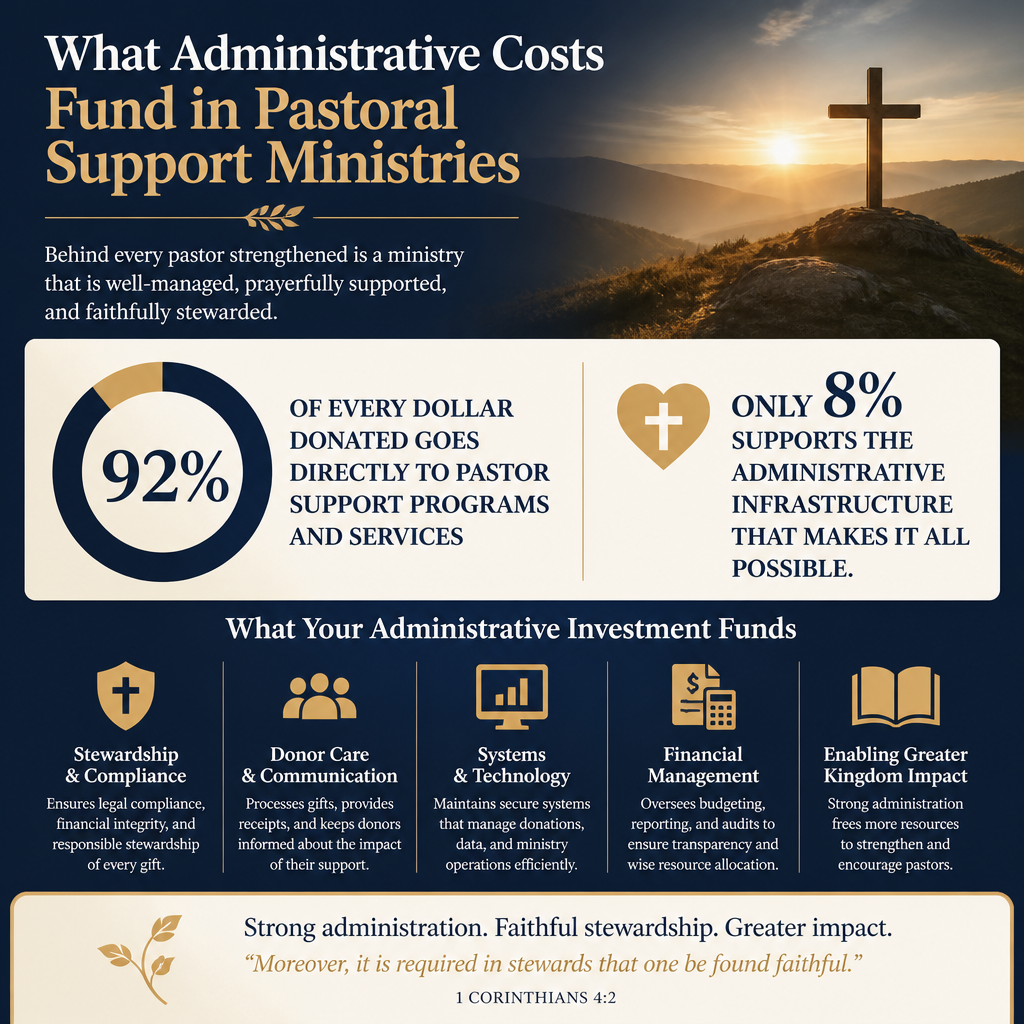
Administrative expenses in pastoral support ministries typically fund the systems that make pastoral care consistent rather than episodic. Donors often picture a direct line from their gift to a retreat, a counseling session, or a sabbatical grant. In practice, those outcomes depend on intake, assessment, scheduling, documentation, vendor management, compliance, and follow-through—work that is rarely visible but frequently decisive.
Pastors come to support ministries in seasons of crisis: burnout, marriage strain, conflict, depression, moral injury after congregational trauma, or the slow exhaustion of carrying burdens in silence. The ministry’s ability to respond with steadiness often hinges on administrative capacity: whether calls are returned promptly, whether care plans are tracked, and whether financial help is disbursed with both compassion and controls.
What donors usually mean by administrative
Many donors use “administrative” as a shorthand for anything that is not obviously programmatic. Yet most ministries classify expenses by accounting standards that can place necessary program support under administration. A well-run pastoral support ministry will explain its classifications plainly and give donors enough detail to evaluate whether “administration” is truly overhead or actually a component of pastoral care delivery.
Why this category differs from large-scale service charities
Pastoral support is often confidential, highly individualized, and relational. Those qualities reduce the visibility of outcomes and increase the need for careful internal processes. A food bank can count meals; a pastoral support ministry often must protect identities, document with discretion, and coordinate care that may include clinicians, spiritual directors, retreat centers, and local church leadership.

Personnel, compliance, and care coordination are often the largest drivers
In our verification work at Most Trusted, we find that donors underestimate how much of “administration” is simply people doing the patient, protective work that allows pastors to receive help without fear. If a ministry serves pastors in crisis but lacks the staff to manage referrals, contracts, and follow-up, the result is often delayed care and preventable harm.
Typical administrative functions that directly protect pastors
Administrative costs frequently include staff and services such as:
- Intake and triage to assess urgency, risk, and the right level of care
- Care coordination with counselors, retreat providers, and spiritual directors
- Finance and disbursements to pay vendors, reimburse pastors, and document restricted gifts
- Confidential recordkeeping with appropriate data security and access controls
- HR and supervision to ensure staff are trained, accountable, and not overextended
These functions are not spiritually neutral. They are part of loving pastors well—loving them in ways that do not depend on a single heroic staff member, and that endure when leadership changes.
Legal and ethical obligations are not optional
Pastoral support ministries often operate at the intersection of pastoral care and mental health care. Even when a ministry is not providing clinical services directly, it may be handling referrals, payments, and sensitive information. Basic compliance—insurance, contracts, financial controls, and data protection—exists because mistakes can injure the very people the ministry exists to serve.
Good administration can be a theological commitment to order and truth
Christians genuinely disagree about how much structure is appropriate in ministry. Some fear that organization becomes a substitute for prayerful dependence. Others have watched ministries collapse under the weight of informal systems that could not bear the load of growth, crisis, or scandal. Wisdom requires acknowledging both risks.
Scripture presents order not as a rival to spiritual vitality, but as one expression of faithfulness. Paul’s insistence that “all things should be done decently and in order” (1 Corinthians 14:40) is not a call to bureaucracy for its own sake. It is a call to practices that protect the church from confusion and harm.
Administration as integrity, not image
Donors are often trained to reward low “overhead” ratios, and ministries sometimes respond by understating legitimate administrative needs or forcing costs into program categories. The nonprofit sector has had to correct this instinct. Charity Navigator, Candid (formerly GuideStar), and the BBB Wise Giving Alliance publicly rejected the idea that overhead ratios are a decisive measure of effectiveness in their “Overhead Myth” letter (Charity Navigator).
The harder question is not whether administrative costs exist, but whether they are ordered toward mission. When administration becomes self-referential—designed primarily to protect reputation, preserve leadership comfort, or build an internal empire—it begins to compete with the ministry’s stated calling.
Why transparency matters more than a single percentage
Mature donors often ask for a number: “What percent goes to programs?” That question is not wrong, but it is incomplete. A truthful ministry can explain what is inside each category, how it allocates shared costs, and what controls it uses to prevent misuse. For donors evaluating pastoral support work, that clarity is often more revealing than a single ratio.
What healthy administrative spending looks like under The Most Trusted Standard
Most Trusted exists to help Christian donors give with confidence by evaluating ministries against The Most Trusted Standard, a 15-criteria framework across faith foundation, financial integrity, governance and leadership, and transparency and effectiveness. Administrative spending becomes most meaningful when it is interpreted through that wider lens: theology, controls, leadership culture, and public accountability.
Across ministries that meet the kinds of expectations we examine, administrative spending tends to correlate with specific evidences of stewardship rather than with self-justifying narratives. We are less persuaded by assurances and more persuaded by policies, reporting, and governance practices that can be checked.
Signals that administrative costs are serving the mission
In pastoral support ministries, we generally look for patterns such as:
Clear purpose for each major cost center. Administrative staffing is tied to concrete responsibilities: intake responsiveness, vendor oversight, donor restrictions, and pastor follow-up.

Appropriate financial controls. Segregation of duties, documented approvals, and a board that receives meaningful financial reporting reduce opportunities for misuse.
Independent oversight. A functioning board and credible financial review practices matter because pastoral support work can be emotionally charged and highly trusted. Trust without controls is a fragile arrangement.
Transparency proportionate to confidentiality. A ministry can protect pastor privacy while still reporting program volume, spending categories, governance structure, and outcomes in aggregated form.
Evidence of learning. The ministry can name what it measures, what it has changed, and what it has stopped doing when it did not serve pastors well.
Why pastoral support requires special care in evaluation
Donors should not expect a pastoral support ministry to publicize stories the way other ministries do. Confidentiality is part of love for neighbor. Yet confidentiality can also be misused as a shield against accountability. The task is to ask for forms of evidence that do not expose individuals: audited or reviewed financials when appropriate, governance transparency, policies on conflicts of interest, and reporting that demonstrates real activity without trading in pastor pain as marketing content.
For donors who want a broader view of the field and its common funding streams, our coverage of Pastoral Support Ministries offers a framework for thinking carefully about stewardship, care, and credibility.
Questions donors should ask when a ministry labels costs as administration
Administrative costs can hide both virtue and vice. A ministry may be under-investing in basic systems, forcing staff to compensate with exhaustion and improvisation. Or it may be over-investing in internal machinery that does not materially improve care for pastors. The point of donor diligence is to discern which is happening.
Practical questions that respect both stewardship and reality
The following questions tend to surface substance quickly:
What is included in administration? Ask for a plain-language breakdown, not only an accounting label.
How quickly can a pastor in crisis be connected to care? Response time is often an administrative capacity issue.
How are grants or subsidies approved and documented? Compassion should be paired with controls.
How does the ministry avoid conflicts of interest? This is especially relevant when leadership networks overlap with providers.
What does the board do in practice? Board minutes need not be public, but real oversight should be visible in reporting and policies.
How overhead debates have shaped donor expectations
The nonprofit field has had to reckon with the “starvation cycle,” the dynamic in which donor pressure for low overhead leads organizations to underinvest in systems, which then depresses performance and reinforces donor skepticism. Stanford Social Innovation Review has documented this pattern and its consequences (Stanford Social Innovation Review). Pastoral support ministries are not exempt. Underfunded administration can mean fewer pastors served, slower response in crisis, and weaker safeguards for money and people.
Donors can support a healthier pattern by rewarding candor: ministries that explain costs without defensiveness, show how systems protect pastors, and demonstrate governance that does not treat donor questions as disloyalty. For additional context on how ministries commonly allocate funds, see our reporting on How Pastoral Support Ministries Use Donations.
FAQs for What administrative costs fund in pastoral support ministries
Should Christian donors avoid ministries with higher administrative costs?
Not automatically. A higher administrative share can reflect legitimate realities: confidential case management, coordination with professional providers, or a deliberate investment in controls and responsiveness. What merits concern is not the presence of administrative cost, but whether the ministry can show that these expenses protect pastors, strengthen delivery, and remain governed with integrity.
What is a reasonable way to evaluate administrative spending without fixating on a ratio?
Ask for explanations you can verify: what administration includes, how quickly pastors receive help, what financial controls exist, what the board oversees, and what outcomes are reported in aggregated form. A ministry that welcomes those questions and answers them with documentation is usually signaling the kind of stewardship Christian donors are right to expect.
Administrative spending is not the enemy of faithful pastoral care
Administrative costs fund the often-unseen work that makes pastoral support dependable: triage, coordination, confidentiality, financial controls, and governance. Christian donors are right to resist waste and self-importance, but the more faithful aim is to fund ministries that are truthful about what care requires and disciplined about how money serves it. When administration is ordered toward love of neighbor and governed with integrity, it becomes part of the ministry itself rather than a regrettable add-on.



