
When Christian donors ask what pastoral support ministry donations pay for, they are usually asking something more searching than a budget question. They are asking whether their giving will strengthen shepherds who are increasingly strained, and whether the work is carried out with integrity. Scripture holds both concerns together: those who labor in preaching and teaching are worthy of material support (1 Timothy 5:17–18), and those who handle funds for ministry must do so “honorably… not only in the Lord’s sight but also in the sight of man” (2 Corinthians 8:21).
Pastoral support is rarely glamorous. It often funds counseling rooms rather than stages, supervised care rather than visible programs, and long-term formation rather than a single measurable event. That hiddenness is not a defect; it is part of how shepherding works. But hidden work also requires careful accountability, especially when donor funds underwrite care that is confidential by necessity and slow by design.
Pastoral support is a ministry to the shepherd and, through him, to the flock
Pastoral support ministries exist because pastors are not disembodied “leaders.” They are men with marriages, bodies, consciences, and limits, called to care for souls while living inside the same pressures and temptations as everyone else. When a pastor collapses—morally, emotionally, or spiritually—the damage does not remain private. Churches fracture, families suffer, and public witness erodes.
Across our verification work at Most Trusted, we see pastoral support ministries at their best when they treat care as both spiritual and practical: sound theology, responsible clinical practice, and structures that keep power from becoming unaccountable. Those are not competing commitments. They are mutually reinforcing.
What the pastoral crisis suggests about donor urgency
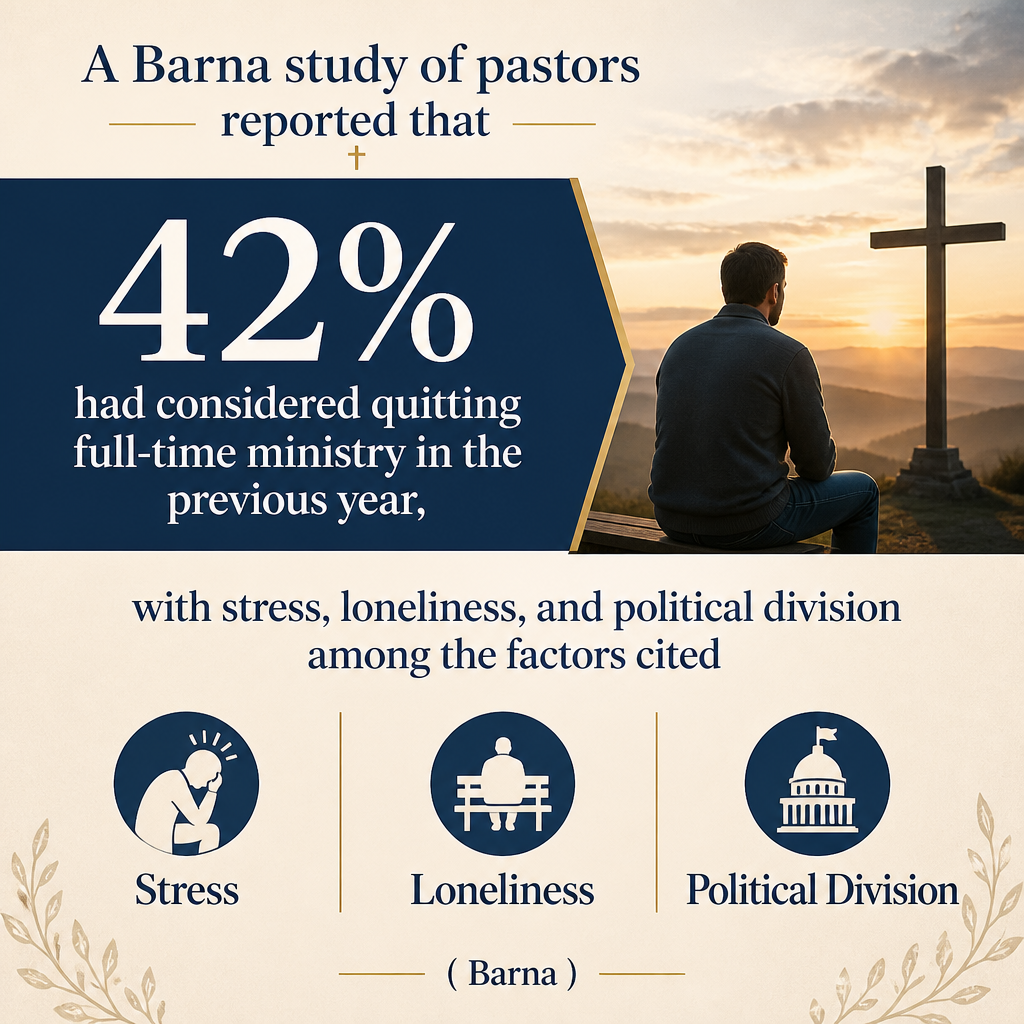
Many donors sense that the pastoral vocation has become harder, and research supports that intuition. A Barna study of pastors reported that 42% had considered quitting full-time ministry in the previous year, with stress, loneliness, and political division among the factors cited (Barna).
That single statistic should not be used as a blunt instrument; “considered quitting” ranges from fleeting thought to active planning, and pastoral experiences vary by denomination, geography, and church size. Still, it signals a real burden. Donors who care about church health should not treat pastoral care as optional overhead.
Why confidentiality and accountability must coexist
Pastoral support often involves sensitive counseling, crisis intervention, addiction recovery, or marriage repair. Donors cannot and should not demand personal details as proof. The better question is whether the ministry has appropriate professional boundaries, documented policies, and independent oversight. A mature ministry can protect a pastor’s privacy while also demonstrating that funds are spent for their stated purpose.

What donations often fund is care that cannot be rushed
Pastoral support ministry donations frequently pay for human time—licensed counseling, coaching, spiritual direction, and case management—because many pastoral problems are not solved by a single resource. They require patient attention and follow-through. This is one reason cost-per-outcome comparisons can be misleading: the “unit” of care is often a relationship sustained through a difficult season.
Counseling, clinical partnerships, and supervised referrals
Many ministries fund sessions with licensed mental health professionals, either on staff or through referral networks. Where counseling is offered, donors should expect clarity about credentials, supervision, and referral thresholds for higher levels of care. In stronger ministries, pastoral care teams do not attempt to replace clinical expertise with spiritual language; they coordinate appropriately, recognizing that depression, trauma, and addiction often require specialized treatment alongside prayer and discipleship.
Retreats, sabbaticals, and restoration plans
Some giving pays for retreat spaces, guided rest, and structured sabbaticals. These are sometimes criticized as “perks,” but the biblical logic of rest is not indulgence; it is creaturely obedience. At the same time, sabbaticals can be poorly designed, especially if they become avoidance rather than renewal. Responsible ministries connect rest to a restoration plan: counseling if needed, marital repair, spiritual disciplines, and concrete boundaries for returning to ministry.
- Short-term crisis counseling and triage
- Ongoing therapy or coaching through vetted providers
- Peer cohorts with trained facilitation and clear confidentiality practices
- Retreats with structured programming rather than vague “refreshment”
- Resource development such as curricula for churches on healthy pastoral care
Strong pastoral support includes preventive formation, not only emergency response
Donors often encounter pastoral support only when a crisis becomes public. Yet wise ministries spend significant resources upstream: forming pastors in habits that make collapse less likely. Preventive support is less dramatic, but it is often more faithful stewardship.
Training in boundaries, accountability, and sexual integrity
Donations may fund training on appropriate pastoral boundaries, digital integrity, and structures of accountability. This is not about suspicion; it is about realism. Scripture assumes that leaders face intensified scrutiny and temptation (James 3:1), and the church has learned painfully that charisma is not character. Programs that normalize wise constraints—financial transparency, counseling when indicated, meaningful elder oversight—protect congregations and pastors alike.
Peer support that resists isolation
Pastors often describe loneliness as a persistent burden, particularly when they cannot speak candidly within their own congregation. Ministries frequently fund peer cohorts, mentoring networks, and facilitated groups. Quality varies. The difference between genuine formation and merely “venting” often comes down to leadership: skilled facilitation, shared commitments, and clear expectations around confidentiality and escalation when someone is at risk.
Donors who want the broader landscape of pastoral care work can situate this conversation within Pastoral Support Ministries, including the different models ministries use to serve pastors across traditions.
Donations also pay for accountability systems that protect pastors and donors
Pastoral support ministry work touches power, money, and vulnerability. Those realities demand governance and financial controls that are not merely technical but moral. In 2 Corinthians 8, Paul takes pains to organize financial administration so that no one can question the integrity of the collection. The principle is enduring: Christians should welcome structures that make honesty visible.
Financial controls, audits, and responsible administrative costs
Donations may pay for bookkeeping, external audits or reviews, donor receipting, and data systems that document services delivered. Some donors instinctively distrust these expenses, but the sector has had to correct simplistic thinking about “overhead.” Charity Navigator, Candid, and BBB Wise Giving Alliance jointly warned against treating low administrative cost as a primary indicator of effectiveness, noting that underinvestment can weaken outcomes and accountability (Charity Navigator).
The harder question is not whether administrative expense exists, but whether it is proportionate and well-governed: clear policies, separation of duties, board oversight, and transparent reporting that matches actual operations.
Safeguarding and professional ethics
Because pastoral support can involve counseling and crisis care, donations may fund safeguarding training, mandated reporting processes, background checks for staff where appropriate, and legal consultation for policies. These costs can feel indirect, but they often prevent the very failures that destroy trust. Where ministries coordinate counseling, donors should look for written agreements, privacy protections, and ethical standards that prevent dual relationships and conflicts of interest.
We describe many of these governance and integrity expectations within How Pastoral Support Ministries Use Donations, since donors frequently need categories that translate spiritual concern into verifiable practices.
What discerning donors should look for before funding pastoral support
Pastoral support ministries can be deeply faithful, and they can also be poorly disciplined—especially when a charismatic founder, a sensitive mission, and donor goodwill combine without strong oversight. Christians genuinely disagree about the best delivery model: centralized national networks versus local church-based care; explicitly clinical approaches versus primarily spiritual direction; intervention for broken leaders versus prevention for healthy ones. In our experience, the more decisive issue is not the model but whether the ministry can demonstrate trustworthiness.
Signals of credibility that are observable
Donors should not be asked to rely on inspirational storytelling alone. A credible ministry can show governance documents, financial statements, clear program descriptions, and evidence of responsible outcomes without violating confidentiality.
Within Most Trusted, we evaluate ministries against The Most Trusted Standard, a 15-criteria framework across Faith Foundation, Financial Integrity, Governance and Leadership, and Transparency and Effectiveness. For pastoral support, that framework matters because “effectiveness” may be less photogenic yet still verifiable: a defined intake process, documented referral pathways, staff qualifications, independent board oversight, and candid reporting about limitations.
Questions that respect both privacy and stewardship
Donors can ask questions that do not intrude into private stories:
- What qualifications and supervision do counselors or coaches have?
- How are pastors referred, screened, and matched to care?
- What does the board review, and how often?
- How do you handle conflicts of interest and safeguarding concerns?
- How do you define success, and what do you do when care does not lead to restoration?
Not every pastor is restored to public ministry, and not every marriage heals. A ministry that promises guaranteed outcomes is likely to disappoint or to conceal. Donors should expect sober honesty, because truthfulness is part of Christian witness.
FAQs for What pastoral support ministry donations pay for
Are pastoral support donations essentially paying for counseling sessions?
Sometimes, but not only. Many ministries do fund licensed counseling or subsidize sessions for pastors who could not otherwise afford them. Donor funding also commonly covers intake and assessment, referrals to specialized care, peer cohorts, retreats, safeguarding, and the financial accountability systems that ensure support is provided ethically and consistently.
How can donors evaluate impact when pastoral care must stay confidential?
Confidentiality limits what a ministry can disclose about individual cases, but it does not eliminate accountability. Donors can look for clear program descriptions, qualifications and supervision standards, governing policies, independent oversight, transparent financial reporting, and aggregated outcomes that are honestly framed. Ministries that meet The Most Trusted Standard tend to provide these forms of evidence without treating privacy as a shield against scrutiny.
Faithful pastoral support is both mercy and stewardship
Supporting pastors is a work of mercy toward those who bear spiritual weight for others, and it is also stewardship on behalf of congregations who need healthy shepherds. Donations that pay for careful, accountable pastoral care are not a distraction from mission; they are an investment in the integrity and resilience of the church’s ministry. The task for donors is to fund that work with eyes open, seeking ministries that combine compassion with verifiable trustworthiness.



