
To read a pastoral support ministry annual report well is to ask whether the ministry is strengthening those who shepherd God’s people—and whether it is doing so with integrity, clarity, and reverence for the trust donors place in it. Pastoral support is often quiet work: counseling a burned-out pastor, providing crisis sabbatical funding, stabilizing a family after moral failure, or building long-term resilience through coaching and peer cohorts. The annual report is where that quiet work should become publicly accountable.
Christian donors rightly feel tension here. Scripture commands honor for those who labor in preaching and teaching (1 Timothy 5:17), and it also warns that leaders can be harmed by greed, secrecy, or celebrity (1 Peter 5:2–3). A credible annual report does not trade on sentiment. It offers verifiable signals that compassion is paired with governance, that confidentiality is paired with transparency, and that care is paired with measurable fruit.
1. Start with the ministry’s theological and pastoral premise
What view of the pastor is being protected
Pastoral support ministries may serve senior pastors, church planters, missionaries, chaplains, or ministry spouses. The first question is whether the report articulates a coherent premise: why this care is necessary, what kind of formation the ministry seeks, and how it understands the pastor as both a spiritual leader and a vulnerable human being. A mature report will avoid slogans and instead frame its work in the language of calling, limits, holiness, and endurance.
When ministries treat pastors primarily as “assets” to be preserved, care can drift into performance maintenance. When they treat pastors primarily as “victims” of congregational dysfunction, care can drift into resentment or blame. The healthiest reports hold both truths: pastors bear real burdens, and pastors remain accountable before God and the church.
Whether Scripture is grounding or decorative
Many reports include biblical references. The question is whether Scripture shapes the ministry’s approach to care, authority, repentance, and restoration, or whether it merely lends a spiritual tone to a fundraising narrative. For example, if a ministry funds restoration after disqualifying sin, does it name the difference between pastoral care and reinstatement? Does it acknowledge that some outcomes rightly include stepping away from office, not returning to it?
Christians genuinely disagree about restoration pathways, especially after abuse. A responsible annual report will not flatten those disagreements. It will state what standards the ministry uses, how decisions are made, and what safeguards protect the vulnerable.

2. Interpret outcomes with pastoral realism, not philanthropic shorthand
What counts as fruit in pastoral support
Pastoral support outcomes are harder to quantify than meals served or Bibles distributed. The report should still name what success looks like and why. In our experience at Most Trusted, the strongest reports define outcomes at multiple levels: immediate crisis stabilization, medium-term health (marriage, emotional resilience, vocational clarity), and longer-term ministry durability.
Be cautious of reports that only count “pastors served” with no definition of service intensity. A single webinar attendee and a pastor receiving months of counseling should not be treated as equivalent impact units. Ask for program-level clarity: coaching hours delivered, retreat days provided, clinical counseling referrals completed, or peer cohort completion rates. Where a ministry cannot quantify well, it can still describe inputs and decision rules with precision.
Watch for the confidentiality transparency trade-off
Because pastoral care often involves mental health crises, marital distress, or moral failure, ministries will rightly protect personal details. But confidentiality does not require opacity. A credible annual report can publish anonymized case categories, eligibility thresholds, and aggregate outcomes without compromising privacy.
As a donor, ask whether you can understand the ministry’s work without knowing any individual’s name. If the answer is no, the report may be substituting emotional storytelling for accountable reporting.
3. Follow the money in ways that honor both compassion and prudence
Expense categories that matter in pastoral care
Pastoral support has cost structures that do not resemble overseas relief or child sponsorship. Counselors, licensed clinicians, regional coordinators, retreat facilities, and crisis grants can be legitimate program expenses. The annual report should help you see how those expenses connect to the ministry’s stated outcomes.
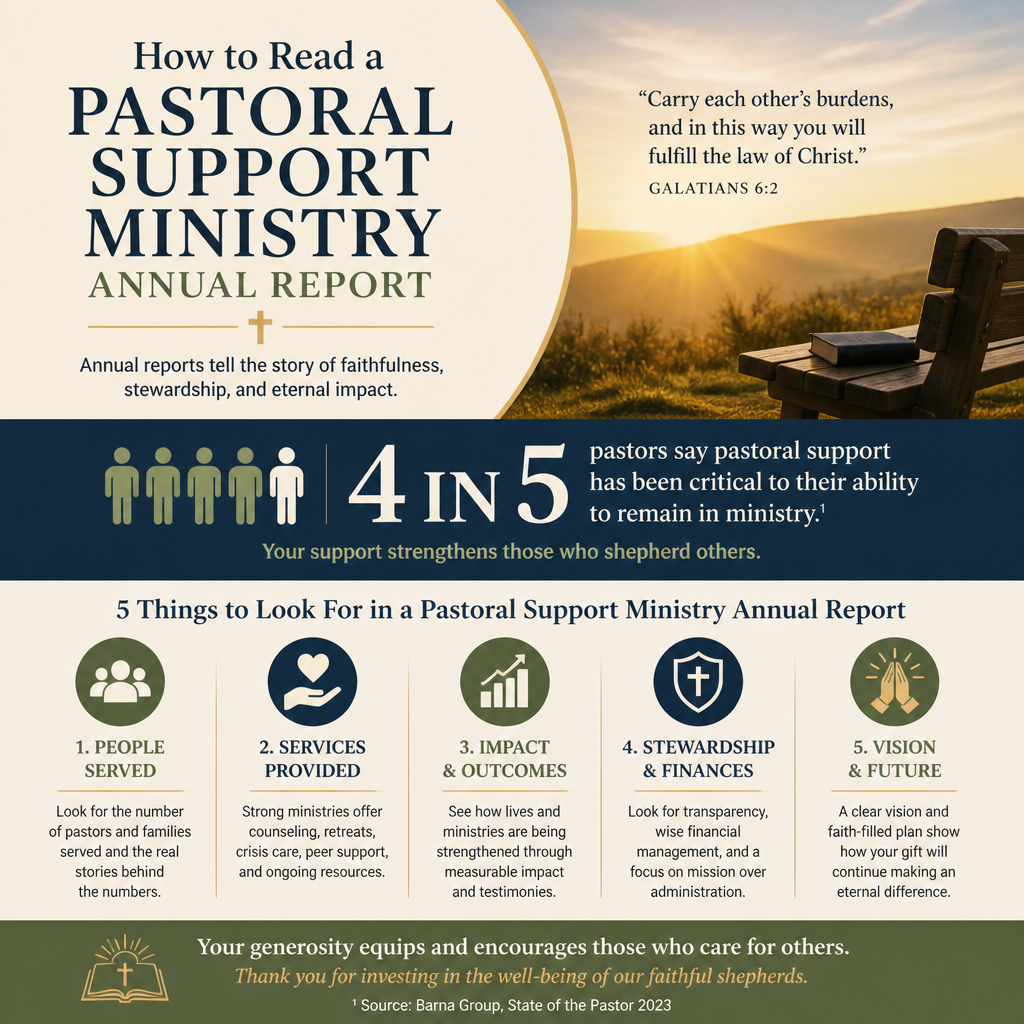
Resist the reflex to judge a ministry primarily by a single “overhead ratio.” The philanthropic sector has repeatedly cautioned donors against that reductionism; the “Overhead Myth” open letter was signed by major evaluators arguing that administrative costs alone do not predict effectiveness (Candid GuideStar). That said, donors are still responsible to ask whether spending is disciplined, whether reserves are appropriate, and whether leaders are compensated in ways consistent with the ministry’s theology of service.
Red flags and green flags in financial presentation
A serious annual report aligns narrative claims with audited financial statements or a clear financial summary that reconciles to the audit. It distinguishes restricted from unrestricted funds and explains how donor designations shape program decisions. It also addresses cash flow realities directly, especially if the ministry funds urgent interventions.
- Green flag: an independent audit is linked or clearly referenced, and the auditor is named.
- Green flag: restricted funds and board-designated reserves are explained in plain language.
- Red flag: heavy emphasis on growth with no discussion of staff capacity, quality control, or safeguarding.
- Red flag: “program” spending is undefined and appears to include broad marketing or fundraising costs.
- Red flag: financial results are presented only as a celebratory narrative without reconciliation to statements.
If the annual report mentions “record giving” or “expansion,” it should also address whether the ministry has the governance and controls to scale without compromising care quality. For donors who support pastoral support, quality is the mission.
4. Evaluate governance and safeguards as part of pastoral love
Board independence and accountability pathways
Pastoral support ministries often serve leaders who are themselves influential. That dynamic makes accountability harder, not easier. A credible report names board members, explains how the board is selected, and clarifies independence—particularly if the ministry founder is prominent or if major donors have outsized influence.
Across our verification work at Most Trusted, ministries that meet The Most Trusted Standard tend to treat governance as a form of pastoral love: it protects the vulnerable, guards the mission, and limits the temptations that can quietly accumulate around money and access. This is particularly important when a ministry provides restoration support, handles allegations, or interacts with churches in crisis.
Safeguarding and referral competence
Annual reports should disclose safeguarding policies appropriate to the ministry’s work: background checks for staff interacting with minors at retreats, mandatory reporting posture where applicable, and boundaries for counseling and spiritual direction. For mental health care, the report should clarify whether care is provided by licensed clinicians, pastoral counselors, or trained lay coaches, and how referrals are made when clinical needs exceed internal capacity.
Donors should not demand clinical detail, but we should expect competence signals: written policies, external expertise, and clear boundaries.
5. Test transparency and effectiveness against what mature donors need
Whether the report answers foreseeable donor questions
A strong annual report anticipates the questions a serious donor will ask and answers them without defensiveness: Who qualifies for help? Who decides? How are crises triaged? How does the ministry avoid dependency? What happens when a supported pastor is not restored to ministry? How does the ministry evaluate whether its interventions reduce harm rather than merely delay collapse?
If you are supporting this space, it also helps to compare the ministry’s claims with the broader landscape of pastoral support. Some ministries are designed for short-term emergency relief. Others focus on preventative formation. Both can be faithful; both should state their lane honestly. For donors exploring the wider context of Pastoral Support Ministries, this clarity allows giving decisions that match actual need rather than marketing emphasis.
How effectiveness is narrated without manipulation
Pastoral support stories can easily become donor theater: a dramatic crisis, a last-minute rescue, a triumphant return. Sometimes those stories are true. But they can also conceal messy realities: relapse, marital breakdown, long recovery, or permanent vocational redirection. Mature Christian donors are not served by triumphalism. We are served by truth told with discretion.
One constructive test is whether the annual report includes any “learning” language—what the ministry changed, refined, or stopped doing based on evidence. In the nonprofit field, the most durable organizations name limits and adapt. Stanford Social Innovation Review has argued that effective evaluation often begins with learning questions rather than public relations metrics (Stanford Social Innovation Review). Pastoral support is no exception.
For donors specifically weighing how resources are deployed across programs and operational needs, the broader set of giving questions in How Pastoral Support Ministries Use Donations can help frame the annual report in a stewardship context rather than a marketing context.
FAQs for How to read a pastoral support ministry annual report
Should a pastoral support ministry annual report include audited financials?
For ministries of meaningful size or complexity, an independent audit is a strong credibility signal, and many mature donors will reasonably expect it. Smaller ministries may not yet be able to fund an audit responsibly; in that case, the annual report should still provide clear financial statements, explain internal controls, and name board oversight practices. The deeper question is not the document itself, but whether financial reporting is independent, consistent, and reconcilable.
What if the report does not give measurable outcomes because of confidentiality?
Confidentiality is a legitimate constraint in pastoral care, but it does not remove the obligation to be accountable. The report can still disclose anonymized categories of care, service intensity, eligibility criteria, decision-making processes, and aggregate outcomes. If the ministry cannot describe what it does in a way that can be evaluated, donors cannot exercise stewardship with clarity.
Giving with discernment for those who shepherd
A pastoral support ministry annual report should leave you with more than gratitude; it should leave you with warranted confidence. The Church needs pastors who endure with humility, and pastors need communities—and institutions—that will care for them with wisdom. When an annual report combines theological seriousness, financial clarity, accountable governance, and honest learning, it becomes part of that care.



