

How pastoral support ministries use donations is ultimately a question of stewardship: whether the resources entrusted by God’s people are directed toward faithful care of pastors and durable health in the church. Donors are right to ask for clarity, because the work is often relational and preventative—categories that can be difficult to quantify, easy to romanticize, and easy to under-document.
Scripture treats the material support of spiritual leaders as a serious moral obligation, not a sentimental add-on. Paul argues that those who preach the gospel have a right to receive their living from the gospel (1 Corinthians 9:14), and he commends churches that shared with him in the matter of giving and receiving (Philippians 4:15). Yet the same New Testament warns against “shameful gain” and calls leaders to be “above reproach” (1 Timothy 3:2–3). Pastoral support is therefore both necessary and accountability-sensitive by design.
What donors are actually funding when a ministry supports pastors
The phrase “pastoral support” can describe several distinct kinds of work. Some ministries focus on direct financial assistance to pastors in crisis. Others provide counseling, spiritual direction, and care for marriages and families. Still others specialize in training, peer networks, sabbaticals, or congregational health interventions that reduce preventable pastoral burnout. The healthiest ministries name which of these they do, which they do not, and why.
Across Pastoral Support Ministries, donors should expect program spending to correspond to a clear theory of pastoral flourishing and church stability. When support is vague—“encouraging pastors” without a defined mechanism—budgets tend to drift toward events, content production, or general administration without a disciplined link to outcomes.
Direct support and emergency assistance
Many pastoral support ministries maintain benevolence-style funds for urgent needs: medical bills, temporary housing, counseling costs after a traumatic event, or a short bridge during an unexpected job transition. This is often the most visible use of donations, and it can be profoundly appropriate. A mature ministry will pair it with policies that prevent favoritism, protect confidentiality, and avoid creating dependency.
Donors should look for written eligibility criteria, a defined approval process, and guardrails around cash assistance. Some of the strongest ministries use third-party payments when possible (for example, paying a counselor directly rather than reimbursing an individual) and require basic documentation without burdening the pastor in crisis.
Pastoral care services and clinical support
A significant share of spending in many pastor-care organizations goes to professional services: licensed counseling, trauma-informed care, spiritual direction, coaching, and sometimes psychiatric referrals. This can be costly because competent care is costly. It is also frequently the category where donors misunderstand what “program” means. Paying qualified clinicians is not administrative bloat; it is often the core mission expense.
The tension is that clinical services can blur into general wellness or life coaching. We find it reasonable for ministries to offer a range of care, but donors should expect an explicit scope, clear qualifications for providers, and a referral approach that recognizes limits of competence.
Formation, training, and preventive support
Preventive support—peer cohorts, mentoring, leadership development, and marriage enrichment—often delivers the most lasting fruit, but it is easier to market than to measure. It can also be expensive if it involves retreats or subsidized travel. Responsible ministries disclose the true cost per participant, explain why an in-person gathering is warranted, and show that the content is not merely inspirational but anchored in pastoral realities: conflict, loneliness, financial pressure, moral injury, and spiritual dryness.
When donors ask whether preventive work is “worth it,” a helpful frame is that Scripture treats shepherding as labor, not as mere gifting (1 Timothy 5:17). Supporting pastors to endure and finish well is not optional; the question is whether a ministry’s chosen methods are disciplined and appropriately scaled.

How donations typically move through a pastoral support ministry budget
Donors often ask for a simple ratio—how much goes to “the pastor” versus “overhead.” The field has had to reckon with the fact that this can be an immature question when asked without context. The widely endorsed “overhead myth” perspective, articulated by Charity Navigator, Candid (GuideStar), and the BBB Wise Giving Alliance, argues that overhead can be necessary for effectiveness and that simplistic pressure to minimize it can lead to underinvestment in systems and staff that protect mission outcomes https://www.charitynavigator.org/.
What this means in practice is not that donors should ignore overhead. It means donors should interpret it. In pastoral support, some “overhead” functions—case management, safeguarding processes, finance controls, confidential data handling, and qualified supervision—are integral to serving pastors well and avoiding harm.
Program costs versus support costs in pastor-care work
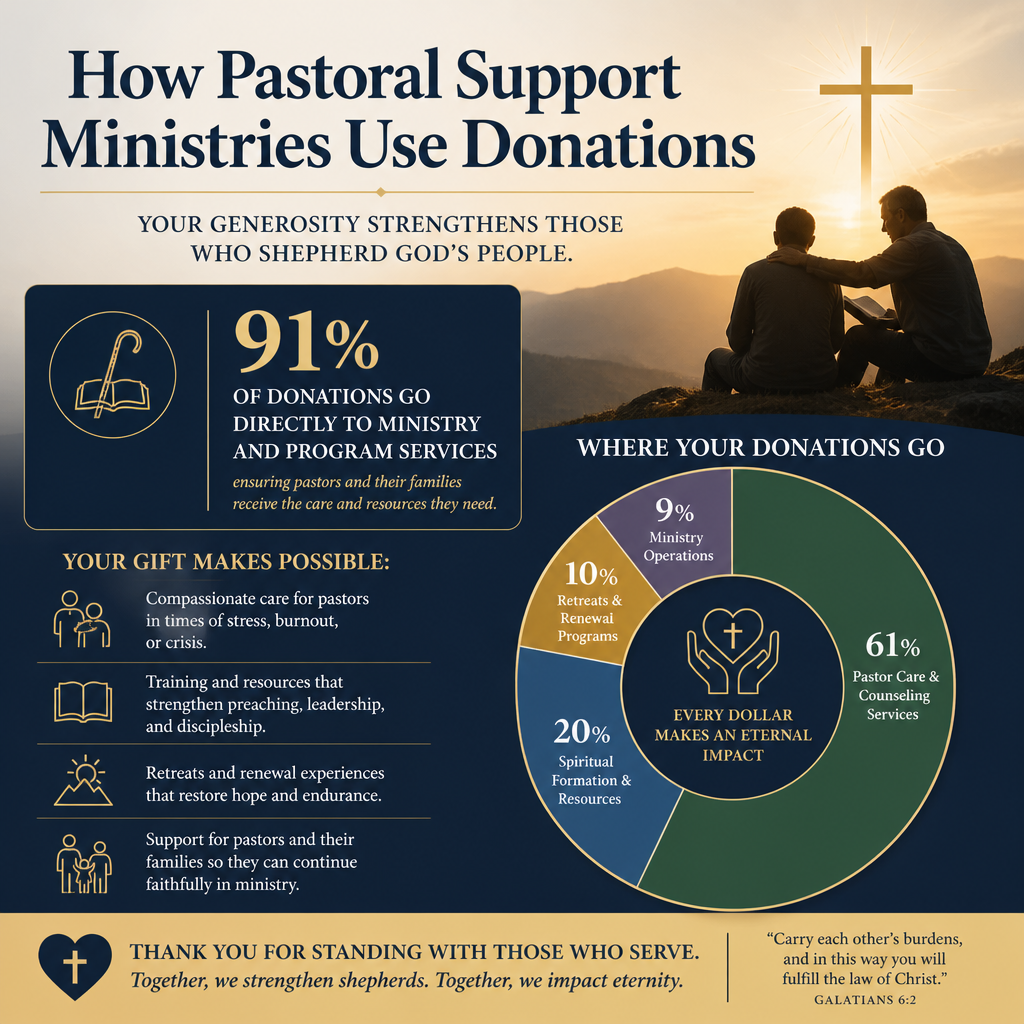
Pastoral support ministries commonly have program costs that are personnel-heavy. Even if a ministry does not provide direct financial grants, the bulk of “program” may be staff time: intake, triage, ongoing care coordination, and follow-up. Donors should ask how staff time is allocated and whether the ministry uses time tracking or reasonable cost allocation methods. Without those disciplines, financial statements can be technically compliant but practically uninformative.
Support costs can include donor relations, accounting, technology, legal counsel, and insurance. Donors should not be surprised to see meaningful spending here if a ministry handles sensitive pastoral data or runs retreat-based programming with real risk exposure.
Why administrative spending can be morally necessary
In the pastoral support context, administration is often where integrity lives. Confidentiality protocols, background checks for staff and volunteers, complaint pathways, and documentation standards are not optional niceties. They are part of honoring pastors as image-bearers and protecting them from exploitation, gossip, and avoidable retraumatization.
A ministry that is lean to the point of fragility may unintentionally shift the true cost of care onto pastors’ families, local churches, or future donors through crisis-driven cycles. Thoughtful donors should be cautious about rewarding “low overhead” when it correlates with weak controls, poor documentation, or staff burnout.
Reserves and sustainability
Many donors are uneasy when they see cash reserves on a balance sheet, especially if pastors have current needs. Yet reserves can be ethically appropriate when they stabilize a ministry’s ability to respond to crises, avoid sudden program cuts, and protect staff from abrupt layoffs. The harder question is whether reserves are governed by a clear policy, reviewed by an engaged board, and sized to the ministry’s risk profile and funding volatility.
For pastors in acute distress, a reserve that exists only to reduce future discomfort can feel like a failure of compassion. For pastors depending on long-term care networks, a ministry with no runway can be equally harmful. Mature pastoral support work acknowledges this tension and manages it transparently.
What transparency should look like for pastor-care ministries
Pastoral care creates a distinctive transparency challenge: donors deserve verifiable evidence of faithful stewardship, while pastors deserve confidentiality. The best organizations do not choose one over the other. They build reporting that is aggregate, specific, and privacy-respecting.
In the United States, donors can often start with a ministry’s IRS Form 990, which includes governance disclosures, key compensation reporting, and program descriptions. The IRS provides access to nonprofit filings through its Tax Exempt Organization Search https://www.irs.gov/charities-non-profits/tax-exempt-organization-search. A 990 is not a full audit, but it does give donors a baseline for consistency between messaging and spending.
Annual reporting that does not hide behind generalities
Annual reports in this space should do more than celebrate stories. Donors should expect concrete, non-identifying metrics such as: number of pastors served; categories of assistance provided; average response time; utilization rates for counseling sessions; and geographic reach. Where outcome measurement is difficult, a ministry can still report process integrity: standardized intake, follow-up cadence, and referral completion rates.
We also encourage donors to look for an honest discussion of constraints. If a ministry cannot meet demand, it should say so and explain how triage decisions are made. In pastoral support, silence about limits often signals that the organization is managing perception rather than managing reality.
Audits, reviews, and the limits of what financial statements can tell you
Christians genuinely disagree about how much assurance is “enough” for smaller ministries. An independent financial audit can be expensive, and a review or compilation offers less assurance. Donors should not treat “audited” as a magical word, but audits do materially strengthen credibility when done by reputable firms and paired with strong governance.
At the same time, financial statements rarely reveal whether a ministry’s pastor-care model is clinically competent, spiritually wise, or appropriately governed. They show whether numbers are fairly presented, not whether the care is effective. That is why donors should weigh financial integrity alongside governance, leadership character, and transparency about methods.
Confidentiality and safeguarding as measurable commitments
Because these ministries handle sensitive information—marital crises, depression, trauma, moral failure, and church conflict—donors should expect explicit safeguarding policies. The absence of such policies is not neutral. It increases the risk of harm to pastors and congregations, and it increases the risk of catastrophic reputational collapse that can destroy a ministry’s capacity to serve.
Good transparency includes describing data handling practices, documenting how conflicts of interest are managed, and clarifying whether the ministry is mandatory-reporting aware and trauma-informed. A ministry does not need to publish private details to show it takes privacy seriously.
How Most Trusted evaluates donor confidence in pastoral support spending
Most Trusted exists because many donors want to give decisively without giving blindly. Across our verification work, we find that the ministries that best serve pastors over time tend to combine compassion with controls: they can act quickly in crisis, but they also document decisions, submit to accountable governance, and communicate clearly about what they do with donor funds.
Our evaluations are organized by The Most Trusted Standard, a 15-criteria framework spanning Faith Foundation, Financial Integrity, Governance and Leadership, and Transparency and Effectiveness. Donors do not need to become auditors to benefit from this approach. They do need to ask questions that match the moral stakes of the work.
Signals of faithful stewardship donors can verify
- Mission clarity: The ministry describes its pastor-care model in concrete terms and ties spending to that model.
- Documented governance: An active board, conflict-of-interest policies, and clear authority over financial decisions.
- Financial controls: Separation of duties, responsible expense policies, and credible external review appropriate to size.
- Evidence of care quality: Qualified providers, clear referral pathways, and boundaries between pastoral care and clinical treatment.
- Truthful communication: Reporting that includes constraints, not only successes.
Common donor misunderstandings that deserve correction
First, the assumption that direct cash assistance is the highest form of pastoral care. Sometimes it is essential; sometimes the most faithful help is paying for counseling, funding a sabbatical, or underwriting skilled mediation that prevents a church split. Second, the assumption that administrative spending is inherently suspect. In pastor-care work, weak administration can be a direct path to confidentiality breaches and mishandled crises.
Third, the belief that effectiveness must be measured with simplistic counts. Some outcomes that matter most—restored marriages, sustained vocational faithfulness, avoided moral collapse—do not submit to neat metrics. Still, donors should not accept vagueness as the price of spiritual work. A ministry can be both spiritually serious and operationally precise.
Giving to pastoral support with open eyes and a steady conscience
Donations to pastoral support ministries are a way of bearing burdens within the household of faith (Galatians 6:2), but they should also be offered with discernment. The question is not whether pastors deserve care; Scripture settles that. The question is whether a particular ministry uses resources in ways that are truthful, governed, and proportionate to the needs it claims to meet.
Donors who insist on clear budgets, credible reporting, and accountable leadership are not distrusting the church. They are practicing a form of love that refuses to separate compassion from integrity, especially where the well-being of shepherds—and by extension, congregations—hangs in the balance.



