
Why orphan care ministries support foster care training is ultimately a question of faithfulness, not fashion. If the church intends to obey Scripture’s command to defend the fatherless, we must also be sober about what helps children heal and what unintentionally harms them.
Donors often associate “orphan care” with adoption or overseas institutions. The field has changed. Many children who lack safe parental care are not legally orphaned; they are caught in neglect, addiction, incarceration, domestic violence, or acute poverty that has overwhelmed a family. In the United States, that reality is concentrated inside the foster care system, where the need is not only placement but stability, trauma-informed caregiving, and churches that can sustain families through years rather than weeks.
Orphan care has matured from rescue narratives to family restoration and permanence
Scripture’s insistence on protecting vulnerable children is not sentimental. God identifies himself as “Father of the fatherless” (Psalm 68:5), and James ties “religion that is pure and undefiled” to the care of orphans and widows in their affliction (James 1:27). Yet Scripture also assumes that care is relational, embodied, and sustained. The biblical aim is not merely extraction from danger but restoration into covenantal belonging.
Foster care sits at the intersection of mercy and public responsibility
Unlike many ministry contexts, foster care is a state-governed system with statutory timelines, court involvement, and rigorous safety constraints. That can feel bureaucratic to donors who prefer direct ministry. But it is also a providential point of access: foster care is where many of the most vulnerable children in our communities can be served without bypassing legal protections or undermining due process for birth families.
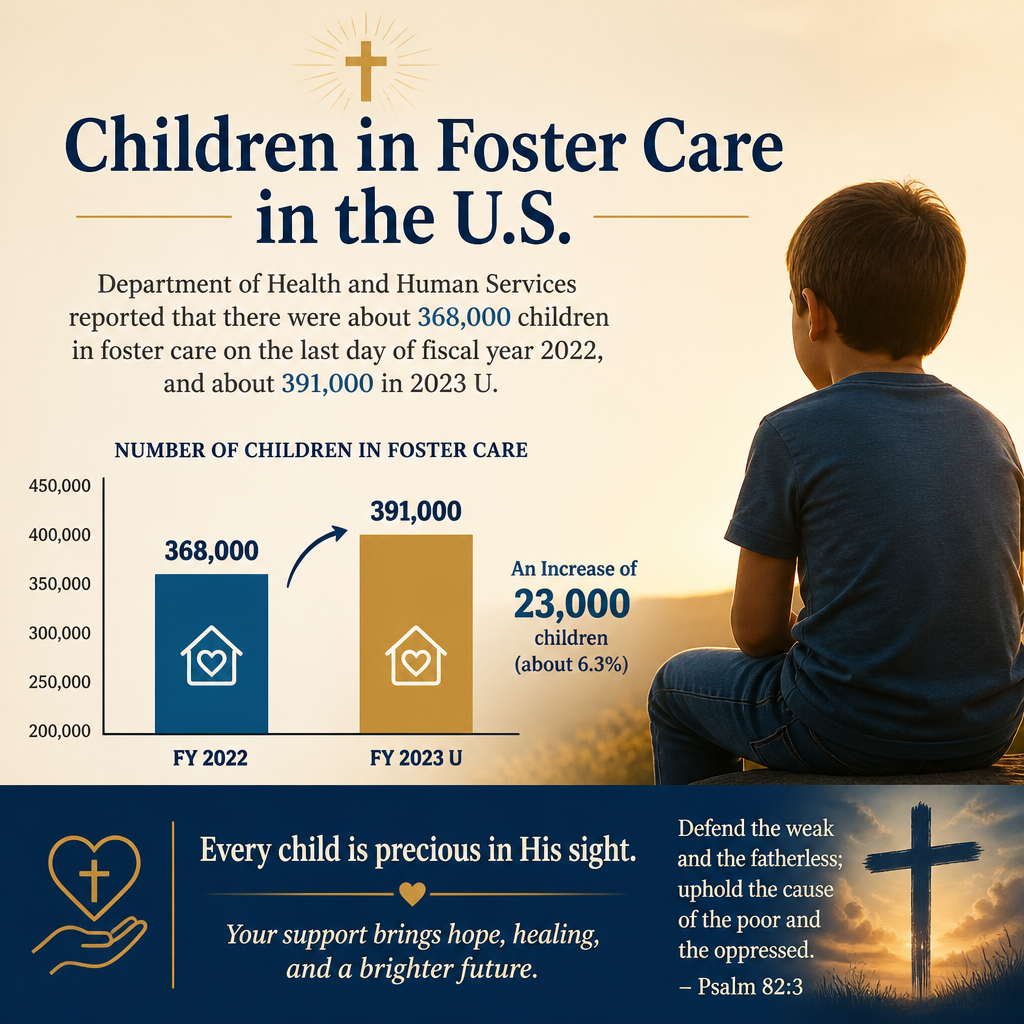
Verifiable evidence suggests the scale of need is not small. The U.S. Department of Health and Human Services reported that there were about 368,000 children in foster care on the last day of fiscal year 2022, and about 391,000 in 2023 U.S. Administration for Children and Families. For Christian donors, that number is not merely a statistic; it is a reminder that orphan care is not primarily “over there.” It is on our streets, in our schools, and in our county courts.
Training is part of love’s moral seriousness
Love without competence can become its own form of presumption. Foster parents face children whose bodies and brains have adapted to threat: hypervigilance, food insecurity behaviors, aggression, dissociation, and attachment disruptions. Ministries that treat foster care as an extension of ordinary parenting can set families up for failure—and set children up for another rupture.
This is one reason ministries historically focused on adoption and international orphan care increasingly invest in foster care training. They have seen that a willing home is not the same as a prepared home, and that preparation is not optional when a child’s history includes trauma.

Training reduces placement disruption and protects children from avoidable harm
Few outcomes are more devastating for a child in foster care than a placement disruption. Each move can reinforce the child’s internal narrative that adults do not stay, rules are unpredictable, and trust is dangerous. Ministries that support foster care training are often attempting to reduce these harms by strengthening caregivers before a crisis arrives.
Trauma-informed care is not therapeutic branding
“Trauma-informed” can become a slogan, but the underlying reality is concrete. The American Academy of Pediatrics has documented how early adversity can alter neurodevelopment and increase long-term health risks American Academy of Pediatrics. Effective training helps parents interpret behaviors as adaptive responses to prior environments rather than as mere defiance, which changes discipline, expectations, and the emotional climate of the home.
Training also helps foster parents understand the roles of caseworkers, therapists, guardians ad litem, and judges, reducing the confusion that often intensifies stress. It is difficult to persevere in love when caregivers feel perpetually surprised and unsupported.
Church-based support must be organized, not improvised
Many donors assume a church can “wrap around” a foster family simply through goodwill. Some churches do this well, but many do not, and the gap is often structural. Meals, childcare, transportation to visits, court-day coverage, and respite care require coordination, background checks, and clarity about boundaries. Ministries that offer training frequently include training for the broader support network, not only for the foster parents.
For donors discerning where to give, it is worth paying attention to whether a ministry’s training is connected to measurable supports: retention of foster families, reduced burnout, and durable partnerships with local agencies. Vague promises of “support” are easy to fund and hard to evaluate.
Foster care training is a stewardship issue for donors who want durable outcomes
Christian donors tend to be generous when the need is vivid and immediate. Foster care is often neither. It is slow, heavily documented, and frequently heartbreaking. Yet this is precisely why training matters: it is an upstream investment that makes downstream ministry more effective, less wasteful, and less prone to crisis-driven spending.
Training is cheaper than collapse
When a foster placement disrupts, the costs are real: emergency placements, increased casework, heightened school instability, and sometimes hospitalization or juvenile justice involvement. Ministries cannot control every outcome, but training can reduce preventable failure by equipping families to recognize warning signs early and to access appropriate services.
Donors also need to recognize a tension: training that is genuinely rigorous takes time, staff capacity, and often professional expertise. It will not always look “efficient” on a simplistic overhead ratio. The widely endorsed “Overhead Myth” statement argues that overhead metrics alone do not measure performance and can pressure nonprofits into underinvesting in the very systems that make outcomes possible Candid GuideStar.
Verification helps donors distinguish seriousness from sentiment
Many organizations claim to support foster families; fewer can show credible evidence that their interventions are coherent, accountable, and sustainable. This is where Most Trusted’s work is often most useful to donors. We evaluate Christian nonprofits against The Most Trusted Standard, a 15-criteria framework that assesses Faith Foundation, Financial Integrity, Governance and Leadership, and Transparency and Effectiveness.
What this means in practice is that a ministry’s foster care training is not evaluated only by the quality of its curriculum. It is also evaluated by the integrity of its financial reporting, the strength of its board oversight, the clarity of its safeguarding practices, and the honesty with which it represents outcomes and limits. For donors who want to give with confidence, those factors are not secondary; they are the conditions that protect both children and the witness of the church.
Orphan care ministries bring distinctive strengths to foster care training
Not every orphan care ministry should pivot into foster care. The needs are specific, and the legal context is demanding. Yet many orphan care ministries are well-positioned to support foster care training because they already possess competencies that translate: family support, trauma awareness, recruitment of volunteers, and spiritual care that does not confuse faith with denial.
The theology of adoption shapes endurance without romanticizing pain
Christian theology speaks of adoption as a central metaphor for salvation (Romans 8:15). That language can be mishandled if it pressures foster families to “save” children or implies that every story ends in adoption. But when held with maturity, it creates a framework for endurance: God does not welcome us because we are easy; he welcomes us because he is faithful.
Training grounded in that theology can help foster parents resist two distortions at once: treating children as ministry projects, and treating foster care as purely secular social work. The calling is neither heroism nor bureaucracy. It is faithful, lawful, patient love, exercised under scrutiny and for the good of a child.
Experienced ministries understand the ethics of helping
The broader orphan care movement has had to reckon with unintended consequences, particularly in international contexts where institutional care can be financially incentivized. The lesson is not cynicism; it is moral clarity. The When Helping Hurts framework, articulated by Steve Corbett and Brian Fikkert, has influenced many ministries by emphasizing that help can harm when it undermines dignity, local agency, or long-term flourishing When Helping Hurts.
That same ethical sobriety is needed in foster care. Birth families are not abstractions; many are living parents in crisis. Christians genuinely disagree about how strongly ministries should emphasize reunification versus adoption, and the foster system itself holds both as legal aims under different conditions. Training that respects these tensions—rather than turning them into slogans—tends to produce families who can serve without being shattered by ambiguity.
What donors should look for when funding foster care training through orphan care ministries
Because foster care work carries spiritual and reputational stakes, donors should apply a higher standard of diligence, not a lower one. It is possible to fund programs that sound compassionate but create instability for children or unsustainable burdens for families. Wise giving asks whether a ministry’s training is integrated into accountable practice.
Signals of credibility and child-centered design
The following indicators are not exhaustive, but they are concrete signals that training is likely to be more than a hopeful workshop:
- Formal partnerships with county or state agencies, or clear alignment with licensing requirements.
- Trauma-informed curriculum that addresses attachment, behavior, and caregiver regulation, not only rules and paperwork.
- Clear safeguarding policies for respite care, mentoring, and volunteer involvement.
- Ongoing coaching or peer support beyond initial training, especially through the first placement.
- Transparent outcome claims that distinguish stories from evidence and acknowledge limits.
How to connect foster care training to the broader orphan care landscape
Training is one part of a larger ecosystem that includes adoption support, family preservation, kinship care, and post-placement services. Donors who want to understand how ministries situate foster care within that wider calling can begin with Orphan Care Ministries, where the theological mandate and programmatic complexity belong in the same frame.
For donors who are comparing organizations working across adoption and foster care, Orphan Care Ministries in Adoption and Foster Care is a useful place to see how different models relate to one another and what signals of integrity tend to persist across contexts.
FAQs for Why orphan care ministries support foster care training
Does funding foster care training distract from adoption and international orphan care?
It can, if a ministry treats foster care as a rebranding exercise rather than as a distinct calling requiring competence and partnerships. But in many communities, foster care training is a direct extension of orphan care’s core concern: children need stable families. International work still matters in many settings, yet the orphan care movement has increasingly recognized that family-based care and family preservation are often more protective than institutional models. Donors can fund both, but should expect clarity about how each program serves child well-being and avoids perverse incentives.
What outcomes should donors reasonably expect from a foster care training program?
Training programs should rarely promise dramatic system-wide change. More credible outcomes are modest and measurable: more licensed foster families, stronger retention over time, reduced caregiver burnout, improved support network engagement, and evidence that families remain stable through crises. Donors should also expect honesty about what training cannot control, including court decisions, birth family circumstances, and the complex mental health needs some children carry into care.
Funding training is funding faithfulness over time
Orphan care ministries support foster care training because compassion without preparation can become another source of instability for children who have already known too much loss. For Christian donors, the opportunity is not merely to sponsor a moment of rescue, but to underwrite the slow work of faithful presence—care that is competent, accountable, and shaped by the God who sets the lonely in families.



