
How donors can deduct orphan care ministry gifts on taxes is not merely an administrative question; it is part of Christian stewardship. When we give to protect children and strengthen families, we should also handle documentation with integrity so that our generosity is both faithful and orderly. Scripture commends both: “Let all things be done decently and in order” (1 Corinthians 14:40).
Tax deductibility will never be the moral basis for giving. Yet for many Christian donors, it affects capacity: larger gifts, multi-year commitments, and the ability to sustain support when economic pressure rises. The aim is not to spiritualize the tax code, but to approach it with clarity, obeying governing authorities (Romans 13:1) while refusing shortcuts that erode trust.
1. Start with the basic rule and do not assume it applies
Deductibility depends on the recipient and the type of gift
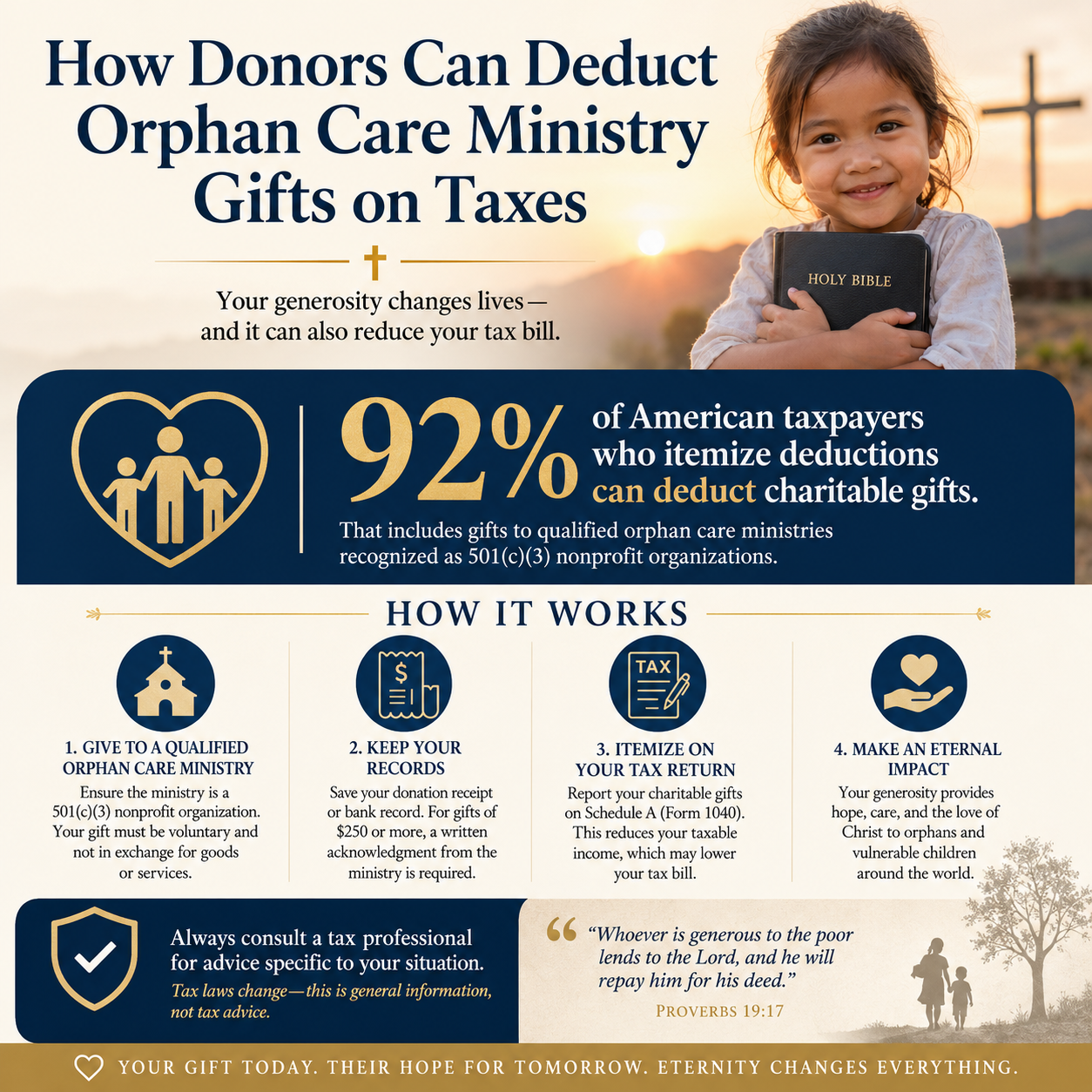
In the United States, most donors can deduct charitable gifts only when they itemize deductions and only when the recipient is recognized by the IRS as an eligible charity. Practically, that usually means a 501(c)(3) public charity, though some other entities qualify. The IRS is explicit: charitable contribution deductions are allowed only for gifts to “qualified organizations.” IRS charitable contribution deductions
Many orphan care efforts are carried out through churches, mission agencies, and nonprofit ministries. Some are fiscally sponsored projects under another nonprofit. Some are informal efforts led by a family or small group. The spiritual worth of an effort is not the same thing as tax deductibility. Christian donors routinely support both kinds of work, but only some gifts will be deductible.
Itemizing is the hidden gatekeeper for many households
Since the Tax Cuts and Jobs Act increased the standard deduction, many households no longer itemize, which means charitable gifts may not reduce federal income taxes in a given year. The IRS describes the current standard deduction amounts and rules for itemizing. IRS Topic no 551 standard deduction
What this means in practice is that the most common “why didn’t my donation lower my taxes?” problem is not a receipt problem. It is that the donor claimed the standard deduction. For donors who give meaningfully and consistently, strategies like bunching multiple years of giving into one year may be appropriate, but those decisions should be made with a qualified tax professional.
2. Treat the donation receipt as a stewardship document
What the IRS expects you to keep
The IRS requires a bank record or written communication from the charity for any cash contribution, regardless of amount, and it requires additional written acknowledgment for larger gifts. These requirements are not optional, and they apply even when a donor is certain the gift was made. IRS Publication 526 charitable contributions
For many orphan care donors, the most important habit is simple: store receipts and acknowledgments in the same place you store year-end giving statements. Good ministries help donors do this well, but the responsibility ultimately rests with the donor.
Quid pro quo and the meaning of no goods or services
If a donor receives something of value in return for a gift, only the amount above that value is deductible. This is why acknowledgments often state that “no goods or services were provided” or describe the value of benefits received. Orphan care contexts can create gray areas: gala dinners, donor banquets, benefit concerts, and certain “sponsorship” packages. Treat those communications carefully and do not assume the full amount is deductible. The IRS addresses quid pro quo contributions in its guidance for donors. IRS quid pro quo contributions
Christians genuinely disagree about how much donor experience is appropriate in ministry fundraising. We have found that the most credible ministries keep donor benefits modest and clearly valued, precisely because they want donors to give freely rather than purchase proximity.
3. Understand the gift types that commonly arise in orphan care
Cash and recurring gifts
Most orphan care ministry giving is straightforward cash giving: checks, online gifts, ACH, and credit card donations. Keep the year-end statement, and for any single gift of $250 or more, ensure the ministry provides a contemporaneous written acknowledgment. If you give through donor-advised funds or through a foundation, your receipt comes from the sponsoring organization, not from the ministry receiving the grant.
Across our verification work at Most Trusted, we observe that ministries that meet The Most Trusted Standard tend to have consistent receipting practices: prompt acknowledgments, accurate language about goods and services, and year-end summaries that reconcile cleanly to donor records. Those practices are not flashy, but they are one of the quiet marks of financial integrity.
Noncash gifts, vehicles, and complex property
Some donors support orphan care through stock, cryptocurrency, vehicles, real estate, or in-kind goods. The tax rules vary substantially by asset type and value, and the documentation requirements increase quickly. The IRS provides detailed rules for noncash charitable contributions, including when Form 8283 is required and when a qualified appraisal is needed. IRS Publication 561 determining the value of donated property
For orphan care ministries, noncash gifts can be a blessing and a burden. Donors should not assume a ministry is equipped to accept every asset class. A wise donor asks in advance, confirms how the gift will be used, and ensures the ministry’s acceptance policy is clear.
Sponsored children and restricted giving
Child sponsorship is common in global orphan care and vulnerable children programs. Many programs are structured so that donors give to a general fund that supports a broader set of services for children and families, even if donors receive updates about a particular child. That distinction matters: donors generally cannot claim a deduction for gifts that are earmarked for the benefit of a specific individual. The IRS addresses this principle in its guidance on charitable contributions and qualified organizations. IRS charitable contributions overview
Some donors dislike the idea that their “sponsorship” does not function as a direct transfer to one child. The harder question is whether the ministry’s model is honest about that reality and whether its communications respect donor intent without implying tax-deductible gifts are personal support.
4. Avoid common deduction mistakes in orphan care giving
Do not treat personal expenses as charitable gifts
Orphan care donors often travel: to visit partner programs, meet ministry leadership, attend adoption-related trips, or participate in short-term service. Some expenses related to volunteer service may be deductible in limited circumstances, but personal travel mixed with charitable activity is a frequent source of confusion, and adoption expenses are governed by separate rules. Donors should be cautious and get professional advice before claiming travel-related deductions.
We recommend a simple boundary: if you control the spending and it primarily benefits you or your family, do not try to convert it into a charitable contribution. Christians can give sacrificially without needing every sacrifice to be deductible.
Keep a clear line between gifts to people and gifts to qualified ministries
Many faithful Christians give directly to families in crisis: rent, groceries, school fees, emergency medical needs. That may be a work of mercy, and in some cases it is precisely what love of neighbor requires. But it is typically not a charitable contribution for federal tax purposes unless the gift is made to a qualified organization that controls the funds and uses them for charitable purposes.
The field has had to reckon with real fraud in compassionate giving appeals, especially online. Tax deductibility is not the ultimate test, but it often forces a practical question: who is accountable for the money once it leaves the donor’s hands?
A short checklist for year-end readiness
- Confirm the recipient is a qualified organization before you give, especially for new or overseas partners.
- Store receipts and acknowledgments with your tax records, not only in email.
- For any gift tied to an event, keep the statement that values any benefits you received.
- For noncash gifts, ask early what documentation the ministry can provide and what you must obtain.
- For sponsorship programs, ensure the ministry retains discretion and control over how funds are used.
As donors deepen their involvement in Orphan Care Ministries, these habits reduce anxiety and prevent avoidable disputes at tax time. They also signal respect for the ministries we support by reducing back-and-forth requests months after a gift has been processed.
5. Give with confidence by verifying ministry integrity, not only tax status
Tax deductibility is a threshold, not a measure of trust
A ministry can be tax-deductible and still be poorly governed, financially opaque, or ineffective. Orphan care donors know this at an intuitive level because the work is emotionally charged and easily marketed. The stories are real, but the incentives can be misaligned: institutional care can be funded because it photographs well, even when family-based care is better for children.
Verification work cannot replace discernment, prayer, and pastoral counsel, but it can help donors distinguish between sentimental appeal and accountable practice. At Most Trusted, we evaluate Christian nonprofits against The Most Trusted Standard, a 15-criteria framework across four domains: Faith Foundation, Financial Integrity, Governance and Leadership, and Transparency and Effectiveness. Our interest is not to police generosity but to protect it, so that the vulnerable are not harmed by sloppy systems or manipulative fundraising.
What to look for when receipts are late or unclear
Receipting problems are sometimes mundane: staff turnover, accounting software changes, or a small finance team. But patterns matter. When a ministry repeatedly cannot produce clear acknowledgments, refuses to clarify quid pro quo benefits, or pressures donors to claim deductions for gifts that appear personal, donors should slow down and ask harder questions.
We recommend that donors see tax documentation as a window into a ministry’s overall discipline. Ministries that are faithful in “little things” such as accurate receipts are often faithful in larger matters such as safeguarding, conflict-of-interest management, and truthful reporting—areas that directly affect children and families.
For more on donor documentation and best practices, our coverage of Tax Receipts and Stewardship for Orphan Care Donors addresses the recurring scenarios Christian givers encounter across churches, mission agencies, and specialized child welfare ministries.
FAQs for How donors can deduct orphan care ministry gifts on taxes
Can we deduct a gift if we give directly to an individual child or a family we know?
Generally, no. Gifts to individuals are usually not deductible as charitable contributions, even when the need is real and the giving is morally serious. For a deduction, the gift typically must be made to a qualified organization that retains discretion and control over how funds are used for charitable purposes. When in doubt, confirm the organization’s status and consult a qualified tax professional.
What documentation do we need for larger orphan care gifts?
For cash gifts, donors should keep a bank record or written communication for every contribution, and for any single contribution of $250 or more, the IRS requires a contemporaneous written acknowledgment from the charity. For noncash gifts, additional forms and, at higher values, qualified appraisals may be required. The safest approach is to request the ministry’s receipting language promptly and store it with year-end statements.
Stewardship that honors both generosity and truth
Orphan care giving is an expression of God’s heart for the fatherless, but it is also a form of stewardship that requires precision. When donors understand what is deductible, keep appropriate records, and insist on truthful communications, they protect the integrity of their own giving and the credibility of the ministries they support. That combination—compassion anchored to accountability—is one of the most practical ways Christian donors can honor the children they seek to serve.



