

What financial audits military outreach ministries should complete is not a technical question for accountants alone. For Christian donors, it is a question of stewardship, truthfulness, and neighbor-love toward service members and families whose trust is hard-won and easily betrayed.
Military communities live with a distinct blend of sacrifice and discretion. Many ministries that serve them also carry unusual operating risks: overseas activity, restricted-access bases, chaplain partnerships, counseling and crisis response, and frequent use of volunteers. Audits and related reviews are not a spiritual substitute for integrity, but they are a disciplined way to make integrity verifiable. Scripture treats weights and measures as moral realities, not administrative details: “A false balance is an abomination to the LORD, but a just weight is his delight” (Prov. 11:1). Financial oversight is one ordinary way ministries pursue “just weights.”
Why military outreach creates distinctive audit expectations
Most nonprofits should have orderly books, sober board oversight, and public-facing transparency. Military outreach adds pressure points that donors should name without suspicion: donor-restricted gifts for care packages and emergency aid, support raised for deployed chaplains or embedded teams, ministry events on or near installations, and pastoral care where confidentiality is essential but financial opacity is not.
Across our verification work at Most Trusted, the ministries that most consistently earn donor confidence do not treat oversight as an adversarial imposition. They treat it as a form of discipleship in stewardship: clear authority, documented decisions, and independent review where independence actually exists.
High-trust mission fields require high-verifiability practices
Christians genuinely disagree about how much “administration” is too much. Some fear that audits divert funds from frontline care. The harder question is whether a ministry can credibly claim to protect service members while leaving basic financial controls to informal trust. In a high-trust mission field, the cost of failure is borne by families already carrying enough.
Audit scope must match operational reality
Not every ministry needs the same level of assurance each year, but every ministry should have a rational, written basis for the level it chooses. If a ministry is handling large volumes of restricted gifts, running significant events, maintaining inventory, or moving money overseas, donors should expect more than internally prepared statements.

The baseline: an independent financial statement audit and what it should cover
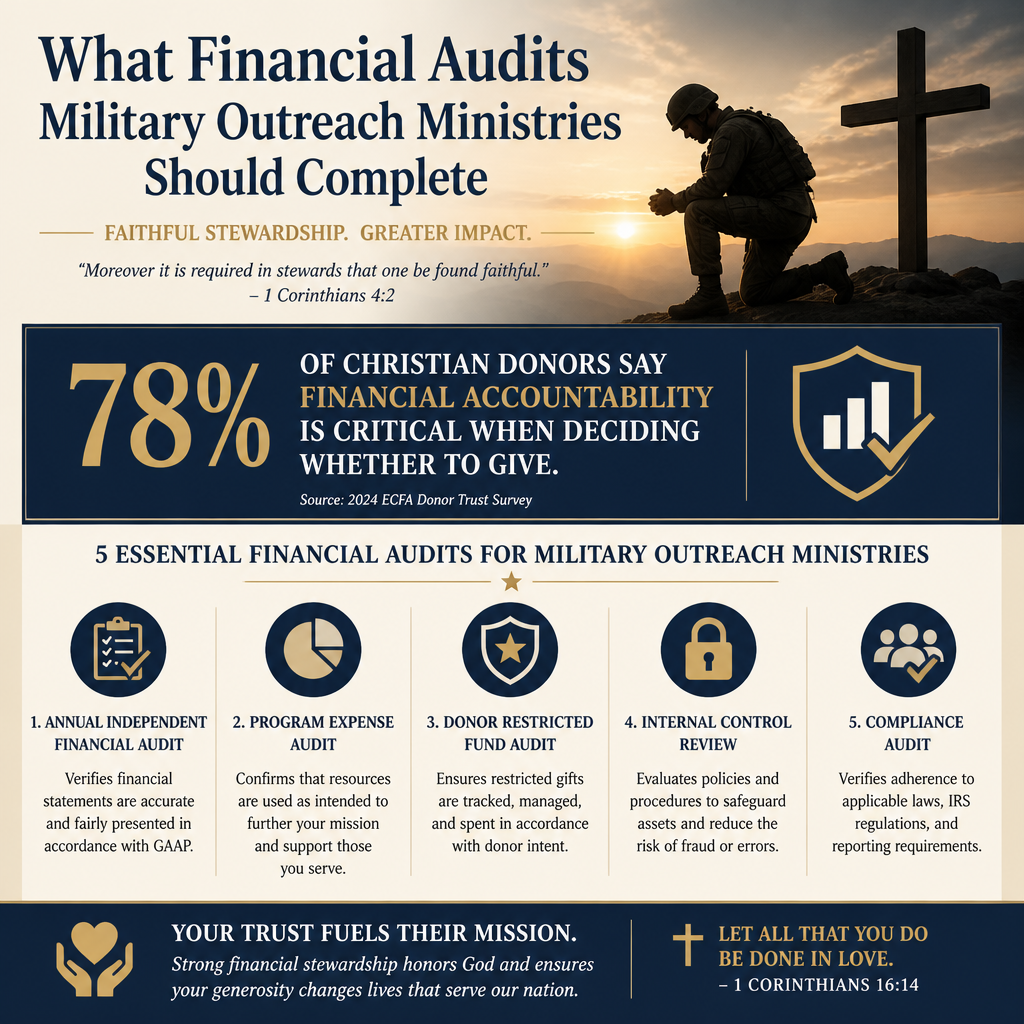
For established military outreach ministries of meaningful scale, an annual independent financial statement audit is the baseline we recommend. This is the familiar “audit” most donors mean: an external CPA firm examines the organization’s financial statements and internal controls and issues an opinion.
For donors, the central value of an audit is not the paper itself. It is the disciplined process: reconciled accounts, documented restrictions, tested samples of transactions, and accountability for management’s representations.
What donors should look for in the audit report
Ask for the audited financial statements and the auditor’s opinion letter. A clean, “unmodified” opinion is generally the goal. If the opinion is qualified or adverse, or if there is a “going concern” warning, donors should not panic reflexively, but they should ask direct questions and expect direct answers about the underlying causes and the corrective plan.
Single Audit for ministries spending federal funds
Some military-facing ministries receive federal funds, directly or indirectly, through grants or subawards. In that case, the question may shift from “Should there be an audit?” to “Is a Single Audit required?” Under the Uniform Guidance, a non-federal entity that expends $750,000 or more in federal awards in a fiscal year must have a Single Audit. See the threshold and requirements in the federal regulation at eCFR.
For donors, a Single Audit is not a badge of virtue; it is a compliance necessity with real rigor. If a ministry crosses the threshold and does not complete it, that is a serious governance failure.
Beyond the audit opinion: internal control findings, fraud risk, and the management letter
Many of the most consequential issues never show up as a dramatic restatement. They appear as internal control weaknesses: poor segregation of duties, inconsistent approval pathways, or informal “workarounds” that feel efficient until they become costly.
Donors should ask whether the ministry receives a management letter (sometimes called a letter of recommendations) and whether the board reviews it. The management letter is often where the auditor documents control deficiencies and practical steps to strengthen them.
Material weaknesses and significant deficiencies should be board-level issues
Not every finding indicates dishonesty. Small ministries sometimes have real constraints: limited staff, volunteer bookkeepers, or rapid growth after a deployment-related surge in giving. Yet the board must treat control findings as governance work, not staff inconvenience. A credible ministry can name its constraints and still show a time-bound plan to address them.
Fraud risk is not solved by trust
Military outreach often inspires intense donor loyalty and a “family” ethos, which can unintentionally weaken skepticism. The ministry most at risk is not always the one with bad theology. It can be the one that assumes shared faith removes the need for controls. Scripture’s warnings about temptation and partiality assume the opposite.
When donors ask about fraud prevention, the ministry should be able to describe controls in plain language: who approves expenses, how reimbursements are documented, how restricted gifts are tracked, and how conflicts of interest are disclosed and handled. This is part of the accountability donors expect within Accountability and Transparency in Military Outreach Ministries.
Restricted gifts, designated funds, and program-specific accountability
Military outreach relies heavily on restricted gifts: donors give for care packages, emergency travel, counseling scholarships, memorial events, or specific base outreaches. Restricted giving is a trust contract. When a ministry blurs restrictions into general operations, it damages more than donor confidence; it damages witness.
Audit testing should address donor restrictions
Donors should expect the audit to include testing around net assets with donor restrictions and the release of restrictions. The ministry should be able to explain how it codes restricted gifts, how it documents donor intent, and how it approves exceptions when a restricted purpose becomes impracticable.
Program audits and agreed-upon procedures can serve targeted concerns
Not every question requires a full-scope additional audit. For discrete, high-sensitivity areas—such as inventory distribution for care packages, camp scholarships for military children, or emergency assistance funds—an agreed-upon procedures engagement can provide narrower assurance. The key is that the scope is written, the procedures are clear, and the report is available to appropriate stakeholders.
This is where donors should resist simplistic overhead thinking. The so-called “Overhead Myth” letter, signed by Charity Navigator, GuideStar, and BBB Wise Giving Alliance, clarified that administrative ratios are a poor proxy for impact and integrity. The letter is publicly available via Charity Navigator. Controls cost something; failures cost far more.
- Restricted gift tracking: clear coding, documentation of donor intent, and timely releases
- Expense approvals: thresholds, dual authorization, and documented exceptions
- Reimbursements: receipts, business purpose, and independent review
- Cash handling: event controls, deposit logs, and reconciliations
- Inventory controls: counts, custody, and distribution documentation
Overseas operations, cybersecurity, and privacy constraints donors should not ignore
Many military outreach ministries operate overseas or support deployed contexts. Cross-border activity raises compliance and control issues that are easy to underestimate: currency exchange, local vendors, documentation standards, and heightened fraud risk in cash-based environments.
Know the difference between discretion and secrecy
Some ministry details should not be broadcast publicly, especially where service member safety or host-country sensitivity is involved. But financial reporting can be transparent without exposing operational specifics. Mature ministries separate what must remain confidential from what must remain accountable: who holds authority, what controls exist, what totals were spent, and what independent review was performed.
Consider additional assurance for technology and donor data
Financial audits are not cybersecurity audits. Yet donor confidence increasingly depends on how ministries protect donor data and payment systems. A ministry may not need a formal SOC 2 report, but it should be able to describe basic safeguards: access controls, vendor due diligence, and incident response planning. Donors can reasonably ask whether the ministry has ever experienced a data breach and, if so, how it responded.
For broader context on the mission field and its complexities, we track patterns across Military Outreach Ministries, including the governance and financial practices that tend to sustain trust over time.
How audits fit within The Most Trusted Standard and what donors should ask next
Audits are necessary, but they are not sufficient. A ministry can pass an audit and still have governance problems, theological confusion, or ineffective programs. The Most Trusted Standard evaluates ministries across 15 criteria that address faith commitments, financial integrity, governance, and public accountability. For donors, this is the difference between “no red flags found” and “a coherent, verifiable pattern of trustworthiness.”
Questions donors should ask a military outreach ministry
Audits become meaningful when donors ask for the evidence that responsible boards routinely review. These questions are not hostile; they are the ordinary work of stewardship:
- Do you have an annual independent audit, and will you share the audited financial statements?
- Did the auditor report any material weaknesses or significant deficiencies, and what did the board do about them?
- How do you track and honor donor restrictions for designated military programs and assistance?
- Do you have a conflict of interest policy with annual disclosures for board and key staff?
- If you handle federal funds, have you completed a Single Audit when required?
What thoughtful donors should not demand
Some donors treat an audit as a weapon: a way to pressure ministries into publishing confidential details or into under-investing in finance staff. That posture misunderstands both accountability and ministry. The goal is not exposure; the goal is faithful administration. A ministry that serves military families may need to limit identifying details, but it should not limit verifiable financial oversight.
FAQs for What financial audits military outreach ministries should complete
Does every military outreach ministry need a full audit every year?
No. Smaller ministries may begin with reviewed financial statements and strong internal controls, moving toward an audit as revenue, complexity, and restricted giving increase. What donors should insist on is a rationale that matches operational risk, plus independent oversight that is not merely internal trust.
What is the most common audit-related issue donors should watch for?
In our observation, the recurring issue is not dramatic embezzlement but weak internal controls that invite it: unclear approval authority, poor segregation of duties, and informal handling of restricted gifts. Donors should ask whether the board receives and acts on auditor recommendations, not merely whether an audit exists.
Stewardship that can be examined
Military outreach ministries often carry a sacred trust: they stand near men and women who have pledged their lives for others, and they minister within a culture that values honor. Donors should expect financial practices that reflect the same seriousness. The right audits and related reviews do not guarantee faithfulness, but they make faithfulness testable, and they protect both the ministry’s witness and the people it serves.



