
Donor privacy policies military outreach ministries should follow are not a matter of administrative neatness; they are a matter of neighbor-love under conditions of unusual risk. A gift to a chaplaincy program, a Bible distribution on base, or a family support initiative can expose donors and recipients alike if names, addresses, giving history, or affiliations are mishandled. The Christian donor’s question is therefore twofold: is this ministry faithful with the resources entrusted to it, and is it faithful with the people those resources implicate?
Military contexts intensify what is already true of Christian giving: personal information is power. Scripture’s insistence that love “does not rejoice at wrongdoing, but rejoices with the truth” (1 Corinthians 13:6) does not only govern speech; it also governs institutional conduct. Truthfulness includes describing how data is collected, stored, used, and shared, and it includes declining to do what is technically legal but pastorally unwise.
Why donor privacy is uniquely sensitive in military outreach
Personal data can become operational risk
Many nonprofits treat donor privacy as a reputational issue. Military outreach ministries must also treat it as a security issue. A donor list tied to a base chapel initiative, a deployed unit care package program, or counseling support for spouses can become a map of relationships. In some environments, that map is actionable for bad actors.
The U.S. Department of Defense has repeatedly warned that data aggregation and location-enabled information can be exploited to identify service members and patterns of life, particularly through brokers and third-party data ecosystems. The underlying point for donors is straightforward: a ministry’s “helpful” integrations can quietly expand the attack surface. See the Department of Defense’s public guidance on data and operational security at Department of Defense.
Small ministries often inherit big-tech assumptions
Across our verification work at Most Trusted, we observe that many ministries adopt default settings in donor management systems, email platforms, and analytics tools without understanding what those defaults permit. A standard “sync to ads” option, a convenience feature for text-to-give, or an embedded social media pixel can place donor identities into ecosystems built for monetization rather than pastoral discretion.
What this means in practice is that a ministry can keep its promises in spirit while breaking them in fact. The donor sees “we do not share your information,” but the infrastructure does share—through vendors, tracking, or permissive contracts.

Core commitments every donor privacy policy should state plainly
Define what you collect and why
A credible privacy policy begins with concrete inventory. “We may collect information” is too vague to be trustworthy. Ministries should name categories: contact information, giving history, payment data, event registrations, prayer requests, correspondence, and any sensitive notes. They should also explain the purpose for each category: receipting, compliance, donor communication, fraud prevention, or relationship stewardship.
Christian donors are not asking for legal perfection. They are asking for moral clarity. When a ministry collects a birthdate, employer information, or a spouse’s name, the policy should say whether it is required, optional, or inferred from other sources.
State a no-sale, no-rent posture and define sharing narrowly
At minimum, donor privacy policies should include an unambiguous commitment not to sell or rent donor information. Many readers assume this is standard; it is not. The policy also needs a disciplined definition of “sharing.” It should distinguish between (a) service providers acting under contract and (b) disclosure to other organizations for their independent use.
In the military outreach field, we recommend policies that default to non-disclosure even within the broader Christian ecosystem. Partnering is often good; transferring donor lists is rarely necessary.
Include an explicit statement about anonymity and honor requests reliably
Some donors give to military outreach because they have personal ties to units or installations and prefer not to be publicly linked. Others have professional or church leadership roles where discretion is wise. A policy should state how donors can give anonymously, whether gifts can be designated anonymously, and whether recognition practices are opt-in rather than opt-out.
Donor intent and donor privacy are not identical, but they are related. Both are questions of fidelity with what has been entrusted.
Data governance practices donors should expect behind the policy
Access controls, retention limits, and real accountability
A privacy policy without governance is a brochure. Mature ministries describe who can access donor data, how access is granted and removed, and how long information is retained. They also name the accountable role—often an operations director, finance leader, or executive—who ensures the policy is actually followed.
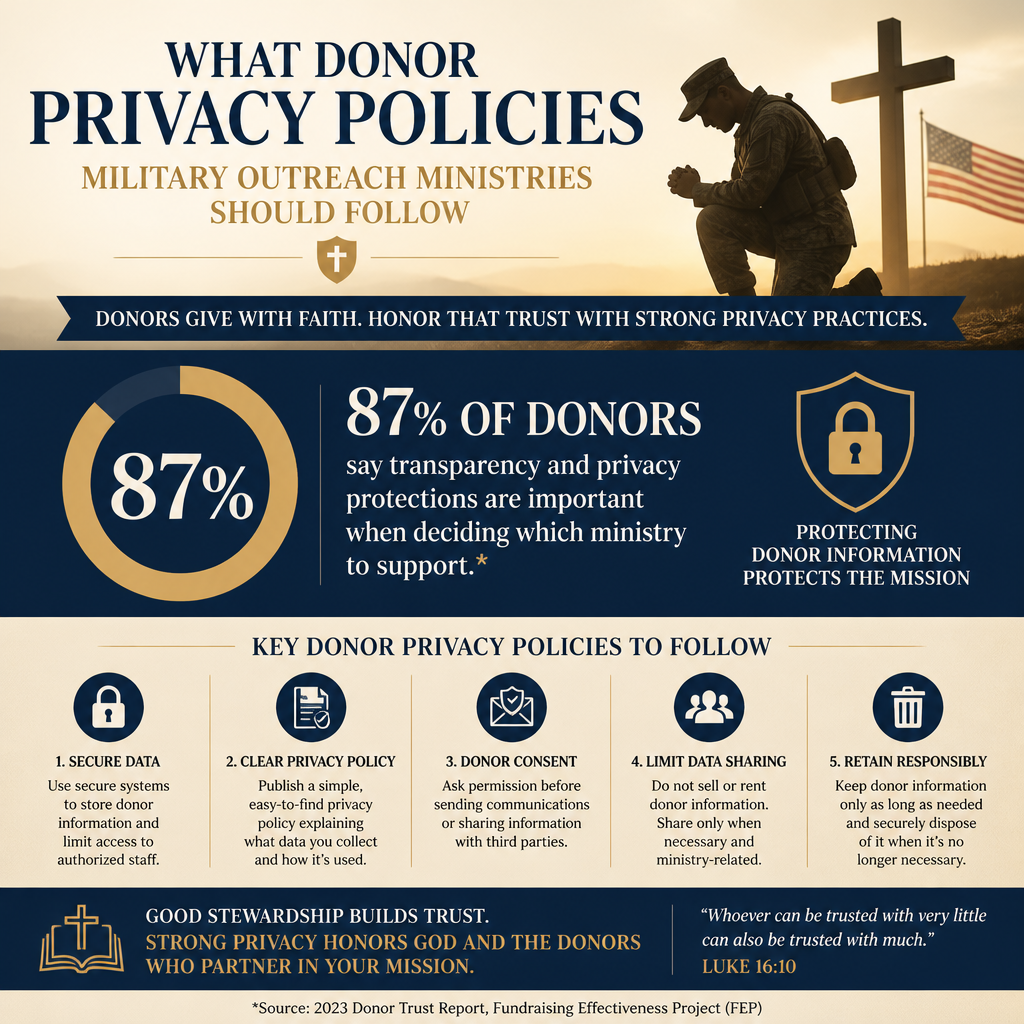
For ministries evaluated against The Most Trusted Standard, we look for governance that treats donor data as a stewardship asset, not merely an administrative byproduct. That typically includes documented procedures for onboarding/offboarding staff, periodic access reviews, and retention practices that are stricter for sensitive data than for general communications history.
Vendor management is part of ministry integrity
Most donor data risk comes through vendors: donor management systems, payment processors, email platforms, texting tools, and analytics. A ministry’s policy should name categories of vendors and should state that vendors are required to protect information, use it only for contracted purposes, and notify the ministry promptly of any breach.
The harder question is whether the ministry understands what vendors do with metadata and whether data can be used for their own product development or aggregated benchmarking. Donors should not need a law degree to see the answer. Transparency is a moral practice before it is a compliance practice.
Security controls should be described at the right level
Ministries should not publish a technical blueprint that invites attack. But donors are right to ask for a plain-language description of baseline controls: encryption for stored and transmitted payment data, multi-factor authentication for administrative access, limited permissions, and staff training for phishing and social engineering.
For a sense of widely recognized baseline controls that can be adapted to nonprofit environments, the National Institute of Standards and Technology provides accessible frameworks at NIST. Ministries do not need to be enterprise-scale to benefit from enterprise-grade principles.
Communication practices that respect donors and protect service members
Separate fundraising from storytelling consent
Military outreach ministries often rely on compelling stories: conversions, reconciled marriages, relief in grief, courage in trauma, and renewed hope. But stories can also become identifiers. A policy should clarify whether donor communications data is ever combined with ministry impact narratives, and it should separate donor data from program participant data.
Donors should expect clear consent practices for any photography, video, or testimonials connected to service members and families. Even when a participant is willing, the ministry must consider whether the story could harm a career, a unit’s cohesion, or a family’s privacy. Legal releases are not the same as wise pastoral care.
Limit political profiling and sensitive inferences
Some outreach organizations operate near policy debates: religious liberty, chaplain access, and culture-war flashpoints. Donors should be wary of ministries that segment lists based on inferred political identity or sensitive traits. This is not merely an etiquette concern. It increases the cost of a future breach and can introduce manipulative fundraising practices.
The Federal Trade Commission has warned that data broker ecosystems can expose sensitive information and create downstream harms. Donors who care about ministry integrity should read the FTC’s consumer-oriented material at Federal Trade Commission.
A simple checklist donors can use when reading a privacy policy
- Does the ministry explicitly say it will not sell or rent donor information?
- Does it define “sharing” and name the kinds of vendors that receive data?
- Does it explain how donors can opt out of communications and data uses?
- Does it describe retention and deletion practices in plain language?
- Does it distinguish donor data from program participant data and stories?
How privacy fits within transparency and verifiable trust
Transparency does not mean exposure
Christian donors rightly ask for transparency: clear financials, honest outcomes, accountable leadership, and truthful communications. But transparency is not identical to disclosure of personal information. A ministry can be financially transparent while being discreet about identities. In military outreach, discretion is often part of the ministry’s duty of care.
We encourage donors to read privacy practices alongside broader governance signals, including board oversight, conflict-of-interest management, and financial reporting. The category of Accountability and Transparency in Military Outreach Ministries exists because donors need more than reassuring language; they need patterns that can be verified.
Questions to ask when a ministry’s policy is thin
Many smaller ministries do excellent pastoral work with limited administrative capacity. That reality deserves respect, not cynicism. Yet donors still bear responsibility for prudent stewardship. When a privacy policy is generic or copied, donors can ask direct questions:
Who has access to donor data? Which systems store it? Do any tools place tracking pixels in emails? Are donor lists ever exchanged with partner organizations? How quickly would donors be notified if a breach occurred?
The ministries that meet The Most Trusted Standard tend to treat these questions as normal accountability rather than as suspicion. Trustworthy ministries understand that donors are not trying to control; they are trying to give faithfully.
Most Trusted’s role in donor confidence
Most Trusted exists to help Christian donors give with confidence by evaluating ministries against The Most Trusted Standard, a 15-criteria framework spanning faith commitments, financial integrity, governance, and transparent communication. Privacy is not a marginal technicality within that work. It is a test of whether a ministry’s internal practices align with its public theology of integrity.
For donors comparing organizations within Military Outreach Ministries, privacy posture often differentiates ministries that are merely active from ministries that are institutionally prepared for the weight of trust placed upon them.
FAQs for What donor privacy policies military outreach ministries should follow
Should a military outreach ministry ever share donor information with churches or partner ministries?
In most cases, no. Partnership can be accomplished through joint reporting, co-branded updates, or referral pathways without transferring donor identities for another organization’s independent use. If sharing is contemplated, donors should expect explicit opt-in consent, a narrow purpose statement, and a written agreement that prohibits further sharing or unrelated solicitation.
What should donors expect if a ministry experiences a data breach?
Donors should expect prompt notification, a clear description of what happened, what information was involved, what the ministry has done to contain the incident, and what steps donors can take. A ministry should also disclose whether law enforcement or relevant authorities were notified when appropriate. Silence and ambiguity after a breach are not compatible with Christian integrity, particularly when donors and service members may face heightened downstream risk.
Privacy is a test of stewardship
Military outreach ministries ask donors to participate in sacred work: strengthening faith under pressure, caring for families under strain, and bringing the Word of God into places where courage and vulnerability coexist. Donor privacy policies military outreach ministries should follow must therefore be more than legal insulation. They should reflect a principled restraint, a disciplined operational posture, and a commitment to tell the truth about data practices. Christian donors can and should treat that posture as a meaningful indicator of whether a ministry is prepared to carry trust faithfully.



