
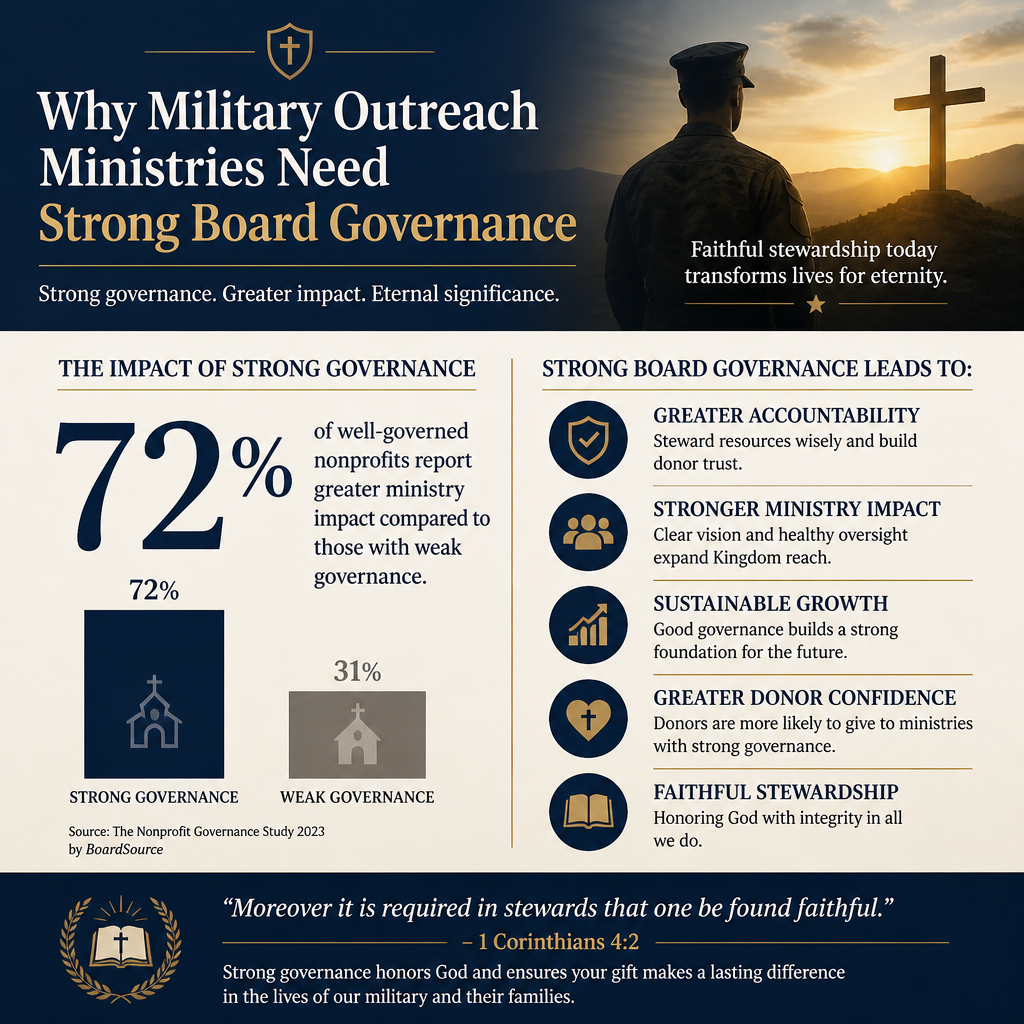
Why military outreach ministries need strong board governance is not a theoretical question for Christian donors. It is one of the most practical safeguards we have for ensuring that a ministry serving servicemembers, veterans, and military families remains faithful to its calling, honest in its reporting, and wise in its use of resources.
Military communities carry unusual pressures: frequent relocation, chronic stress, confidentiality concerns, and a chain-of-command culture that can discourage reporting problems. Those realities do not make governance less important; they make it more important. A healthy board does not exist to slow ministry down. It exists to keep mission, integrity, and care for people from being traded for speed, charisma, or crisis-driven decision-making.
Board governance is a ministry of stewardship, not bureaucracy
Christian donors rightly think about military outreach as pastoral care: presence in suffering, perseverance under strain, and a credible witness of Christ among those who serve. Yet Scripture frames the handling of money, authority, and reputation as moral matters, not administrative ones. The church’s early leadership created structures for fair distribution of aid not because mercy was optional, but because mercy without accountability can become partial and untrue (Acts 6:1–7).
In military outreach, governance is where stewardship becomes concrete. A board that understands its fiduciary duties, keeps minutes, reviews financials, and asks hard questions is not drifting from the Great Commission. It is guarding the conditions under which a ministry can keep the Great Commission without hidden compromises.
Why donors should care about the board, not only the program
Programs can look compelling while internal controls quietly fail. Across the nonprofit sector, credible oversight is associated with fewer opportunities for misstatement or misuse because basic controls—segregation of duties, independent review, documented approvals—reduce the likelihood that one leader can act without accountability. Those controls are governance questions before they are accounting questions.
Donors also face a structural disadvantage: by the time the public learns about a failure, much of the damage is already done. The Association of Certified Fraud Examiners estimates that organizations lose about 5% of revenue to fraud each year, and that tip-offs are the most common way fraud is detected (Association of Certified Fraud Examiners). A board that receives staff feedback, reviews anomalies, and fosters a culture where concerns can be raised is one of the best early-warning systems available.
The difference between spiritual authority and organizational authority
Military outreach ministries often have founders with real spiritual credibility: combat experience, chaplaincy background, or decades of pastoral work with military families. That credibility can be a gift. It can also create a subtle confusion where spiritual authority becomes organizational exemption. A mature board honors a leader’s calling while refusing to let any one person become unaccountable.
Christian donors should not interpret careful governance as suspicion. It is better understood as love of neighbor expressed through truthful processes.

Military context heightens the governance risk profile
Many donors support military outreach because they know the burdens carried by those who serve: moral injury, family strain, loneliness after transition, and the quiet wear of repeated deployments. Those pressures can also shape how ministries operate—often with urgency, confidentiality, and a high degree of trust placed in a few leaders.
Confidentiality is essential, but it can be misused
Some information must remain private: pastoral counseling details, service-related trauma, or security-adjacent concerns. Governance is not a demand for public disclosure of sensitive material. It is the discipline of ensuring that confidentiality does not become a blanket that hides misconduct, weak financial practice, or coercive leadership.
A board that understands this tension can require reporting that is aggregate, de-identified, and still verifiable. Ministries can protect servicemembers while also giving donors and regulators enough transparency to confirm that funds are used as promised.
Chain-of-command culture can discourage internal challenge
Military life forms leaders and members to respect authority, keep moving, and handle difficulty without complaint. Those virtues can be beautiful, but they can also make it hard for staff, volunteers, or counselees to report concerns. A board that expects unanimous positivity is likely missing reality.
What this means in practice is that boards should build formal channels for feedback and whistleblowing, and they should actually use them. The point is not to create suspicion; it is to make truth speakable. For donors, this is directly tied to trust.
A strong board protects mission drift and doctrinal confusion
Military outreach often sits at the intersection of church, patriotism, and public life. Christians genuinely disagree about how to relate those commitments. Some donors want explicitly evangelistic programming; others prioritize pastoral care and presence; others emphasize family support and suicide prevention. A board’s job is not to satisfy every preference. It is to preserve the ministry’s stated mission and theological commitments with clarity and consistency.
Mission clarity is not a slogan
Mission drift rarely announces itself. It appears as a series of pragmatic decisions: a grant that nudges programming toward a different population, a partnership that requires theological vagueness, or a messaging strategy that avoids the ministry’s faith commitments to broaden appeal. A board that reviews strategy against mission and doctrine serves donors by ensuring that the ministry they fund remains the ministry they intended to support.
This is also where verification helps. Most Trusted evaluates ministries against The Most Trusted Standard, which includes clear expectations for faith foundation and governance. Donors should not be forced to choose between theological seriousness and organizational competence; mature Christian ministry requires both.
Guardrails around political activity and public messaging
Because military service is tied to national identity, ministries can be tempted to slide from pastoral support into partisan mobilization. This is not only a legal risk for many nonprofits; it is a discipleship risk. Boards should set and enforce policies for public statements, endorsements, and event partnerships, ensuring the ministry’s witness remains anchored in Christ rather than in the cycle of political outrage.
For donors tracking trust and credibility, this belongs in the same conversation as financial integrity. A scandal rooted in public messaging can collapse donor confidence as quickly as a financial scandal.
Governance is where donor trust becomes verifiable
Donors are not called to cynicism. But donors are called to stewardship. Scripture commends careful handling of resources given for ministry purposes (2 Corinthians 8:20–21). Paul’s concern was not only that funds be used rightly, but that it be evident that they were used rightly. That distinction matters: faithful ministries should welcome verification.
In our verification work at Most Trusted, the ministries that meet The Most Trusted Standard tend to treat documentation as an act of honesty rather than an external nuisance. They can explain who has authority, how decisions are recorded, how conflicts are managed, and how outcomes are assessed.
What donors can reasonably expect from board governance
Donors do not need to micromanage a board, but donors can expect certain basics to be true. As a practical reference point, strong governance commonly includes:
- Documented board independence, with a majority of members not employed by the ministry
- Clear conflict-of-interest disclosures, reviewed regularly and enforced consistently
- Regular board meetings with recorded minutes and documented votes on major decisions
- Financial oversight appropriate to the ministry’s size, including review of budgets and year-end statements
- Policies for reporting misconduct, including protection against retaliation
These are not elite practices reserved for large institutions. They are basic ways of ensuring that the ministry’s spiritual aims are matched by truthful administration.
Transparency without voyeurism
Donors sometimes fear that demanding governance means demanding exposure of private pastoral matters. Mature transparency is different. It provides visibility into leadership structure, financial integrity, and program commitments without violating confidentiality. The category of Accountability and Transparency in Military Outreach Ministries is where many donors do their most important discernment: not asking for spectacle, but for evidence that a ministry is safe and honest.
How governance failures typically unfold in military outreach settings
Most governance failures do not begin with deliberate malice. They begin with a culture that treats urgency as permission, charisma as competence, and loyalty as the same thing as accountability. Military outreach can be especially vulnerable because it often operates near crisis: suicidality, trauma, addiction, family breakdown, and abrupt transitions from active duty to civilian life.
Common patterns donors should not ignore
Certain warning signs show up across many nonprofit contexts, and they carry particular weight in military ministry because of the power dynamics involved:
Founder-centered control. When the founder appoints close friends, family members, or subordinates as a board that rarely challenges decisions, governance becomes ceremonial.
Blurry boundaries between pastoral care and authority. When spiritual counsel becomes a tool for compliance—silencing questions as “lack of faith” or “disloyalty”—a ministry can become spiritually coercive.
Cash handling and designated gifts without traceability. Military events, retreats, and small-group settings can involve informal giving. Without documented processes, even honest leaders can create confusion and mistrust.
Overpromising outcomes. Trauma care and spiritual formation are hard to measure. That does not justify exaggeration. A board should challenge claims that are not supportable.
Why donors should reward governance, not punish it
A consistent temptation in Christian giving is to celebrate visible sacrifice while quietly penalizing administration. But administration can be the means by which sacrifice is protected from waste and misdirection. The nonprofit sector has had to correct simplistic thinking about overhead, particularly after the “Overhead Myth” statement signed by major evaluators argued that overhead ratios alone do not indicate effectiveness (BBB Wise Giving Alliance). For donors, the parallel lesson is that governance is not a distraction from impact; it is part of what makes impact honest.
Donors evaluating Military Outreach Ministries should therefore ask not only whether the ministry’s work moves the heart, but whether its governance makes that work durable, safe, and worthy of trust.
FAQs for Why military outreach ministries need strong board governance
Should a military outreach ministry have veterans on the board?
Often, yes, because lived experience can improve discernment about military culture, deployment realities, and the needs of families and veterans. But representation is not a substitute for independence. We look for boards that combine relevant experience with the willingness and structural ability to provide oversight, including members who can ask hard questions about finance, safeguarding, and mission fidelity.
What documents should a donor ask to see before giving?
At minimum, donors can reasonably request recent financial statements, the ministry’s Form 990 if applicable, a board roster, and basic policies such as conflict of interest and whistleblower reporting. If a ministry cannot provide these or treats the request as a personal affront, that is usually a governance concern rather than a mere communication issue.
Conclusion
Military outreach ministries serve people carrying heavy burdens, often in contexts where trust is assumed and questions are discouraged. Strong board governance keeps trust from being merely assumed. It makes trust verifiable. For Christian donors seeking to give with confidence, governance is one of the clearest signs that a ministry intends to honor Christ not only in what it proclaims, but in how it leads, accounts, and tells the truth.



