
Accountability and transparency in military outreach ministries are not secondary questions for Christian donors; they shape whether our giving becomes faithful stewardship or well-funded confusion. Military communities carry unique burdens—mobility, moral injury, secrecy requirements, and a strong culture of loyalty—and those realities can either deepen a ministry’s integrity or provide cover for weak oversight. Donors who want to serve service members well have to ask for evidence that is both credible and appropriately sensitive.
Scripture’s emphasis is not on suspicion, but on honesty before God and man. Paul described a deliberate approach to financial integrity: “We take this course so that no one should blame us about this generous gift… for we aim at what is honorable not only in the Lord’s sight but also in the sight of man” (2 Corinthians 8:20–21). Military outreach adds a layer of complexity, but it does not remove the obligation. It raises the standard for clarity, controls, and restraint.
Why accountability in military outreach carries spiritual and practical weight
Military outreach ministries operate close to the realities of war, trauma, family disruption, and public trust. Donors are not merely funding programs; they are often funding access—onto installations, into chapels, into units, and into the private suffering of service members and spouses. When accountability is weak, the harm is rarely limited to finances. It can undermine pastoral trust, damage partnerships with chaplains, and reinforce cynicism among people already trained to be cautious.
What this means in practice is that donors should evaluate accountability not as a defensive posture, but as a form of love. A ministry that welcomes scrutiny signals that it expects its work to withstand light. A ministry that treats scrutiny as hostility may still be sincere, but sincerity is not an internal control.
The military context can distort ordinary nonprofit signals
In many sectors, donors can observe impact directly: a food pantry distribution, a school, a clinic. Military outreach is different. Many activities are relational and private by necessity. Some details cannot be public without endangering trust or violating installation rules. A mature ministry does not use those limits to avoid reporting; it learns to report responsibly within them.
Christians genuinely disagree about how much narrative detail is appropriate when people’s stories involve combat experiences, mental health crises, or confidential counseling. That disagreement is not a loophole. It is an invitation to disciplined reporting: aggregate outcomes, de-identified case examples with permission, and clear boundaries about what will never be shared.
Stewardship is not reducible to overhead ratios
Some donors still rely on simplified “low overhead” assumptions. The sector has publicly warned against that approach for years. Charity Navigator, Candid (formerly GuideStar), and the BBB Wise Giving Alliance issued an open letter arguing that overhead alone is a misleading measure of nonprofit performance, and that donors should focus on results, governance, and transparency instead (Charity Navigator). For military outreach, this matters because quality often requires investment: credentialed counselors, trauma-informed training, secure data systems, and compliant safeguarding practices. Underfunding these functions can create spiritual and operational risk.

What transparent reporting should look like when privacy and security matter
Transparency in military outreach does not mean publishing everything. It means giving donors an honest picture of what the ministry does, what it costs, who oversees it, and what evidence exists that it is bearing fruit. Donors should be able to answer basic questions without guesswork: What programs are offered? Who receives services? How are outcomes defined? What safeguards exist for vulnerable people? What happens when something goes wrong?
Impact reporting that respects dignity
The most credible impact reporting is specific about activities and cautious about claims. A ministry can report how many chaplain trainings were delivered, how many retreats were held, how many counseling sessions were provided, and what follow-up pathways exist, without turning service members into marketing material. When outcomes are reported, mature ministries define them carefully: improved marital stability indicators, reduced isolation as measured by validated surveys, increased connection to local church communities, or referrals to clinical care when appropriate.
Donors should listen for ethical restraint. If a ministry regularly implies that a single event “saved marriages” or “stopped suicides” without explaining methodology, that is not faith—it is imprecision. Suicide prevention, for example, is a high-stakes domain where overstated claims can be dangerous. National reporting underscores the seriousness of the problem; the U.S. Department of Veterans Affairs has documented elevated suicide risk among veterans in recent national suicide prevention reports (U.S. Department of Veterans Affairs). The right response is not inflated certainty, but sober competence.
Annual reports that are complete, not glossy
A serious annual report includes more than photographs and gratitude. It should include audited or reviewed financial statements when scale warrants, a clear summary of revenue sources, a breakdown of major expense categories, and plain disclosure of related-party transactions if any exist. Donors should be able to see whether growth is being managed, whether reserves exist, and whether a sudden spike in revenue is being stewarded prudently.
Many donors also want to understand dependency risks. If a ministry relies heavily on one donor, one church network, or one government-related channel, transparency requires acknowledging that concentration and describing mitigation plans. Mature boards do not treat risk as a lack of faith; they treat it as a stewardship responsibility.
Data stewardship and confidentiality as part of transparency
Confidentiality is not the enemy of transparency; it is one of its forms. Ministries serving military families often collect sensitive information: mental health disclosures, family conflict details, and sometimes personally identifying data tied to installation life. Donors should expect clear donor privacy policies, clear participant privacy practices, and written limits on data sharing. If a ministry does not publish a privacy policy, donors should ask for one before giving at scale.
Financial integrity and governance donors should expect
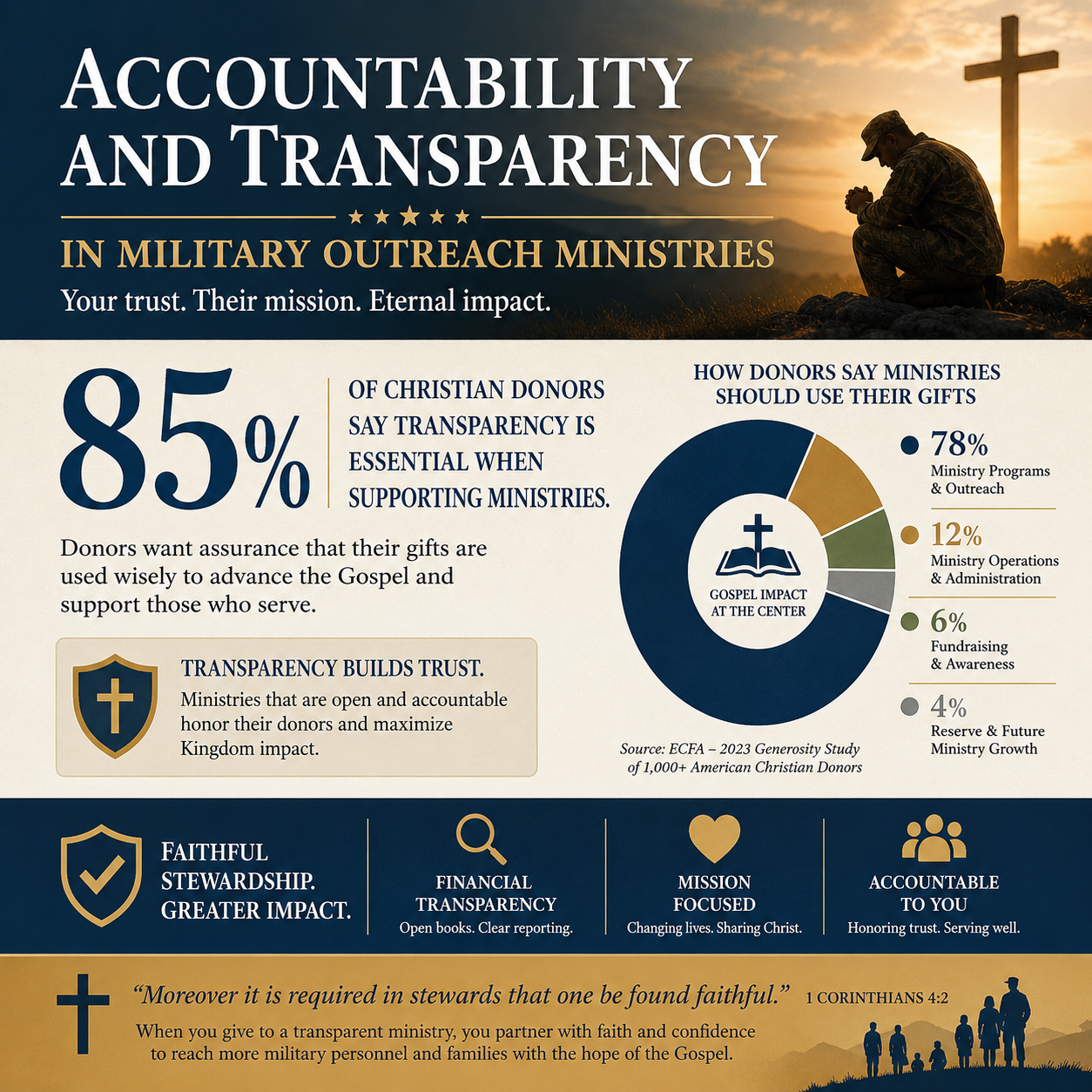
Accountability is rarely secured by good intentions. It is secured by governance systems that are strong enough to withstand pressure—financial pressure, relational pressure, and the pressure that comes from proximity to authority. Military outreach can attract charismatic leaders, mission-driven urgency, and powerful stories. Those dynamics are not inherently unhealthy, but they do require counterweights: independent oversight, documented controls, and board leadership that is willing to say “no” when necessary.
Audits, reviews, and internal controls
Not every ministry requires a full independent audit every year, but donors should expect a level of external financial scrutiny appropriate to revenue size and complexity. As budgets grow, audited financial statements become a reasonable expectation. Smaller organizations can still demonstrate integrity through independent reviews, consistent bookkeeping, segregation of duties, and written financial policies.
In practice, donors can ask straightforward questions: Who approves expenses? Who reconciles bank accounts? Are there spending limits? Are credit cards controlled? Is there a conflict-of-interest policy, and is it enforced annually? Transparent ministries answer these questions without irritation.
Board governance that is truly governing
Board governance is where many ministries quietly fail. A board that functions primarily as a cheering section will not protect a ministry when a crisis comes. Donors should look for signs of independence: a board with relevant expertise (finance, legal, pastoral, clinical), regular meeting cadence, documented minutes, term limits or renewal practices, and a willingness to evaluate the chief executive with clarity and charity.
Some military outreach ministries have strong ties to chaplaincy networks or veterans’ communities. Those ties can be a strength, but donors should still expect a board that is not dominated by employees, family members, or vendors. Where conflicts exist, they should be disclosed and managed, not normalized.
Compensation and related-party transactions
Donors are right to ask how leaders are compensated and whether compensation is set through an objective process. Responsible ministries use comparability data and board-approved processes, and they document decisions. Related-party transactions—renting property from a board member, purchasing services from a family-owned company, contracting with a founder’s consulting entity—are not automatically disqualifying, but they are inherently high-risk. They require disclosure, competitive bidding where possible, and recusal practices that are more than symbolic.
How Christian donors can verify legitimacy without treating ministries as suspects
Verification is an act of stewardship, not cynicism. Military communities have been targeted by fraud and by well-intentioned but poorly governed efforts. Donors should not outsource discernment to emotion, even when the cause is compelling. The New Testament’s repeated warnings about deception and misuse of resources were addressed to believers, not to outsiders; vigilance is part of discipleship.
Across our verification work at Most Trusted, the ministries that meet The Most Trusted Standard tend to share a common posture: they can explain their mission precisely, document their financial and governance practices, and show donors how they measure faithfulness and effectiveness without overselling certainty. They also tend to treat donor questions as a normal part of stewardship rather than an affront.
A practical due diligence sequence
Donors can begin with public documentation. A legitimate U.S. nonprofit should be findable through the IRS Tax Exempt Organization Search, and its status should be current (IRS Tax Exempt Organization Search). Ministries should also make Form 990 filings accessible, either on their own site or through a nonprofit database. While the 990 is not a spiritual document, it is a disclosure instrument that reveals governance structure, revenue sources, and certain transactions.
Next, donors should examine whether the ministry’s reporting matches its fundraising claims. If fundraising emphasizes “direct impact,” financials should show program expenses commensurate with that claim. If the ministry claims to be “chaplain-endorsed” or “installation-approved,” donors should ask what that means operationally. Is there a memorandum of understanding? A letter of support? A defined partnership with a chaplaincy office? Words that imply military endorsement should be used carefully and verifiably.
Questions that clarify culture
Culture reveals itself in how leaders answer ordinary accountability questions. Donors can ask: How do you handle allegations of misconduct? Do you have a written safeguarding policy for working with minors and vulnerable adults? Do you conduct background checks for staff and key volunteers? What training exists for trauma-informed care and referral pathways when someone needs clinical support?
These questions are not accusations. They are a way of honoring the reality that military families often carry layered vulnerability. A ministry that has prepared for hard cases is usually a ministry that has taken its pastoral responsibility seriously.
How often ministries should report
For ongoing donor confidence, most mature ministries provide at least an annual report and periodic updates that are specific enough to be meaningful. The appropriate cadence depends on the program model and donor expectations, but silence is rarely neutral. If a ministry communicates only during fundraising drives, donors should ask whether communications are being used primarily as revenue instruments rather than as stewardship accountability.
What donors should expect is consistency: the same categories of reporting year over year, clear explanation when metrics change, and candid acknowledgment when results fall short. Christian integrity includes the willingness to name limits.
Giving with confidence in a field that deserves serious trust
Accountability and transparency in military outreach ministries are ultimately about whether the Church’s witness is strengthened or compromised in a community that has learned to measure words against reality. When ministries handle money, authority, and stories with disciplined care, donors can give with freedom rather than anxiety. That kind of giving does not ignore risk; it funds integrity.
For donors evaluating organizations within Military Outreach Ministries, the goal is not to demand perfection. The goal is verifiable faithfulness: governance that can withstand pressure, financial integrity that is documented, and reporting that respects both truth and confidentiality. This is the kind of stewardship Scripture commends, and it is the kind of stewardship military families deserve.



